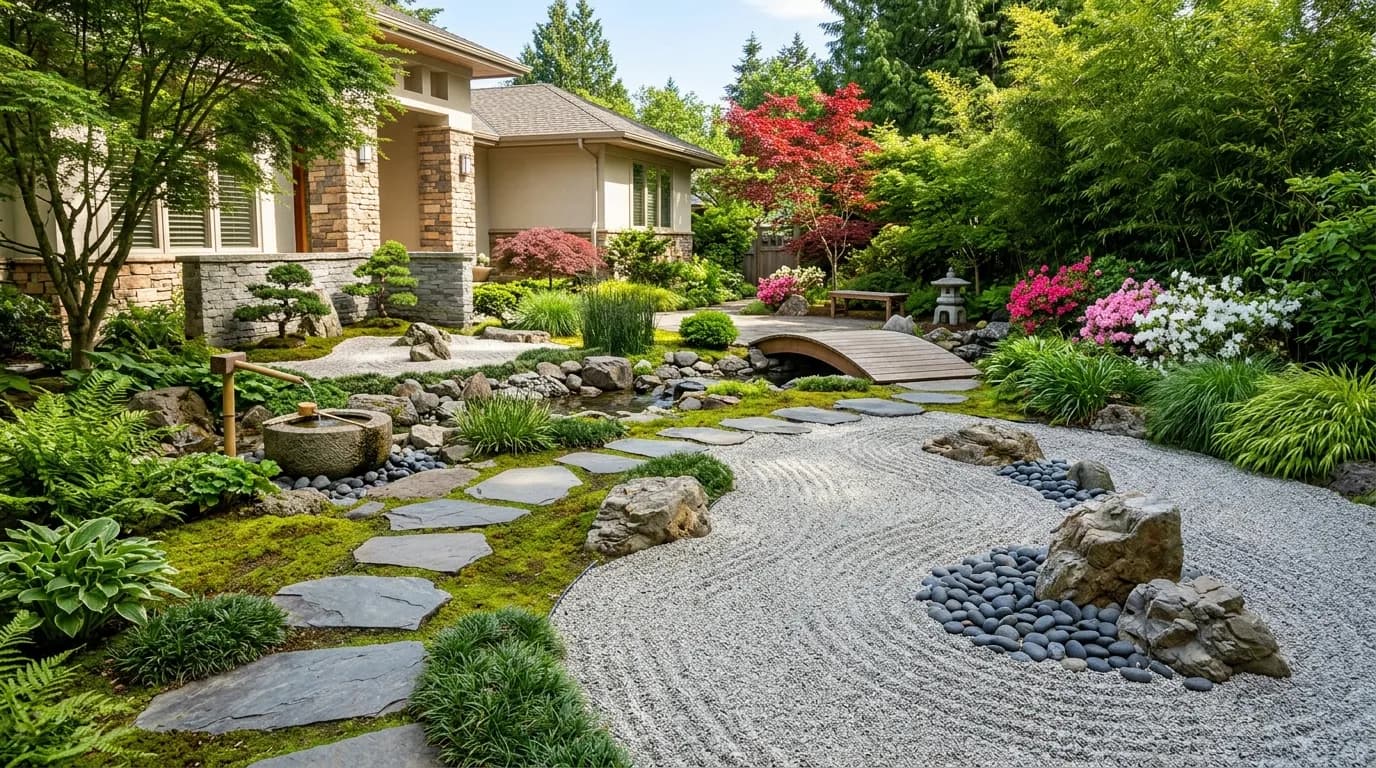
There's a reason Zen garden imagery is everywhere in interior design, meditation apps, and wellness culture: it works.
The principles of Zen garden design — intentional simplicity, balanced asymmetry, natural materials, meaningful negative space — produce spaces that genuinely feel calmer than their surroundings. You don't have to be a Buddhist monk to benefit from them.
Here are 25 Zen garden ideas scaled for real residential yards, from apartment balconies to full backyard transformations, with specific materials, plant lists, and design principles at every step.
The Core Principles Behind Every Zen Garden
Before the ideas, understand the rules. Zen garden design isn't just "Japanese-looking things." It's a specific design philosophy:
Ma (間) — Negative space. Empty space is not wasted space. The gravel between stones is as designed as the stones themselves. Resist filling every inch.
Wabi-sabi (侘寂) — Imperfect beauty. Weathered stone, irregular moss, asymmetric arrangements. Perfection isn't the goal. Natural aging is.
Kanso (簡素) — Simplicity. Remove everything that isn't necessary. Each element earns its place. Less is always more.
Shizen (自然) — Naturalness. Nothing forced or artificial-looking. Stones placed as if they fell there. Plants allowed their natural form (with some guidance).
These four principles guide every design decision. When in doubt, remove something rather than add it.
Gravel & Stone Ideas
1. Classic Raked Gravel Panel
The foundation of dry Zen gardens: a rectangular panel of fine decomposed granite or grey crushed granite, raked into parallel lines or wave patterns representing water. Use a homemade wooden rake (5–7 tines, 3–4 inches apart). The raking is itself meditative — it's meant to be done and redone. Area: any size from 4×6 ft up. Material cost: $0.50–$1.50/sq ft for gravel.
2. The Three-Stone Composition
Three stones of significantly different sizes arranged in a triangular composition in a gravel field. In Zen design, three unequal elements create perfect tension — one tall vertical stone, one medium diagonal stone, one low horizontal stone. No mulch or plants needed. The stones and gravel are the complete composition.
3. River of Stone
Lay a "river" of smooth river rock through a garden bed, surrounded by plantings. Use grey or cream stones 2–4 inches diameter, laid 3–4 inches deep in a meandering path 18–24 inches wide. Edge with ornamental grass or Japanese forest grass on both sides. No water required — the eye reads it as movement.
4. Gravel Garden with Moss Islands
In a shaded area with moist soil, create a gravel base and allow or cultivate moss to grow in islands between stepping stones. Moss growth takes 6–18 months but becomes permanent. Once established, it requires only occasional watering and never needs mowing or edging.
5. Crushed Granite Courtyard
Replace a section of lawn with 4 inches of decomposed granite, bordered by timber or steel edging. Add 3–5 large boulders as anchors, a single specimen tree (Japanese maple, multi-trunk crape myrtle), and one bench. This is the most buildable version of a Zen garden for most homeowners — one weekend, $500–$1,200 in materials, lifetime of low maintenance.
Water Feature Ideas
6. The Tsukubai (Stone Basin)
A tsukubai is a small stone water basin, traditionally used for ritual handwashing before entering a tea house. Place a carved stone basin near the entrance to your garden, fed by a simple recirculating pump through a bamboo spout. The sound of dripping water creates the auditory equivalent of a raked gravel garden — immediate calm.
7. Shishi-Odoshi (Bamboo Deer Chaser)
A traditional Japanese water device: a bamboo tube fills with water, tips, empties with a satisfying "clunk" against a stone, and refills. Used originally to scare deer from gardens. Now purely ornamental. The rhythmic sound — fill, tip, clunk, silence, repeat — is as meditative as anything in a garden. Kits: $60–$150.
8. A Still Reflecting Pool
A rectangular pool 12–18 inches deep, lined with black liner (black water reads as a mirror), edged with flat stone, with a single potted plant or stone lantern at the far end. The reflection doubles the garden. No plants in the water — keep it still and dark for the mirror effect. Add a small recirculating pump to prevent stagnation; no visible ripple or fountain needed.
9. Dry Stream with Boulders
A dry streambed: excavate a meandering channel 18–24 inches wide and 4–6 inches deep. Fill with cobblestone (grey or tan) 2–3 inches diameter. Place 3–5 large boulders along the banks as if deposited by water. Plant Japanese iris, rush, or blue flag iris at the edges — moisture-suggesting plants in a dry context. The contrast between the "stream" and the surrounding landscape reads as water to the eye.
Plant Ideas for Zen Gardens
10. Japanese Maple as Focal Point
A single Acer palmatum — laceleaf or upright form — as the compositional anchor of a Zen garden. Placed asymmetrically, ideally slightly off-center in a gravel panel or at the corner of a stone composition. In fall, the color is extraordinary. In winter, the bare branching structure is architecture. No other tree creates the same sense of seasonal contemplation.
11. Clumping Bamboo Screen
Clumping bamboo (never running — never) like Fargesia rufa or Bambusa multiplex creates an instant privacy screen with vertical movement and the sound of wind. Plant in a line along a fence or wall. Bamboo requires zero maintenance beyond occasional thinning. The sound of bamboo leaves in a breeze is one of the defining sensory experiences of a Zen garden.
12. Moss Groundcover
Moss lawns and moss groundcovers require no mowing, no fertilizer, and no pesticides. They thrive in shade and moisture — conditions where grass fails. In a Zen garden, moss between stepping stones or under a tree creates a quality of deep time. To establish: inoculate bare soil with moss slurry (blend moss, water, and buttermilk), keep moist for 6 weeks.
13. Cloud-Pruned Shrubs
Japanese cloud pruning (niwaki) shapes evergreen shrubs — boxwood, privet, Japanese holly — into floating organic cloud shapes. This takes years to develop but transforms an ordinary shrub into a sculpture. A single well-pruned specimen in a gravel garden creates an entire aesthetic. YouTube tutorials exist for the technique; it's achievable for patient DIYers.
14. Mondo Grass as Border
Black mondo grass (Ophiopogon planiscapus 'Nigrescens') is a dramatic, near-black groundcover that edges paths and beds with clean lines. It spreads slowly, requires no maintenance, and stays 6 inches tall permanently. Plant 6 inches apart for a continuous edge in 2–3 seasons. The dark color creates contrast with light gravel that's distinctly Zen.
15. Single Clump of Ornamental Grass
One large clump of Japanese forest grass (Hakonechloa macra) or miscanthus placed at the base of a stone grouping or beside a stepping stone path. The grass moves in any breeze — introducing gentle life into a still composition. Golden-colored varieties glow against grey gravel.
Design Your Zen Garden with AI →
Zen gardens look simple but require precise proportions to work — stone placement, gravel depth, plant size relative to space. Yardcast generates 3 layout options for your specific yard, including Japanese and Zen garden styles. Upload your photos, describe the aesthetic, and get a complete design with materials list, costs, and spacing. 60 seconds, $29, no landscape architect appointment needed.
Hardscape & Structure Ideas
16. Stepping Stone Path
Irregular flat stones (flagstone, bluestone, or natural fieldstone) set in gravel or moss at 18–22 inch intervals — the natural gait distance. The stones slow you down as you walk, creating mindful movement through the garden. Set stones 1 inch above grade; they'll settle to flush with time. Cost: $2–$8/stone at landscape suppliers.
17. A Stone Lantern (Tōrō)
A carved granite lantern placed at a path intersection, beside water, or at the garden entrance. Traditional Japanese lanterns mark transitions — from one space to another, from activity to contemplation. Modern versions include solar LED candles inside the lantern chamber. Cost: $80–$400 for a quality granite lantern.
18. Timber or Bamboo Fence Panel
A section of horizontal cedar, ipe, or bamboo fencing as a backdrop for a planting composition. The fence creates a deliberate frame — the composition in front reads against a neutral background. Paint the fence dark charcoal or leave natural (cedar weathers to silver). A 6-ft section of horizontal cedar fence costs $150–$300 to install and instantly creates a Japanese aesthetic.
19. A Wooden Bridge over a Dry Stream
A simple arched or flat wooden bridge — 4 feet wide, 4–6 feet long — over a dry streambed or gravel feature. Even without water underneath, the bridge creates the sensation of crossing over something. It's one of the most powerful psychological cues in garden design: the act of crossing initiates the transition into a different space.
20. The Viewing Bench
A Zen garden is meant to be observed, not just passed through. Place a simple wooden or stone bench at the ideal viewing angle — typically facing south or southwest, set back from the main composition 8–12 feet, with nothing blocking the sightline. The bench invites stillness. Position it and your whole garden redesigns itself around that viewpoint.
Small Space & Urban Zen Ideas
21. Balcony Zen Corner
Two large containers: one with Japanese maple or clumping bamboo, one with black mondo grass and fine gravel top-dressing. Add a small stone (any smooth river rock at least 8 inches across). That's it. The combination of vertical plant, horizontal stone, and gravel texture creates the Zen triad in 6 square feet.
22. A Desktop or Tabletop Zen Garden
A 12×18 inch tray filled with fine white sand and 3–5 small stones. Comes with a small wooden rake. Used at a desk or outdoor table as a meditative object. Takes 2 minutes to set up, costs $25–$50. Not a landscape — but it's the same design principles at miniature scale. Many Zen garden enthusiasts start here.
23. A Shaded Entry Courtyard
Pave a small front entry courtyard (8×10 ft) with irregular flagstone set in decomposed granite. Plant one small Japanese maple at the corner. Add a stone lantern beside the front path. Install up-lighting for the tree. This makes the entire arrival experience contemplative — you shift mentally before you open the door.
24. A Side Yard Transformation
Side yards are typically wasted: too narrow for a patio, too shaded for a lawn. A Zen treatment works perfectly: decomposed granite or dark stone, a stepping stone path, ferns or Japanese forest grass along the fence, and a single stone or lantern as a focal point. Suddenly the side yard is the most interesting part of the property.
25. The Meditation Circle
A circular gravel area 12–15 ft diameter, edged with a simple stone ring, centered on one large stone or a small specimen tree. A single bench or meditation cushion on a flagstone pad at the edge. Designed for one purpose: sitting, breathing, being still. No distractions. No extra plants. The circle is complete.
Building Your Zen Garden: Step-by-Step
- 1Define the boundary. Use steel edging, timber, or stone. Clean lines are essential.
- 2Remove grass and weeds. Sod cutter or herbicide (allow 2 weeks before planting if using herbicide).
- 3Install landscape fabric. Overlap seams 4 inches. This step extends the life of your gravel bed by years.
- 4Add gravel or decomposed granite. 3–4 inches depth. Tamp lightly.
- 5Place stones. Start with the largest stone, then work down. Odd numbers (3, 5, 7) always.
- 6Plant focal plants. Dig through fabric. Set plant at proper depth. Backfill and water.
- 7Add finishing details. Lantern, stepping stones, path edging.
- 8Rake. And then rake again. The act of raking is the point.
Design Your Own Zen Garden
The hardest part of Zen garden design is restraint — knowing what to leave out. Most homeowners add too much. The second-hardest part is proportion: stones that are too small, gravel panels that are too narrow, focal plants that compete rather than anchor.
Yardcast generates 3 design options for your specific outdoor space — including Japanese and Zen-inspired styles — using photos of your actual yard. You see the composition before building anything, make adjustments, and get a complete materials list and cost estimate.
[Generate My Free Zen Garden Preview →](/redesign)
Upload a photo, describe the aesthetic you're after, and see 3 design options in 60 seconds. The design comes with a printable PDF, plant list, and cost breakdown — everything you need to hand to a contractor or build yourself.
A calmer outdoor space starts with a calmer design process.