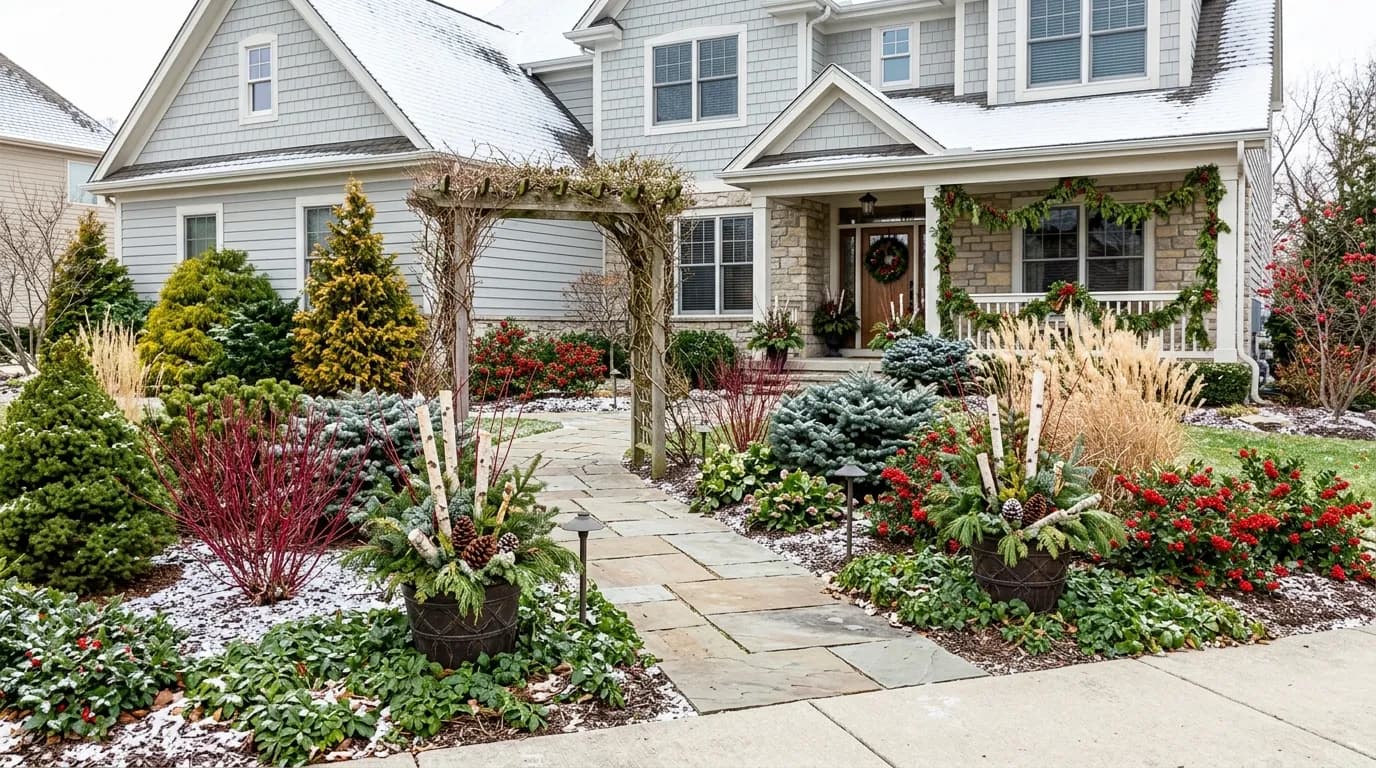
Winter is where most landscaping falls flat. The annuals die, the perennials disappear underground, and the grass goes brown — leaving nothing but bare soil and the structural skeletons of whatever was planted in spring. For most homeowners, the yard becomes invisible from October to April.
But winter doesn't have to be a write-off. With intentional plant selection and a few structural choices, your yard can have beauty, color, and movement through the coldest months — often with less maintenance than any other season.
Here are 30 winter landscaping ideas, organized from the simplest (almost no effort) to the most architectural.
Why Winter Landscaping Is Actually Easier Than You Think
Winter landscaping works differently than warm-season planting. You're not chasing color from annuals that need constant replacing. Instead, you're working with:
- Structure — the bones of the landscape that read beautifully against snow or bare ground
- Texture — bark patterns, dried seedheads, and evergreen foliage that photographs well even in gray light
- Color — a surprisingly wide range of plants with red, orange, yellow, or variegated winter stems and berries
- Movement — ornamental grasses that sway in winter wind; plants that rustle and animate an otherwise still landscape
The key insight: winter landscaping is largely about choosing the right plants in the design phase, not adding work later.
30 Winter Landscaping Ideas
Structure & Evergreens
1. Anchor with evergreen foundation shrubs. Holly, boxwood, yew, and dwarf spruce hold their color and form all winter. A well-sheared ball boxwood in January looks as good as it does in June. These are the bedrock of any winter-interest landscape.
2. Add a dwarf conifer as a focal point. A blue spruce, golden hinoki cypress, or weeping Norway spruce commands attention 12 months a year. They're the equivalent of a sculpture that doesn't need maintenance. Place one at a key corner or flanking an entry.
3. Plant a Japanese maple. In winter, the bare structure of a Japanese maple is arguably more beautiful than its foliage. The zigzag branching pattern and deep red or gray bark create winter silhouettes that look architectural against a snowy backdrop.
4. Use evergreen groundcovers to cover bare soil. Pachysandra, creeping Jenny, and liriope stay green through hard winters in most zones. A 3-inch layer of bark mulch between them adds warmth visually and thermally.
5. Install a pyramidal arborvitae ('Emerald Green') as an accent. Slim, vertical, fast-growing, and deeply evergreen. Two planted symmetrically at a gate or entry create instant formality. Stays a manageable 10–12 feet in 20 years. Zones 2–7.
Bark & Branch Interest
6. Plant red-twig or yellow-twig dogwood. Cornus alba 'Siberian Pearls' (red) and Cornus sericea 'Flaviramea' (yellow) are shrubs grown almost entirely for their winter stem color. The new growth is the brightest — cut to the ground in late winter every 2–3 years to regenerate neon-colored stems. Zones 2–8.
7. Add a paperbark maple (Acer griseum). Cinnamon-colored bark that peels in curling sheets, catching morning light and looking luminous against snow. A slow-growing small tree, perfect for suburban lots. Zones 4–8.
8. Plant a river birch. Creamy white-to-salmon exfoliating bark plus a graceful multi-stem structure makes river birch one of the most striking winter trees available. Also extremely adaptable to wet soils. Zones 4–9.
9. Add a stewartia tree. Flaking multi-colored bark in gray, orange, and rust tones — the kind of thing that looks like a painting in winter. Slow-growing, but worth the wait. Zones 5–8.
Berries & Fruit
10. Plant holly for winter berries. American holly (Ilex opaca) and its cultivars produce bright red berries from October through February. You need both a male and a female for berry production. One of the best foundation plants for zone 5–9.
11. Add winterberry holly (Ilex verticillata). This is the deciduous holly that turns completely red with berries in late October — the one you see in holiday wreaths. Stunning in masses or as a hedge. Needs a pollinator male. Zones 3–9.
12. Plant crabapple trees. Modern crabapple varieties like 'Prairifire' and 'Louisa' hold their small fruits (size of marbles) well into winter, feeding cedar waxwings and other birds while providing color. Pink spring blooms are a bonus. Zones 4–8.
13. Add beautyberry (Callicarpa americana). Violet-purple berries in dense clusters along arching stems — truly unlike anything else. Birds eventually eat them, but they typically persist through most of December. Zones 5–10.
14. Plant nandina (Heavenly Bamboo). Evergreen in zones 7–10, semi-evergreen elsewhere. Red berries and red-tinged winter foliage. Compact forms like 'Firepower' stay under 2 feet. Zones 6–9. Check invasiveness in Southeast.
Ornamental Grasses
15. Leave ornamental grasses standing through winter. Karl Foerster feather reed grass, switchgrass, and miscanthus varieties look spectacular in winter. Tawny seed heads catch snow, backlight beautifully, and provide bird habitat. Cut down in late February before new growth emerges.
16. Plant blue oat grass (Helictotrichon sempervirens) for evergreen texture. This steel-blue grass stays evergreen in most zones and holds its color through winter. It's one of the few ornamental grasses that actually looks better in cold weather than summer heat.
17. Use prairie dropseed (Sporobolus heterolepis) in masses. Delicate, fine-textured native grass that turns golden-orange in fall and holds structure through winter. The dried seed heads are airy and luminous. Zones 3–9.
Lighting for Winter Impact
18. Add pathway lighting to highlight winter structure. Winter nights are long and dark. Low-voltage pathway lights along a front walk, or uplights on architectural trees, create nighttime curb appeal that's honestly more striking in winter than summer (no foliage competing for attention).
19. Uplight a focal tree. A single LED uplight buried at the base of a Japanese maple or specimen conifer creates a luminous winter display visible from the street and from inside the house. A $40 solar uplight does the job.
20. Install string lights on a pergola or arbor. Overhead string lights define outdoor living spaces visually even when they're not being used. They also look magical through a window on a cold night — a feature that adds warmth to the interior experience of your home.
Containers & Decorative Elements
21. Create winter container displays. Large pots flanking an entry don't have to go empty in winter. Fill them with: cut evergreen boughs, red-twig dogwood stems, dried hydrangea heads, pine cones, or winter ornamental cabbage. Refresh monthly for ongoing interest.
22. Add stone, metal, or ceramic sculptures. A well-chosen garden sculpture doesn't care what season it is. Large stone spheres, abstract metal shapes, or a simple weathered urn become focal points when every plant around them has gone dormant.
23. Install a boulder or rock feature. Large boulders look their most dramatic in winter — especially dusted with snow or frosted in early morning. Arrange 3–5 boulders of varying sizes as a permanent year-round feature. They also provide visual mass and anchor a planting area visually.
Plants with Winter Bloom or Late Season Color
24. Plant witch hazel (Hamamelis x intermedia). One of the most remarkable plants in any zone 4–9 garden: it blooms in January or February with fragrant yellow, orange, or red strappy flowers directly on the bare branches. Absolutely nothing else blooms in the middle of winter.
25. Add hellebores (Lenten rose, Helleborus orientalis). Evergreen to semi-evergreen with nodding flowers from February through April in zones 4–9. Clumps of dark, leathery foliage look attractive all winter even before bloom. Deep shade tolerant.
26. Plant ornamental kale and cabbage for late fall color. While technically warm-weather plants, ornamental kale in burgundy, purple, and cream holds interest well into December in most zones. Plant in October for holiday-season curb appeal.
Hardscape for Winter Structure
27. Install a low stone or brick wall along a bed edge. Low masonry walls (12–18 inches) look beautiful with snow accumulated on top, and they provide year-round structure that reads well even when plants are dormant. They also allow you to raise beds above the natural grade, improving drainage and visual interest.
28. Build a pergola or overhead structure. Even bare in winter, a well-built pergola creates an architectural frame for the yard. Add string lights, train climbing plants for three-season coverage, and you've created a year-round outdoor "room."
29. Add a dry creek bed for drainage and interest. A well-constructed dry creek bed with varied stone sizes becomes a landscape feature that looks particularly dramatic with winter frost. It also solves drainage problems and reduces lawn area.
30. Lay a flagstone or decomposed granite path. Hardscape elements read clearly in winter when plants fade. A beautifully laid flagstone path is a year-round asset — especially when flanked by low ornamental grasses or perennials that rise in spring to soften it.
Visualize Your Winter Landscape Before You Plant
The hardest part of planning for winter interest is imagining how your yard will look in January — without any plants in front of you. Yardcast's AI design tool generates photorealistic landscape renderings onto your actual yard photos, letting you see how different plant combinations, hardscape elements, and structural features will look across all seasons.
Upload a photo of your yard and get 3 professional-quality designs in under 60 seconds — try it free at yardcast.ai/redesign.