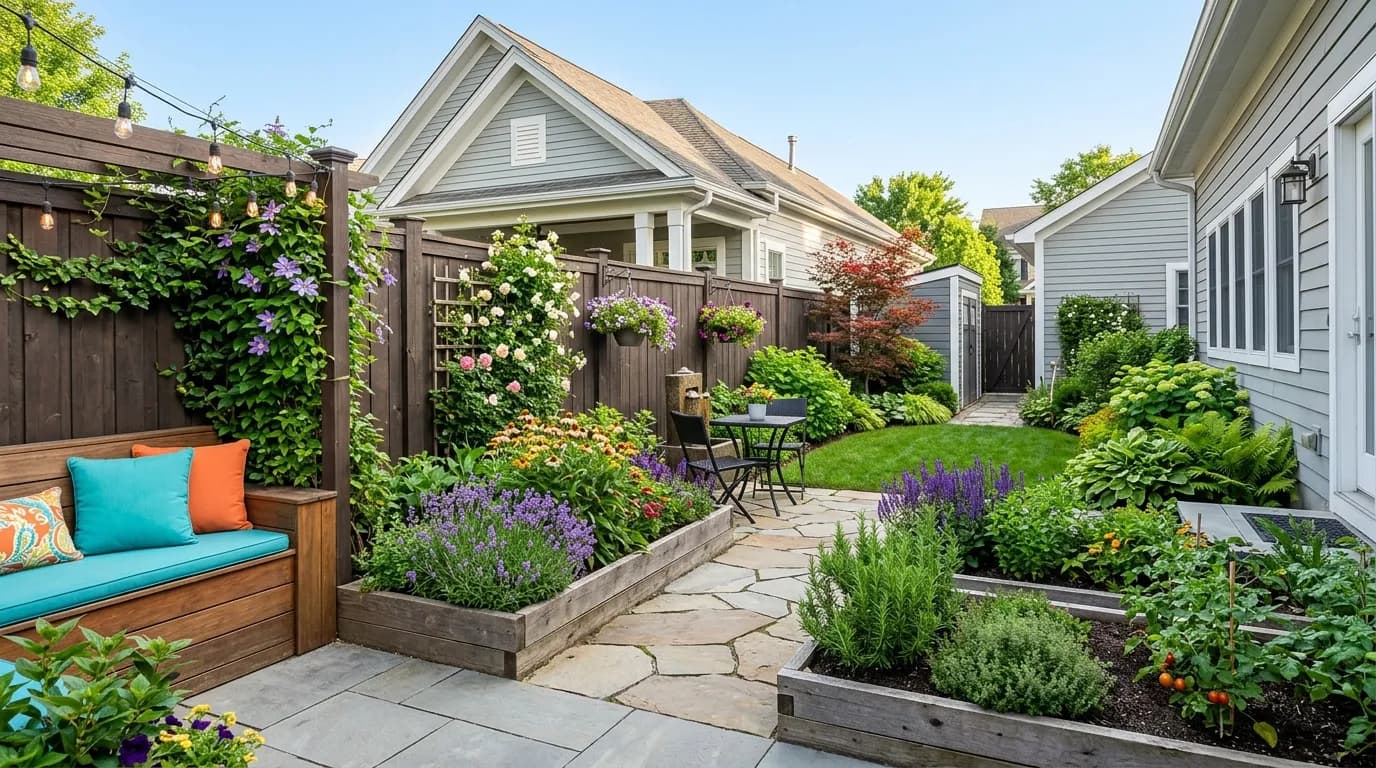
A small backyard is not a design problem — it's a design challenge. And like any constraint, it often produces more creative, intentional results than unlimited space would. The best small backyards feel intentional: every element earns its place, every square foot does double or triple duty, and the whole thing feels like a room, not a leftover.
This guide covers 35 ideas across seven categories — from vertical gardening and multi-functional furniture to lighting tricks, planting strategies, and full budget breakdowns. Whether you're working with 200 square feet or 800, these ideas will help you design a backyard you actually want to spend time in.
1. Zone Your Space (Even If It's Tiny)
The biggest mistake in small backyards is treating the whole thing as one undifferentiated area. Zoning — creating distinct areas for different activities — makes a small space feel larger and more intentional.
Three zones that work in even the smallest yards:
- Dining zone: A bistro table and two chairs, or a folding table that expands for guests
- Lounge zone: A loveseat, hammock, or a pair of low chairs with a side table
- Green zone: Containers, raised beds, or a vertical garden wall
You don't need walls or fences to define zones. Changes in flooring (pavers vs. gravel vs. lawn), raised platforms, or simply different furniture groupings create psychological separation.
2. Go Vertical — Your Most Underused Space
Vertical space is free real estate. In a small backyard, walls, fences, and pergola beams can host more plantings and storage than your floor plan ever could.
Vertical ideas that actually work:
- Trellis + climbers: Clematis, jasmine, climbing hydrangea, or climbing roses soften a fence and add 8–15 feet of green wall
- Wall-mounted planters: Modular systems like a living wall panel turn a bare fence into a herb garden or succulent display
- Vertical vegetable towers: Stackable planters grow strawberries, lettuce, herbs, and cherry tomatoes in 1–2 square feet of floor space
- Espaliered fruit trees: Trained flat against a sunny wall, an apple or pear tree takes up almost no depth while producing real fruit
- Hanging baskets: Pergola beams, porch ceilings, and shepard's hooks add color at eye level and above without using floor space
Plant pick: Climbing hydrangea (Hydrangea anomala subsp. petiolaris) is self-supporting, cold-hardy to Zone 4, and produces dramatic white flower clusters in June — and it thrives on a north-facing wall.
3. Multi-Functional Furniture Is Non-Negotiable
In a small backyard, every piece of furniture should do at least two jobs. This isn't about compromise — it's about smart specification.
| Furniture type | Primary function | Secondary function |
|---|---|---|
| Storage bench | Seating | Stores cushions, tools, toys |
| Ottoman/coffee table | Footrest or coffee table | Extra seating when needed |
| Folding bistro table | Dining | Collapses flat against wall |
| Raised planter bench | Planting/growing | Defines seating perimeter |
| Daybed with storage | Lounging | Blanket/pillow storage below |
Look for furniture made from teak, powder-coated aluminum, or HDPE (high-density polyethylene) — all are weather-resistant and compact-friendly.
4. Use Pavers, Gravel, or Decking Instead of (or Beside) Grass
Grass in a small backyard is almost always a bad idea. It needs mowing, watering, and fertilizing — and in a tight space it rarely looks good because it's hard to edge cleanly around furniture legs and planters.
Alternatives:
- Flagstone stepping stones through groundcover: Low-maintenance, beautiful, and you can lay them yourself for $3–8/sq ft in materials
- Decomposed granite or pea gravel: $1–3/sq ft installed, great drainage, pairs well with Mediterranean plants
- Composite decking: $15–25/sq ft installed, creates a defined 'room,' adds resale value
- Concrete pavers: $8–15/sq ft installed, can DIY with rental equipment, dozens of pattern options
Budget tip: Use a mix of materials — pavers for the main sitting area, gravel for border edges, and groundcover (like creeping thyme or sedum) between stepping stones. You get visual richness without a high price tag.
> 🌿 Want to see how these ideas look in your actual backyard?
> Get an AI-generated small backyard design in both bed options on your real yard photos →
> $29.99 Design Pack. Takes about 60 seconds. One free redo included.
5. Choose the Right Plants for Small Spaces
Not all plants scale down. A small backyard with the wrong plants — overgrown hollies, a silver maple, or a massing of ornamental grasses — quickly becomes a maintenance nightmare. These plants are sized right.
Trees and shrubs (keep under 12 ft):
- Dwarf Japanese maple (Acer palmatum) — 6–10 ft, stunning fall color, Zones 5–9
- Serviceberry (Amelanchier) — edible berries, white spring blooms, multi-season interest
- Dwarf Hinoki cypress — architectural structure, evergreen, very slow growing
- Ruby Ball redbud — compact, heart-shaped leaves, lavender-pink spring flowers
Perennials that stay put:
- Agastache 'Blue Fortune' — deadhead-free, drought tolerant after establishment, bee magnet
- Karl Foerster grass — vertical accent, golden fall color, survives Zone 4
- Salvia 'May Night' — long bloomer, deer resistant, drought tolerant Zones 4–8
- Echinacea (coneflower) — native, tough, blooms June–frost
Low-maintenance groundcovers (replace mulch):
- Creeping thyme — fragrant, tiny pink flowers in summer, handles foot traffic
- Blue star creeper — delicate blue flowers, stays under 2 inches tall
- Sedum 'Dragon's Blood' — succulent, turns red in fall, drought tolerant
6. Maximize Privacy Without Fences
You don't need a 6-foot cedar privacy fence to feel secluded. These alternatives create privacy while adding beauty.
Privacy strategies:
- Tall ornamental grasses: Karl Foerster or Miscanthus 'Gracillimus' planted in a row creates a soft, swaying screen that reaches 5–6 feet
- Privacy screen trellises: Lattice panels with fast-growing vines like passionflower or hops provide dense cover within one season
- Strategic pergola + curtains: Outdoor curtain panels (UV-resistant polyester) hung from a pergola add shade and visual enclosure — no permanent structure required
- Columnar trees: Emerald Green arborvitae, Sky Pencil holly, or columnar blue spruce create a vertical wall with a tiny footprint
- Raised planter walls: A U-shaped raised bed, 30–36 inches tall, planted with grasses or ornamental shrubs defines your space and feels like architecture
7. Lighting Transforms a Small Space After Dark
Good outdoor lighting doubles the usable hours of your backyard. In a small space, it also creates depth, drama, and the sense that the yard extends further than it does.
Layered lighting for small backyards:
- String lights: Hang from fence to pergola in an X or grid. Creates instant warmth, $20–60.
- Path/step lighting: Low-voltage or solar lights along edges define the space at night and improve safety
- Uplighting: A single well-placed uplight on a tree or large plant creates dramatic shadows and a sense of depth
- Lanterns: A cluster of outdoor lanterns on a table or stairs adds romantic, flickering light without installation
- Candles: Citronella candles or a tabletop fire bowl pull double duty — ambiance plus mosquito deterrent
8. Add a Focal Point
Every great garden, no matter how small, has a focal point — one element your eye moves toward first. Without it, a small space feels cluttered. With it, it feels designed.
Small backyard focal point ideas:
- A small water feature (tabletop fountain, wall-mounted cascade, or in-ground pondless waterfall)
- A sculpture or large ceramic planter at the end of a sight line
- A fire pit or fire bowl as the social center
- A feature wall — painted or clad in stone, wood, or tile — with a mirror to expand depth
- A pergola or arbor as the entry point into the space
A focal point doesn't need to be expensive. A $60 galvanized metal tub planted with a dwarf Japanese maple and surrounded by river rocks becomes a focal point. It's about intentional placement.
9. Budget Breakdown: Small Backyard Makeover Costs
| Scope | What's included | Typical cost |
|---|---|---|
| Weekend refresh | Mulch, annuals, string lights, container plants | $200–$800 |
| DIY transformation | Pavers, raised beds, fence trellis, planting | $1,500–$4,000 |
| Contractor install (basic) | Paver patio, planting beds, sod removal | $5,000–$12,000 |
| Full outdoor room build-out | Pergola, kitchen, custom lighting, full planting | $15,000–$35,000 |
Where to spend vs. save:
- Spend on: Hardscaping (pavers, decking) — it lasts 20+ years and adds real value
- Save on: Plants — buy smaller sizes, plant in fall (better establishment), divide perennials from friends
- DIY-able: Mulching, container gardening, string lights, raised bed kits, fence trellis installation
10. Real Design Strategies by Backyard Shape
Narrow and Long (Under 15 ft wide)
Break the length with a cross-axis — a path that goes sideways, or a raised bed that bisects the space. Use circular or diagonal pavers to interrupt the tunnel effect. Plant tall items at the sides, not the back.
Perfectly Square
Avoid square furniture in a square space — go round or L-shaped. A circular patio in the center with radiating gravel paths creates movement. Soften corners with planted beds.
L-Shaped
The inner corner is a gift: it's naturally sheltered and secluded. Put your seating there, surrounded on two sides by plants. Use the outer arms for utility (storage, composting, herb beds).
Overlooked by Neighbors
Prioritize overhead screening (pergola + vines, shade sails, tall plants) over horizontal fencing. You want to block sightlines from second-floor windows, not just from the street.
> Ready to see your specific small backyard transformed?
> Try Yardcast — upload your yard photo, get a design in both bed options in 60 seconds →
> AI designs your actual yard. $29.99 Design Pack with one free redo. Pay $29.99 to download your full plant list + PDF.
Frequently Asked Questions
How do I make a small backyard look bigger?
Use diagonal pavers or decking (the diagonal line tricks the eye), keep furniture low-profile, mount a large outdoor mirror on a fence wall, use consistent light colors in hardscaping, and zone your space clearly. Lighting after dark is the single biggest transformation — a well-lit small yard feels 2–3x larger.
What is the cheapest way to redo a small backyard?
For under $500: fresh mulch, a container plant grouping, string lights, and clean edging. For $500–$2,000 (DIY): a paver patio, a few large containers, a raised bed, and a trellis. The biggest budget-stretchers are buying small plants, doing your own labor, and shopping late-season nursery sales (50–70% off).
What plants are best for a small backyard?
Compact and dwarf varieties: dwarf Japanese maple, Karl Foerster grass, serviceberry, ornamental grasses, climbing hydrangea, lavender, and perennials like coneflower and agastache. Avoid large-canopy trees, invasive spreaders, and anything that needs frequent pruning.
Can I have a garden in a very small backyard?
Absolutely. Vertical planters, raised beds, and container gardening can produce more vegetables per square foot than traditional in-ground rows. A 4×8 raised bed with square-foot gardening methods can grow enough lettuce, herbs, tomatoes, and peppers for a household of two.
How do you create privacy in a small backyard?
Fastest option: privacy screen panels ($40–120) with climbing vines. Permanent option: columnar evergreens (Emerald Green arborvitae) planted 3 feet apart. Structural option: a pergola with outdoor curtains. For sightlines from above, a shade sail or pergola roof is the only real solution.
Should I use artificial grass in a small backyard?
It depends on your use case. Artificial grass makes sense if you have children or pets who need a soft, green surface and you want zero maintenance. Downsides: it gets hot in summer (can reach 150°F+ on a sunny day), it has an upfront cost of $10–20/sq ft installed, and it doesn't provide the environmental benefits of real plants. If kids/pets aren't a factor, consider groundcovers, gravel, or pavers instead.
What is a good size for a small backyard patio?
For 1–2 people: a 10×10 ft patio is comfortable. For entertaining up to 6: aim for 12×12 ft or 10×16 ft. In a very small backyard, even a 8×8 ft flagstone or paver area anchors the space well. The rule of thumb: the patio should occupy 25–35% of your total backyard square footage.
How long does a small backyard transformation take?
A weekend DIY refresh (mulch, containers, lights) takes 1–2 days. A paver patio + raised beds is a 3–5 day DIY project. A full contractor build-out (pergola, patio, planting) typically takes 1–3 weeks depending on scope and material lead times.