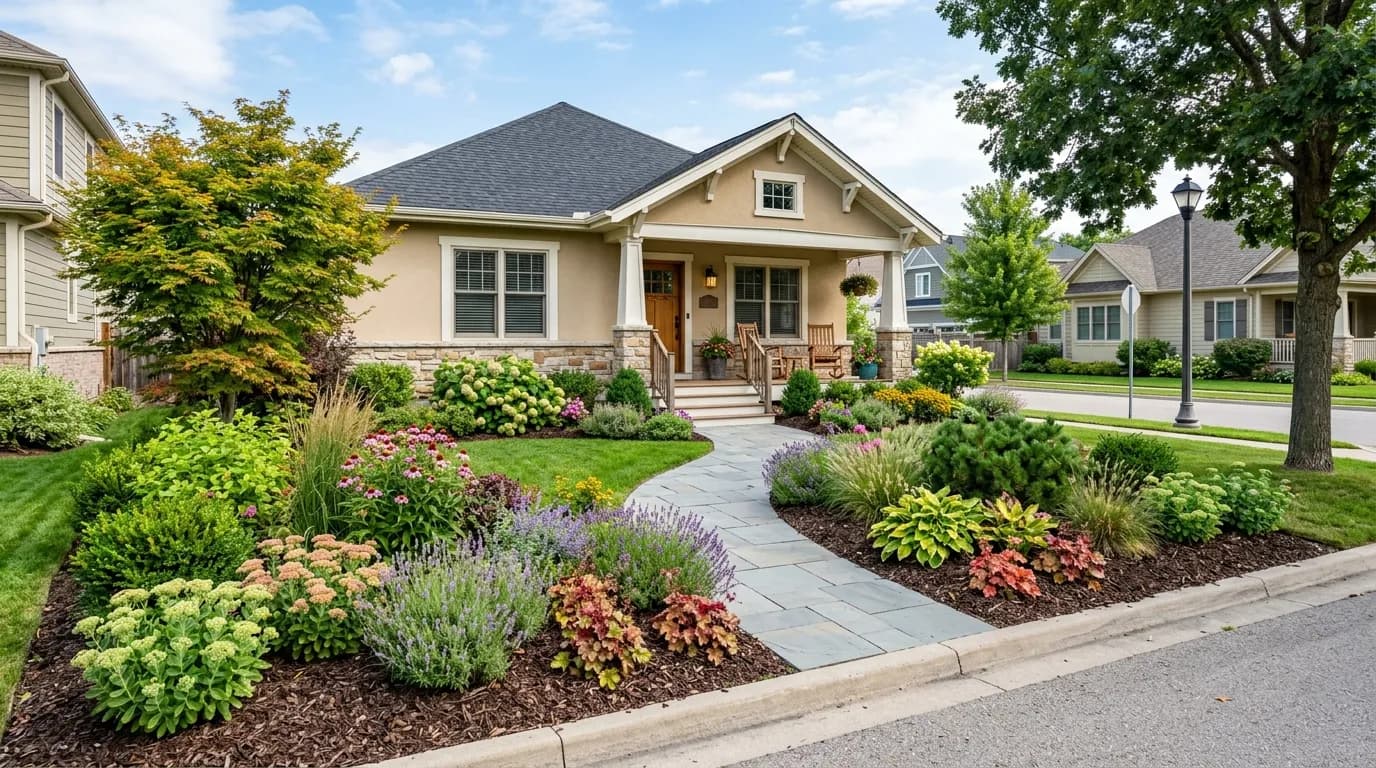
Your front yard is the first thing visitors see — and it shouldn't require constant maintenance to look great. The good news? With smart design choices and the right plants, you can create a stunning, low-maintenance front yard that adds thousands to your home value while requiring minimal upkeep.
According to the National Association of Realtors, professional landscaping adds 10-15% to property value. But traditional high-maintenance landscapes — with weekly mowing, constant deadheading, and thirsty annuals — cost homeowners 4-6 hours per week in upkeep. Low-maintenance front yard landscaping flips this equation: maximum curb appeal, minimal time investment.
Why Front Yards Need a Different Approach
Front yards face unique challenges that make low-maintenance design even more valuable:
Public visibility: Front yards are on display 24/7. Neglect shows immediately.
Water restrictions: Most municipalities restrict front yard watering first during droughts.
HOA rules: Many neighborhoods mandate "neat and tidy" front yards but don't require high-maintenance grass.
Limited usable space: Unlike backyards, front yards rarely get active use — why spend maintenance time on space you don't use?
High-impact area: Real estate agents consistently rank curb appeal as the #1 factor in buyer interest and first impressions.
The smartest homeowners invest in front yard designs that look professionally maintained year-round with under 30 minutes of maintenance per month.
1. Replace High-Maintenance Lawn with Groundcovers
Traditional turfgrass is the single biggest maintenance drain in any front yard. It demands weekly mowing (25-40 minutes), edging (10-15 minutes), fertilizing 3-4 times annually, pest/weed management, and significant watering.
Smart alternative: Low-growing groundcovers that eliminate mowing entirely.
| Groundcover | Zones | Water Needs | Height | Bloom |
|---|---|---|---|---|
| Creeping thyme | 4-9 | Very low | 2-4" | Purple, summer |
| Microclover | 3-10 | Low | 4-6" | White, spring |
| Sedum (stonecrop) | 3-9 | Very low | 3-6" | Yellow/pink |
| Blue star creeper | 5-9 | Low | 2-3" | Light blue |
| Ajuga (bugleweed) | 3-10 | Low | 4-6" | Purple, spring |
| Mazus reptans | 5-8 | Medium | 1-2" | Purple |
Maintenance savings: Replacing 300 sq ft of front lawn with creeping thyme saves approximately 120 hours per year in mowing alone, plus fertilizing, edging, and watering time.
Pro tip: Keep a narrow strip of traditional lawn (18-24") between the groundcover and the street/sidewalk for a clean, intentional transition. This 2-minute weekly trim maintains the "tidy" look most HOAs require.
2. Install Permanent Bed Edging
Poorly defined beds are a front yard nightmare — grass constantly invades, edges look ragged, and you're trimming weekly just to maintain the boundary.
Solution: Steel, aluminum, or concrete edging creates a permanent physical barrier.
- Steel edging: $1.50-$3 per linear foot, lasts 15+ years, nearly invisible when installed flush with soil
- Concrete curbing: $6-$12 per foot installed, highly visible and formal
- Aluminum: $2-$4 per foot, lighter weight, easier DIY installation
A typical front yard needs 60-100 linear feet of edging. At $150-300 for DIY steel edging, it pays for itself in time saved within the first season.
Installation time: 3-4 hours for 80 feet of steel edging (one-time investment).
Maintenance eliminated: 2-3 hours per month of edge trimming.
3. Use Native Shrubs as Structural Anchors
Native shrubs are the backbone of low-maintenance front yard design. Once established (typically 1-2 growing seasons), they require:
- Zero supplemental watering
- Zero fertilization
- Zero pest management
- One annual pruning (15-30 minutes per shrub)
Best native shrubs by region:
Northeast: Inkberry holly (Ilex glabra), bayberry (Morella pensylvanica), sweet pepperbush (Clethra alnifolia)
Southeast: Wax myrtle (Myrica cerifera), beautyberry (Callicarpa americana), yaupon holly (Ilex vomitoria)
Midwest: Ninebark (Physocarpus opulifolius), serviceberry (Amelanchier), chokeberry (Aronia)
Southwest: Texas sage (Leucophyllum frutescens), damianita (Chrysactinia mexicana), desert marigold (Baileya multiradiata)
West Coast: Manzanita (Arctostaphylos), ceanothus (Ceanothus spp.), toyon (Heteromeles arbutifolia)
Design principle: Use 3-5 larger native shrubs (3-5 feet mature height) as "anchors" at corners and foundation areas, then fill between them with lower-growing perennials or groundcovers.
4. Add Ornamental Grasses for Year-Round Interest
Ornamental grasses are the ultimate low-maintenance front yard plant. They provide:
- Four seasons of visual interest
- Zero deadheading or staking
- Minimal watering once established
- One annual "haircut" in late winter (5-10 minutes per clump)
- Movement and texture that looks expensive
Top 5 ornamental grasses for front yards:
- 1Karl Foerster feather reed grass (Calamagrostis × acutiflora 'Karl Foerster') — Zones 5-9, upright habit, golden plumes summer-fall, 4-5 feet tall
- 2Little bluestem (Schizachyrium scoparium) — Zones 3-9, native, blue-green summer foliage turns copper-red in fall, 2-3 feet
- 3Blue oat grass (Helictotrichon sempervirens) — Zones 4-8, steel-blue evergreen foliage, compact 2-3 feet
- 4Muhly grass (Muhlenbergia capillaris) — Zones 5-9, airy pink plumes in fall, 3-4 feet
- 5Fountain grass (Pennisetum alopecuroides) — Zones 5-9, arching habit, tan plumes, 2-4 feet
Maintenance: One annual cut-back in late February/early March. That's it.
Design tip: Plant ornamental grasses in groups of 3-5 for maximum visual impact. A trio of Karl Foerster grass at a front corner creates a statement focal point that lasts 5+ years with zero maintenance.
Want to see how ornamental grasses would look in your specific front yard? [Generate 3 AI landscape designs tailored to your home →](/redesign)
5. Mulch Generously with Long-Lasting Materials
A 3-4 inch layer of quality mulch is the single most effective weed-suppression and moisture-retention strategy in low-maintenance landscaping.
Best mulches for front yards:
- Shredded hardwood bark: Lasts 2-3 years, $35-50 per cubic yard, natural appearance
- Cedar mulch: Lasts 2-3 years, natural pest deterrent, $45-65 per cubic yard
- Pine straw: Lasts 1-2 years, excellent for acid-loving plants like azaleas, $6-8 per bale
- Rubber mulch: Lasts 10+ years, $8-12 per bag, controversial for plant health
Coverage: 1 cubic yard of mulch covers approximately 100 sq ft at 3 inches depth.
Maintenance schedule:
- Year 1: Apply 3-4 inches in spring
- Year 2: Top off with 1-2 inches in spring
- Year 3+: Refresh with 1-2 inches annually
Time investment: Spreading 5 cubic yards of mulch (covers 500 sq ft) takes 2-3 hours once per year.
Weed suppression: A proper mulch layer eliminates 85-95% of weed emergence, cutting weeding time from 2-3 hours per month to under 20 minutes per month.
6. Choose Evergreen Plants for Year-Round Structure
Deciduous plants look great for 6-8 months, then leave your front yard looking bare all winter. Evergreens maintain curb appeal 12 months a year with zero seasonal cleanup.
Best low-maintenance evergreen plants:
- Boxwood (Buxus) — Zones 5-9, classic hedge plant, slow-growing, one annual trim
- Juniper (Juniperus) — Zones 3-9, drought-tolerant, zero pruning needed for spreading varieties
- Dwarf Alberta spruce (Picea glauca 'Conica') — Zones 2-6, naturally pyramidal, zero pruning
- Inkberry holly (Ilex glabra) — Zones 4-9, native, 4-6 feet tall, minimal pruning
- Lavender (Lavandula) — Zones 5-9, fragrant, gray-green foliage year-round, one spring trim
Design formula: Aim for 60-70% evergreen plants in your front yard. This ensures the landscape looks finished and intentional even in January.
7. Use Hardscaping to Reduce Planting Area
Every square foot of patio, walkway, or gravel area is one less square foot that needs watering, weeding, or mowing.
High-impact hardscaping for front yards:
Wider walkways: Expand your front walkway from 36" to 48-60" wide. The extra 100-200 sq ft eliminates maintenance while improving arrival experience.
Permeable gravel areas: Replace turf areas near the foundation with 3-4 inches of decomposed granite or pea gravel over landscape fabric. Maintenance: zero. Cost: $2-4 per sq ft DIY.
Steppers through groundcover: Instead of a solid walkway, use 18-24" stepping stones set in groundcover. Looks high-end, costs 60% less than continuous pavers, eliminates the need to mow around the path.
Front porch expansion: Extending your front porch or stoop by even 2-3 feet adds usable space while reducing landscape maintenance area.
8. Install Smart Drip Irrigation
Drip irrigation is the single best investment in low-maintenance front yard landscaping. It delivers water directly to plant roots, eliminating evaporation and hand-watering.
Cost: $200-400 DIY for a typical front yard, $600-1,200 professionally installed.
Maintenance time saved: 2-3 hours per week during growing season (April–October) = 50-75 hours per year.
Water savings: 30-50% compared to sprinklers or hand watering.
Smart controllers: Models like Rachio or RainBird WiFi controllers adjust watering automatically based on local weather data, eliminating the need to manually adjust schedules seasonally.
ROI: Most drip systems pay for themselves in water bill savings within 2-3 years, plus the time savings.
9. Group Plants by Water Needs (Hydrozoning)
Hydrozoning — grouping plants with similar water requirements — makes irrigation far more efficient. You're not overwatering drought-tolerant plants to keep moisture-lovers alive, or vice versa.
Front yard hydrozoning strategy:
Zone 1 (High water): Immediately around the front door and along the main walkway — this is the most visible 10-15% of your front yard. Use lush, colorful plants here.
Zone 2 (Medium water): Foundation beds and secondary focal areas — 30-40% of front yard. Use native shrubs and perennials.
Zone 3 (Low/no water): Outer areas, slopes, and areas far from the house — 50% of front yard. Use native groundcovers, ornamental grasses, and drought-tolerant plants.
This strategy concentrates maintenance and water investment where visibility and impact are highest.
10. Add Seasonal Color with Perennials, Not Annuals
Traditional front yards rely on annuals (impatiens, petunias, marigolds) for color. But annuals require replanting every spring ($100-300 in plants alone), plus constant deadheading throughout summer.
Smart alternative: Long-blooming perennials that return every year.
| Perennial | Zones | Bloom Period | Color | Height |
|---|---|---|---|---|
| Coneflower (Echinacea) | 3-9 | June–Sept | Pink, purple, white | 2-4' |
| Black-eyed Susan (Rudbeckia) | 3-9 | July–Sept | Yellow | 2-3' |
| Catmint (Nepeta) | 3-8 | May–Sept | Lavender-blue | 1-2' |
| Daylily (Hemerocallis) | 3-9 | June–Aug | All colors | 1-4' |
| Salvia (Salvia spp.) | 4-9 | June–frost | Purple, red, white | 1-3' |
| Coreopsis | 4-9 | June–Sept | Yellow | 1-2' |
Maintenance: One annual cut-back in late winter. Optional mid-summer deadheading extends bloom (15-20 minutes total).
Cost comparison:
- Annual color (replanted yearly): $150-300/year ongoing
- Perennial color (planted once): $200-400 upfront, then $0/year for 5-10 years
The Low-Maintenance Front Yard Blueprint
Here's a simple framework for transforming any front yard:
Step 1: Install permanent edging around all beds (one-time, 3-4 hours)
Step 2: Replace 50-80% of turf with groundcovers or mulched beds (one season project)
Step 3: Plant 5-7 native shrubs as structural anchors (one weekend)
Step 4: Add 3-5 clusters of ornamental grasses for movement (2-3 hours)
Step 5: Install drip irrigation on a smart timer (one weekend DIY or hire out)
Step 6: Mulch all beds to 3-4 inches depth (2-3 hours annually)
Step 7: Fill gaps with long-blooming perennials (ongoing as budget allows)
Most homeowners can implement this blueprint over 1-2 growing seasons, spreading cost and labor while seeing immediate reductions in maintenance time at each phase.
ROI: Time and Money Saved
Let's compare a traditional high-maintenance front yard to a well-designed low-maintenance landscape:
Traditional front yard (500 sq ft):
- Weekly mowing: 30 min
- Edge trimming: 15 min
- Hand weeding: 45 min
- Hand watering or moving sprinkler: 20 min
- Total weekly time: 1 hour 50 minutes
- Annual time: 92 hours
- Annual cost: $800-1,200 (water, fertilizer, gas, annuals, mulch)
Low-maintenance front yard (same 500 sq ft):
- Optional upgrade spot weeding: 15 min
- Annual mulch refresh: 2 hours total
- Annual perennial cut-back: 2 hours total
- Irrigation adjustments: 20 min total
- Total annual time: 9-10 hours
- Annual cost: $200-400 (mulch, drip repairs)
Net savings: 82+ hours per year + $400-800 in annual costs.
Design Your Low-Maintenance Front Yard in 60 Seconds
Not sure where to start? [Yardcast's AI landscape design tool](/redesign) analyzes your front yard photos and generates three photorealistic design concepts optimized for low maintenance. You'll get:
- Plant lists of native, low-maintenance species appropriate for your zone
- Layout concepts that minimize lawn and maximize curb appeal
- Phased installation plans so you can tackle the project over 1-2 seasons
- Cost breakdowns for accurate budgeting
[Generate 3 free AI front yard designs now →](/redesign)
Upload your front yard photos, set your maintenance preference to "low," and see exactly what's possible.