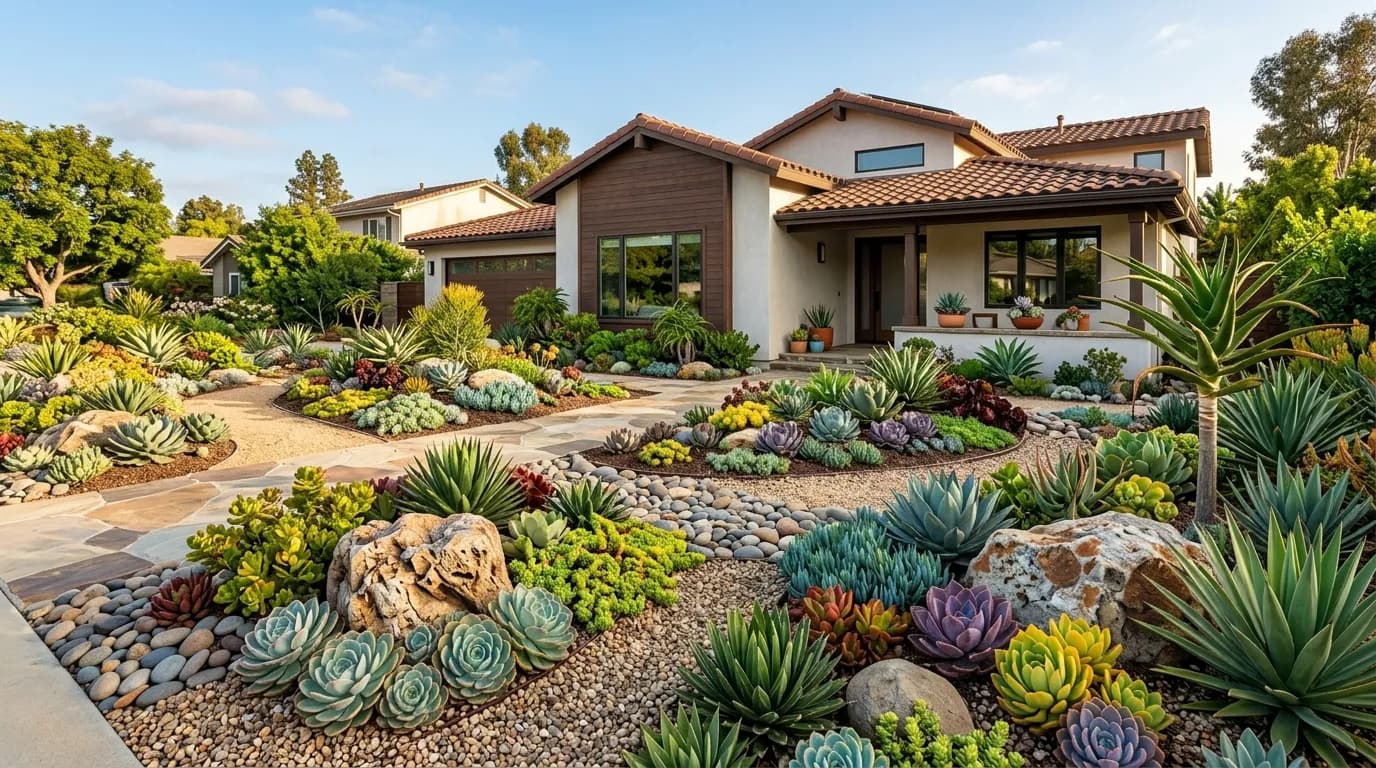
Succulents are having their biggest moment in landscape design — and not just because they look amazing in Instagram feeds. These plants genuinely solve the two biggest pain points in modern gardening: water waste and time. A well-designed succulent garden can look stunning year-round with almost no irrigation, no fertilizing, and minimal pruning.
Whether you're in the California coastal hills, the Arizona desert, the Texas hill country, or even the humid Southeast (with the right variety choices), there's a succulent garden design that will work for your climate, your style, and your schedule.
Here are 25 outdoor succulent garden ideas — from container arrangements to full front-yard transformations.
Why Succulents Work So Well in Landscape Design
Succulents store water in their leaves, stems, or roots — which means they survive extended drought without irrigation. But that's not the only reason they've taken over modern landscaping:
- Year-round interest. Unlike perennials that die back, most succulents look good in every season.
- Color diversity. Succulents span the full spectrum: silver-blue (Echeveria), deep purple (Aeonium 'Zwartkop'), golden yellow (Sedum 'Angelina'), rich burgundy (Sempervivum), bright green with pink edges (Graptosedum).
- Texture. Spiky agaves, rosette echeverias, trailing sedums, and towering cactus all provide architectural contrast that's difficult to achieve with flowering perennials.
- Low water cost. In water-stressed regions, switching to succulents can reduce outdoor water use by 50–70%.
- Incredibly low maintenance. Most succulents need watering once every 2–4 weeks in summer, even less in winter. The main maintenance task: removing dead leaves from the base.
The one limitation: most succulents (with notable exceptions like Sempervivum and Sedum) are not frost-hardy. In climates with hard freezes, you'll need to focus on cold-tolerant varieties or treat them as annuals — or use container arrangements you bring in.
Succulent Garden Ideas for Full Sun
1. The Desert Modernist Front Yard
Replace lawn with a clean composition: decomposed granite in warm gray, punctuated by large specimen agaves (Agave 'Blue Flame' or Agave parryi), clusters of golden barrel cactus, and low mounding sedums and echeverias at ground level. This look dominates modern California and Arizona landscaping for good reason — it's striking, requires zero irrigation once established, and eliminates lawn entirely.
2. Rock Garden with Succulents
A naturalistic rock arrangement (boulders in groups of 3–5, varying sizes) with succulents planted in the crevices and at the bases: Sempervivum in the rock gaps, low sedums spreading at boulder bases, and one large Agave or Yucca as an anchor. This is the most affordable succulent garden style — rocks are often free or cheap locally, and succulents are easy to propagate.
3. Succulent Slope Planting
If you have a sunny slope or hillside, succulents are one of the best erosion-control options available. Plant Trailing Ice Plant (Delosperma cooperi) as a groundcover — it blooms in bright pink/purple for months, spreads quickly, and holds soil exceptionally well. Mix in clumping Agaves, Yucca, and drought-tolerant grasses for height variation.
4. Cactus and Succulent Xeriscape Border
Create a layered border 4–6 feet wide along a fence line or property edge: tall Saguaro-type cactus (or Euphorbia ingens as a non-spiny alternative) in back, mid-height Agave and Aloe in the middle, low Sedum and Echeveria at the front. Add a 3-inch gravel mulch layer. This border looks maintained without any actual maintenance beyond quarterly cleanup.
5. Mediterranean Terrace Succulent Garden
Inspired by Moroccan and Spanish courtyard gardens: raised terracotta planters grouped at different heights with a central large specimen plant (Aeonium or large Agave), surrounding gravel, and small accent plants woven in. Add a few terracotta pots with Agapanthus or Lavender for non-succulent contrast. The textural mix of terracotta, gravel, and succulent forms is visually rich and requires almost no care.
Succulent Container and Raised Bed Ideas
6. Layered Hypertufa Bowl
Hypertufa (lightweight artificial rock made from perlite, peat, and Portland cement) bowls planted with a mix of small succulents — Echeveria, Haworthia, Gasteria, and trailing Sedum — create striking living sculptures. You can make your own molds for under $20. These work on patios, outdoor tabletops, and as centerpieces in garden beds.
7. Driftwood Planter
Hollow out large driftwood pieces or use natural crevices to plant succulents directly — the look is organic and sculptural. Line with cactus potting mix and plant small Echeveria, Sempervivum, and trailing Sedum. These work beautifully in coastal or beachy-style gardens where the driftwood aesthetic fits naturally.
8. Old Colander or Metal Bucket Arrangements
Rustic containers — galvanized buckets, colanders, old boots — planted with mixed succulents create a farmhouse/vintage aesthetic that's extremely popular in cottage and bohemian garden styles. Use a gritty soil mix (50% standard potting soil + 50% perlite), add drainage holes, and plant loosely.
9. Living Wall Panel
A wooden frame with chicken wire backing and cactus mix allows succulents to root horizontally and create a flat "living tapestry" on a fence or wall. Use small rosette Echeverias and Sempervivums in a pattern — alternating colors or gradients. This takes 4–6 weeks to root in fully and looks stunning once established.
10. Terraced Raised Beds
Three stepped stone or concrete raised beds of descending height, each filled with complementary succulent compositions: large architectural plants on the top tier, medium texture in the middle, trailing Sedum and Echeveria spilling over the edges of the lowest tier. This creates a dramatic focal point in any yard.
🌵 See what a succulent garden would look like in your yard
[Upload a photo and get 3 AI succulent garden designs in 60 seconds →](/redesign)
Choose "Desert Modern," "Mediterranean," or "Natural/Wild" style. Yardcast generates photorealistic designs with a plant list specific to your climate zone, plus a complete maintenance guide. Preview is free.
Succulent Garden Ideas by Style
11. Japanese Minimalist Succulent Garden
Combine blue-gray gravel (raked in gentle patterns), flat stepping stones, a single large Agave parryi, and clusters of Sedum rupestre 'Angelina' (golden-yellow trailing sedum) for contrast. The restraint of Japanese design aesthetic — negative space, asymmetry, one strong focal plant — makes succulents look especially powerful.
12. Coastal Boho Garden
Terracotta pots in clusters on a weathered wood deck, mixed with driftwood accents, macramé plant hangers (for smaller succulents), shells used as groundcover accents, and trailing Senecio (String of Pearls/Bananas) cascading over the edges. This style is most popular in California and Florida coastal regions.
13. Industrial Modern Garden
Black gravel, black metal raised beds or planters, concrete pavers, and bold architectural succulents — Agave 'Black Widow', Aeonium 'Zwartkop' (near-black rosettes), and Opuntia cactus. The dark palette with stark forms looks stunning against a modern home with black window frames.
14. Fairy Garden / Miniature Landscape
Small-scale succulent arrangements in shallow bowls or trays, designed to look like miniature landscapes: gravel paths, tiny stepping stones, small figurines, with Haworthia (looks like tiny aloe), small Echeveria rosettes, and miniature Sedum as the "landscape." Perfect for children's gardens, patios, or as patio table centerpieces.
15. Cottage-Meets-Succulent
Mix traditional cottage plants (Lavender, ornamental Alliums, Catmint) with hardy succulents (Sempervivum, Sedum 'Autumn Joy') in a lush border. This hybrid style retains the romantic abundance of cottage gardens while dramatically reducing water needs. The key: use succulents as groundcover and low-level fillers; use traditional flowering perennials for height and seasonal bloom.
Best Outdoor Succulents by Climate
Hot, Dry Climates (Zones 9–11: California, Arizona, Nevada, Texas, Florida)
- Agave — 100+ species, sizes from 12 inches to 12 feet. Drought-proof. Iconic architectural form.
- Aeonium — Glossy rosettes in green, black, and burgundy. Perfect for California coastal.
- Echeveria — Powder-blue to pink rosettes. Drought-tolerant, tender to frost. Year-round gorgeous.
- Aloe vera and Aloe arborescens — Dramatic orange blooms in winter. Medicinal uses.
- Opuntia (Prickly Pear) — Native to most of the US. Edible fruit, dramatic form. Hardy to Zone 4.
- Trailing Ice Plant — Brilliant magenta/purple flowers. Excellent groundcover and slope stabilizer.
Cold-Hardy Succulents (Zones 4–7: Pacific Northwest, Midwest, Mid-Atlantic, New England)
- Sempervivum (Hen and Chicks) — Hardy to Zone 3. Grows in rock crevices. Spreads prolifically.
- Sedum (Stonecrop) — Many cold-hardy species. 'Autumn Joy' is a garden classic.
- Delosperma (Hardy Ice Plant) — Brilliant purple/yellow/pink flowers. Hardy to Zone 5.
- Yucca filamentosa — Hardy to Zone 4. Dramatic architectural spikes. White flower spires in summer.
- Opuntia humifusa — Eastern prickly pear. Native to the eastern US. Hardy to Zone 4.
Shade-Tolerant Succulents
Most succulents need full sun, but these handle partial shade:
- Haworthia — Low-growing, window-like markings on leaves. Great for morning sun + afternoon shade.
- Gasteria — Tongue-shaped leaves, tolerates less light than most.
- Sempervivum — Tolerates partial shade better than most rosette succulents.
Succulent Garden Soil and Planting Tips
The #1 mistake in succulent gardening: using regular potting soil. It retains too much moisture and rots roots. Use:
- Cactus/succulent potting mix (available at any garden center), or
- DIY mix: 50% standard potting soil + 50% coarse perlite or coarse sand
Planting tips:
- 1Drainage is everything. In containers, ensure drainage holes. In ground, amend heavy clay with coarse sand and gravel.
- 2Plant at the right depth. Don't bury the crown (the center growing point). Plant at the same depth as the nursery pot.
- 3Water after planting, then wait. Give plants 1–2 weeks to recover from transplant stress before establishing a watering schedule.
- 4Mulch with gravel, not bark. Organic mulch holds moisture at the crown and can cause rot. Gravel mulch keeps moisture away from the stem while regulating temperature.
Watering Schedule for Outdoor Succulents
The phrase "set and forget" is almost true with outdoor succulents:
- Summer: Water deeply every 7–14 days. Let soil dry completely between waterings.
- Spring/fall: Water every 2–3 weeks.
- Winter: Water monthly or not at all (dormant season; overwatering in winter is the most common cause of death).
Key rule: When in doubt, don't water. Succulents survive drought far better than overwatering. The leading cause of outdoor succulent death is root rot from too much moisture — not too little.
Design your succulent garden today →
Upload a photo of your yard and describe the look you want — desert modern, low-water, Mediterranean courtyard, or cottage-succulent mix. Yardcast generates 3 AI-designed options with photorealistic visuals, a climate-matched plant list, and a full PDF with cost estimates and maintenance calendar.
No account needed. Preview free →