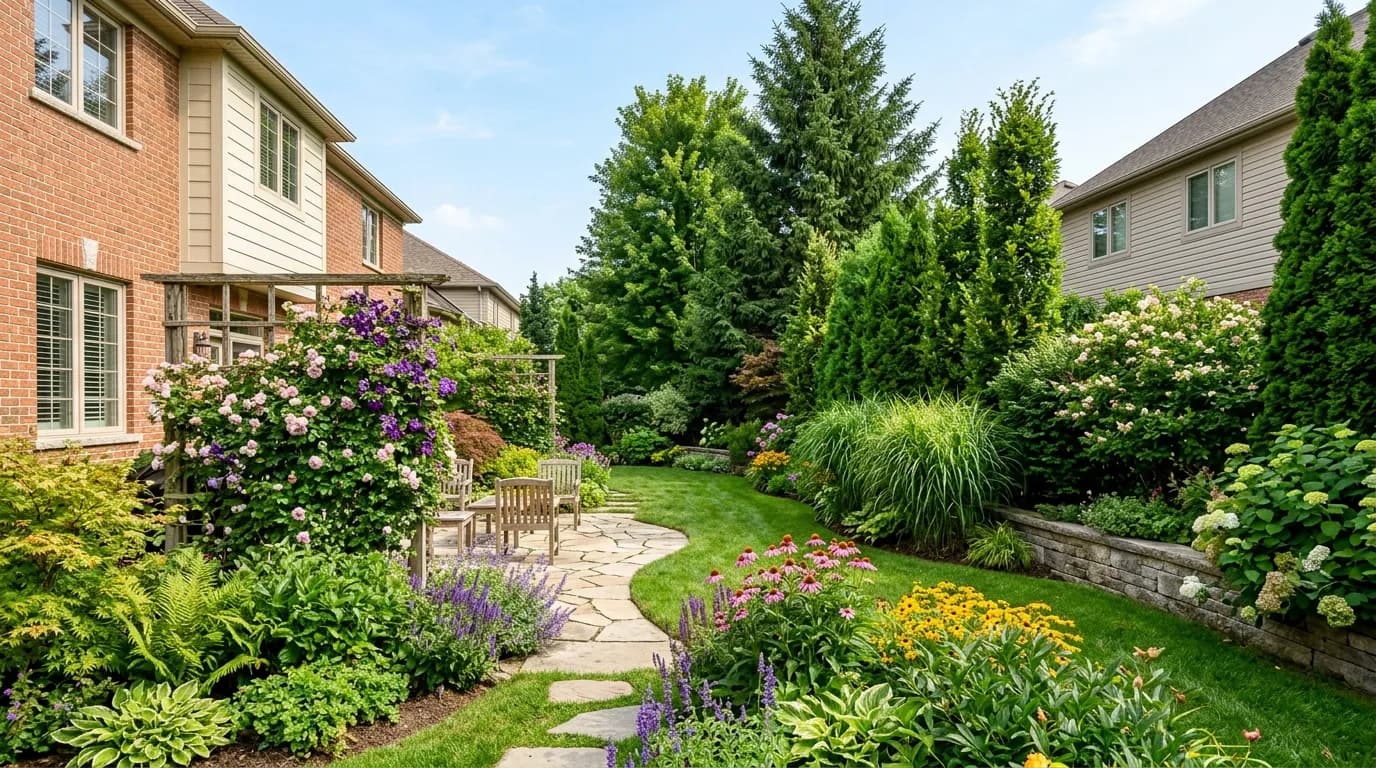
Want privacy in your yard without the look and feel of a fortress? Natural screening with plants is more beautiful, more effective over time, and better for the environment than any fence. Done right, a privacy planting adds significant property value while creating a living, breathing backdrop that improves with every passing year.
Here's a comprehensive guide to choosing and designing privacy plantings for every situation, budget, and timeline.
Fast-Growing Privacy Plants
When you need screening ASAP and can't wait years for slow-growing evergreens, these plants deliver.
Bamboo (Clumping Varieties)
Clumping bamboo (Fargesia, Bambusa) grows 2-4 feet per year and reaches 10-20 feet tall, creating dense, graceful screening. Unlike running bamboo, clumping varieties stay in place — no need for root barriers.
Best varieties:
- Fargesia robusta ('Pingwu') — Hardy to zone 5, excellent dense screen
- Fargesia dracocephala — Very cold-hardy (zone 4), upright and compact
- Bambusa oldhamii — For warm climates (zone 8+), very fast and tall
Avoid: Running bamboo unless you install 36-inch-deep root barriers. It can travel 20+ feet underground.
Leyland Cypress (× Cuprocyparis leylandii)
The classic fast privacy screen. Grows 3-5 feet per year in good conditions, reaching 40-70 feet if left unpruned. Dense, evergreen, and takes formal shearing well.
Pros: Very fast, very dense, fine texture, tolerates coastal conditions
Cons: No seasonal interest, susceptible to Seiridium canker disease in humid climates, becomes enormous if not pruned
Best for: Zones 6-10, areas needing quick, tall screening
Spacing: Plant 6-8 feet apart for a screen that fills in within 2-3 years; 4-5 feet apart for faster fill-in.
'Green Giant' Arborvitae (Thuja 'Green Giant')
The most widely planted privacy tree in America for good reason. Grows 3-5 feet per year, reaches 30-40 feet, is deer-resistant (unlike most arborvitae), and has no serious pest or disease problems.
Pros: Fast, disease-resistant, deer-resistant, stays dense to the ground, beautiful emerald-green color
Cons: Gets large over time; needs space to grow; can look uniform in large numbers
Best for: Zones 5-8, most of the country except extreme cold or heat
Spacing: 6-8 feet for hedge; 10-12 feet for softer, more natural grouping
Privet (Ligustrum species)
Fast-growing (2-3 ft/year), adaptable to shade and sun, tolerates hard pruning, inexpensive. A workhorse for privacy hedges.
Caveat: Most privet species are considered invasive in the eastern US — their berries are spread by birds into natural areas. The non-invasive Chinese privet (L. sinense 'Variegatum') and Ligustrum x vicaryi are better choices if you're in the east.
Evergreen Screens for Year-Round Privacy
For privacy that never goes bare, evergreen choices are essential. These slower-growing options are worth the wait.
Holly (Ilex species)
Inkberry holly (I. glabra):* Native, deer-resistant, excellent for wet or shady sites. Grows 6-8 feet. Very deer-resistant and adaptable.
American holly (I. opaca):* Native tree, reaches 15-40 feet. Glossy green leaves, red berries. Slower growing but long-lived and beautiful.
Nellie Stevens holly (I. × 'Nellie R. Stevens'):* Fast-growing (2-3 ft/year), very dense, reaches 15-25 feet, excellent screening tree.
Skip Laurel (Prunus laurocerasus 'Schipkaensis')
Dense, shiny-leaved evergreen that reaches 6-10 feet and spreads 5-7 feet. Excellent in sun or heavy shade (unlike most screening plants). White flowers in spring. Hardy to zone 5b.
Ideal use: Shade gardens needing privacy screening; under trees; north-facing walls.
Wax Myrtle (Morella cerifera)
Native to the Southeast, this fast-growing evergreen (1-2 ft/year) reaches 8-15 feet and is extremely adaptable — tolerates wet, dry, salty, and poor soil conditions. Beautiful blue-gray berries attract birds. Semi-evergreen in cold winters.
Best for: Zones 6-10, coastal gardens, native plant gardens
Podocarpus (Podocarpus macrophyllus)
"Japanese Yew Pine" — a slow-growing but beautiful evergreen for warm climates (zones 8-11). Dense, soft texture, tolerates shearing extremely well. Excellent for privacy hedges in Florida, Texas, and the West Coast.
The Art of Layered Privacy
The most effective privacy planting isn't a single row of one species — it's a layered system that provides screening at multiple heights and creates a naturalistic, beautiful planting.
Layer 1: The Tall Backdrop (15-30+ feet)
Purpose: Screen second-floor windows, block elevated views, create a visual "ceiling" effect
Best plants: Arborvitae, Leyland cypress, American holly, red cedar, white pine
Layer 2: Mid-Level Screening (6-15 feet)
Purpose: Block sight lines from the street or neighboring properties at eye level
Best plants: Skip laurel, inkberry holly, privet, wax myrtle, viburnum, forsythia
Layer 3: The Foreground (2-6 feet)
Purpose: Add interest, soften the look, attract pollinators, create seasonal color
Best plants: Ornamental grasses, flowering shrubs (roses, hydrangea, spirea), native perennials, groundcovers
Design tip: Stagger the three layers in a gentle arc rather than lining them up in a straight row. This creates a more natural look, allows each layer to be seen, and creates depth that makes a 6-foot-wide planting feel like a full woodland edge.
Privacy By Problem Type
"My neighbor's second-floor windows look down into my yard"
Solution: You need tall screening (18-25 feet) AND the right setback from the property line. Plant the tall screen 10-15 feet inside your property line so the trees can grow to full width without encroaching.
Best choice: 'Green Giant' arborvitae 20 feet back, supplemented with mid-story cherry laurel or holly.
"I need immediate privacy on a budget"
Solution: Combine fast-growing annual screening (ornamental grasses like miscanthus, which reach 6-8 feet in one season) with permanent evergreen investment that takes longer to mature. The annuals provide immediate relief while the permanent plants establish.
Budget option: Plant 5-gallon inkberry holly ($25/plant) at 4-foot spacing for the hedge, and fill gaps temporarily with tall ornamental grasses.
"I want privacy but also wildlife value"
Solution: A layered native hedge. Eastern US — viburnum, inkberry, American beautyberry, native hollies, and native grasses. This combination feeds birds all winter (berries), provides nesting cover, and creates excellent insect habitat.
"I have a shaded yard"
Solution: Most screening plants need sun. Options for shade: skip laurel (tolerates deep shade), native hollies, native viburnums, and shrubby native dogwoods like gray dogwood (Cornus racemosa).
Privacy Planting Timeline
| Planting Year | Expected Privacy |
|---|---|
| Year 1 | Minimal — plants establishing |
| Year 2 | Partial — bottom half is screening |
| Year 3 | Solid screening to 6-8 feet |
| Year 5 | Complete screening, naturalized appearance |
| Year 10 | Full-height, mature, beautiful privacy planting |
Cost Guide for Privacy Plantings
| Plant | 5-gal cost | 15-gal cost | Linear ft for full screen |
|---|---|---|---|
| 'Green Giant' arborvitae | $25-40 | $80-150 | 1 plant per 8 ft |
| Leyland cypress | $20-35 | $65-120 | 1 plant per 8 ft |
| Skip laurel | $20-30 | $60-100 | 1 plant per 4 ft |
| Inkberry holly | $20-30 | $55-90 | 1 plant per 4 ft |
| Clumping bamboo | $40-80 | $100-200 | 1 plant per 5 ft |
For 50 linear feet of privacy screen: Budget $800-2,000 for 5-gallon plants; $2,500-6,000 for 15-gallon plants. Larger plants establish faster but require more watering during establishment.
Design Your Privacy Landscape
Yardcast's AI landscape design tool generates photorealistic privacy planting designs based on your specific yard photos, climate zone, and privacy goals. See exactly how your property will look in 2, 5, and 10 years with different planting strategies — before spending a dollar on plants.
[See a privacy landscape design in both bed options for your yard →](/redesign)