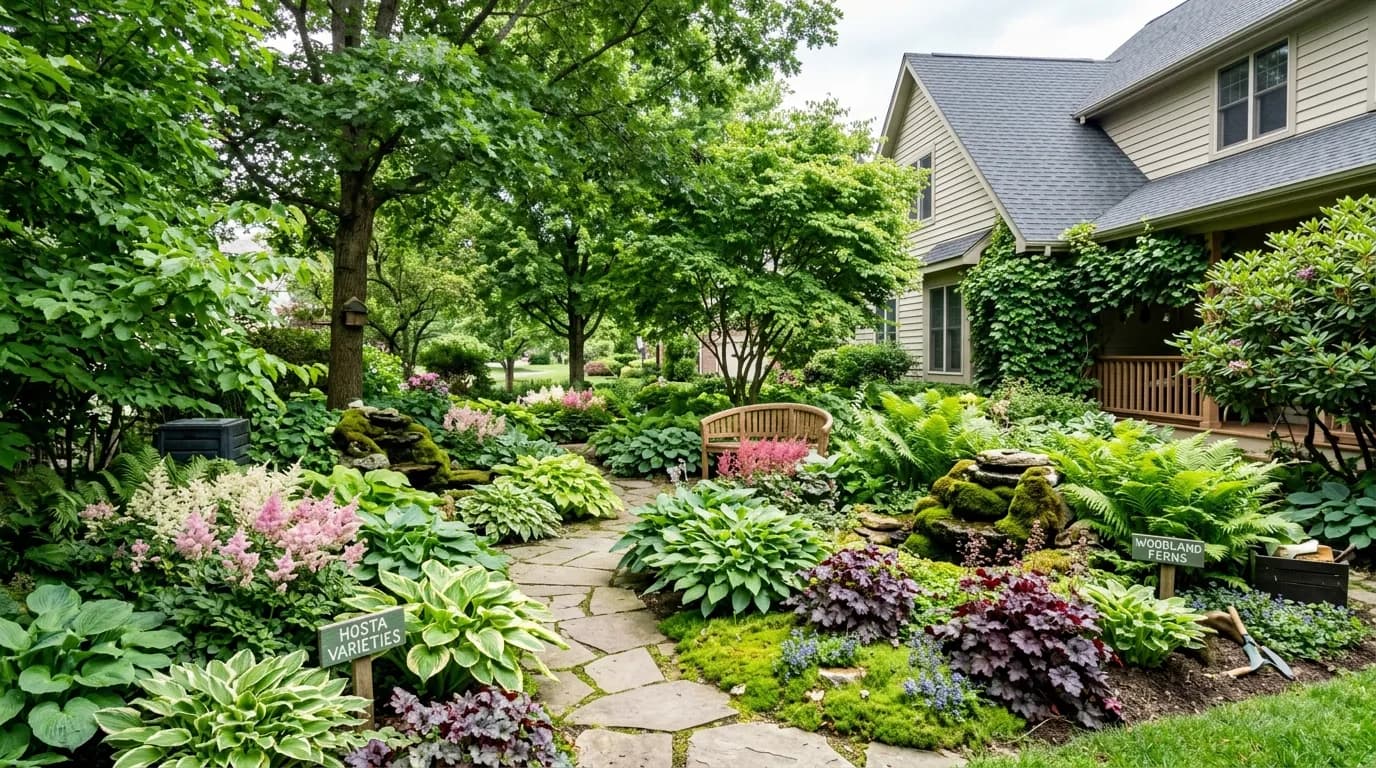
Shade is the single most common landscaping challenge homeowners face. Whether it's from mature trees, a north-facing lot, or a structure that blocks the afternoon sun, shady areas can feel impossible to landscape. The truth? A well-designed shade garden is often more dramatic and lush-looking than a sun-drenched yard — you just need the right approach.
This guide covers 35 shade garden ideas, the best plants for every shade type, design principles that make shady spaces feel intentional and inviting, and a clear path to getting started.
Understanding Your Shade: 3 Types That Determine Everything
Before choosing plants or layouts, identify which type of shade you're working with:
| Shade Type | Light Level | Typical Cause | Best Plants |
|---|---|---|---|
| Full shade | Less than 2 hrs direct sun/day | Dense tree canopy, buildings | Hostas, ferns, astilbe, bleeding heart |
| Part shade | 2–4 hrs direct sun/day | Filtered canopy, east/west exposure | Heuchera, impatiens, hydrangea, hellebores |
| Dappled shade | Filtered light all day | Tall open-canopy trees | Wide range — most shade plants thrive here |
Most yards have a mix of all three, which actually gives you more design flexibility than a fully sunny yard.
35 Shade Garden Ideas by Style and Function
Classic Woodland Style
1. Layered fern grotto. Create depth by layering ostrich ferns (tall), autumn ferns (medium), and maidenhair ferns (delicate) around a birdbath or stone focal point. The varying textures and greens create visual richness without flowers.
2. Hosta collection bed. Hostas are the kings of shade gardening. Mix giant varieties like 'Sum and Substance' (chartreuse, 3 feet wide) with blue-toned 'Halcyon' and white-edged 'Patriot' for a bed that's dynamic all season.
3. Bleeding heart + spring bulb combo. Plant drifts of Dicentra spectabilis under deciduous trees where they capture early spring sun. Add snowdrops, trillium, and Virginia bluebells to fill the spring window before the canopy closes.
4. Wild ginger groundcover path. Canadian wild ginger (Asarum canadense) forms a dense, uniform groundcover under large trees where nothing else grows. Edge it with stepping stones for a naturalistic woodland path feel.
5. Native trillium drift. Trillium are dramatic spring ephemerals native to woodland floors. Mass plant them for a carpet of white, pink, or maroon flowers that emerge before tree leaves unfold.
Statement Focal Points
6. Japanese forest grass as a centerpiece. Hakonechloa macra 'Aureola' glows golden-yellow in shade and moves beautifully in the breeze. Use it as a focal point surrounded by dark-leaved heuchera for maximum contrast.
7. Astilbe for late-summer color. Astilbe delivers feathery plumes of pink, red, white, and lavender in July and August — rare for shade plants. Plant in groups of 3–5 for maximum impact.
8. Ligularia 'The Rocket'. Huge architectural leaves and tall yellow flower spikes make Ligularia a statement plant in moist, shady spots. It's a showstopper near ponds or in low areas that stay damp.
9. Drumstick alliums in shade edge. The transition zone between sun and shade is often overlooked. Plant ornamental alliums along the edge for vertical interest — they tolerate part shade and bloom in May.
10. Oakleaf hydrangea as shade anchor. The most shade-tolerant hydrangea, oakleaf varieties produce massive white flower cones that fade to parchment, exfoliating bark in winter, and brilliant fall color. Plant one as a 4-season anchor.
Color Without Sun
11. Heuchera (coral bells) color mass. Modern heuchera varieties come in burgundy, caramel, lime, silver, and near-black. Mass plant contrasting varieties for a no-sun color display that lasts all season.
12. Impatiens for summer-long bloom. Standard impatiens are the classic shade flower — available in every color, blooming from June until frost. Use SunPatiens for dappled areas where they'll get more size and vigor.
13. Caladiums for tropical drama. In zones 9–11 (or as annuals elsewhere), caladiums bring outrageous color to full shade: red, pink, white, and near-purple patterns on large leaves. Plant in masses for a lush tropical look.
14. Begonias — tuberous and wax types. Tuberous begonias produce enormous rose-like flowers in pink, red, orange, and yellow in full shade. Wax begonias stay compact and bloom relentlessly in part shade.
15. Foxglove for towering vertical color. Digitalis thrives in part shade, producing 4–5 foot spikes of tubular flowers in purple, pink, white, and apricot. Biennial but self-sows freely — plant once and enjoy them every year.
Groundcovers That Solve Problems
16. Pachysandra for dense, uniform coverage. Japanese pachysandra creates a maintenance-free evergreen carpet under trees that completely crowds out weeds once established. Plant 6 inches apart, water the first year, then forget it.
17. Vinca minor (periwinkle) for slopes. Creeping myrtle handles shade, erosion, and root competition — three of the hardest conditions in landscaping. Its small blue flowers in spring are a bonus.
18. Ajuga for fast color coverage. Ajuga reptans spreads quickly and produces electric blue flower spikes in spring. Its bronze or purple foliage provides color the rest of the season. Perfect for filling awkward shady spots quickly.
19. Sweet woodruff under roses or shrubs. Galium odoratum forms a low, lacy green carpet with tiny white flowers in spring. It smells like vanilla when brushed — plant it where you'll walk past it.
20. Creeping Jenny for wet shady spots. Lysimachia nummularia 'Aurea' is chartreuse-gold and cascades beautifully over walls or along stream edges. It tolerates shade and moisture better than most groundcovers.
Mid-Article CTA: Design Your Shady Yard with AI
Figuring out what to plant where in a complex shaded yard is harder than it sounds. You need to account for shade type, soil moisture, root competition, and visual balance — all at once.
[→ Try Yardcast's free AI landscape preview for your yard](/redesign)
Upload a photo of your shady space and answer 5 quick questions. Our AI generates 3 customized design concepts in 60 seconds — including plant placement, groundcover zones, and focal point suggestions tailored to your shade conditions.
Design Layouts for Shady Spaces
21. Concentric ring planting. Plant rings outward from a tree trunk: inner ring (groundcover tolerating root competition), middle ring (hostas and ferns), outer ring (astilbe and hydrangea where the shade lightens). Creates a finished, designed look around any large tree.
22. Stream or dry creek through shade. A dry creek bed (even without water) winds naturally through shade plantings, creates interest, solves drainage problems, and provides a visual path that draws the eye through the space.
23. Shade patio with living walls. A pergola or arbor creates deliberate shade over a patio. Pair with wall-mounted planters of ferns and impatiens for a lush enclosed feel. Add string lights for evening ambiance.
24. Moss garden floor. In consistently moist, acidic, shady areas, embrace moss instead of fighting it. Clear weeds, press live moss into bare soil, and you'll have a velvety green floor that needs zero maintenance.
25. Elevated shade platform. Raise a simple deck or platform to canopy level under a large tree, creating a "treehouse without walls" feeling. Surround with hanging baskets of fuchsia and begonias.
26. Rock and fern naturalistic planting. Arrange large boulders in a naturalistic cluster and plant ferns, moss, and native woodland wildflowers between them. Mimics a shaded forest floor — impossible to distinguish from nature after a few seasons.
27. Japanese maple as a garden centerpiece. A lace-leaf Japanese maple casts beautiful dappled shade and provides year-round structure — spring red, summer purple-green, blazing autumn color, elegant winter silhouette. Everything else orbits around it.
28. Shade border with seasonal interest. Plan a shade border that has 3-4 overlapping bloom times: snowdrops (Feb), hellebores (March), bleeding heart (April-May), astilbe (July), toad lily (Sept). Color all season with only shade plants.
Functional Shade Solutions
29. Privacy shade garden. Dense plantings of fatsia japonica, aucuba, and mahonia under trees can create a privacy screen up to 8 feet tall that thrives in shade — solving two problems at once.
30. Edible shade garden. Many vegetables and herbs tolerate part shade: lettuce, kale, arugula, mint, cilantro, and parsley. Build raised beds in dappled areas to create a productive food garden without full sun.
31. Shade-tolerant pollinator garden. Native bees and bumblebees actually prefer part-shade during hot afternoons. Plant native shade-tolerant pollinator plants: wild columbine, native violets, mountain mint, and black cohosh.
32. Container shade garden. If the ground under a tree is impossible to plant (surface roots, dry, compacted), use large decorative containers placed around the base. No root competition and you can move them seasonally.
33. Seating nook in deep shade. A pair of chairs or a small bench under a mature tree, surrounded by hostas and ferns, creates an inviting garden room that's actually cooler and more comfortable than a sunny patio in summer.
34. Night-glow garden. White-flowered and white-variegated shade plants — white astilbe, white caladiums, white hostas, white bleeding heart — glow in evening light. Design a shade garden specifically for nighttime visibility and ambiance.
35. Four-season shade garden framework. Choose plants across these categories: evergreen structure (holly, leucothoe, hellebore), spring ephemerals (trillium, Virginia bluebells), summer foliage (hostas, heuchera), fall color (fothergilla, serviceberry), winter interest (winterberry holly, snowberry). The result: a garden with something to see every month of the year.
Best Shade Plants by Category
Perennials
- Hosta — Zones 3–9, full to part shade, dozens of varieties
- Astilbe — Zones 3–9, part shade, feathery plumes July–Aug
- Hellebore — Zones 4–9, full shade, blooms Feb–April
- Bleeding heart — Zones 3–9, full shade, spring color
- Toad lily — Zones 4–9, full shade, orchid-like fall flowers
- Heuchera — Zones 4–9, part shade, colorful foliage
- Solomon's seal — Zones 3–9, full shade, arching stems
Shrubs
- Oakleaf hydrangea — Zones 5–9, part to full shade, 4-season interest
- Itea (Virginia sweetspire) — Zones 5–9, part shade, fragrant flowers + fall color
- Fothergilla — Zones 4–8, part shade, white bottlebrush flowers + brilliant fall color
- Mountain laurel — Zones 4–9, full shade, spring flowering evergreen
- Nandina — Zones 6–11, part shade, berries, evergreen foliage
Groundcovers
- Pachysandra — Zones 4–8, full shade, evergreen, weed-suppressing
- Vinca minor — Zones 4–9, full to part shade, blue spring flowers
- Ajuga — Zones 3–9, part shade, fast spreading, spring bloom
- Wild ginger — Zones 3–9, full shade, native, forms dense carpet
Ferns
- Ostrich fern — Zones 3–9, full shade, dramatic 4-foot fronds
- Japanese painted fern — Zones 3–8, part shade, silver and green variegation
- Autumn fern — Zones 5–9, part shade, copper-orange new growth
- Christmas fern — Zones 3–9, full shade, evergreen
Common Shade Garden Mistakes
Planting sun-lovers in shade. Lavender, roses, most vegetables, and ornamental grasses need full sun. They'll survive in shade but won't thrive — thin, leggy, prone to disease.
Ignoring soil moisture. Deep shade under large trees is often bone-dry from root competition. The fix: add organic matter, mulch heavily, and choose plants tolerant of dry shade like epimedium, pachysandra, or dry-tolerant hostas.
Planting too close to tree trunks. Keep all plantings at least 18 inches from a tree's base to avoid competition with surface roots and to prevent moisture against the bark.
Overcrowding. Shade plants often grow slowly at first, then spread vigorously. Space them properly from the start or you'll be dividing constantly.
What Does a Shade Garden Cost?
| Project | Typical Cost Range |
|---|---|
| Groundcover bed (500 sq ft, pachysandra) | $300–$800 |
| Mixed shade border (25 linear feet) | $500–$1,500 |
| Full shade garden design + installation (small yard) | $2,000–$6,000 |
| Shade patio with plantings | $5,000–$20,000 |
| Professional shade garden design only | $500–$2,500 |
[→ Get a free AI landscape preview for your shady yard — takes 60 seconds](/redesign)
FAQ: Shade Garden Questions Answered
<script type="application/ld+json">
{
"@context": "https://schema.org",
"@type": "FAQPage",
"mainEntity": [
{
"@type": "Question",
"name": "What grows best in full shade with no sun?",
"acceptedAnswer": {
"@type": "Answer",
"text": "The best plants for full shade (less than 2 hours of direct sun) include hostas, astilbe, hellebores, bleeding heart, ferns (ostrich, Christmas, maidenhair), pachysandra, ajuga, wild ginger, Solomon's seal, toad lilies, and shade-tolerant shrubs like oakleaf hydrangea, mountain laurel, and aucuba. Focus on foliage texture and variety rather than relying on flowers for impact."
}
},
{
"@type": "Question",
"name": "How do I landscape under a large tree?",
"acceptedAnswer": {
"@type": "Answer",
"text": "Landscaping under large trees requires working with root competition and dry shade. Best approach: add 2–4 inches of compost over the root zone (never dig deep), plant drought-tolerant shade plants like epimedium, pachysandra, or dry-tolerant hostas, mulch 3 inches deep (keeping mulch away from the trunk), and use containers if ground planting proves difficult. Avoid raised beds with retaining walls that could suffocate surface roots."
}
},
{
"@type": "Question",
"name": "What flowers bloom in shade all summer?",
"acceptedAnswer": {
"@type": "Answer",
"text": "For continuous summer bloom in shade: impatiens (June–frost), begonias (June–frost), astilbe (July–August), and toad lilies (September–October) overlap to provide color all season. For part shade, add hydrangeas (July–September) and foxglove (May–June). The key is combining plants that bloom in succession rather than expecting any single plant to bloom for the entire summer."
}
},
{
"@type": "Question",
"name": "Can you have a colorful garden in full shade?",
"acceptedAnswer": {
"@type": "Answer",
"text": "Yes — foliage color is the key to a vibrant shade garden. Modern heuchera comes in burgundy, caramel, lime, silver, and near-black. Hostas range from deep blue-green to bright gold. Caladiums offer red, pink, and white patterns. Japanese forest grass glows chartreuse-gold. Layer foliage colors and textures for a rich, colorful garden that maintains its look all season — far longer than sun-dependent flowering plants."
}
},
{
"@type": "Question",
"name": "What is the best ground cover for shade?",
"acceptedAnswer": {
"@type": "Answer",
"text": "The best shade groundcovers: pachysandra (evergreen, dense, excellent weed suppressor — best choice for uniformity), vinca minor (evergreen, blue spring flowers, handles slopes), ajuga (fast spreading, bronze foliage, blue flower spikes), sweet woodruff (lacy texture, fragrant, excellent under shrubs), and creeping jenny (chartreuse color, handles moist areas). For dry shade, choose epimedium — the most drought-tolerant option."
}
},
{
"@type": "Question",
"name": "How much does it cost to landscape a shady backyard?",
"acceptedAnswer": {
"@type": "Answer",
"text": "A basic shade garden (groundcovers + perennials, 300–500 sq ft) typically costs $500–$2,000 installed. A complete shade garden redesign with shrubs, perennials, groundcovers, and mulch for a typical suburban backyard runs $2,500–$8,000 installed. DIY labor can cut those costs roughly in half. Ongoing maintenance costs are generally lower than sun gardens because shade plants grow more slowly and require less frequent division and replacement."
}
}
]
}
</script>