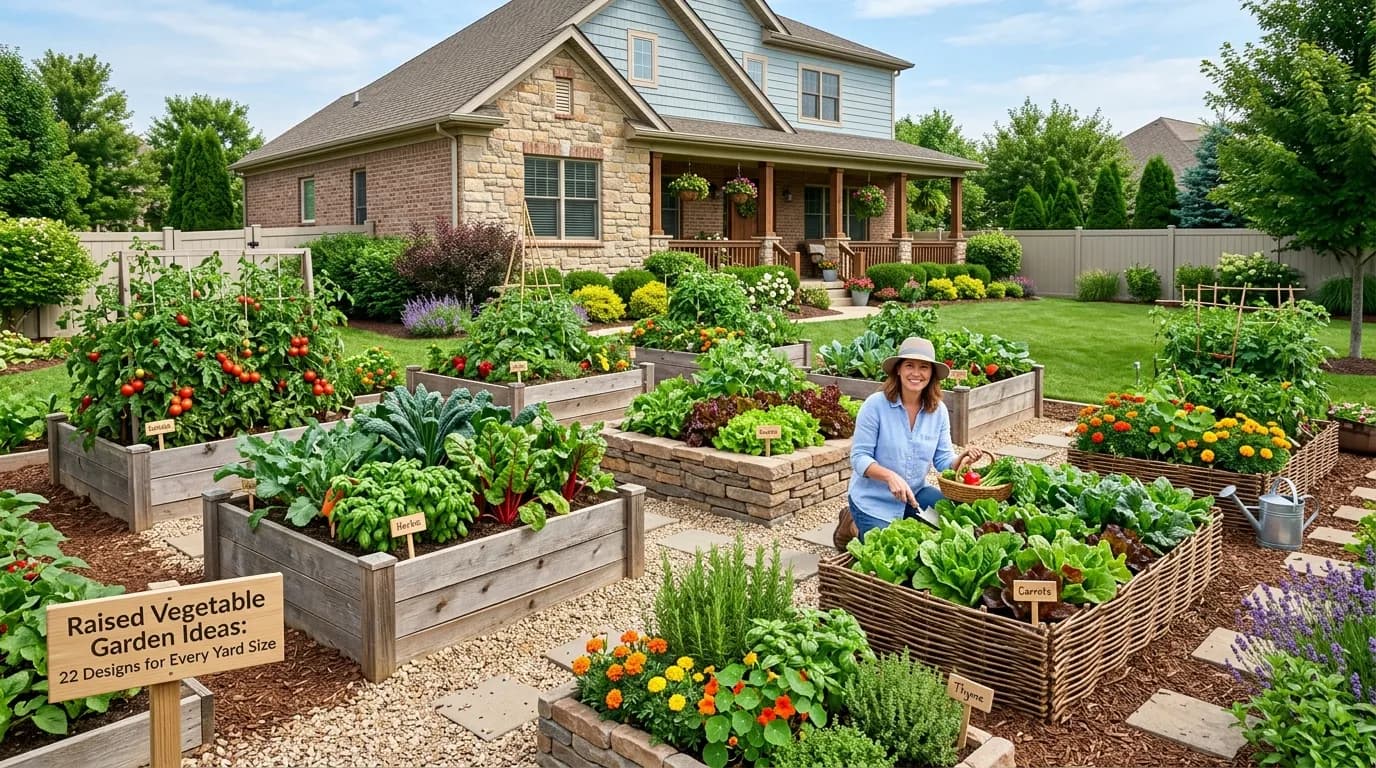
Raised vegetable gardens are the fastest-growing segment of American home landscaping — and for good reason. They produce more food per square foot than in-ground gardens, are easier on your back, drain better, warm up faster in spring, and look intentional and polished in any yard.
Whether you have a 200 sq ft urban patio or a half-acre suburban lot, there's a raised bed layout that will work beautifully. Here are 22 raised vegetable garden ideas, from simple weekend projects to full kitchen garden transformations.
Why Raised Beds Beat In-Ground Gardening
Before the ideas, here's why raised beds consistently outperform in-ground plots:
- Better soil control. You fill beds with exactly the right mix (⅓ compost, ⅓ topsoil, ⅓ coarse material) rather than fighting your native clay or sand.
- Fewer weeds. Raised beds dramatically reduce weed pressure — fewer seeds blow in, and the ones that do are easy to pull.
- Earlier planting. Raised soil warms 2–4 weeks faster than ground soil in spring, extending your growing season significantly.
- No compaction. You never walk in the beds, so the soil stays loose and aerated — roots penetrate easily, yields go up.
- Accessible ergonomics. 12–18" high beds eliminate almost all bending. At 24–30" with caps, they're wheelchair accessible.
- Better drainage. Even in heavy rain years, raised beds rarely suffer the waterlogging that kills roots in clay-heavy yards.
The trade-off: they cost more to set up ($100–$600 per bed depending on material) and need watering more frequently. Both are manageable.
Raised Vegetable Garden Ideas for Small Spaces
1. The 4×8 Starter Bed
The single most popular raised bed size: 4 feet wide (reachable from both sides without stepping in), 8 feet long, 12 inches deep. One 4×8 bed can grow a serious amount of food: 9 tomato plants, or 4 tomatoes + 6 peppers + 2 zucchini, or an entire salad garden. Materials: cedar boards (~$80–$120), 2 bags compost, topsoil mix. Build time: 2–3 hours.
2. Patio Container Garden
No yard? No problem. A 2×4 cedar planter on a 6×10 patio can grow lettuce, herbs, cherry tomatoes, and peppers simultaneously. Add a vertical trellis against the wall for cucumbers or beans to climb — suddenly a tiny patio becomes a productive food space.
3. Three-Bed Salad Garden
Three 2×6 beds arranged in a U-shape create a complete salad garden in about 36 sq ft of footprint. Bed 1: mixed lettuce, spinach, arugula. Bed 2: cherry tomatoes (staked or caged) + basil + parsley. Bed 3: carrots, radishes, beets. You'll be harvesting salads within 30–40 days of planting.
4. Keyhole Bed Design
A keyhole garden is a circular raised bed (roughly 6 ft diameter) with a narrow path cut into the center, allowing access to all parts of the bed from a standing position. The center often contains a compost column that feeds the bed as it breaks down. Perfect for tight spaces, and one of the most efficient designs per square foot.
5. Vertical Raised Bed with Trellis
Build a standard 4×8 bed, then add a 6-foot A-frame trellis across the center. Plant climbing crops on the trellis (pole beans, cucumbers, small pumpkins, indeterminate tomatoes), and low-growing crops on the outer sides (lettuce, herbs, root vegetables). This doubles effective growing area on the same footprint.
Raised Vegetable Garden Ideas for Medium Yards
6. The Classic Potager
The potager is a French kitchen garden that elevates utility into art. Four square beds arranged around a central focal point (a birdbath, standard-trained rosemary, or a terracotta urn), with geometric paths between. Beds are planted with a mix of vegetables, herbs, and edible flowers (nasturtiums, borage, marigolds). The result looks as beautiful as any ornamental garden while producing real food.
7. The Market Garden Grid
Six to eight 3×12 or 4×8 beds arranged in parallel rows with 24-inch paths between. This layout mimics small-scale market gardens and allows efficient planting, watering, and harvesting. Add drip irrigation on a timer and you can grow more food than a family of four can eat in 400 square feet.
8. Perimeter Raised Beds
Line the fence perimeter of a 20×25 backyard with L-shaped or straight 18-inch-deep raised beds and leave the center as a lawn or patio. This approach maximizes edge space (where sunlight hits the fence) for tall crops like corn, pole beans, and staked tomatoes while maintaining open space in the yard's center.
9. Tiered Hillside Garden
If your yard has a slope, build 3-tier raised beds that step down the incline — each level about 12 inches taller than the next. Fill with progressively lighter crops from tallest tier (back) to shortest (front). This design prevents erosion, is extremely photogenic, and turns a difficult grade into a productive asset.
10. The Three-Sisters Circle
Plant the traditional Native American companion planting trio in a large circular raised bed: corn in the center (provides a trellis), beans climbing the corn (fix nitrogen), squash sprawling at the outer edge (shades soil, prevents weeds). The combination is mutually beneficial and visually dramatic. Minimum 8-foot diameter bed works best.
🌿 Design your kitchen garden layout before you build
[Upload a photo of your yard and see exactly where raised beds would go →](/redesign)
Yardcast generates AI landscape designs that show raised beds, paths, and plantings in the context of your actual yard. Preview free — no account required.
Raised Vegetable Garden Ideas for Large Yards
11. Full Kitchen Garden Quarter-Acre
Reserve a 30×40 section of the yard for a dedicated kitchen garden. Include: 8–12 raised beds of varying sizes, a compost area (3-bin system), a tool shed or supply cabinet, perennial herb border along one edge (mint, chives, oregano, thyme, rosemary), a fruit tree or berry bushes in corners, and a central path meeting point. This is the homestead dream — achievable on a suburban lot.
12. Four-Season Food Garden
Design beds specifically for year-round production: spring beds (spinach, peas, radishes, carrots), summer beds (tomatoes, peppers, zucchini, beans), fall beds (broccoli, kale, cabbage, beets), winter beds (covered with row cover or cold frames — kale, spinach, chard). Plan succession plantings so one crop follows another and the beds never sit empty.
13. Cut Flower + Edible Combo
Integrate a cut-flower section with the vegetable garden. Rows of Zinnias, Sunflowers, Dahlias, and Cosmos next to tomatoes and peppers look beautiful together and aren't competing plants. You get fresh flowers for the house and fresh food at the same time.
Best Vegetables for Raised Beds
High-Yield Crops (Most Return Per Square Foot)
- Tomatoes (indeterminate) — A single healthy plant yields 20–40 lbs over a season. Use 1 plant per sq ft with aggressive staking.
- Zucchini/Summer Squash — Prolific producers. 1–2 plants per bed is genuinely enough.
- Lettuce and Salad Greens — Succession plant every 2–3 weeks for continuous harvests. 4 plants per sq ft.
- Green beans (bush variety) — Plant 9 per sq ft. High production, small space, no staking.
- Swiss Chard — Pick outer leaves as needed. Productive for 4–5 months. Beautiful purple or rainbow stems.
Beginner-Friendly Crops
- Radishes — Ready in 25–30 days. Great first crop for kids and beginners.
- Cherry tomatoes — More forgiving than beefsteak. Start with 'Sungold' or 'Sweet 100'.
- Zucchini — Plant in late May, harvest by late June. Hard to kill.
- Lettuce — Grows fast, tolerates partial shade, and you can harvest continuously.
- Herbs (basil, parsley, chives) — Nearly impossible to fail with. Use constantly in cooking.
Crops to Avoid in Small Raised Beds
- Corn (needs large blocks for pollination, space-inefficient)
- Full-size pumpkins or watermelons (sprawl takes over everything)
- Asparagus and artichokes in year one (perennials that take 2–3 years to produce)
Raised Bed Materials Comparison
| Material | Cost/Bed | Lifespan | Appearance |
|---|---|---|---|
| Cedar | $80–$180 | 15–20 yr | Classic, natural |
| Redwood | $120–$250 | 20–25 yr | Premium natural |
| Pine (treated) | $40–$80 | 10–15 yr | Budget option |
| Galvanized metal | $150–$400 | 20+ yr | Modern, sleek |
| Concrete block | $100–$200 | Permanent | Industrial |
| Brick | $200–$600 | Permanent | Traditional/elegant |
Best overall: Cedar. It's rot-resistant naturally, doesn't leach chemicals, looks beautiful, and lasts 15–20 years in most climates.
Best modern look: Galvanized corrugated metal beds (Birdies brand is the most popular). Lightweight, durable, extremely easy to assemble, and look sharp in contemporary and farmhouse-style yards.
Soil Mix for Raised Beds
The best all-purpose raised bed mix: ⅓ compost, ⅓ topsoil, ⅓ coarse material (coarse perlite, coarse sand, or aged bark).
For a 4×8×12" bed you need roughly 32 cubic feet of mix — or about 3 bags of 2-cubic-foot compost, 3 bags topsoil, and 2 bags perlite/amendment.
Mel Bartholomew's original "Mel's Mix" for square foot gardening: ⅓ blended compost, ⅓ peat moss (or coir), ⅓ coarse perlite. Completely soilless, extremely fertile, and never compacts. Slightly more expensive upfront but requires very little amendment in subsequent years.
Raised Garden Bed Layout Tips
- 1Maintain 18–24" paths between beds — wide enough for a wheelbarrow or comfortable walking.
- 2Orient beds north-south so neither side shades the other throughout the day (in most climates).
- 3Keep beds to 4' wide maximum — you should be able to reach the center from either side without stepping in.
- 4Add drip irrigation from day one if you're planting more than 2 beds. Manual watering becomes very time-consuming quickly.
- 5Build taller than you think — 12" is the minimum; 18" is better for root crops; 24" is ideal for ergonomics and large yields.
- 6Design the overall layout on paper first. Use Yardcast to visualize where beds would actually fit in your yard before committing to materials.
Get a custom raised garden layout for your yard →
Upload a photo, describe what you want (raised beds, kitchen garden, mix of food and flowers), and Yardcast generates 3 photorealistic layout options in 60 seconds — with a plant list, cost estimate, and seasonal care calendar in the full PDF.
See your yard before you dig. Preview free →