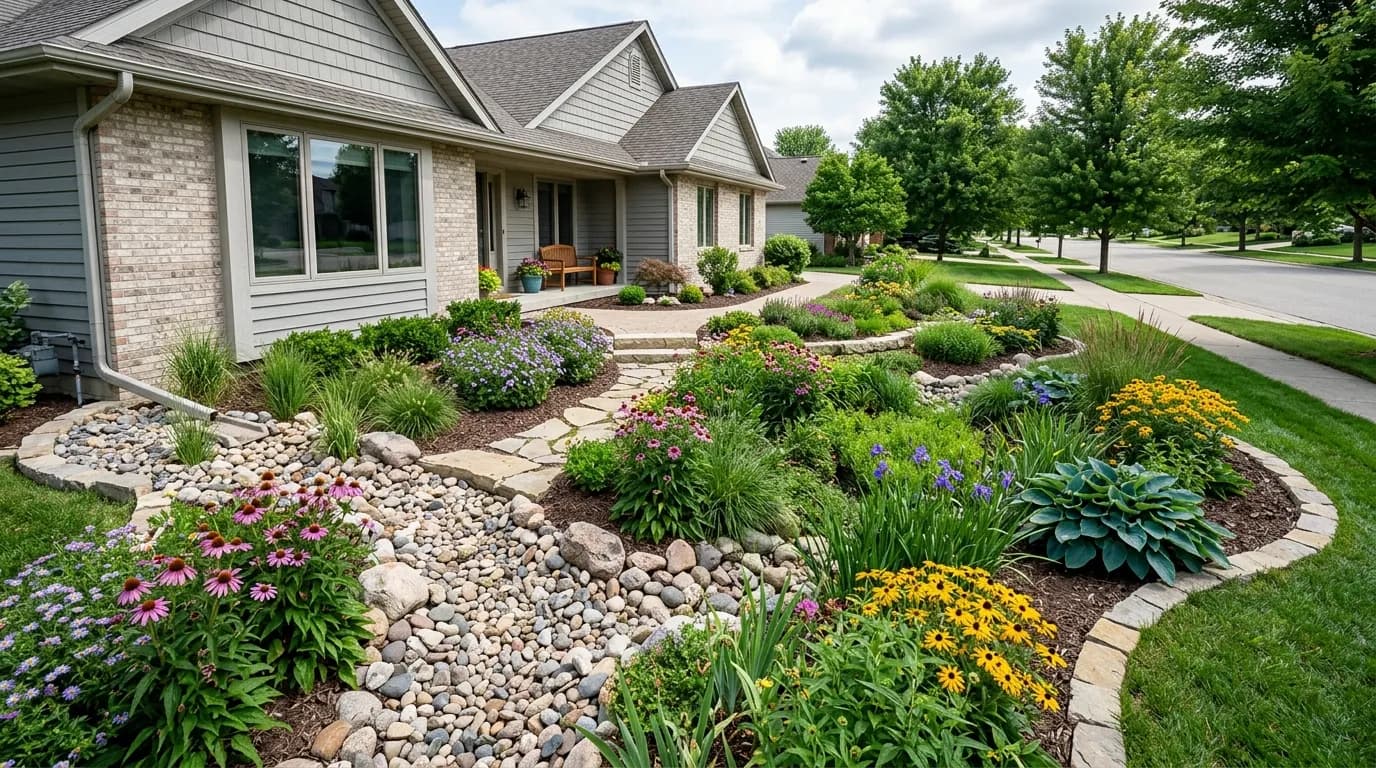
If your yard has drainage problems — standing water after rain, muddy low spots, erosion channels — a rain garden might be the most elegant solution available. Rain gardens are shallow depressions planted with deep-rooted native plants that capture stormwater runoff, allow it to soak into the ground slowly, and send clean water back to the water table rather than the storm drain.
They solve a real problem. And they look genuinely beautiful doing it.
This guide covers 25 rain garden ideas, plant recommendations by region, sizing instructions, and everything you need to know to design or hire out your own rain garden.
What Is a Rain Garden?
A rain garden is a planted depression or hole in the landscape that collects stormwater runoff from roofs, driveways, and lawns, holds it temporarily (typically draining within 24–48 hours), and allows it to infiltrate into the ground rather than run off into storm drains.
They're NOT ponds — rain gardens don't hold standing water permanently. They're not bog gardens — the plants are selected for tolerance of both wet periods and dry periods between rain events.
The key structural elements:
- A gently sloped depression (6–12 inches deep) with a flat center
- An inlet (from downspout, swale, or pipe) directing runoff in
- An overflow outlet for heavy rain events
- A amended soil mix that drains faster than native soil
- Deep-rooted native plants that handle both wet and dry conditions
The Benefits — Why Rain Gardens Are Worth It
- 1Solve drainage problems without expensive drainage systems ($3–$8/sq ft vs. $20–$80/linear ft for French drains)
- 2Filter pollutants — studies show rain gardens remove 80–90% of nutrients and up to 90% of sediment from runoff
- 3Recharge groundwater — water infiltrates rather than evaporating from storm drain pipes
- 4Support pollinators — native plant selections support bees, butterflies, and birds
- 5Reduce mosquitoes — properly designed rain gardens drain within 24–48 hours, which is before mosquitoes can hatch (they need 7–10 days of standing water)
- 6Reduce stormwater utility fees — many municipalities offer credits for rain gardens and other green infrastructure
- 7Beautiful — when planted well, they're among the most naturalistic and attractive garden styles
25 Rain Garden Ideas
Style Ideas
1. The Native Prairie Rain Garden
The most functional and ecologically valuable option: filled with native prairie grasses and wildflowers — little bluestem, prairie dropseed, black-eyed Susan, purple coneflower, blazing star. Naturalistic, seasonal, and virtually self-maintaining once established.
Best for: suburban yards with sun, particularly Midwest and Mid-Atlantic. Spectacular in bloom June–October.
2. The Formal Symmetrical Rain Garden
Placed in a formal lawn with symmetrical plantings (matching specimen plants on each side, even plant arrangement), edged with Cor-Ten steel or stone — a rain garden can be every bit as tidy and architectural as a traditional formal bed.
Best for: traditional homes where naturalistic planting feels out of character. Requires more maintenance than an informal design.
3. The Streambed Rain Garden
Design the inlet as a dry creek bed — a channel of river rock flowing downhill and emptying into the rain garden bowl. Between rain events, it looks like a decorative dry streambed; during rain, it functions as the water conveyance channel.
Best for: sloped yards, naturalistic landscapes, yards with a need to channel water across a distance before reaching the garden.
4. The Curved Crescent Rain Garden
A curved, crescent-shaped depression following the contour of the yard — often placed below a sloped lawn or at the base of a hill. The curve creates a graceful, organic shape that reads as intentional design rather than a problem-fix.
5. The Rain Garden Sequence
In very large yards or yards with significant grade change, design a series of connected rain gardens — each one overflowing to the next in heavy rain, creating a cascade of managed water movement through the landscape.
6. The Entrance Rain Garden
Placed at the entry of the driveway or front walk, capturing roof runoff from the front elevation. Well-designed, it becomes a welcoming feature rather than a drainage ditch.
7. The Pocket Rain Garden
A small (50–100 sq ft) rain garden for a tight urban or suburban lot — capturing a single downspout and planted with a compact selection of natives. Proof that rain garden benefits don't require large yards.
Plant-Led Ideas by Style
8. The Pollinator Paradise Rain Garden
Maximize ecological benefit with milkweed (monarch host plant), native bee balm, Joe-Pye weed, swamp rose mallow, wild bergamot, ironweed, and cardinal flower. This becomes a buzzing, blooming wildlife corridor from midsummer through fall.
9. The Fern and Hosta Rain Garden (Shade)
For shaded areas under tree canopy: native ferns (ostrich fern, royal fern), hostas, astilbe, Virginia bluebells, blue cardinal flower. Elegant, lush, and suited to consistently moist conditions under deciduous trees.
10. The Ornamental Grass Rain Garden
Focused on grasses for year-round interest: maiden grass, switchgrass, blue wild indigo, sedge varieties. Grasses provide movement, winter interest (seed heads persist), and are extremely tough once established.
11. The Shrub-Anchored Rain Garden
For a lower-maintenance option, anchor the rain garden with 2–3 moisture-tolerant shrubs: buttonbush, inkberry holly, native viburnums (arrowwood), or Virginia sweetspire. Shrubs provide structure and are harder to confuse with weeds during the establishment period.
12. The Cut Flower Rain Garden
Combine utility with beauty: plant the rain garden with varieties that double as cut flowers — purple coneflower, rudbeckia, Joe-Pye weed, swamp rose, native sunflowers. You get a functioning rain garden AND a cutting garden.
Regional Ideas
13. Pacific Northwest Rain Garden
The Pacific Northwest has abundant rainfall and acidic, clay-heavy soils in many areas. Excellent native choices: red flowering currant, Oregon grape, red osier dogwood, Douglas spirea, Pacific rush, and sedges (Carex obnupta). Design for volume — PNW rain events are frequent and sustained.
14. Southeast Coastal Rain Garden
Hot, humid, and prone to intense rainfall events. Native choices: swamp rose, buttonbush, bald cypress (in larger spaces), blue flag iris, pickerelweed, cardinal flower, river oats. Design with heavier volume in mind — overflow routes are essential.
15. High Desert Southwest Rain Garden
Even desert regions benefit from rain gardens — monsoon rains deliver large volumes in short periods, causing flash erosion. Use desert willows, desert marigold, Apache plume, globe mallow, and native sedges. Rocky gravel mulch prevents erosion and looks appropriate to the region.
16. Great Plains / Midwest Rain Garden
The heartland of rain garden culture, where the concept was developed. Blue wild indigo, prairie dropseed, switchgrass, little bluestem, wild bergamot, black-eyed Susan, purple coneflower. These plants are native to the region and will thrive with minimal establishment support.
17. Northeast Rain Garden
Wet springs, cold winters, variable soils. Excellent choices: native joe-pye weed, ironweed, swamp milkweed, cardinal flower, swamp white oak (larger gardens), sweetspire, and arrowwood viburnum.
Functional and Technical Ideas
18. The Downspout Diverter Rain Garden
The simplest application: disconnect a downspout from the storm drain system and direct it — via a short underground pipe or surface gravel channel — to a rain garden placed 10+ feet from the foundation. One downspout from a 1,000 sq ft roof section generates 600 gallons per inch of rainfall.
19. The Driveway Edge Rain Garden
A long, narrow rain garden along the edge of a driveway captures sheet flow runoff from the impervious surface. Filter strip planting (dense low plants) between the driveway and the garden prevents direct gravel or dirt wash-in.
20. The French Drain Alternative
Instead of a buried perforated pipe and gravel trench (expensive, requires excavation, eventually clogs with fine soil), use a series of interconnected small rain gardens along the problem area. More effective biologically, less expensive, and visually superior.
21. The Bioswale Rain Garden Hybrid
A bioswale is a linear vegetated channel for water conveyance. Connect a long bioswale (gently graded grass or planted channel) to a terminal rain garden at the lowest point. The swale carries water across a distance; the garden infiltrates it.
22. The Permeable Patio + Rain Garden Combo
Combine a permeable paver or decomposed granite patio with an adjacent rain garden. The patio allows some infiltration on-site; overflow from the patio feeds the rain garden. An integrated system that handles significant impervious area with elegance.
Aesthetic Enhancement Ideas
23. The Boulder-Edged Rain Garden
Frame the perimeter of the rain garden with naturalistic boulders (3–5 per garden). The boulders define the edge, prevent erosion at the inlet, provide seating, and create a naturalistic "bowl" look that reads as intentional design.
24. The Mulched Path Rain Garden
Install a wood chip or decomposed granite path around and through the rain garden — allowing close access to plants and defining the space as a destination rather than just a depression. Paths make rain gardens feel intentional and welcoming.
25. The Educational Rain Garden
Add a small interpretive sign (can be made from a simple weatherproof stake) explaining how the rain garden works. Increasingly popular in front yards — communicates environmental stewardship to neighbors and passersby. Multiple municipalities offer grants for front-yard rain gardens with educational components.
Sizing Your Rain Garden
The standard sizing rule: your rain garden should be 10–20% the area of the watershed feeding it (roof section, driveway area, or lawn area draining to it).
| Watershed Area | Recommended Rain Garden Size |
|---|---|
| 500 sq ft roof | 50–100 sq ft |
| 1,000 sq ft roof | 100–200 sq ft |
| 1,500 sq ft driveway | 150–300 sq ft |
| 2,000 sq ft lawn section | 200–400 sq ft |
Depth: 6 inches in well-draining sandy soil; 8 inches in loam; up to 12 inches in clay soil. The goal is complete drainage within 24–48 hours after a storm.
Percolation test: Dig a 12-inch hole, fill with water, let drain, refill. If it drains in under 24 hours, you have adequate drainage. Slower than 24 hours = either amend the soil or consider a different drainage solution.
Rain Garden Soil Mix
Native soil alone is rarely appropriate for rain garden fill — it compacts, drains slowly, and limits plant options. Standard rain garden soil mix:
- 50% sand (washed coarse sand)
- 25% topsoil (screened, loam-based)
- 25% compost (aged, not fresh)
This mix provides rapid drainage while retaining enough nutrients and structure for plant establishment. For heavy clay sites, increase sand to 60%; for sandy sites, increase compost to 35%.
Rain Garden Cost Guide
| Garden Size | DIY Cost | Professional Cost |
|---|---|---|
| Small (100 sq ft) | $200–$500 | $800–$2,000 |
| Medium (250 sq ft) | $400–$900 | $1,500–$4,000 |
| Large (500 sq ft) | $700–$1,500 | $3,000–$7,500 |
DIY breakdown (250 sq ft):
- Soil mix (5 cubic yards): $150–$300
- Native plants (30–50 plants): $150–$400
- Mulch (3 cubic yards): $75–$150
- Gravel for inlet: $50–$100
- Edging: $50–$150
Professional includes: design, excavation, soil preparation, planting, mulching, irrigation connection. Pricing varies significantly by region — urban markets and landscapers unfamiliar with rain gardens charge 30–50% more.
Maintenance: Year One vs. Long-Term
Year 1: The critical establishment period. Rain gardens need consistent moisture in the first growing season until roots establish. Water weekly during dry spells. Weed aggressively — native plants can't out-compete weeds until they're established. Expect 30–50% of the space to look weedy year one; this is normal.
Years 2–5: Minimal weeding. Apply 2–3 inches of wood chip mulch annually. Divide aggressive spreaders (asters, native mints) every 3–4 years.
Long-term: Established rain gardens with appropriate native plants are among the lowest-maintenance gardens possible. Cut back in late winter (not fall — leave seed heads for birds). Every 5–7 years, check that the basin depression hasn't filled with sediment; remove accumulated sediment from the inlet area.
Design Your Yard with Yardcast
Not sure where to put a rain garden, how large to make it, or what style fits your landscape? Get a free AI landscape design at yardcast.ai/redesign.
Upload your yard photos, describe your drainage issues, and Yardcast's AI will generate 3 photorealistic landscape designs showing exactly how a rain garden and surrounding plantings could transform your space. Takes under 60 seconds. Free to preview.
Each design includes regional plant recommendations, a cost estimate, and a phased implementation plan — perfect for discussing options with a landscaping contractor or planning a DIY project.