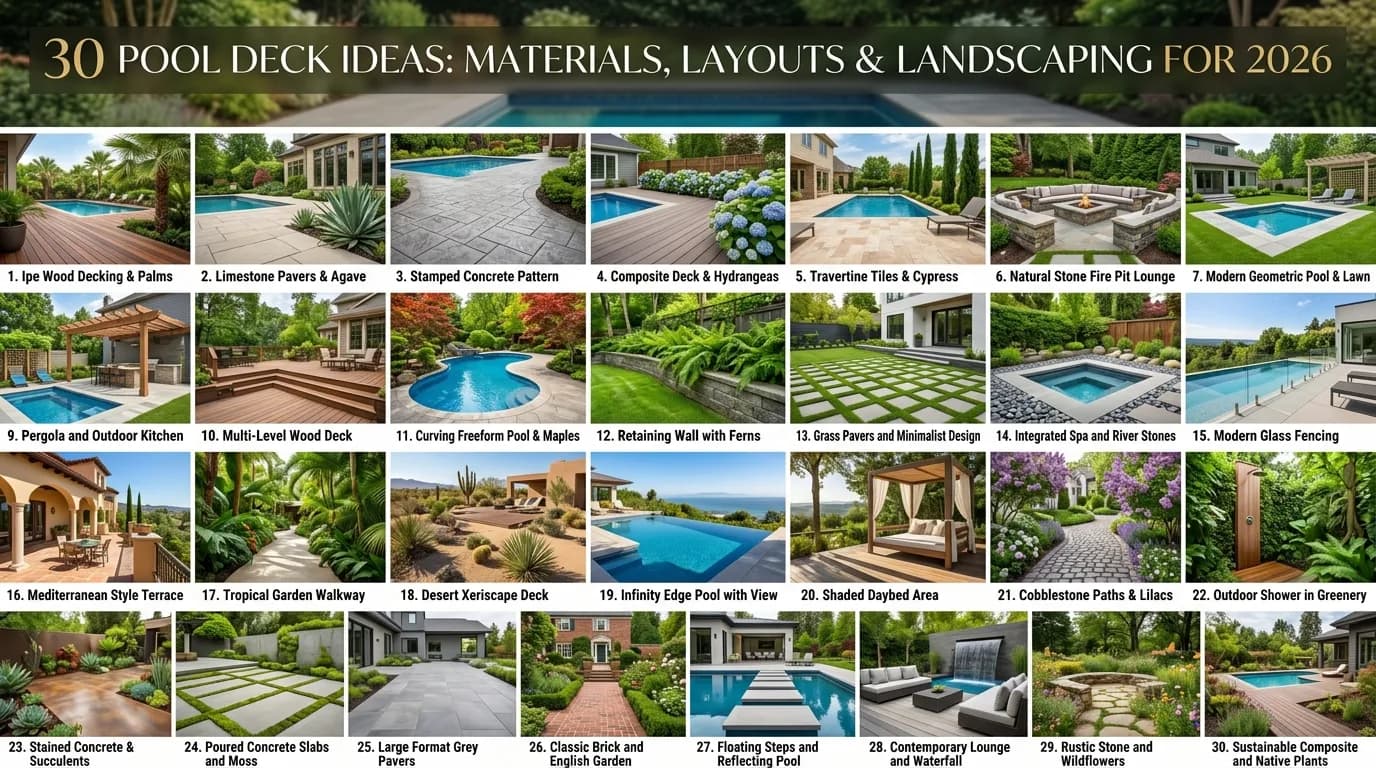
Your pool is already a significant investment. The deck that surrounds it either makes it feel like a backyard resort or an afterthought. The difference is rarely about spending more — it's about thoughtful materials, layout decisions, and landscaping that ties the space together.
This guide covers 30 pool deck ideas from budget concrete refinishing to full resort-style travertine installations, with real cost data, design principles, and plant recommendations for every region and style.
Why Your Pool Deck Design Matters More Than the Pool
Most homeowners pour most of their pool budget into the pool itself and treat the deck as an afterthought. But the deck is what you actually live on — where you lay out towels, set up chairs, host parties, and walk barefoot. A stunning pool with a mediocre deck feels unfinished. A modest pool with a thoughtfully designed deck and landscaping feels like a destination.
The deck also determines safety (slip resistance), comfort (heat absorption), and maintenance burden for the lifetime of the pool.
Pool Deck Materials: The Foundation of Every Design
1. Concrete — The Versatile Workhorse
Plain concrete is the most common pool deck material — and the most transformable. On its own, basic concrete feels industrial. Treated, it becomes a design canvas.
Options and costs:
| Finish | Cost/sq ft | Slip Resistance | Heat Retention |
|---|---|---|---|
| Broom finish (basic) | $5–$8 | Good | High |
| Stamped concrete | $12–$20 | Moderate | Moderate–High |
| Exposed aggregate | $10–$16 | Excellent | Moderate |
| Cool deck coating | $3–$5 overlay | Good | Low (stays cool) |
| Spray texture | $4–$7 overlay | Good | Moderate |
Best for: Any climate, any budget, most design styles. Concrete is the most DIY-friendly upgrade option (overlays and coatings require minimal skill).
2. Travertine — The Resort Standard
Natural travertine is the premium pool deck material for a reason: it stays cool underfoot even in direct summer sun due to its porous structure and light color, it's slip-resistant when textured, it ages beautifully, and it looks undeniably luxurious.
Cost: $15–$30/sq ft installed. For a typical 800–1,200 sq ft pool deck, budget $12,000–$36,000.
Best for: Mediterranean, Spanish, modern, and resort-style homes. Excellent for hot climates (Texas, Florida, Arizona, California). Requires sealing every 2–3 years to prevent staining.
3. Pavers — Flexible and Repairable
Concrete pavers give you the look of a custom stone deck at a fraction of natural stone pricing. They're also uniquely repairable — if a paver cracks or settles, you replace that paver, not the whole deck.
Cost: $10–$20/sq ft for standard concrete pavers; $15–$30/sq ft for premium tumbled or textured pavers.
Design tip: Pavers allow pattern mixing — running bond, herringbone, and basket weave all have different visual effects. Herringbone is the most slip-resistant due to interlocking direction changes.
4. Natural Stone (Bluestone, Limestone, Slate)
Natural stone pools look genuinely dramatic. Bluestone in charcoal tones makes a modern pool look editorial. Limestone in buff creates a beachy California feel. Slate in dark tones makes a spa-like environment.
Costs:
- Bluestone: $20–$35/sq ft installed
- Limestone: $15–$25/sq ft installed
- Slate: $15–$28/sq ft installed
Caution: Some natural stones (especially polished) become dangerously slippery when wet. Always specify a honed, brushed, or thermal finish for pool areas — never polished.
5. Composite Decking (for Attached Structures)
Composite decking (Trex, TimberTech, Fiberon) is ideal for raised pool decks, pool houses, and pergola attachment points. It's splinter-free, fade-resistant, and requires almost no maintenance. It does get hot in direct sun — choose lighter colors and specify heat-resistant formulations in hot climates.
Cost: $18–$30/sq ft installed.
Layout Designs That Transform How You Use Your Pool
6. Classic Rectangular Surround
The most space-efficient layout: a 4–6 foot wide deck on all four sides. Works with any pool shape. Add width at the primary seating end (expand to 10–12 feet) and keep service sides narrow.
7. Asymmetric Lounging Deck
Extend one side of the pool to create a generous 16–20 foot sun deck for lounge chairs, while keeping other sides minimal. This creates a clear indoor/outdoor flow from a patio door and feels more intentional than a uniform surround.
8. Multi-Level Decking
Adding 1–2 step changes in deck level creates visual separation between zones — eating area up one step, pool level, lounging zone up another step. Works beautifully on sloped lots. Budget $2,000–$8,000 additional for steps and retaining work.
9. Curved Deck Edge with Planting Pockets
A curved deck edge (achieved with pavers or poured forms) softens the geometry and creates planting pockets at the deck boundary. This is the most effective way to integrate landscaping directly into the deck — plants emerge from cutouts in the hardscape for a seamless look.
10. Sun Shelf Surround with Shaded Pergola Zone
Design the deck to address both needs: a south-facing open sun zone for tanning, and a pergola or shade sail covered zone on the north side for eating and shaded relaxation. This is the most functional layout for year-round use.
11. Pool House Integration
If you have or plan a pool house, align the deck to create a continuous indoor-outdoor floor. Using the same material indoors and outdoors (both travertine, for example) makes the transition feel seamless and significantly increases perceived square footage.
Landscaping Ideas That Elevate Every Pool Deck
Great pool landscaping does four things: provides privacy, adds softness to hard edges, doesn't drop excessive debris into the water, and looks incredible.
12. Tropical Border Planting
For warm climates (Florida, Texas, Southern California): create a 4–6 foot deep planting border on the pool's long sides using elephant ear, bird of paradise, cordyline, and giant liriope. This creates an instant tropical resort feel, provides privacy screening, and requires minimal maintenance.
Cost: $800–$2,500 for a 50-foot border with specimen plants.
13. Mediterranean Herb Garden Integration
For the California and Southwest: lavender hedges, rosemary, ornamental sage, and agave clustered at deck corners create a fragrant, drought-tolerant border that looks intentional. The herbs are also practical — pick fresh rosemary from poolside.
14. Privacy Hedges and Screening Trees
Nothing ruins a pool experience like feeling watched by neighbors. Use arborvitae (fast-growing, 6–10 feet in 3 years), Podocarpus, or clumping bamboo to create screening on property lines. Place 6–8 feet back from the deck edge to avoid root interference with the pool shell.
Cost: $150–$400 per screening tree or shrub installed; a complete privacy screen of 10–12 trees runs $2,000–$5,000.
15. Low-Maintenance Accent Plantings
For debris-conscious pool owners: choose plants that drop minimal litter. Agave, ornamental grasses (cut back in late fall), succulents, and low-growing perennials like black-eyed Susan create color without filling your skimmer basket. Avoid deciduous trees anywhere near the pool.
16. Vertical Garden Walls
A vertical garden wall on a pool house or fence transforms a boring barrier into a living feature. Use modular panels with drip irrigation — low maintenance and incredibly visual. Best plants for vertical pool walls: ferns, succulents, sedums, ivy, and climbing roses (with adequate distance from pool).
Water Features That Work With Your Deck
17. Raised Planter with Waterfall
A raised concrete planter at one end of the pool with a sheet waterfall or single-stream spillways is the single highest-ROI upgrade you can add to an existing pool. Cost: $3,000–$12,000 depending on size and material. The sound of moving water transforms the pool experience.
18. Fire + Water Combination
A natural gas fire feature (fire pit table, fire wall, or bowl) at one end of the deck and water feature at the other creates a dramatic yin-yang effect. Fire bowls sit on concrete pedestals or can be integrated into raised planters. Cost: $500–$2,000 for a freestanding fire bowl; $5,000–$15,000 for a permanent built-in fire feature.
19. Fountain Jets Along the Deck
Deck jets (small water spouts mounted at deck level that arc water into the pool) add movement and visual drama for surprisingly low cost. Typically $200–$600 per jet installed during construction; retrofitting is more expensive. 3–4 jets create a significant visual effect.
Pool Deck Lighting Ideas
20. In-Deck LED Paver Lights
Flat LED lights set flush with the deck surface create a dramatic night look and improve safety. They're low-voltage and can be programmed with color-changing control systems. Cost: $40–$80 per light installed. A full deck lighting scheme with 20–30 in-deck lights runs $1,500–$3,500.
21. Step Lighting
Illuminating each step change in a multi-level deck is both safety-critical and beautiful. Use linear LED strips in waterproof aluminum channels recessed into the step riser. Cost: $60–$150 per linear foot of step lighting.
22. Bollard Lights Along the Deck Edge
Low bollard lights (18–24 inches tall) positioned at 8–10 foot intervals along the deck perimeter create ambient light that doesn't overpower the sky view while clearly defining the deck boundary. Cost: $80–$200 per bollard installed.
23. Underwater Pool Lighting
LED underwater lights transform how the pool looks at night — a well-lit pool glows from within and becomes the focal point of the entire backyard. Retrofit underwater LED lights cost $200–$500 per light installed. Color-changing LED lights add drama for outdoor entertaining.
Pool Deck Design Ideas by Style
24. Modern Minimalist Pool Deck
Clean lines, large-format pavers (24×24 or 24×48), minimal planting in precise geometric beds, and a monochromatic material palette. Use charcoal, white, or warm gray tones. No clutter — each piece of furniture is intentional.
Key elements: Large concrete or porcelain pavers, linear drainage channels (no round drains), precisely-trimmed boxwood or ornamental grasses, integrated lighting.
25. Tropical Resort Style
Lush planting right to the deck edge, warm-toned travertine or sandstone, thatched roof pergola or cabana, tropical plants (palms, bird of paradise, elephant ear), plenty of color.
Key elements: Natural stone, fabric shade structures, tropical specimen plants, water features, fire elements.
26. Mediterranean Courtyard
Terracotta tones, wrought iron accents, clay pot plantings, climbing vines on the pool fence, olive trees or Italian cypress as vertical accents. Feels like a Tuscan villa — achievable in any warm climate.
27. Rustic Natural
Irregular flagstone or stacked stone edging, natural wood pergola, wildflower borders, a mix of native plants with informal (not clipped) growth habits. Feels organic and lived-in.
28. Coastal Relaxed
Light tones (white, pale gray, sand), natural wood accents, rope or wicker furniture, beach-inspired plantings (ornamental grasses, succulents, seaside plants). Works in any climate with beach-tone material choices.
Pool Deck Upgrades and Finishing Touches
29. Built-In Seating Walls
A low seating wall (16–18 inches tall) around part of the deck perimeter eliminates the need for moveable chairs, creates an architectural edge, and can double as a planting bed retainer. Built in concrete block with stucco or stone veneer: $60–$100 per linear foot.
30. Outdoor Kitchen or Bar on the Deck
A built-in grill station or wet bar integrated into the pool deck creates the ultimate entertainment space. Use concrete countertops with stainless appliances. Budget $5,000–$15,000 for a functional built-in setup, or $1,500–$4,000 for a premium freestanding grill station with side burner and refrigerator.
Pool Deck Cost Summary
| Project | Budget | Mid-Range | Premium |
|---|---|---|---|
| Resurface existing concrete | $3,500–$6,000 | $6,000–$12,000 | $12,000–$20,000 |
| New concrete deck | $6,000–$12,000 | $12,000–$20,000 | — |
| Paver deck (1,000 sq ft) | $10,000–$16,000 | $16,000–$25,000 | $25,000–$40,000 |
| Travertine deck (1,000 sq ft) | $15,000–$22,000 | $22,000–$32,000 | $32,000–$50,000 |
| Landscaping package | $2,000–$5,000 | $5,000–$15,000 | $15,000–$40,000 |
| Lighting package | $1,500–$4,000 | $4,000–$8,000 | $8,000–$20,000 |
| Pergola/shade structure | $3,000–$8,000 | $8,000–$20,000 | $20,000–$50,000 |
Ready to Design Your Pool Deck Layout?
Whether you're building a new pool deck or transforming an existing one, visualizing the complete picture — deck material, landscaping, lighting, and furniture — before you commit is essential. Yardcast's AI generates photorealistic landscape designs for your actual yard, including pool deck areas, in under 60 seconds. Preview your design free → /redesign
The most valuable thing you can do before getting contractor quotes is have a clear design to show them. Contractors quote more accurately and more competitively when they're bidding from a specific plan rather than a vague description.