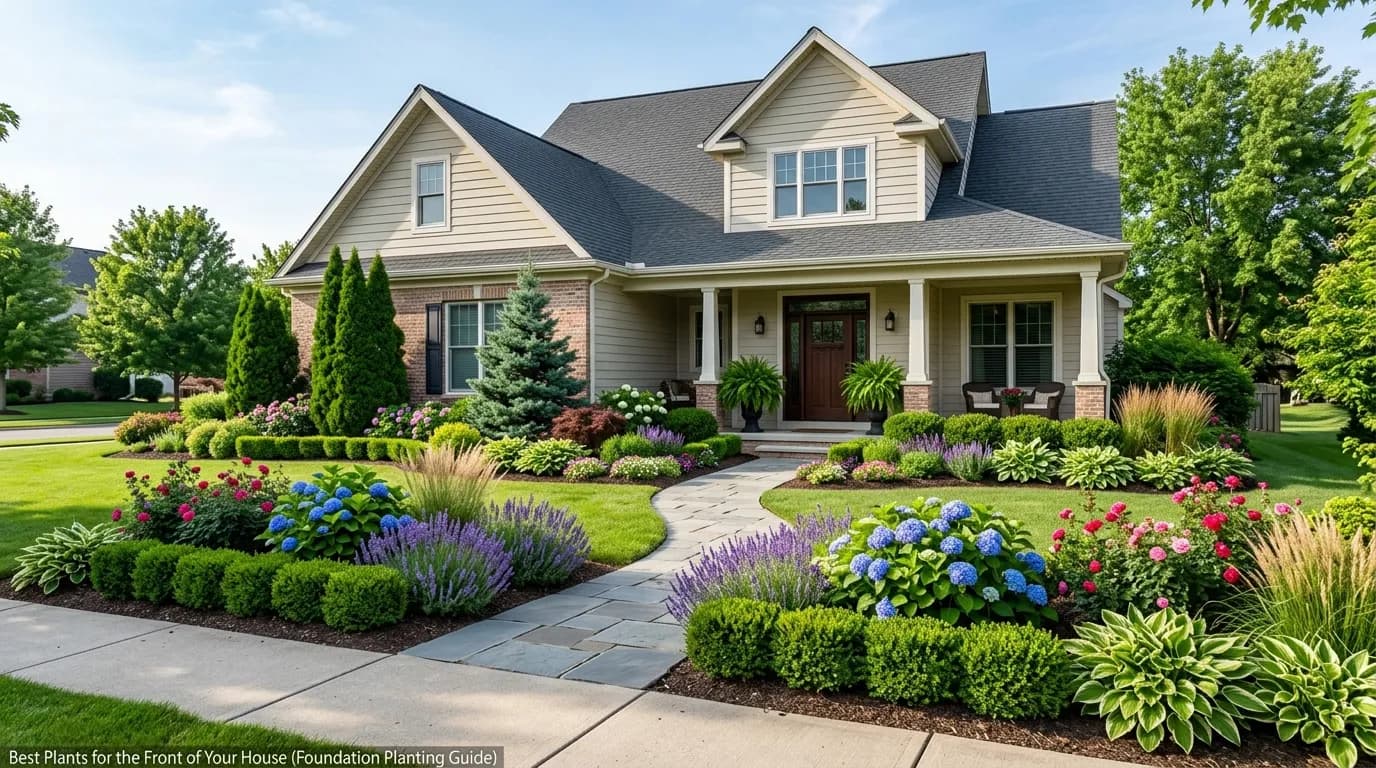
The plants you choose for the front of your house do more work than almost any other landscaping decision you'll make. They're the first thing visitors see, they frame every photo of your home, and they're the difference between a house that looks "finished" and one that looks abandoned. Done right, a well-planted foundation bed can add $15,000–$25,000 to perceived property value before you've lifted a trowel inside.
Done wrong — wrong heights, wrong spreads, planted too close to the foundation — and you're looking at blocked windows, cracked siding, moisture damage, and a major removal bill in five years.
This guide covers everything: how to choose the right plants, the best species for sun, shade, and mixed conditions, regional recommendations, and a design framework you can start using today.
What Is Foundation Planting — and Why Does It Matter?
Foundation planting is the band of shrubs, perennials, ornamental grasses, and groundcovers planted along the base of your home's exterior walls. Originally, it was designed to hide the exposed concrete block foundations common in older construction. Today, it serves a broader purpose: visual grounding, seasonal interest, framing the architecture, and directing visitors to the front door.
A house without foundation planting looks like it's floating — or like it just moved in. A house with well-designed foundation beds looks established, cared-for, and intentional. Real estate agents consistently cite curb appeal (of which foundation planting is a major component) as one of the highest-ROI improvements a homeowner can make.
The 5 Rules of Foundation Plant Selection
Before buying a single plant, understand these fundamentals:
1. Know your mature height. The most common foundation planting mistake is choosing shrubs that grow to 8 or 10 feet in front of windows designed for a 3-foot plant. Always check the mature height, not the size in the nursery pot. Under windows: stay under 3 feet. At corners: 4–6 feet is usually appropriate. Flanking the entry: use taller accent plants (5–8 feet) to frame without blocking.
2. Keep plants 18–24 inches from the foundation. Planting against the wall traps moisture, encourages pests and disease, and can damage siding. Minimum distance from the foundation wall: 18 inches for small plants, 24–36 inches for larger shrubs.
3. Match sun exposure precisely. The north side of most homes gets almost no direct sun. The south side gets 8+ hours in summer. East-facing beds get gentle morning light; west-facing beds get intense afternoon heat. Getting this wrong means dead or struggling plants within a season.
4. Think in layers. A flat row of identical shrubs looks boring and unnatural. Layer heights from front to back: low groundcovers at the edge (6–12 inches), mid-height shrubs in the middle (18–36 inches), taller accent plants toward the foundation wall and corners (3–6 feet).
5. Plan for all four seasons. Great foundation beds have structure and interest in every season — not just spring when everything blooms. Include at least one evergreen anchor (boxwood, holly, dwarf spruce), one plant with fall color or winter berries, and seasonal blooms spread across spring, summer, and fall.
Best Foundation Plants: Full Sun (6+ Hours)
If your front yard faces south or southwest, you have full sun conditions. These plants thrive:
Shrubs (Full Sun)
Spirea (Spiraea japonica) — One of the most reliable low-maintenance foundation shrubs in North America. Varieties like 'Goldmound' stay under 3 feet and bloom in pink or white through summer. Fall foliage turns orange-red. Zones 4–9.
Knockout Rose (Rosa 'Radrazz') — Blooms from May to frost with virtually no disease issues. Mature size: 3–4 feet. No deadheading required. Perfect under windows. Zones 5–9.
Dwarf Burning Bush (Euonymus alatus 'Compactus') — Dense, rounded shrub prized for its spectacular scarlet fall color. Stays 4–5 feet in most conditions. Full sun brings out the best fall color. Zones 4–8. Note: check local invasiveness before planting in the Northeast or Pacific Northwest.
Blue Star Juniper (Juniperus squamata 'Blue Star') — Steel-blue evergreen that stays under 3 feet tall, spreading slightly wider. Virtually indestructible once established. Zones 4–9.
Dwarf Mugo Pine (Pinus mugo 'Mops') — Globe-shaped evergreen with bright green needles. Slow-growing, eventually reaching 3–5 feet. Incredible for winter interest and structure. Zones 2–8.
Perennials & Groundcovers (Full Sun)
Catmint (Nepeta x faassenii 'Walker's Low') — Silvery foliage, blue-purple flowers from June through September, deer-resistant, and self-cleans with a light shear. Stays under 2 feet. Zones 4–8.
Black-Eyed Susan (Rudbeckia fulgida) — Native to North America, blooms gold-yellow from July through frost. Self-seeds lightly to fill in bare spots. 18–24 inches tall. Zones 3–9.
Creeping Phlox (Phlox subulata) — Low-growing (4–6 inches) carpet of color in spring. Spreads gradually to fill edges and spill over walkway borders. Zones 3–9.
Russian Sage (Perovskia atriplicifolia) — Wispy silver stems with blue-purple flower spikes from July–September. Drought-tolerant once established, 3–4 feet tall. Best as a mid-border plant or at corners. Zones 5–9.
Best Foundation Plants: Partial Shade (3–6 Hours)
Many front yards have a mix of sun and shade, especially if there are mature street trees. These plants perform well with 3–6 hours of direct light:
Shrubs (Partial Shade)
Oakleaf Hydrangea (Hydrangea quercifolia) — American native. Stunning white flower heads (June–August), exfoliating bark for winter interest, red-orange fall foliage. 4–6 feet tall. Zones 5–9.
Drift Roses — Mini version of Knockout Roses, topping out at 18–24 inches. Perfect for window-front planting. Requires only 4–5 hours of sun. Zones 4–9.
Spirea 'Little Princess' — More shade-tolerant than most spireas. Pink flowers in late spring. Stays under 2 feet. Zones 4–9.
Dwarf Alberta Spruce (Picea glauca 'Conica') — Classic cone-shaped evergreen for flanking entries. Slow-growing to 6–8 feet over 20 years. Tolerates partial shade and is deer-resistant. Zones 2–6.
Andromeda / Lily-of-the-Valley Shrub (Pieris japonica) — Evergreen with white, pendulous spring flowers and attractive red new growth. 4–6 feet. Prefers acid soil. Zones 5–8.
Perennials & Groundcovers (Partial Shade)
Astilbe — Feathery plumes of pink, red, or white in June–August. Native to Asia but widely adapted. 18–36 inches depending on variety. Zones 3–8.
Coral Bells (Heuchera) — Grown primarily for stunning foliage: purple, caramel, silver, chartreuse. Partial shade brings out color depth. Compact, 12–18 inches. Zones 4–9.
Hostas — The definitive shade plant. Available in hundreds of varieties from 6-inch dwarfs to 4-foot giants. Best used in partial shade; deep shade produces slower growth. Zones 3–8.
Best Foundation Plants: Full Shade (Under 3 Hours)
North-facing foundations and heavily overhung entries present a real design challenge. These plants can handle it:
Japanese Yew (Taxus cuspidata) — Dense evergreen, highly shade-tolerant, easily pruned to maintain shape. Available in low-spreading varieties (2–3 feet) perfect for window areas. Zones 4–7. Note: berries are toxic — avoid near children's play areas.
Inkberry Holly (Ilex glabra) — Native shrub with glossy dark green leaves and black winter berries. Shade-tolerant, wet-soil-tolerant, slow-growing to 5–6 feet. Zones 4–9.
Mountain Laurel (Kalmia latifolia) — Stunning late spring bloomer in shade. White to deep pink blossoms. Slow-growing, 5–8 feet at maturity. Zones 4–9. Prefers acid, well-drained soil.
Dead Nettle (Lamium maculatum) — Low groundcover (6–8 inches) that spreads in full shade. Silver-and-green foliage, pink-purple spring flowers. Tolerates dry shade once established. Zones 3–8.
Pachysandra — Dense evergreen groundcover, 6–12 inches, spreads steadily in shade. Works as a "floor" beneath taller foundation shrubs. Zones 4–9.
Foundation Plants by Region
The plants above cover broad zones, but regional climate details matter enormously:
Northeast (Zones 5–6): Lead with boxwood (low-growing varieties like 'Green Gem'), oakleaf hydrangea, inkberry holly, and spirea. Avoid anything needing long hot summers to thrive.
Southeast (Zones 7–9): Indian hawthorn, dwarf pittosporum, loropetalum (Chinese fringe flower — excellent!), knockout roses, and cast-iron plant for deep shade. Heat and humidity favor plants with good air circulation.
Midwest (Zones 4–6): Hardy coneflower (Echinacea), Karl Foerster grass (for corners), dwarf mugo pine, spirea, and viburnum. Choose plants that handle both wet springs and dry summers.
Southwest / California (Zones 8–11): Agapanthus, dwarf pittosporum, salvia varieties, lavender, Indian hawthorn, and trailing rosemary for edges. Water-wise plants are non-negotiable in most parts of this region.
Pacific Northwest (Zones 7–9): Rhododendrons and azaleas are in their element here. Add pieris japonica, ornamental grasses, and native ferns for a lush, naturalistic look.
Designing Your Foundation Beds: A Simple Framework
Step 1 — Measure and map. Sketch your home's front elevation. Note window sill heights, utility boxes, spigots, and meters. Mark where sun hits at various times.
Step 2 — Anchor with evergreens. Place 2–3 evergreen shrubs first: one to anchor each corner of the main facade, and one or two flanking the entry. These create year-round structure.
Step 3 — Fill with medium-height interest plants. Hydrangeas, knockout roses, ornamental grasses — plants that bloom or turn color through the season. Space them to leave room for 3–5 year growth.
Step 4 — Edge with low plants and groundcovers. Creeping phlox, catmint, spilling ornamental grasses, or groundcovers at the front edge soften the bed and create a layered look.
Step 5 — Add seasonal bulbs. Spring tulips and alliums planted between shrubs in October add a flush of early-season color at virtually no cost (bulbs are $1–3 each).
Step 6 — Mulch and define. A crisp edge between lawn and bed, plus 3 inches of mulch, makes even an average plant selection look polished.
Skip the Guesswork — See Your Design Before You Plant
Choosing foundation plants is easier when you can visualize the finished result. Yardcast's AI design tool lets you upload photos of your home's front and get 3 photorealistic landscape designs rendered onto your actual property in under 60 seconds.
Each design includes a zone-matched plant list, spacing guide, and a phased installation plan broken out by budget. It's free to preview — generate your design here.
Common Foundation Planting Mistakes to Avoid
Planting too close to the house. Moisture damage, pest problems, and poor air circulation result. Maintain the 18–24 inch minimum.
Choosing plants for their nursery size. A 1-gallon Leyland cypress looks manageable. At 10 years old, it's 20 feet tall and 8 feet wide — covering your entire front window.
No evergreens. All-deciduous foundation beds look skeletal from November through April. Include at least 40% evergreen plants for year-round structure.
Single species monoculture. A row of identical boxwoods looks formal and feels sterile. Mix at least 3–4 different species even in a small bed.
Ignoring soil prep. Most foundation soils are compacted fill from construction, often very alkaline near concrete. Amend with compost and adjust pH before planting for 3x better results.