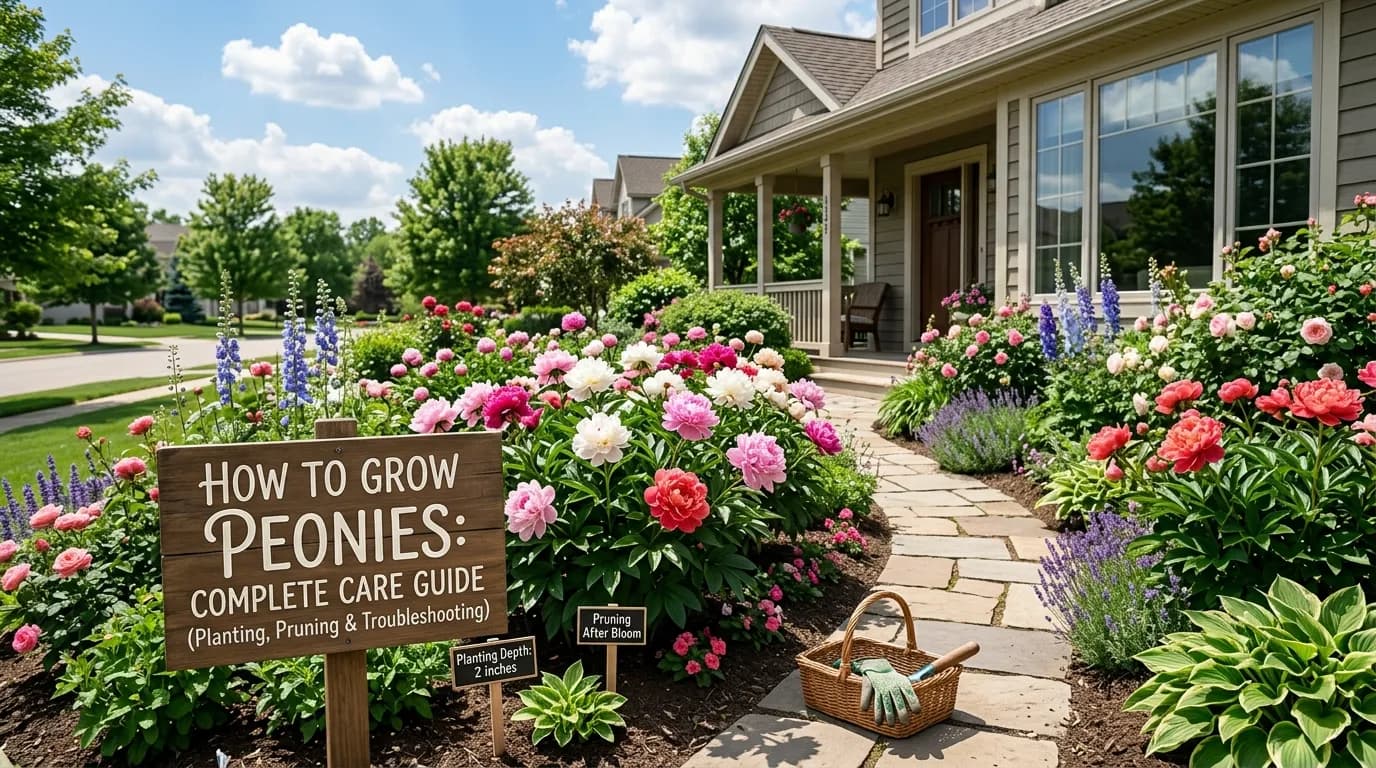
Peonies are the aristocrats of the perennial garden — lush, fragrant, extravagant — and remarkably long-lived. A well-planted peony can outlast the house it grows beside, producing magnificent blooms for 50 to 100 years. But they have one infamously unforgiving quirk: plant the roots at the wrong depth, and they'll never bloom. Not for years. Maybe ever.
This guide covers everything you need to know: planting depth (it's more critical than almost anything else in gardening), soil prep, supporting the heavy flowers, pruning, troubleshooting, and how to use peonies effectively in a designed landscape.
Peony Basics: What You're Working With
Garden peonies (Paeonia lactiflora) are herbaceous perennials — they die back completely to the ground each fall and re-emerge from tuberous roots each spring. In most climates (zones 3–8), they're bomb-proof once established: cold-tolerant, drought-resistant after establishment, and largely pest-free.
Types of peonies:
| Form | Description | Example Varieties |
|---|---|---|
| Single | One row of large petals, visible stamens | 'Bowl of Beauty', 'Krinkled White' |
| Japanese | Single outer petals, central staminodes | 'Elsa Sass', 'Gay Paree' |
| Anemone | Double center, single outer petals | 'Gay Paree' |
| Semi-double | Multiple layers, center visible | 'Coral Sunset', 'Coral Charm' |
| Double | Fully doubled, ball-like blooms | 'Sarah Bernhardt', 'Karl Rosenfield' |
| Bomb | Dense bomb of petals in center | 'Festiva Maxima', 'Mrs. Franklin D. Roosevelt' |
Bloom season: Late spring to early summer — typically May in zones 5–6, April in zones 7–8, June in zone 3–4. The bloom window is 7–14 days per variety, but by planting early, mid, and late-season varieties, you can extend the show to 4–6 weeks.
The Most Important Rule: Planting Depth
Planting depth is the single most critical factor in peony success. Plant the "eyes" (the red growth buds on the root) too deep, and the plant will grow lush foliage year after year — and never bloom.
In zones 3–5 (cold climates): Plant the eyes 1–1.5 inches below the soil surface.
In zones 6–7 (moderate climates): Plant the eyes exactly at soil level — just barely covered.
In zones 8–9 (warm climates): Plant with eyes at or just above soil level, and mulch lightly. Peonies need cold winters to bloom reliably and struggle at the southern edge of their range.
How to check your planting: After settling, you should be able to see the red eyes when you look down at the plant from above. If they're invisible under soil, the plant is planted too deep.
Transplanting established peonies: Divide and transplant in early fall (September–October). Dig up the entire root clump, wash it clean, and divide into sections of 3–5 eyes each. Replant immediately at the correct depth.
Soil Preparation: The Foundation of Success
Peonies are not heavy feeders, but they're extremely sensitive to drainage. The absolute requirements:
Drainage above all. Peonies will rot and die in soggy soil. If your soil is clay-heavy, amend it aggressively with coarse compost, perlite, or sharp sand before planting — or build a raised bed.
Soil preparation:
- 1Dig a hole 18 inches wide and 18 inches deep.
- 2Mix the excavated soil with one part compost and a handful of bone meal (promotes root development and early-season flowering).
- 3Backfill to the correct planting depth.
- 4Do not add fresh manure — peonies dislike high-nitrogen soil and it promotes lush leaves over flowers.
pH: Peonies prefer slightly acidic to neutral soil (pH 6.0–7.0). Most garden soils are naturally in this range.
Sun: Full sun is mandatory — at least 6 hours of direct sun per day. Peonies in shade grow beautifully and never bloom. Even partial shade in hot climates helps afternoon heat without affecting morning sun.
Where to Plant Peonies in Your Landscape
Peonies' brief but spectacular bloom period makes placement critical. Design around their natural rhythm:
- Don't plant where they'll be invisible in bloom — put them along paths, driveways, or near patios where you'll walk by daily during the 2-week show.
- Use as anchors in mixed perennial borders. After bloom, the bold glossy foliage remains attractive all summer as a backdrop for later-blooming perennials.
- Plant in groups of 3 for impact. Single peonies are lovely; three planted in a triangle 18–24 inches apart create a massive fragrant sweep.
- Pair with late-spring companions: Salvia nemorosa ('May Night'), Nepeta (catmint), Iris, Alliums, and Baptisia bloom at the same time and disguise the peony's unspectacular fall dieback.
Want to see how peonies would look in your specific yard with your house style and bed configuration? Generate a free AI landscape design →
Supporting Heavy Blooms
One of the most common peony frustrations: the day after the first rain, your prized peonies are lying flat in the mud, stems bent and blooms ruined. Large-headed double and bomb varieties are especially prone to flopping.
Solution: Install supports in early spring when stems are 6–8 inches tall — not after they've flopped.
Best support methods:
- Wire peony rings or cages (the most effective): Place over emerging growth in April. Stems grow up through the grid. Available at garden centers or online.
- Grow-through grids on adjustable legs: Allow exact height adjustment.
- Three-stake and twine method: Place three 36-inch stakes in a triangle around the plant and run twine around them at 18-inch and 30-inch heights.
- Tomato cages work for smaller varieties.
Single and Japanese-form peonies have lighter flowers and often don't need support. Large bomb-type varieties like 'Mrs. Franklin D. Roosevelt' almost always do.
Pruning and Fall Cleanup
In fall (after first frost): Cut all stems to the ground — down to 3–4 inches. Remove all foliage and stems from the garden bed entirely. Do not compost (botrytis blight spores can overwinter in debris). Bag and dispose in trash.
Why complete removal matters: Peony botrytis blight (Botrytis paeoniae) overwinters in infected plant debris. Removing all stems and foliage each fall dramatically reduces disease pressure the following year.
In spring: Resist the urge to cut back the dead stubs — the red eyes are pushing up from the roots just below. New shoots will emerge nearby, not necessarily from the old cut stems.
Deadheading: Remove spent blooms after petals fall to prevent seed formation (which wastes plant energy). Cut the stem back to the first leaf below the bloom.
Why Peonies Don't Bloom: Troubleshooting
| Problem | Likely Cause | Fix |
|---|---|---|
| Green, healthy foliage — no blooms | Planted too deep | Dig up in fall, replant with eyes 1–1.5" deep |
| Buds form but turn brown and never open | Botrytis blight | Improve air circulation, avoid overhead watering, clean up debris |
| Poor blooms after years of good ones | Root competition from nearby trees/shrubs | Remove competition or relocate peony |
| No blooms after transplanting | Transplant stress | Normal for 1–2 years — wait |
| Tiny buds that blast (abort) | Drought, late frost, or nutrient deficiency | Consistent watering during bud development, protect from late frost |
| Ants on buds | Normal — they feed on nectar | No action needed; ants don't harm flowers |
The Ants on My Peonies Question
If you've grown peonies, you've wondered: why are there ants all over the buds? Do I need to spray them?
The answer: ants are completely harmless to peonies. They're attracted to a sticky nectar secreted by the outer bud scales — they eat it and move on. They do not cause the buds to open (a persistent garden myth), they do not damage the flowers, and they don't need to be treated. A light shake before cutting blooms for indoor arrangements is all you need to do.
Cutting Peonies for Vases
Peonies make spectacular cut flowers — and properly cut flowers don't weaken the plant significantly if done correctly.
How to cut without harming the plant:
- 1Cut in early morning when blooms are in "marshmallow" stage — fully colored but not yet fully open.
- 2Cut stems at an angle, leaving at least 2–3 leaves on each stem.
- 3Never remove more than 1/3 of the plant's stems for cutting — the remaining foliage feeds the roots for next year.
- 4Place immediately in cool water and move indoors.
- 5For longer vase life: strip leaves that would be submerged, change water every 2 days, keep away from heat and direct sun.
Tip: Cut peonies in bud stage and refrigerate them — they'll hold for 2–3 weeks and open on demand for special occasions.
🌿 Want peonies in your landscape design?
Our AI landscape tool selects the right peony varieties for your hardiness zone, pairs them with complementary perennials, and shows you exactly how a peony-rich garden will look at your property — before you order a single plant.
Peony Care Calendar
| Month | Task |
|---|---|
| March–April | Install supports when stems are 6–8" tall; apply balanced fertilizer |
| May–June | Enjoy bloom season; deadhead spent flowers; water during drought |
| July–August | Continue watering; no pruning needed |
| September | Optional: divide and transplant if needed |
| October–November | After hard frost, cut all stems to ground; dispose (don't compost) |
| December–February | Rest period; no action needed |