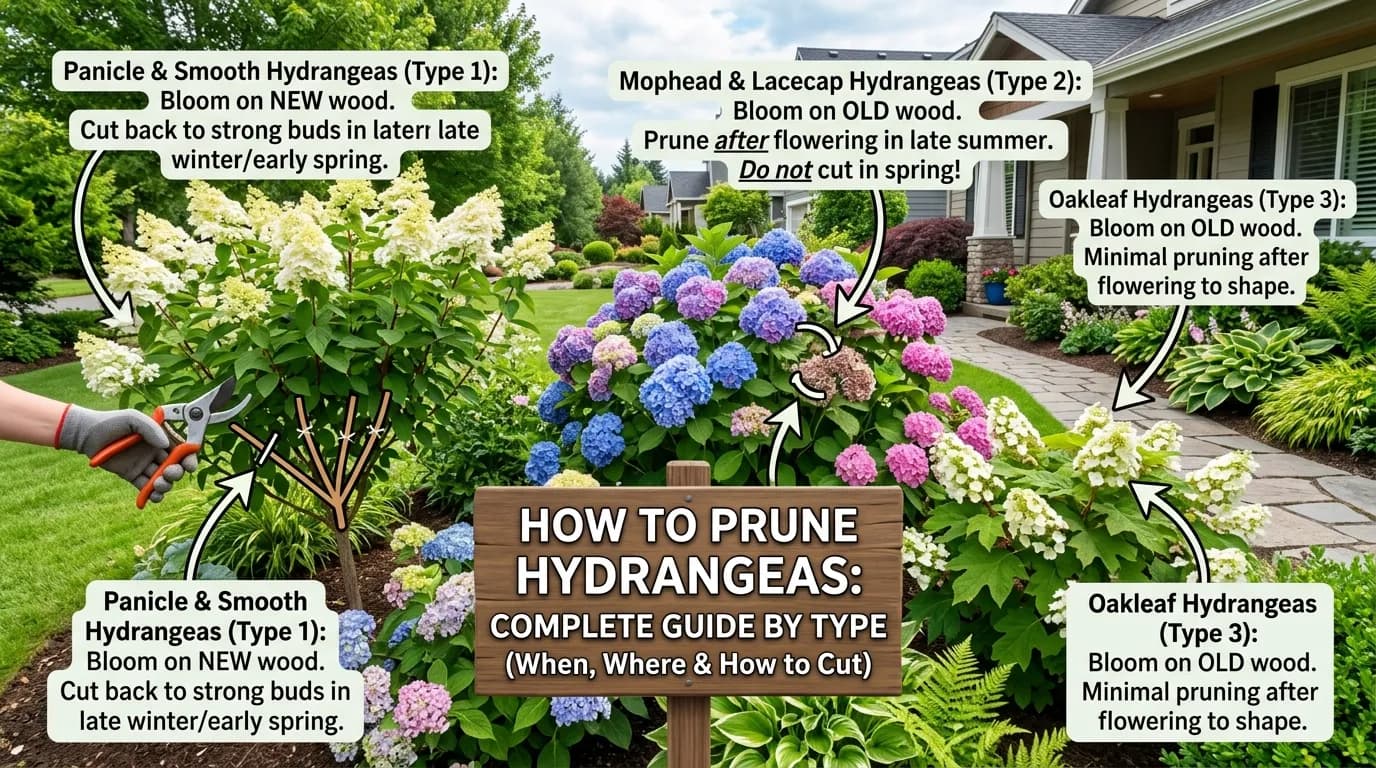
Hydrangeas are the most searched flowering shrub in America — and also one of the most commonly pruned wrong. The #1 mistake homeowners make: cutting them back in fall or early spring and then wondering why they got zero blooms the following summer. Whether you have bigleaf mopheads, white-flowered Annabelles, PeeGee trees, or the oakleaf species native to Southern forests, the rules are completely different for each type.
This guide cuts through the confusion. By the time you finish reading, you'll know exactly when to prune, where to cut, and what to do if you accidentally pruned at the wrong time.
Why Pruning Time Matters More Than Almost Anything Else
Hydrangeas fall into two fundamental categories based on where they form their flower buds:
Old wood bloomers set flower buds on stems grown the previous season. If you cut those stems in fall, winter, or early spring — you're cutting off next summer's flowers. These include bigleaf hydrangeas (Hydrangea macrophylla), mountain hydrangeas (H. serrata), and oakleaf hydrangeas (H. quercifolia).
New wood bloomers set flower buds on stems grown in the current season. These can be pruned almost any time without losing blooms. These include smooth hydrangeas (H. arborescens — 'Annabelle', 'Incrediball') and panicle hydrangeas (H. paniculata — 'Limelight', 'PeeGee', 'Quick Fire').
Repeat bloomers (reblooming bigleafs like 'Endless Summer', 'Incrediball Blush') bloom on both old and new wood — giving you a safety net but still rewarding careful timing.
Identify your type first. The rest of this guide walks through each one.
Type 1: Bigleaf Hydrangeas (Hydrangea macrophylla) — Old Wood
Varieties: 'Nikko Blue', 'Endless Summer', 'Cityline', 'Let's Dance', 'Big Daddy', mopheads and lacecaps
When to prune: Immediately after flowering ends in summer (July–August). This gives the plant maximum time to grow and set new buds before fall dormancy.
What NOT to do: Never cut bigleafs in fall, winter, or early spring. That's when the buds are either already set or just waking up — you'd be cutting off every bloom.
How to prune:
- 1After the last blooms fade, trace each stem back to the first pair of large, healthy buds below the spent flower head.
- 2Cut just above that bud node using sharp bypass pruners.
- 3Remove only dead, damaged, or crossing stems at ground level.
- 4If the plant is severely overgrown, remove no more than 1/3 of the oldest canes at the base — never cut the whole plant back hard.
Deadheading: Remove spent flower heads anytime during summer without affecting next year's blooms. In fall, leave dried flower heads on the plant — they protect the buds below from frost and provide winter interest.
Tip: In cold climates (zones 5 and below), bigleaf hydrangea buds often die in harsh winters even without pruning — that's why they don't bloom. Consider a reblooming variety like 'Endless Summer' which sets buds on new wood as a backup.
Type 2: Smooth Hydrangeas (Hydrangea arborescens) — New Wood
Varieties: 'Annabelle', 'Incrediball', 'Incrediball Blush', 'Haas' Halo', 'Hayes Starburst'
When to prune: Late winter to early spring, just as buds are breaking (late February–March in most zones). You can also do a light cleanup in fall after frost.
How to prune:
- 1Cut entire plant back to 12–18 inches above ground. These are hard-pruning champions — severe cutbacks produce the largest flowers.
- 2Or, for a more natural look with multiple stems: cut 1/3 of the oldest, thickest stems to the ground to encourage rejuvenation, then cut remaining stems back by 1/3.
- 3Remove dead stems by snapping or cutting them at ground level.
Why hard pruning works here: Smooth hydrangeas bloom on new wood only, so last year's stems are irrelevant. New growth explodes from the base in spring and flowers form on the tips of those fresh shoots. Without pruning, plants get leggy, weak-stemmed, and produce smaller flowers.
Result of hard pruning: The famous soccer-ball blooms on 'Incrediball' — those are only possible when you cut back hard in late winter.
Type 3: Panicle Hydrangeas (Hydrangea paniculata) — New Wood
Varieties: 'Limelight', 'PeeGee' (H. paniculata grandiflora), 'Quick Fire', 'Pinky Winky', 'Fire Light', 'Bobo', 'Little Quick Fire'
When to prune: Late winter to early spring (February–March). These are the most forgiving hydrangeas for pruning timing.
How to prune:
- 1For shrub forms: cut back by 1/3 to 1/2 of overall height, removing dead tips and weak crossing stems. Panicles tolerate harder pruning than bigleafs.
- 2For tree forms (standard 'PeeGee' trees): prune to maintain the canopy shape, removing any shoots from the trunk and cutting back lateral branches to 2–3 bud nodes from the main framework.
- 3Deadheading is optional — dried flower heads turn attractive rosy-tan in fall and winter, providing seasonal interest.
Tip: Panicle hydrangeas trained as small trees ('tree hydrangeas') need annual pruning to maintain the standard trunk form and prevent the canopy from becoming congested. Remove any new shoots from the trunk or root zone immediately.
Why panicles are great for beginners: They bloom reliably every year even if pruning is slightly off-schedule, they're more cold-hardy (zones 3–8) than bigleafs, and they tolerate a range of pruning approaches.
Type 4: Oakleaf Hydrangeas (Hydrangea quercifolia) — Old Wood
Varieties: 'Snow Queen', 'Alice', 'Pee Wee', 'Ruby Slippers', 'Gatsby Pink'
When to prune: Immediately after flowering in summer (the flowers are long-lasting — typically June through September). Never prune in fall or early spring.
How to prune:
- 1Remove only dead wood and spent flower clusters after the last blooms fade.
- 2These are slow-growing shrubs that benefit more from benign neglect than aggressive pruning — resist the urge to cut them back.
- 3For shape: remove crossing or rubbing stems and any dead wood at the base.
- 4Oakleaf hydrangeas have beautiful multi-season interest — exfoliating bark, rich fall foliage color, and persistent dried flower heads. Remove dried flowers only if you prefer a cleaner look.
Important: Oakleaf hydrangeas set buds in late summer and fall, so any pruning after August risks removing next year's blooms.
Type 5: Climbing Hydrangeas (Hydrangea anomala petiolaris) — Old Wood
When to prune: Immediately after flowering in early summer (June–July).
How to prune:
- 1Remove spent flower clusters and any crossing or wayward stems.
- 2On young plants (first 3–5 years), avoid pruning at all — climbing hydrangeas are slow to establish and every stem is precious.
- 3On mature plants covering walls or fences: cut back any stems growing in unwanted directions immediately after bloom. Don't cut into old, woody main stems.
- 4These are very slow to establish (often minimal growth for the first 2–3 years), so patience is essential.
The Hydrangea Pruning Cheat Sheet
| Type | Old or New Wood | Prune When | How Hard |
|---|---|---|---|
| Bigleaf (macrophylla) | Old wood | After bloom (summer) | Deadhead + light shape only |
| Oakleaf (quercifolia) | Old wood | After bloom (summer) | Deadhead + dead wood only |
| Climbing (anomala) | Old wood | After bloom (June–July) | Remove wayward stems only |
| Smooth (arborescens) | New wood | Late winter/early spring | Hard — cut to 12–18" |
| Panicle (paniculata) | New wood | Late winter/early spring | 1/3 to 1/2 reduction |
| Reblooming bigleaf | Both | After first bloom + late winter light tidy | Light — preserve old buds |
What If I Pruned at the Wrong Time? (Damage Control)
Pruned a bigleaf or oakleaf in fall/winter? You've cut off next year's buds. There's nothing you can do to get those blooms back this season — but don't panic. The plant will be fine. It'll grow new stems this season that will bloom the following year. If it's a reblooming variety ('Endless Summer', etc.), you may still get some blooms from new wood later in summer.
Pruned too hard? Even severely cut bigleaf hydrangeas will recover. They just won't bloom for 1–2 years. Apply a slow-release fertilizer in spring to encourage vigorous regrowth.
Didn't prune at all? For bigleafs and oakleafs, this is actually fine. These shrubs do well with minimal intervention. For smooth and panicle hydrangeas, skipping a year of pruning will result in smaller, weaker blooms — not fatal, but worth correcting next late winter.
🌿 Planning a hydrangea-heavy landscape?
Generate a free AI landscape design → Our AI matches the right hydrangea varieties to your climate zone, sun exposure, and design style — then shows you exactly how they'll look in your yard before you plant a single thing.
General Hydrangea Care Tips
Watering: Hydrangeas have high water needs, especially in summer. Water deeply 1–3 times per week during drought. Morning watering reduces disease pressure. Wilting in afternoon heat is normal in summer heat — if plants recover by morning, they're fine.
Fertilizing: Apply a balanced slow-release shrub fertilizer (10-10-10 or similar) in early spring as new growth emerges. Avoid high-nitrogen fertilizers in summer — they push leafy growth at the expense of flowers. A second light feeding in June can support rebloomers.
Soil and pH: Bigleaf hydrangea flower color is pH-dependent. Acidic soil (pH 5.5–6.0) produces blue flowers by making aluminum available to the plant. Alkaline soil (pH 6.5–7.0) produces pink flowers. Add sulfur to acidify, or lime to raise pH. White-flowering varieties (Annabelle, oakleaf, PeeGee) don't change color with pH.
Mulching: Apply 2–3 inches of organic mulch around the root zone to conserve moisture and moderate soil temperature. Keep mulch away from the main stems.
Sun exposure: Most hydrangeas prefer morning sun and afternoon shade, especially in hot southern climates. Full sun is tolerable in cool northern gardens. Deep shade produces lush foliage but few flowers.
FAQ: Hydrangea Pruning
Q: Why didn't my hydrangea bloom this year?
A: The most common reason is pruning at the wrong time — cutting an old-wood bloomer (bigleaf or oakleaf) in fall, winter, or early spring removes the flower buds. Other causes: a harsh winter killing buds, too much shade, excessive nitrogen fertilizer, or drought stress during bud formation.
Q: Should I cut off dead hydrangea blooms in fall?
A: For bigleaf and oakleaf types, leave the dried flower heads on through winter — they protect the flower buds below from frost damage and provide visual interest. Remove them in early spring as new growth emerges. For smooth and panicle types, you can deadhead or leave them as winter interest — it makes no difference to next year's blooms.
Q: Can I cut hydrangeas down to the ground?
A: Only for smooth hydrangeas (Annabelle, Incrediball) — these are the only type that reliably regrow and bloom from a hard cut to the ground. For all other types, avoid cutting to the ground as it removes flower buds (old-wood types) or stresses the plant unnecessarily.
Q: How do I make my hydrangeas blue?
A: Only bigleaf hydrangeas (macrophylla) change color based on soil pH. To shift from pink to blue: acidify the soil with sulfur or aluminum sulfate to bring pH below 6.0. This makes aluminum ions available for the plant to take up, which causes blue pigmentation. Apply in fall or early spring and be patient — the color shift takes 1–2 growing seasons to fully show.
Q: My hydrangea is leggy and floppy — what should I do?
A: Flopping stems on smooth hydrangeas (Annabelle types) are almost always caused by insufficient pruning. Hard-cut these types to 12–18 inches in late winter — this produces shorter, sturdier stems that hold up the large flower heads. For bigleaf hydrangeas, flopping is normal for large-headed varieties; try tomato cages or stakes for support, or choose a more compact variety.
Q: When should I prune hydrangeas in the South (zones 7–9)?
A: In warm climates, bigleaf and oakleaf hydrangeas may bloom later (June–July) and retain leaves longer into fall. Prune immediately after the last blooms fade, usually by August. Smooth and panicle types can be pruned in late January or February in the South when growth begins earlier.
Q: What tools do I need to prune hydrangeas?
A: Sharp bypass pruners (not anvil-type, which crush stems) for stems up to 3/4 inch diameter. Loppers for thicker, older canes. Always clean tools with rubbing alcohol or a 10% bleach solution between plants to prevent spreading disease.
Q: How do I know what type of hydrangea I have?
A: Key identifiers: Bigleaf hydrangeas have large, bold leaves and round blue/pink/purple flower clusters (mopheads) or flat-topped flowers with petals only on the edge (lacecaps). Smooth hydrangeas have white mophead blooms on fresh green stems — very common as 'Annabelle'. Panicle hydrangeas have cone-shaped (not round) flower clusters and are often trained as small trees. Oakleaf hydrangeas have distinctly oak-shaped leaves with deeply cut lobes, and cone-shaped white flowers that age to rose-tan. If all else fails, look up the tag name online.