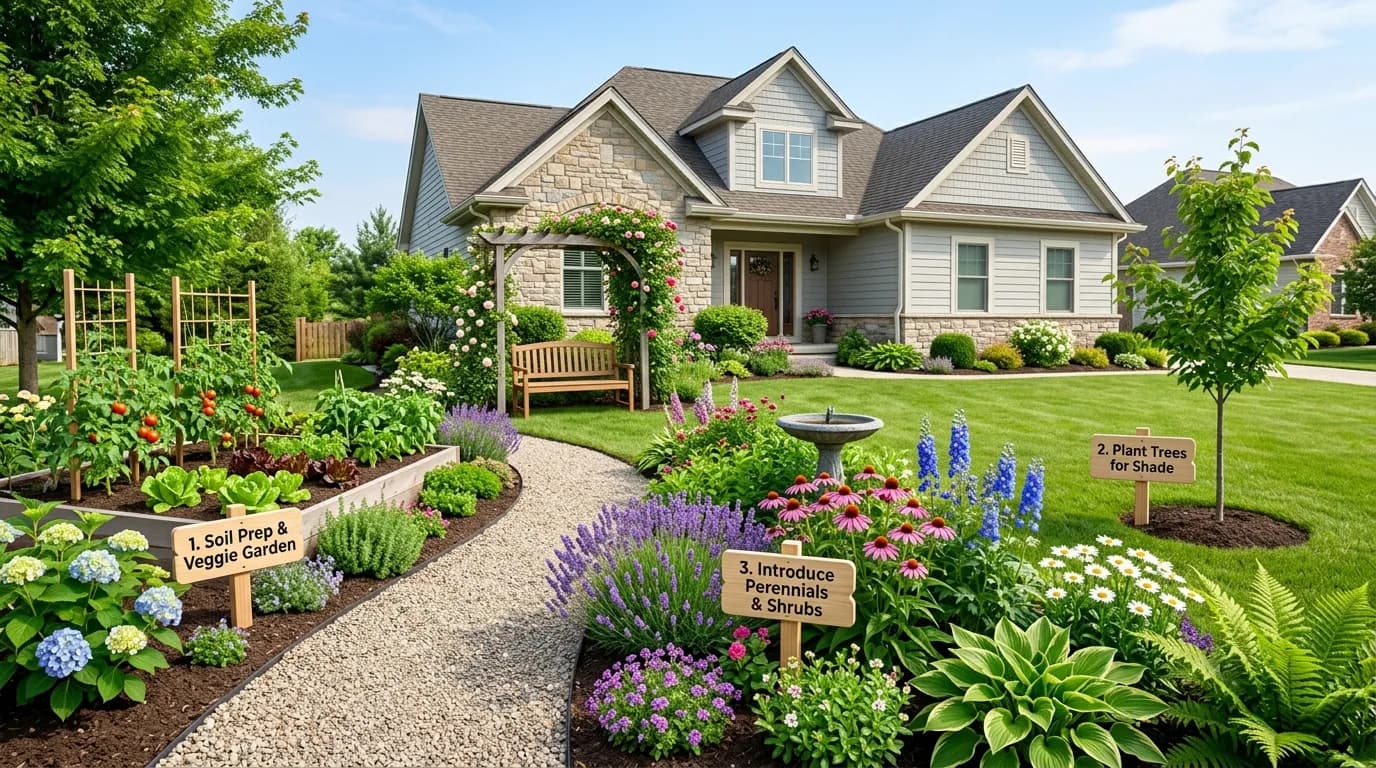
Congratulations — you own a house. Now you're staring at a yard that might be a blank canvas, an overgrown mess, or someone else's design that doesn't suit you. Here's exactly what to do, when to do it, and how to prioritize so you don't waste money or time.
Month 1-2: Observe and Document
Do NOT plant anything yet. The biggest mistake new homeowners make is rushing to the garden center on the first warm weekend. You don't know your yard yet.
What to observe:
- Where does sun hit? Track shadows at 9 AM, noon, and 3 PM. Take photos. Your "sunny corner" might be shaded by 2 PM.
- Where does water pool? After the next rain, walk the yard at 24 and 48 hours. Note standing water, wet spots, and drainage paths.
- What's already growing? That "weed" might be a perennial about to bloom. Wait one full season before removing anything you can't identify.
- Where does wind blow? Note prevailing wind direction. This affects plant placement and outdoor living comfort.
- What do the neighbors see? Walk the property perimeter and note sight lines. This tells you where to add privacy screening.
What to document:
- Property survey (should have come with closing docs)
- Utility locations — call 811 for a free underground utility locate
- Existing irrigation system map (if any)
- Trees — species, approximate age, health condition
- Soil test — send to your local extension office ($10-25). This is non-negotiable.
Month 3-4: Plan
Get a design
Three options:
- 1AI design ($29.99 — Yardcast): Upload a photo, answer questions, get a complete plan with plant lists, spacing, lighting, drainage, and phased installation timeline. Best value.
- 2Online landscape designer ($200-500): Yardzen, Tilly, or similar. Human designer, 2-4 week turnaround.
- 3Local landscape architect ($2,000-8,000): Full plan set with site visit. Best for complex projects over $20K.
Define your priorities
Rank these 1-5:
- Curb appeal (front yard)
- Privacy
- Outdoor living (patio, fire pit)
- Play area (kids, pets)
- Low maintenance
- Food production (garden)
Your top 2 priorities should get 60% of your budget.
Month 5-6: Foundation Work (Spring)
Phase 1 priorities:
- 1Fix drainage — If water pools near the foundation, fix it NOW. Regrade, extend downspouts, install French drains. This prevents $10,000+ foundation damage.
- 2Remove dead/hazardous trees — Get a certified arborist assessment for any tree within falling distance of the house. Remove hazards before they become emergencies.
- 3Install irrigation — Even a basic drip system saves time and water. Install the mainline and zones during dry spring weather.
- 4Plant trees — Trees are the highest-ROI landscape investment and take the longest to mature. Plant your shade trees now and thank yourself in 5 years.
- 5Define bed edges — Cut clean edges between lawn and beds. This alone transforms curb appeal.
Month 7-8: Structure (Early Summer)
Phase 2 priorities:
- 1Build hardscape — Patio, paths, retaining walls. Do this in summer when the ground is dry and workable.
- 2Install outdoor lighting — Path lights, uplighting for trees, patio ambiance. Low-voltage LED is DIY-friendly.
- 3Plant shrubs — If you can't wait until fall, plant shrubs with extra irrigation attention through summer heat.
Month 9-10: Planting Season (Fall)
Fall is the best time to plant in most of the US. Cooler temperatures, more rain, and roots establish over winter.
Phase 3 priorities:
- 1Plant shrubs and perennials — Fall planting gives roots 4-6 months to establish before summer stress.
- 2Overseed or sod lawn — Fall is prime time for cool-season grass (fescue, bluegrass). Warm-season grass (bermuda, zoysia) should wait for spring.
- 3Plant bulbs — Tulips, daffodils, alliums, crocuses. Plant now for spring color.
- 4Mulch everything — 3" of hardwood mulch in all beds before winter.
- 5Winterize irrigation — Blow out lines before first hard freeze.
Month 11-12: Evaluate and Adjust
Year-end review:
- What grew well? What struggled?
- Did your drainage fix work?
- Are the sight lines right? Do you need more privacy?
- Did the irrigation cover everything?
- What do you want to add next year?
Document everything with photos and notes. This information is invaluable for Year 2 planning.
The 5 Things NOT to Do in Year 1
- 1Don't rip everything out immediately. Live with it for one full season first. That ugly shrub might be spectacular in bloom.
- 2Don't plant a lawn first. Fix drainage, plant trees, install hardscape, THEN do lawn. Otherwise you'll tear up your new lawn for every subsequent project.
- 3Don't buy plants without a plan. Impulse plant purchases at the garden center = random collection, not a design.
- 4Don't ignore the soil test. $15 now saves hundreds in dead plants later.
- 5Don't skip the tree assessment. A dead tree falling on your house costs $20,000-$100,000. An arborist visit costs $150-300.
Budget Guide for Year 1
| Priority | Budget Range | What You Get |
|---|---|---|
| Essential (drainage, tree removal) | $500-2,000 | Safety and foundation protection |
| Foundation (trees, beds, edges) | $500-1,500 | Framework that appreciates over time |
| Living (patio, fire feature) | $1,000-5,000 | Outdoor room you'll use daily |
| Polish (perennials, lighting, mulch) | $300-800 | The details that make it professional |
| Total Year 1 | $2,300-$9,300 | Complete transformation |
Get your design before you spend a dollar on plants. A $29.99 Yardcast plan pays for itself by preventing one wrong plant purchase.
Start your design → — the first step every new homeowner should take.