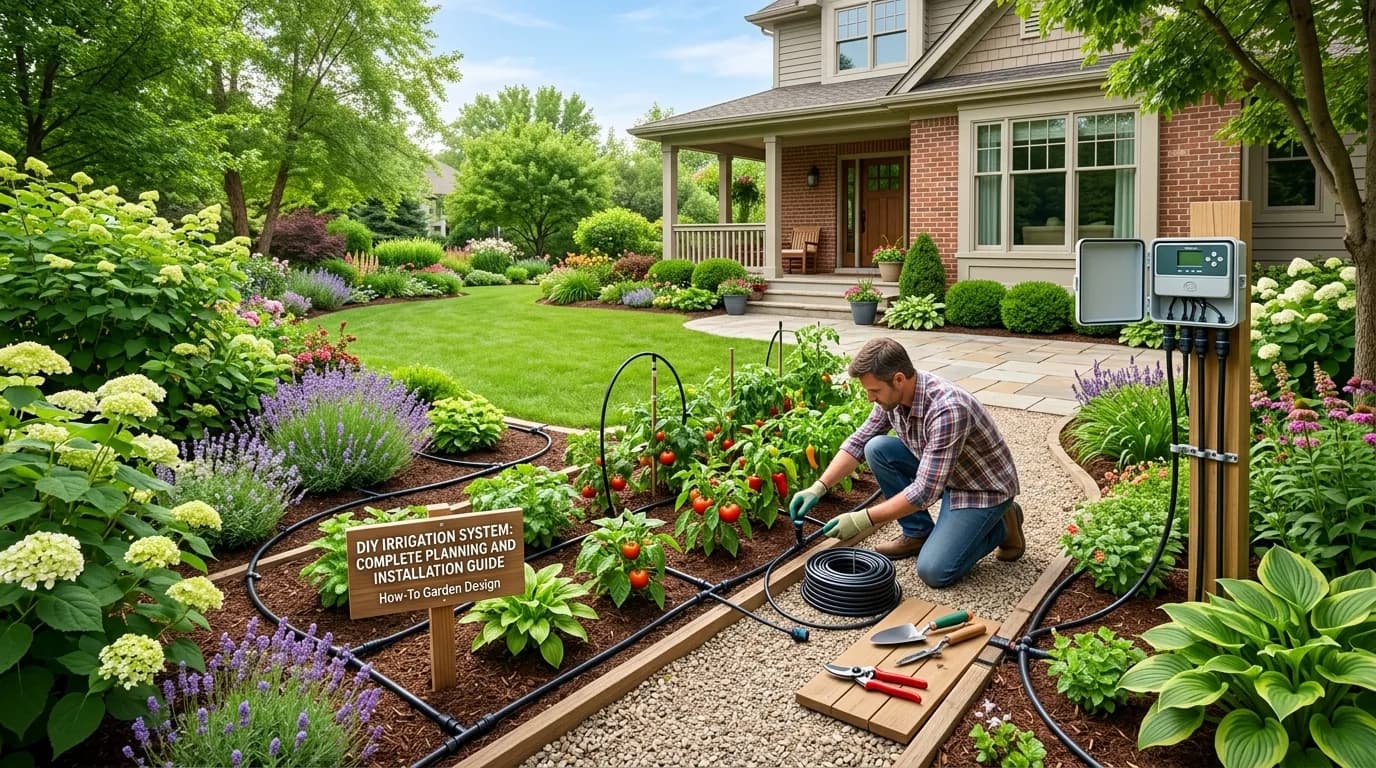
An irrigation system is the single best investment you can make in your landscape's long-term health. Plants watered by drip irrigation grow 30-50% faster than hand-watered plants because they receive consistent, deep moisture right at the root zone.
Here's how to design and install one yourself for $200-$800 (vs. $2,000-$5,000 professionally installed).
Step 1: Map Your Zones
The fundamental rule of irrigation design is hydrozoning — grouping plants by water needs:
Zone 1 — High Water (Spray/Rotor):
- Lawn areas, annual flower beds, vegetables
- Water 3-4x per week, 30-45 minutes
- Use spray heads (small areas) or rotary nozzles (large areas)
Zone 2 — Medium Water (Drip):
- Most perennials, shrubs, established hedges
- Water 2x per week, 60 minutes
- Use 1/2" drip tubing with emitters every 12-18"
Zone 3 — Low Water (Drip, Infrequent):
- Native plants, ornamental grasses, drought-tolerant species
- Water 1x per week (or rain-only once established)
- Use 1/4" drip tubing with emitters every 24"
Never mix spray heads and drip on the same zone. They require different pressures and run times.
Step 2: Calculate Water Supply
Before designing anything, measure your available water:
- 1Place a 5-gallon bucket under your outdoor spigot
- 2Turn the spigot full on
- 3Time how long it takes to fill (usually 30-90 seconds)
- 4Calculate: (5 gallons ÷ seconds) × 60 = gallons per minute (GPM)
Most residential supplies provide 5-15 GPM. You need to know this to size your zones — each zone can only use a portion of your total supply.
Step 3: Design the Layout
Spray Zone Layout
- Head-to-head coverage: Each spray head's radius should reach the adjacent head. If heads are spaced 12 feet apart, use heads with a 12-foot throw radius.
- Types: Fixed spray (4-15ft radius), rotary (15-35ft radius), impact (25-50ft radius)
- Spacing: Square pattern for rectangular areas, triangular for irregular shapes
- GPM per head: Fixed spray = 1-3 GPM, rotary = 0.5-1 GPM
Drip Zone Layout
- Mainline: Run 1/2" poly tubing as the main loop around planting beds
- Emitters: Pressure-compensating drip emitters at each plant (1 GPH for small plants, 2 GPH for shrubs, 4 GPH for trees)
- Inline drip: For groundcovers and mass plantings, use inline drip tubing with built-in emitters every 12-18"
- Trees: Dedicated emitter ring at the drip line (outer edge of canopy), not at the trunk
Step 4: Parts List
Every irrigation system needs:
- Backflow preventer (required by code) — $30-80
- Timer/controller — WiFi-enabled recommended ($80-200). Rain Bird, Rachio, or Hunter are top brands
- Valves — One per zone ($15-30 each)
- Valve boxes — Protect underground valves ($10-20 each)
- Pipe — 3/4" PVC for mainline, 1/2" poly for laterals
- Spray heads/rotors — $3-15 each
- Drip tubing + emitters — $0.50-1 per linear foot
- Wire — 18-gauge direct burial wire, 1 conductor per valve + 1 common
Step 5: Installation
- 1Mark sprinkler locations with flags before digging
- 2Dig trenches 6-8 inches deep for PVC mainlines, 4-6 inches for laterals
- 3Install valves in accessible valve boxes near the water source
- 4Connect mainline PVC with primer and cement (let cure 2+ hours before pressurizing)
- 5Run lateral pipes to each head location
- 6Install spray heads/rotors at grade level (flush with soil surface)
- 7Lay drip tubing on soil surface under mulch (do not bury)
- 8Run valve wire in the same trench as pipe, 6 inches deep
- 9Connect controller and program zones
- 10Test each zone — adjust heads for full coverage, check for leaks
Step 6: Programming
Morning watering (6-8 AM) is best. Less evaporation than midday, less fungal disease risk than evening.
Run time formula: Total plant water need (GPH) ÷ emitter output (GPH) = minimum run time in hours.
Seasonal adjustment:
- Spring: 75% of summer schedule
- Summer: 100% (baseline)
- Fall: 50%
- Winter: 0-25% (depending on region)
Rain sensor ($25-50): Automatically skips watering when it rains. Required by law in some states (FL, TX, NJ, CT, MN). Saves 20-30% on water annually.
Cost Breakdown
| Component | DIY Cost | Pro Install |
|---|---|---|
| Timer/Controller | $80-200 | $200-400 |
| Valves + Boxes | $60-120 | $150-300 |
| Pipe + Fittings | $100-300 | $300-800 |
| Heads/Emitters | $50-200 | $200-500 |
| Backflow + Misc | $50-100 | $200-400 |
| Labor | $0 (your time) | $800-2,000 |
| Total | $340-920 | $1,850-4,400 |
Your Yardcast design pack includes an irrigation zone map showing which plants go on which zone, with head type recommendations.