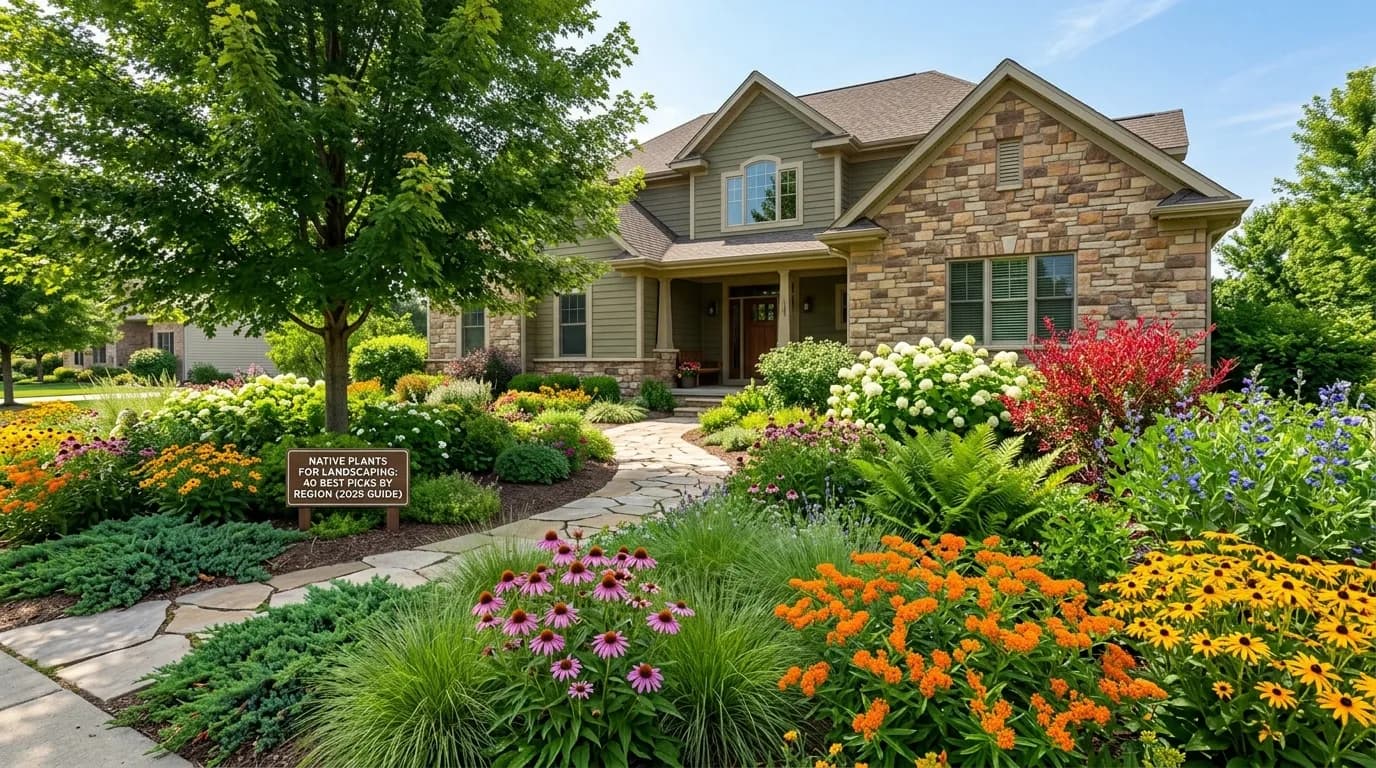
Native plants are plants that evolved in your specific region over thousands of years. They're adapted to your soil, your rainfall patterns, your pollinators, and your pest pressures — which is why they're the lowest-maintenance, highest-impact choice for any landscape.
But "native plants" isn't one thing. A plant native to coastal Maine is completely wrong for central Texas. This guide organizes the best native landscaping plants by region, explains how to use them in a real design, and shows you how to generate a personalized plan for your specific yard in about 60 seconds.
Why Use Native Plants for Landscaping?
Before the plant list: a quick case for native plants, because the reasons are more practical than most people realize.
Water savings: Once established (usually 1–2 growing seasons), most native plants need zero supplemental irrigation. The average American lawn uses 9 billion gallons of water per day nationally. Switching your landscape to natives can cut your outdoor water use by 50–70%.
No fertilizer: Native plants evolved in your regional soil. They don't need the fertilizer inputs that turf and exotic ornamentals require. That's money in your pocket and nitrogen out of your watershed.
Fewer pests: Native insects evolved alongside native plants. Most pests that devastate exotic ornamentals — Japanese beetles, emerald ash borers, aphid explosions — are dramatically less problematic on native species.
Wildlife value: A native oak tree supports over 500 species of caterpillars. A non-native ornamental pear? Around 1. Caterpillars are the primary food source for nesting birds. Planting natives is one of the most powerful things a homeowner can do for biodiversity.
Resale value: A 2024 survey by the National Association of Landscape Professionals found that homebuyers increasingly prefer low-maintenance, sustainable landscaping — and native plant gardens score highest on both counts.
Native Plants by Region
Pacific Northwest (Washington, Oregon, Northern California Coast)
The Pacific Northwest has mild, wet winters and dry summers — which means natives that thrive here are adapted to summer drought despite lush appearances.
- 1Red flowering currant (Ribes sanguineum) — Early spring bloomer, attracts hummingbirds, extremely drought-tolerant once established. 6–12 ft shrub.
- 2Oregon grape (Mahonia aquifolium) — Evergreen ground cover/shrub, yellow flowers in late winter, blue berries for wildlife. Deep shade tolerance.
- 3Pacific rhododendron (Rhododendron macrophyllum) — The state flower of Washington. 6–20 ft, spectacular bloomer, perfect for woodland edges.
- 4Blue wild rye (Elymus glaucus) — Cool-season native grass, beautiful blue-green color, tolerates shade and dry conditions.
- 5Kinnikinnick (Arctostaphylos uva-ursi) — Low ground cover (6 inches), pink flowers, red berries, handles full sun to part shade. Excellent lawn replacement on slopes.
- 6Sword fern (Polystichum munitum) — The workhorse of shady Pacific Northwest gardens. Evergreen, deeply architectural, requires zero maintenance.
California (Central Valley, Southern California, Bay Area)
California's Mediterranean climate — wet winters, dry summers — made it the global epicenter of drought-tolerant native landscaping.
- 1California poppy (Eschscholzia californica) — The state flower, self-seeds prolifically, blazing orange in spring, needs zero water after establishment.
- 2Manzanita (Arctostaphylos spp.) — Stunning red bark, small white flowers, extremely drought-tolerant. Dozens of species from ground cover to 15-foot shrubs.
- 3Toyon (Heteromeles arbutifolia) — The "California holly," bright red berries in winter that inspired the name "Hollywood." 6–10 ft, deer resistant, no summer water needed.
- 4Ceanothus (California lilac) — Available in ground cover to 8-ft shrub sizes. Intense blue-purple flowers in spring. Thrives on zero summer water.
- 5Salvia clevelandii (Cleveland sage) — Powerfully aromatic blue sage, 3–5 ft, highly deer-resistant, outstanding for pollinators.
- 6Dymondia (Dymondia margaretae) — Ground cover grass replacement, 2 inches tall, silvery leaves with yellow flowers. Handles foot traffic, no water once established.
Southwest (Arizona, Nevada, New Mexico, Texas West)
The Southwest has the most dramatic native plant palette in North America — sculptural, bold, and adapted to conditions that would kill conventional landscaping.
- 1Saguaro cactus (Carnegiea gigantea) — Arizona's iconic columnar cactus. Slow-growing but lifespan exceeds 200 years. Only plant in the Sonoran Desert zone.
- 2Desert willow (Chilopsis linearis) — Fast-growing tree to 25 ft, orchid-like flowers in pink/white/lavender, blooms summer through fall. Outstanding hummingbird plant.
- 3Brittlebush (Encelia farinosa) — Golden-yellow blooms on silver foliage, 3 ft mound, one of the most cheerful desert natives. Excellent for dry slopes.
- 4Black-eyed Susan (Rudbeckia hirta) — Native to the Great Plains and adaptable throughout the Southwest at higher elevations. Long-blooming, attracts goldfinches for seed.
- 5Agave (Agave spp.) — Structural anchors for any Southwest landscape. Many species from small (agave parryi at 2 ft) to massive (agave americana at 8 ft).
- 6Texas sage (cenizo) (Leucophyllum frutescens) — Purple flowers after summer rains, silver foliage, 4–8 ft. One of the most reliable low-water shrubs in the country.
Great Plains & Midwest
Tallgrass prairie once covered 170 million acres of North America. These plants evolved to handle temperature extremes, droughts, and floods.
- 1Purple coneflower (Echinacea purpurea) — America's most popular native perennial. Pink-purple flowers all summer, seed heads feed birds through winter. Extremely adaptable.
- 2Little bluestem (Schizachyrium scoparium) — Native prairie grass, steel blue in summer turning copper-red in fall and winter. Outstanding four-season interest.
- 3Prairie dropseed (Sporobolus heterolepis) — Fine-textured native grass, arching form, fragrant flowers, brilliant orange in fall. Perfect lawn alternative.
- 4Wild bergamot (Monarda fistulosa) — Lavender flowers, extremely fragrant, blooms all summer, major pollinator plant. Deer resistant.
- 5Compass plant (Silphium laciniatum) — Bold, architectural prairie plant with yellow flowers on 8-ft stalks. Deep taproot makes it nearly indestructible once established.
- 6Ironweed (Vernonia fasciculata) — Intense electric-purple flowers in late summer, 4–5 ft. One of the most striking late-season natives.
Southeast (Florida, Georgia, Carolinas, Tennessee)
The Southeast's heat, humidity, and clay soils frustrate conventional landscaping — but native plants evolved here and thrive in these conditions.
- 1Beautyberry (Callicarpa americana) — Shocking purple berries in fall that are genuinely one of the most stunning native plant sights in America. 4–6 ft, partial shade.
- 2Florida native azalea (Rhododendron austrinum) — Fragrant yellow-orange flowers in early spring before leaf-out. More heat and drought-tolerant than Asian azalea cultivars.
- 3Muhly grass (Muhlenbergia capillaris) — Pink cloud of flower heads in September-October. One of the showiest fall plants in the entire country. Full sun, drought tolerant.
- 4Coral honeysuckle (Lonicera sempervirens) — Vine with red-orange tubular flowers beloved by hummingbirds. Non-invasive (unlike Japanese honeysuckle). Blooms spring through fall.
- 5Inkberry holly (Ilex glabra) — Evergreen shrub, tolerates wet soil, deer resistant, black berries for birds. Outstanding hedge or massed planting.
- 6Swamp sunflower (Helianthus angustifolius) — 6 ft tall, yellow daisies in October when most other plants are done. Handles wet or dry soil equally well.
Northeast (New England, Mid-Atlantic, Great Lakes)
The Northeast's cold winters and variable rainfall suit plants built for resilience — and the region has outstanding native shrubs and perennials for four-season interest.
- 1Serviceberry (Amelanchier spp.) — Multi-season: white flowers in spring, edible berries in June, brilliant fall color. One of the best small native trees for residential landscapes.
- 2Inkberry holly (Ilex glabra) — Evergreen, wet-tolerant, deer resistant, black berries for birds. A Northeast landscape staple.
- 3Wild columbine (Aquilegia canadensis) — Red and yellow flowers loved by hummingbirds, self-seeds freely, tolerates shade. Blooms April–June.
- 4Joe Pye weed (Eutrochium purpureum) — 5–7 ft tall, mauve flower clusters in late summer, major monarch butterfly host plant. Outstanding at the back of a border.
- 5Switchgrass (Panicum virgatum) — Adaptable native grass for sun or light shade, wet or dry. Red and gold fall color. Many cultivars from 2 ft to 6 ft.
- 6Black chokeberry (Aronia melanocarpa) — White flowers in spring, glossy black berries in fall, intense red fall color. Adaptable to poor soils, wet or dry.
Rocky Mountain West (Colorado, Utah, Wyoming, Montana, Idaho)
High altitude, cold winters, and short growing seasons define the Rockies — and native plants here are built for exactly that.
- 1Rocky Mountain penstemon (Penstemon strictus) — Spikes of blue-purple flowers, 18–24 inches, deer resistant, extremely cold-hardy. Excellent for dry, sunny slopes.
- 2Apache plume (Fallugia paradoxa) — White rose-like flowers followed by feathery pink seed plumes that persist all summer. 4–6 ft, xeric once established.
- 3Blue grama grass (Bouteloua gracilis) — Short native prairie grass (6–12 inches), extremely drought-tolerant, can be mowed as a lawn alternative or left natural.
- 4Gambel oak (Quercus gambelii) — Thicket-forming native oak, brilliant gold-orange fall color, critical wildlife plant for the Rockies. Handles dry rocky soils.
How to Use Native Plants in a Real Landscape Design
Knowing the plants is step one. Designing with them is step two — and that's where most homeowners get stuck.
Start with structure: Choose 1–3 native trees or large shrubs as your anchors. These set the scale and provide year-round presence (serviceberry in the Northeast, toyon in California, desert willow in the Southwest).
Layer in medium shrubs: Mid-story shrubs fill the space between trees and groundcovers. Ceanothus, beautyberry, inkberry, and Texas sage all work in this layer.
Add perennials for seasonal color: Echinacea, penstemon, salvia, wild bergamot, and native asters give you a succession of bloom from early spring through hard frost.
Finish with groundcovers or grasses: Native grasses like little bluestem, prairie dropseed, and blue grama prevent weeds, reduce erosion, and add texture between flowering plants.
Mulch everything: 3 inches of wood chip mulch when you plant. It conserves moisture during establishment, moderates soil temperature, and prevents weeds without chemicals.
Ready to see exactly what a native plant landscape could look like for your yard? Yardcast's AI design tool generates 3 custom landscape concepts based on your yard's dimensions, sun exposure, climate zone, and style preferences — in about 60 seconds.
You'll see your specific space, with real plant placement, before you buy a single plant or move a single shovel of dirt. Start your free native plant design preview →
What to Avoid When Choosing "Native" Plants
The native plant market is flooded with marketing confusion. Watch out for:
Nativars: Cultivated varieties of native plants (like the 'Magnus' echinacea or 'Limelight' native hydrangea cultivars) often have reduced wildlife value compared to straight species. They're better than non-natives, but not equivalent to straight species natives.
Regional mismatches: "Native to North America" doesn't help you. A plant native to Louisiana is wrong for Minnesota. Always confirm your USDA Hardiness Zone and the plant's native range before purchasing.
Invasive look-alikes: Japanese barberry looks similar to native barberries but is highly invasive in eastern states. Purple loosestrife is often mislabeled at nurseries. Buy from reputable native plant nurseries rather than big-box stores.
Wrong ecotype: Some plants like switchgrass or echinacea have genetically distinct populations adapted to specific regions. Seed from a Kansas switchgrass population may not be optimal for a Pennsylvania garden. When possible, buy from local native plant nurseries that source from regional seed.