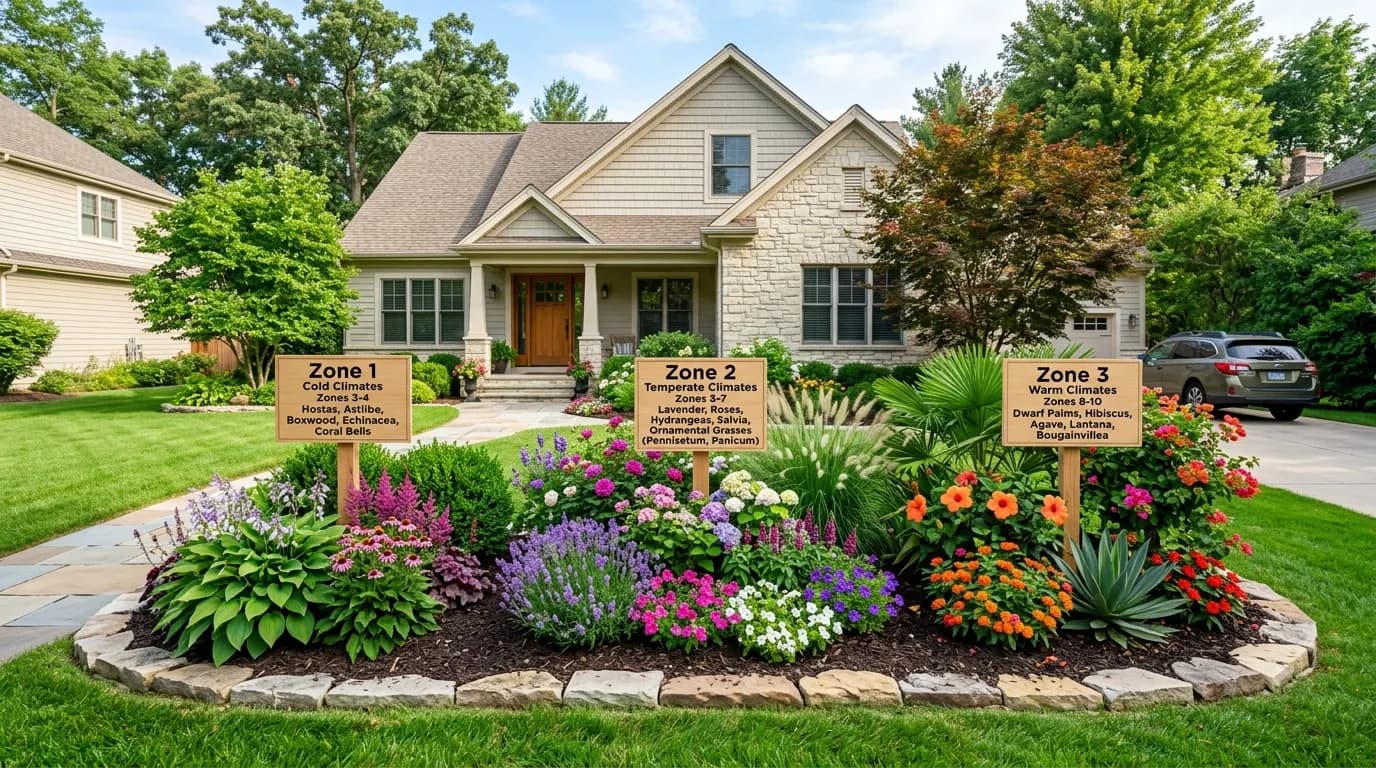
Choosing the right plants for a landscape island is different from choosing border or foundation plants. Islands are visible from every direction, exposed to more sun and wind, and need to look good from 360 degrees. That changes everything about plant selection.
Key Principles for Island Planting
360-Degree Visibility
Unlike a border bed against a fence, an island is seen from all sides. Tall plants go in the center, medium plants form a ring, and low groundcovers define the edge. Every direction should look intentional.
Wind Exposure
Freestanding islands get more wind than sheltered beds. Choose plants with strong stems or flexible habits. Avoid top-heavy plants that flop without support — they look messy in an island setting.
Seasonal Succession
Plan for all four seasons. An island that's stunning in June but dead-looking in December is a missed opportunity. Include evergreen structure, winter berries, fall color, and spring bulbs.
Zone 4–5 (Northern US: Minnesota, Wisconsin, Michigan, New England)
Full Sun Island
Thriller: 'Karl Foerster' feather reed grass (6 ft, zones 4–9) — upright, never flops, golden fall color, stands through winter
Fillers: Purple coneflower (Echinacea purpurea), Russian sage, black-eyed Susan
Spillers: Sedum 'Angelina' (chartreuse groundcover), creeping thyme
Shade Island
Thriller: Pagoda dogwood (15 ft, native understory tree)
Fillers: Hosta 'Sum and Substance' (giant gold leaves), astilbe, brunnera
Spillers: Wild ginger, sweet woodruff
Budget Pick
Daylilies (Hemerocallis) — plant 10 different varieties in a mass planting for $3–5 each. Bloom from June through September with overlapping bloom times. Virtually indestructible.
Zone 6–7 (Mid-Atlantic, Upper South: Virginia, Tennessee, North Carolina, Missouri)
Full Sun Island
Thriller: Crape myrtle 'Natchez' (25 ft, white blooms, cinnamon bark)
Fillers: Knockout roses, switchgrass 'Shenandoah', butterfly bush 'Miss Molly'
Spillers: Liriope muscari, creeping phlox
Shade Island
Thriller: Japanese maple (any dissectum variety)
Fillers: Hydrangea 'Endless Summer', heuchera varieties, Japanese painted fern
Spillers: Pachysandra, vinca minor
Budget Pick
Ornamental grasses — a mix of maiden grass, little bluestem, and prairie dropseed creates a meadow island for under $100 in plants. Zero maintenance once established.
Zone 7–8 (Southeast: Georgia, Alabama, Mississippi, South Carolina)
Full Sun Island
Thriller: Windmill palm or jelly palm (cold-hardy tropicals)
Fillers: Encore azaleas, muhly grass (pink cloud in fall), firebush
Spillers: Asiatic jasmine, dwarf mondo grass
Shade Island
Thriller: Live oak (long-term — plan for 30+ ft spread)
Fillers: Camellia sasanqua, cast iron plant, fatsia
Spillers: Ferns (autumn fern is semi-evergreen), ajuga
Heat-Proof Pick
Agapanthus (Lily of the Nile) — mass plant for dramatic blue flower globes June–August. Pair with society garlic for a low-water, high-impact island.
Zone 8–9 (Gulf Coast, Deep South, Coastal California)
Full Sun Island
Thriller: Pygmy date palm or queen sago
Fillers: Bird of paradise, plumbago, firecracker plant
Spillers: Purple queen (Tradescantia pallida), lantana
Shade Island
Thriller: Tree fern (Dicksonia antarctica) or banana
Fillers: Bromeliads, caladiums, peace lily (outdoor in zone 9+)
Spillers: Wandering Jew, frogfruit
Zone 9–11 (South Florida, Southern California, Hawaii)
Full Sun Island
Thriller: Royal palm, coconut palm, or traveler's palm
Fillers: Croton, ti plant, heliconia, ixora
Spillers: Beach sunflower, blue daze
Statement Island
Create a bromeliad bowl — a low, circular island packed with 20–30 bromeliads in different colors. Zero maintenance, always in bloom, incredible color impact. Cost: $200–$400 in plants.
Zone 4–9 (Desert / Xeriscape)
Full Sun Island
Thriller: Blue agave or desert spoon
Fillers: Red yucca, desert marigold, globe mallow, penstemon
Spillers: Trailing rosemary, Mexican feather grass
Rock Garden Island
Combine 3 sizes of boulders with pockets of succulents and decomposed granite. Zero water needed after establishment. Works from zone 5 (with cold-hardy succulents) through zone 11.
Universal Tips
Spacing for Islands
| Plant Type | Spacing | Why |
|---|---|---|
| Specimen tree | 1 per island center | Anchor point |
| Ornamental grasses | 2–3 ft apart | They spread |
| Shrubs | 3–4 ft apart | Full in 2 years |
| Perennials | 12–18 in apart | Fills gaps fast |
| Groundcovers | 6–12 in apart | Carpet effect |
Color Strategy
Pick 3 colors maximum plus green. Too many colors looks chaotic from a distance. A proven combination: one warm (yellow, orange, red) + one cool (blue, purple) + white or silver.
Maintenance by Zone
- Zones 4–5: Spring cleanup critical (remove winter damage)
- Zones 6–7: Divide perennials every 3 years
- Zones 8–9: Prune tropicals after any cold snap
- Zones 9–11: Watch for hurricane damage, stake palms
See It Before You Plant
Upload a photo of your yard to Yardcast's AI Designer and see exactly what these plant combinations look like in your specific space. Our AI uses region-specific plant data to generate photorealistic designs you can take to any nursery or contractor.