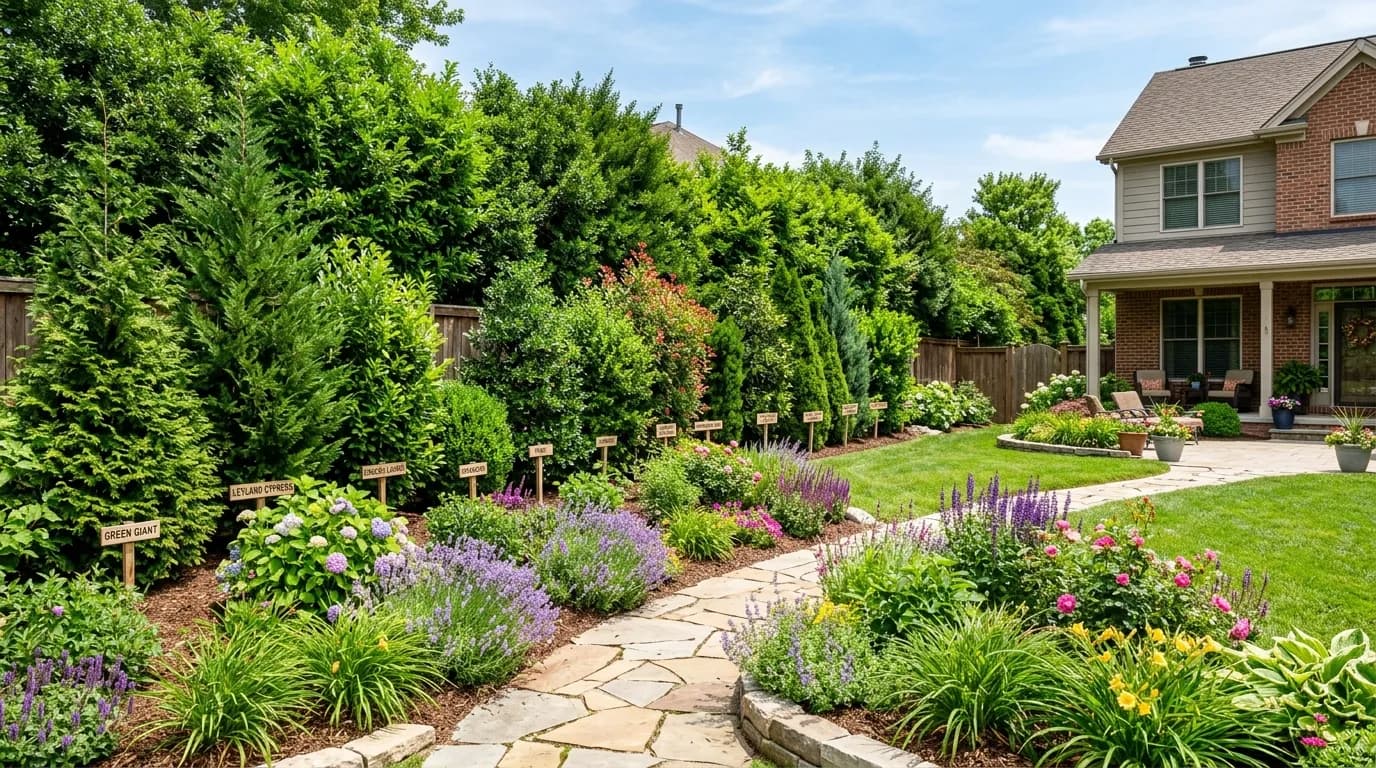
A living privacy screen beats a fence in every category: it looks better, increases over time, adds property value, supports wildlife, and costs less in the long run. The right plants can create a solid visual barrier in 2-3 years.
Here are the 12 best screening plants, organized by type.
Evergreen Trees (Year-Round Privacy)
1. Green Giant Arborvitae (Thuja 'Green Giant')
The #1 privacy plant in America.
- Growth rate: 3-5 feet/year (one of the fastest evergreens)
- Mature size: 40-60ft tall, 12-18ft wide
- Spacing: 5-6ft apart for a solid wall in 3-4 years
- Zones: 5-8
- Best for: Large properties needing quick screening
- Cost: $30-80 per 5-6ft specimen
- Note: Too large for small yards. Use Emerald Green arborvitae instead.
2. Emerald Green Arborvitae (Thuja 'Smaragd')
Best for tight spaces and formal hedges.
- Growth rate: 6-12 inches/year (moderate)
- Mature size: 12-15ft tall, 3-4ft wide — naturally columnar
- Spacing: 2-3ft apart
- Zones: 3-7
- Best for: Narrow spaces, property lines, formal gardens
- Cost: $25-60 per 4-5ft specimen
- Note: Deer resistant (unlike some arborvitae). Tolerates cold down to -40°F.
3. Leyland Cypress (× Cuprocyparis leylandii)
Fastest evergreen screen available.
- Growth rate: 3-5 feet/year
- Mature size: 60-70ft tall, 15-25ft wide
- Spacing: 6-8ft apart
- Zones: 6-10
- Best for: Southern climates where arborvitae struggle
- Cost: $30-60 per 5-6ft specimen
- Note: Susceptible to canker disease in humid climates. Not ideal for the Southeast.
4. Eastern Red Cedar (Juniperus virginiana)
Native, bulletproof, low-maintenance.
- Growth rate: 12-24 inches/year
- Mature size: 30-50ft tall, 10-20ft wide
- Spacing: 8-10ft apart
- Zones: 2-9
- Best for: Drought-tolerant screening, wildlife habitat
- Cost: $20-50 per 4-5ft specimen
- Note: Native plant that supports 40+ bird species. Extremely drought and wind tolerant.
Evergreen Shrubs (6-12ft Hedges)
5. Nellie Stevens Holly (Ilex × 'Nellie R. Stevens')
Best broadleaf evergreen hedge.
- Growth rate: 2-3 feet/year
- Mature size: 15-25ft tall, 5-10ft wide
- Spacing: 5-6ft apart
- Zones: 6-9
- Best for: Dense, impenetrable screening with winter berries
- Cost: $30-60 per 3-5ft specimen
- Note: Red berries attract birds. Tolerates heavy pruning. Shade-tolerant.
6. Skip Laurel (Prunus laurocerasus 'Schipkaensis')
Fast broadleaf hedge for sun or shade.
- Growth rate: 2-3 feet/year
- Mature size: 10-15ft tall, 5-7ft wide
- Spacing: 3-4ft apart
- Zones: 6-9
- Best for: Shady areas where other evergreens fail
- Cost: $25-50 per 3-4ft specimen
- Note: Glossy leaves look clean year-round. Deer resistant.
7. Wax Myrtle (Morella cerifera)
Best native screening for the Southeast.
- Growth rate: 3-5 feet/year
- Mature size: 10-15ft tall, 8-12ft wide
- Spacing: 4-6ft apart
- Zones: 7-11
- Best for: Coastal properties, wet areas, natural screening
- Cost: $15-40 per 3-4ft specimen
- Note: Semi-evergreen in Zone 7. Aromatic foliage. Fixes nitrogen (improves soil).
Deciduous Options (3-Season Privacy + Winter Light)
8. Privet (Ligustrum)
The classic fast hedge.
- Growth rate: 2-3 feet/year
- Mature size: 8-15ft tall, 4-8ft wide
- Spacing: 2-3ft apart
- Zones: 5-8
- Best for: Quick hedge, tolerates heavy shearing
- Cost: $10-25 per plant (very affordable)
- Note: Semi-evergreen in mild climates. Some species are invasive — check local regulations. Use Japanese or California privet.
9. Rose of Sharon (Hibiscus syriacus)
Flowering privacy with summer blooms.
- Growth rate: 1-2 feet/year
- Mature size: 8-12ft tall, 4-6ft wide
- Spacing: 3-4ft apart
- Zones: 5-9
- Best for: Flower lovers who want a colorful screen
- Cost: $15-35 per plant
- Note: Blooms August-October when little else is flowering. 'Blue Chiffon' and 'White Chiffon' are sterile (no seedlings).
Ornamental Grasses (Seasonal Screen + Movement)
10. Maiden Grass (Miscanthus sinensis 'Gracillimus')
Tall grass screen with winter interest.
- Growth rate: Full size in one season
- Mature size: 5-8ft tall, 4-6ft wide
- Spacing: 3-4ft apart
- Zones: 5-9
- Best for: Modern designs, seasonal screening, low maintenance
- Cost: $12-25 per plant
- Note: Cut back to 6" in late winter before new growth. Dried plumes provide winter interest.
11. Karl Foerster Feather Reed Grass (Calamagrostis × acutiflora)
Strictly upright — perfect for narrow spaces.
- Growth rate: Full size in one season
- Mature size: 5-6ft tall, 2ft wide — perfectly columnar
- Spacing: 18-24 inches apart
- Zones: 4-9
- Best for: Narrow property lines, modern/architectural designs
- Cost: $10-20 per plant
- Note: Non-invasive. Stays upright through winter. One of the best-behaved ornamental grasses.
Bamboo (Instant Dense Screen)
12. Clumping Bamboo (Bambusa multiplex, Fargesia)
Dense, tropical screen — without the invasion.
- Growth rate: 3-5 feet/year
- Mature size: 15-25ft tall (Bambusa) or 8-15ft (Fargesia)
- Spacing: 3-5ft apart
- Zones: 5-10 (species dependent)
- Best for: Dense, tropical-look screens, contemporary designs
- Cost: $40-100 per 5-gallon specimen
- CRITICAL: Only plant clumping bamboo. Running bamboo (Phyllostachys) is invasive and will take over your yard AND your neighbor's yard. This is the #1 mistake.
Spacing Guide
| Privacy Level | Spacing | Time to Solid Screen |
|---|---|---|
| Loose/filtered | 8-10ft | 4-5 years |
| Moderate | 5-6ft | 2-3 years |
| Dense/solid | 3-4ft | 1-2 years |
| Instant | 2-3ft (smaller plants) | Immediate but expensive |
Pro Tips
- 1Stagger in two rows for faster coverage. Plant in a zigzag pattern with rows 3ft apart.
- 2Mix species for disease resilience. A monoculture hedge can be wiped out by one disease.
- 3Plant in fall for best root establishment before the growing season.
- 4Don't top arborvitae — they don't regenerate from old wood. Shear sides only.
- 5Budget hack: Buy smaller plants (1-2 gallon) and wait one extra year. They'll catch up to larger specimens and cost 1/3 as much.
Your Yardcast design pack includes privacy screening recommendations based on your yard size, zone, and privacy needs — with exact spacing and placement.