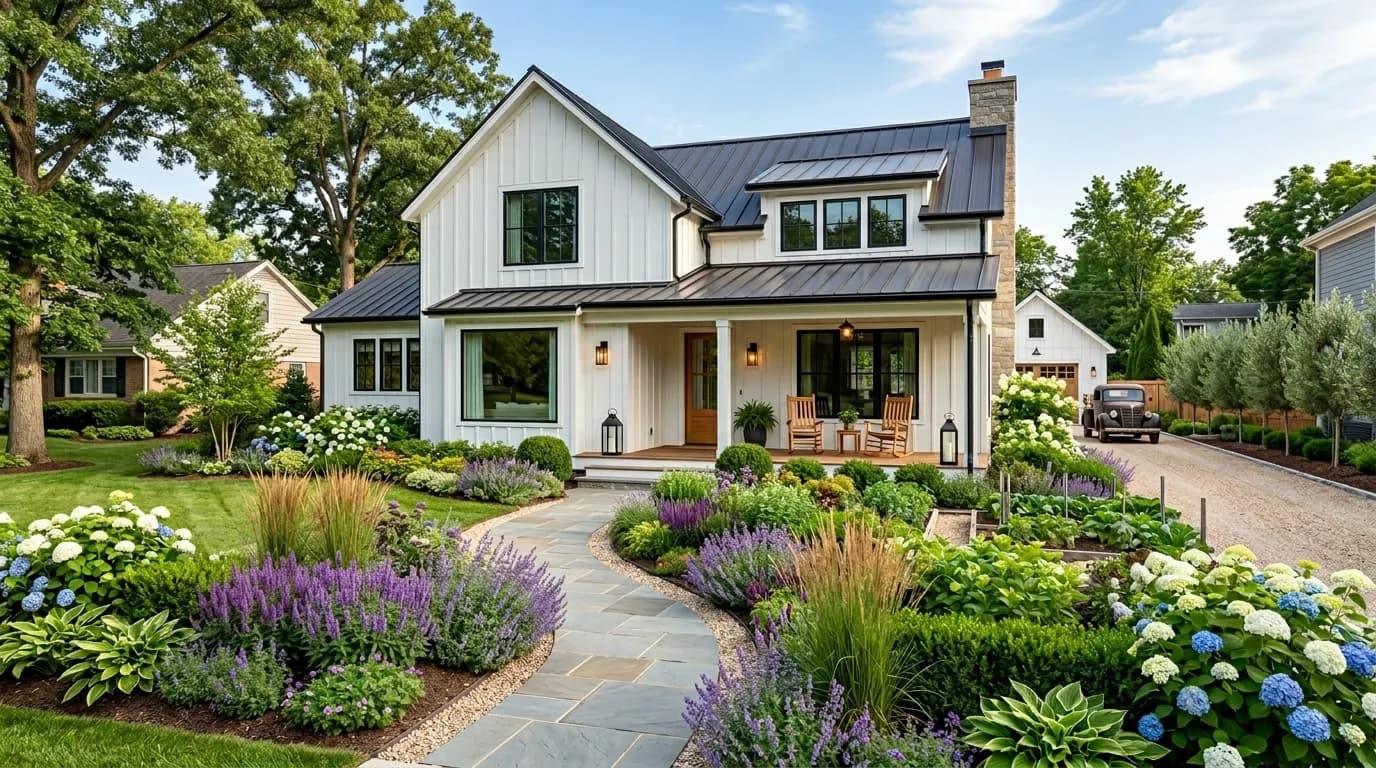
Modern farmhouse style has become one of the most searched home aesthetics of the decade — and the landscaping that surrounds these homes matters just as much as the shiplap and open-concept interiors inside. The right landscaping ties the farmhouse look together, creates undeniable curb appeal, and adds thousands of dollars in property value.
This guide covers 30 specific modern farmhouse landscaping ideas organized by yard zone, budget, and project type — plus a plant guide, materials breakdown, and cost estimates. Whether you're starting from scratch or refreshing an existing yard, these ideas work for true farmhouses, suburban homes with farmhouse aesthetics, and everything in between.
What Makes Landscaping "Modern Farmhouse"?
Modern farmhouse landscaping blends three visual vocabularies:
- 1The functional farm: Raised vegetable beds, cutting gardens, productive plants with beauty built in, a working garden that feeds and provides
- 2The romantic cottage: Climbing roses, overflowing borders, imperfect and lush — nothing too clipped or controlled
- 3The clean modern edit: White-painted timber accents, galvanized metal, black steel window boxes, restrained hardscape that keeps the house center stage
The result is warm, lived-in, and genuinely beautiful — not a museum-perfect formal garden, but a yard that looks like someone actually lives and loves it.
Materials that scream farmhouse:
- White or black painted timber fencing (picket or board-and-batten)
- Galvanized metal planters, troughs, and water features
- Weathered cedar raised beds
- Crushed limestone or pea gravel paths
- Reclaimed wood edging
- Black steel window boxes and plant hangers
- Natural stone stepping paths
Plants that define the aesthetic:
Climbing roses (especially 'New Dawn', 'Blaze', or 'William Baffin'), lavender, salvia, echinacea, black-eyed susans, sunflowers, ornamental grasses, hydrangeas, herbs in abundance, and heirloom vegetables spilling from raised beds.
Front Yard Modern Farmhouse Landscaping Ideas
1. Classic White Picket Fence with Climbing Roses
Nothing says modern farmhouse like a crisp white painted picket fence draped in climbing roses. Plant 'New Dawn' (blush pink, extremely vigorous) or 'Blaze' (vivid red) at every third post and train them as they grow. Within 2 years, you'll have a fence that looks like it's from a Joanna Gaines photoshoot.
Cost: $800–$2,000 for fence installation + $50–$100 per rose plant
Maintenance: Medium — annual pruning, spring feeding
2. Wildflower Meadow Front Border
Replace a traditional lawn edge with a wildflower meadow strip: 3–5 feet of cosmos, black-eyed susans, cornflowers, and native grasses along the property line or sidewalk edge. This explodes with color all summer, attracts pollinators, and requires almost no maintenance after the first year.
Cost: $100–$400 for seeds and initial prep
Maintenance: Low — cut back once in late fall
3. White Board-and-Batten Planter Boxes at the Entry
Flank your front door or porch steps with large white board-and-batten planter boxes (DIY or purchased). Fill them with seasonal plantings: tulips in spring → geraniums and trailing ivy in summer → ornamental kale and mums in fall. The structure is permanent; the planting changes with the seasons.
Cost: $200–$600 for boxes (DIY cedar) + $50–$150 seasonal planting
Maintenance: Low — replant 3 times per year
4. Lavender-Lined Driveway
Line both sides of a driveway or front walkway with lavender in dense rows. 'Hidcote' and 'Munstead' are the most compact varieties. In full bloom they create a purple-blue corridor that smells extraordinary and turns the approach to your house into a destination.
Cost: $400–$1,200 (18–36 plants at $15–$30 each)
Maintenance: Low — cut back after flowering each year
5. Black Steel Window Boxes Overflowing with Trailing Herbs
Black steel window boxes (or dark-painted cedar) under every window, planted densely with trailing rosemary, cascading nasturtiums, and petunias. The dark box pops against white or grey siding and adds farmhouse character to any elevation.
Cost: $200–$600 for boxes + $100–$200 for plants
Maintenance: Low to medium — water regularly, replant seasonally
6. Galvanized Metal Trough as a Front Yard Feature
A large galvanized metal stock tank or trough — 6 to 8 feet long — planted as a focal-point display garden. Fill it with a thriller, filler, spiller combination: a tall ornamental grass, compact hydrangea, and trailing nasturtiums or sweet potato vine. The galvanized metal is unmistakably farmhouse.
Cost: $150–$400 for trough + $100–$200 for planting
Maintenance: Low — water-retentive potting mix keeps maintenance manageable
7. Picket Gate Arbor with Wisteria or Climbing Hydrangea
A white-painted timber arbor gate framing your front walkway or garden entrance, planted with wisteria (for sun) or climbing hydrangea (for shade). The arbor becomes a floral arch in season that frames every entry and exit to your front yard.
Cost: $1,500–$4,000 installed (cedar arbor with picket gate)
Maintenance: Medium — wisteria needs annual pruning to keep controlled
8. Sunflower Cutting Garden Border
Along a fence or property line, plant a dense row of giant sunflowers (8–12 feet, like 'Mammoth') behind a mixed cutting garden border of zinnias, dahlias, and cosmos. This is pure farmhouse utility-meets-beauty — and cutting from it all summer long keeps it producing.
Cost: $50–$200 for seeds + $200–$400 for dahlia tubers
Maintenance: Low — water well, stake giants in wind, harvest continuously
> Want to see what any of these styles would look like on YOUR actual house? Generate a free AI landscape preview at Yardcast — upload your front yard photos, pick "Farmhouse" or "Cottage" as your style, and see 3 photorealistic renders in under 60 seconds. Free to preview, $29 to download the full plan.
Backyard Modern Farmhouse Landscaping Ideas
9. Cedar Raised Vegetable Beds Organized in a Kitchen Garden Layout
The centerpiece of any farmhouse backyard: 4–8 cedar raised beds arranged in a formal kitchen garden grid with crushed limestone paths between them. Grow heirloom tomatoes, basil, climbing beans, herbs, and colorful vegetables. The cedar ages to a beautiful silver-grey. Add a galvanized watering can, terracotta pots, and a rustic sign for atmosphere.
Cost: $800–$3,000 depending on size and number of beds
Maintenance: Medium — but you're growing food, so it's worth it
10. White Pergola with Grapevine Canopy
A white-painted timber pergola over the main seating area, planted with a grapevine that takes 3–5 years to create a full leafy canopy. In summer it provides dappled shade and grapes; in winter its bare structure is beautiful against a blue sky. This is the single most loved feature in farmhouse-style backyards.
Cost: $3,000–$8,000 installed (cedar or pressure-treated, white-painted)
Maintenance: Low once established — annual pruning
11. Fire Pit Circle with Gravel and Stone Seating
A central fire pit surrounded by a gravel circle with a low stone seating wall (or weathered wood log seats) and ornamental grasses at the perimeter. The gravel-and-stone combination is distinctly farmhouse; add a few potted lavenders or geraniums in galvanized buckets around the edge.
Cost: $1,500–$5,000 depending on fire pit type and seating wall
Maintenance: Low — rake gravel occasionally, edge the stone
12. Dahlia Garden as the Backyard Focal Point
A dedicated dahlia garden bed (8–12 feet wide, backed by a picket fence or lattice panel) with dinner-plate dahlias in crimson, terracotta, and deep burgundy. Stake them as they grow. Cut them weekly all summer — they produce more the more you cut. This is the quintessential farmhouse cutting garden.
Cost: $200–$600 for tubers + $200–$500 for bed preparation
Maintenance: Medium — staking, weekly cutting, dig tubers in cold climates
13. Herb Spiral or Herb Parterre
A circular or spiral raised herb garden made of stacked stone or reclaimed brick, planted with thyme, rosemary, sage, chives, mint (contained), and lemon balm. Functional, beautiful, and clearly farmhouse in spirit.
Cost: $300–$800 for materials + $100–$200 for plants
Maintenance: Low — herbs are largely self-sufficient
14. White Painted Barn Door Garden Gate
If you have a back gate or garden entrance, replace it with a sliding barn door style gate in white-painted cedar. This architectural detail transforms a functional element into a farmhouse statement.
Cost: $800–$2,500 depending on size and hardware
Maintenance: Low — repaint every 5–7 years
15. Wildflower Border Along the Fence Line
Behind a white picket or horizontal cedar fence, a 4-foot deep wildflower border running the entire fence length. Mix annuals and perennials: coneflowers, rudbeckia, salvia, cosmos, and ornamental grasses. This looks intentional and lush while requiring almost no maintenance after establishment.
Cost: $200–$800 for a 50-foot border
Maintenance: Low — cut back in fall, occasional deadheading
Best Plants for Modern Farmhouse Landscaping
| Plant | Why It Works | Season | Sun | Hardiness |
|---|---|---|---|---|
| Climbing Rose ('New Dawn') | Classic farmhouse; covers fences beautifully | Late spring–fall | Full sun | Zones 4–9 |
| Lavender ('Hidcote') | Fragrant, purple, bee magnet | Summer | Full sun | Zones 5–8 |
| Black-Eyed Susan | Cottage wildflower native to North America | Summer–fall | Full sun | Zones 3–9 |
| Coneflower (Echinacea) | Bold, pollinator magnet, long-blooming | Summer | Full sun | Zones 3–9 |
| Karl Foerster Grass | Upright structure, catches the light | Summer–winter | Full sun | Zones 5–9 |
| Sunflower (Giant) | The farmhouse annual par excellence | Summer | Full sun | Annual |
| Peonies | Romantic, fragrant, once-established for decades | Late spring | Full sun | Zones 3–8 |
| Hydrangea (Incrediball) | White blooms from summer through fall | Summer–fall | Part sun | Zones 3–9 |
| Wisteria | Arbor and pergola canopy (needs management) | Spring | Full sun | Zones 5–9 |
| Rosemary | Aromatic, edible, evergreen in mild climates | Year-round | Full sun | Zones 7–11 |
| Cosmos | Feathery, romantic, self-seeds prolifically | Summer–frost | Full sun | Annual |
| Dinner Plate Dahlia | Dramatic cutting garden; crimson and terracotta | Summer–frost | Full sun | Zones 8–11 |
| Ornamental Kale | Winter/fall interest in containers and borders | Fall–winter | Full sun | Annual |
| Catmint ('Walker's Low') | Low-growing, long-blooming lavender-blue | Spring–fall | Full sun | Zones 4–8 |
Budget Breakdown by Yard Size
| Scope | Budget | What It Covers |
|---|---|---|
| Front yard refresh | $1,000–$3,000 | Picket fence, climbing roses, planter boxes, gravel path, lavender border |
| Backyard starter | $2,000–$5,000 | 2 raised vegetable beds, wildflower border, fire pit gravel circle, herb garden |
| Full property transformation | $8,000–$20,000 | Fence, pergola, multiple raised beds, cutting garden, gravel paths, kitchen garden layout, established rose climbing on fence |
| Premium farmhouse estate | $20,000–$50,000+ | Barn-style pergola, complete kitchen garden, orchard trees, wildflower meadow, stone retaining features, grapevine-covered outdoor room |
Most homeowners create their ideal farmhouse landscape in 2–3 phases over 2–3 years. Phase 1 is typically the structure (fencing, paths, raised beds); Phase 2 is the planting (roses, perennials, trees); Phase 3 is the refinement (cut flower garden, pergola plantings, seasonal display containers).
16–30: Quick-Hit Farmhouse Ideas (by Category)
Hardscape & Structure
- 16. Reclaimed wood gate with black iron hardware
- 17. Crushed limestone or pea gravel paths between beds
- 18. Low stone retaining wall along a sloped border
- 19. Black-painted wrought iron plant stands on the porch
- 20. Cedar split-rail fence as a perennial garden backdrop
Seasonal and Edible
- 21. Apple, pear, or cherry espalier along a south-facing wall
- 22. Heirloom tomato cage garden with ornamental support frames
- 23. Potager-style mixing of edibles and ornamentals in the same bed
- 24. Bulb tapestry lawn: tulips and narcissus naturalized in grass
- 25. Pumpkin patch corner in the back (seriously — it's beautiful)
Details and Accents
- 26. Antique or vintage milk cans planted with trailing petunias
- 27. Weathered terracotta pot collection at the front door
- 28. Bee skep or beehive as a garden ornament (working or decorative)
- 29. Chalkboard plant markers in the herb and vegetable garden
- 30. Copper or aged metal garden bells as wind chimes at the arbor
How to Design a Modern Farmhouse Landscape
The classic mistake homeowners make with farmhouse landscaping is trying to do everything at once. The most authentic farmhouse gardens grew slowly, with layers added over time, and that lived-in quality is part of the charm.
Step 1: Start with structure. Fence, paths, raised beds, or an arbor. These define the bones of the garden.
Step 2: Plant the perennials. Roses, lavender, peonies, hydrangeas, echinacea — plants that come back bigger each year. Give them 2 years to establish.
Step 3: Fill with annuals. Sunflowers, zinnias, cosmos, dahlias. These are the cutting garden layer that changes each season.
Step 4: Add productive elements. The raised beds, herb garden, and fruit trees that make the garden genuinely functional.
Step 5: Refine with containers and details. Galvanized planters, window boxes, terracotta pots, and seasonal displays that express personality.
Using AI to Design Your Farmhouse Landscape
Visualizing how farmhouse landscaping will look on your specific property is genuinely difficult without design software or a landscape professional. The proportions of fencing, the placement of beds, the screening from neighbors, the relationship between the cutting garden and the pergola — these spatial relationships are hard to imagine from a list of ideas.
Yardcast lets you upload photos of your actual yard and generate 3 photorealistic AI landscape designs in under 60 seconds. Choose the "Farmhouse" or "Cottage" style, select your features (raised beds, pergola, cutting garden, fire pit), and the AI renders what your specific property would look like transformed. You can preview all 3 designs free before deciding to download the full plan ($29) — which includes the plant list, cost estimate, irrigation zones, and a 44-page contractor-ready PDF.
It's the fastest way to go from "I love this style" to "here's exactly what it would look like on my house."
Generate your free farmhouse landscape preview →
Frequently Asked Questions About Farmhouse Landscaping
What plants are best for a farmhouse landscape?
The classic farmhouse plant palette includes climbing roses (especially 'New Dawn' and 'Blaze'), lavender, coneflowers, black-eyed susans, sunflowers, peonies, hydrangeas, catmint, ornamental grasses, and a full kitchen garden of heirloom vegetables and culinary herbs. The mix of ornamentals and edibles defines the farmhouse aesthetic — it's a garden that looks beautiful and produces something useful.
How much does farmhouse landscaping cost?
A front yard farmhouse refresh typically runs $1,000–$3,000 for fencing, planting, and a gravel path. A backyard transformation with raised beds, a pergola, and cutting garden runs $5,000–$15,000. A full-property farmhouse landscape with mature plantings, stone features, and an established kitchen garden runs $20,000–$50,000+. Most homeowners phase the work over 2–3 years to spread costs and allow plantings to establish.
What fencing is best for modern farmhouse style?
White-painted picket fencing is the classic choice — tight 3-inch pickets with pointed or dog-ear tops, painted bright white. For a more contemporary farmhouse look, horizontal cedar boards (board-and-batten style) painted white or left to weather naturally also work beautifully. Cedar split-rail fencing is another option that has a more rustic, unfussy quality. All three work; which you choose depends on whether your home leans romantic/classic or clean/contemporary.
What is a cutting garden and how do I start one?
A cutting garden is a dedicated garden bed grown specifically for cut flowers you can bring indoors. For a farmhouse cutting garden, plant: dinner plate dahlias, zinnias, cosmos, sunflowers, sweet peas, lisianthus, snapdragons, and ornamental grasses. Start with 4–6 varieties, plant them in rows (for easy harvesting), and cut frequently — most flowers produce more the more you cut. A 4×8-foot raised bed is enough to supply a household with bouquets all summer.
Can I have a modern farmhouse garden in a small yard?
Absolutely. The farmhouse aesthetic scales beautifully. In a small front yard: a picket fence section, a pair of statement window boxes, lavender along the walkway, and a climbing rose on the porch pillar creates the full effect in a 200 sq ft space. In a small backyard: one or two cedar raised beds, a galvanized trough planter, and a wildflower border along the fence delivers the kitchen-garden-meets-romance feel that defines the style.
What's the difference between cottage garden and farmhouse landscaping?
They overlap significantly — both feature abundance, climbing roses, perennials, and an aesthetic of productive beauty. The farmhouse style leans more toward structure and utility: raised beds, picket fencing, galvanized metal, and organized kitchen gardens. The cottage style is more romantically informal: overflowing borders, winding paths, and ornamental chaos. Most successful modern farmhouse gardens borrow from both.
How do I get a farmhouse-style landscape design for my specific yard?
The fastest option is Yardcast: upload photos of your yard, pick "Farmhouse" or "Cottage" as your style, select features like raised beds, pergola, and cutting garden, and AI generates 3 photorealistic designs specific to your property in under 60 seconds. You can see what the style would actually look like on your house before spending anything. Full design pack — plant list, cost estimate, and contractor PDF — is $29.
What ground cover works best between farmhouse garden paths?
Crushed limestone and pea gravel are the most authentically farmhouse path materials — they're informal, inexpensive, and age beautifully. Stepping stones of irregular flagstone or reclaimed brick with creeping thyme or moss growing between them is another beautiful option that reads as both rustic and romantic. Avoid formal brick patterns or concrete pavers in a farmhouse landscape — they're too structured for the aesthetic.