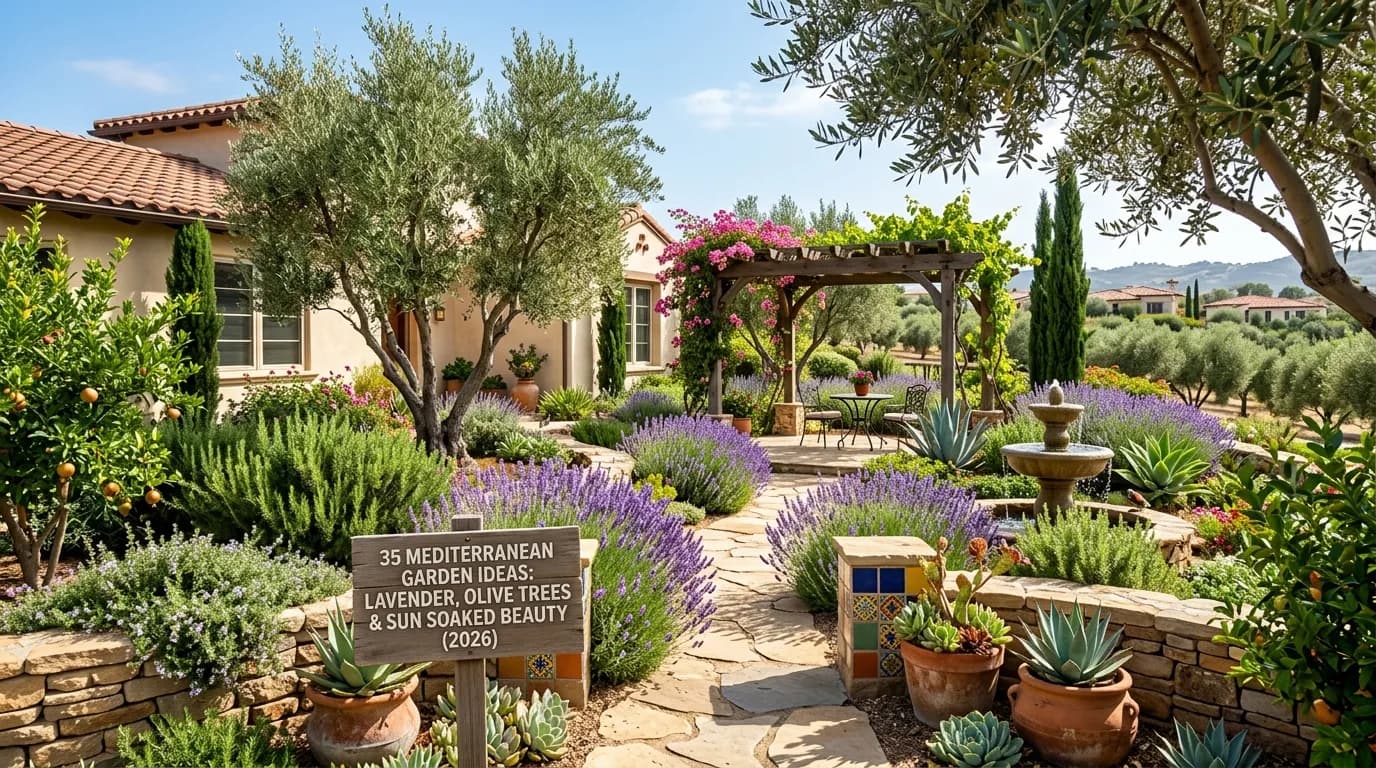
Mediterranean gardens are among the most beautiful, practical, and widely copied in the world — and for good reason. They're naturally drought-tolerant, fragrant, low-maintenance once established, and possess a timeless aesthetic that works equally well in California, Texas, the Pacific Northwest, and genuinely Mediterranean climates.
Whether you're inspired by lavender fields in Provence, ancient olive groves in Tuscany, whitewashed courtyards in Greece, or sun-bleached Spanish haciendas, the design language is consistent: warm materials, aromatic plants, water-wise planting, and an unhurried atmosphere of outdoor living.
This guide covers 35 Mediterranean garden ideas across plants, hardscape, water features, containers, and complete design strategies — plus a cost guide and plant list to help you get started.
What Makes a Mediterranean Garden?
Mediterranean gardens share a handful of defining characteristics regardless of which country inspired them:
1. Drought-tolerant plants. The Mediterranean basin gets hot, dry summers and mild, wet winters. Plants evolved for this pattern — aromatic, often silver-leaved, heat-loving, and deep-rooted.
2. Warm, earthy materials. Terracotta, limestone, aged stone, wrought iron, and weathered wood are the palette of Mediterranean hardscape. No concrete, no pressure-treated lumber, no plastic.
3. Outdoor living as the center of life. The courtyard, the shaded pergola, the terrace with a view — Mediterranean gardens exist to be lived in, not just looked at.
4. Scent. Lavender, rosemary, thyme, jasmine, wisteria, and citrus blossoms combine to create a garden you smell before you see.
5. Restrained color. Silver, grey-green, dusty blue, terracotta, and cream dominate. Accent colors come from bold flowers — vivid purple lavender, crimson bougainvillea, cobalt agapanthus, hot-orange California poppy.
35 Mediterranean Garden Ideas
Signature Plants
1. Mass-plant lavender as the cornerstone. A Mediterranean garden without lavender is like a kitchen without salt. Plant in groups of 7–11 for impact. English lavender (Lavandula angustifolia) for zones 5–8; Spanish lavender (Lavandula stoechas) for zones 7–10. Full sun, very well-drained soil.
2. An ancient olive tree as the focal point. A mature multi-trunk olive tree (Olea europaea) in a terracotta urn or planted in-ground creates an immediate sense of age and place. Hardy to zone 8b in-ground; container-grown can go anywhere. The gnarled silver bark is as beautiful in winter as summer.
3. Italian Cypress for vertical drama. Pencil-thin Cupressus sempervirens 'Stricta' flanking a gate, entry, or path endpoint is the single most transformative signature move of Italian garden design. Fully hardy to zone 7, they can reach 50 feet tall and 3 feet wide — a living exclamation point.
4. Rosemary as a structural shrub. Not just a kitchen herb — rosemary in full flower is one of the prettiest blue-flowered shrubs in the Mediterranean palette. 'Tuscan Blue' reaches 5 feet; 'Prostratus' cascades beautifully over walls and raised planters. Cut back hard after flowering to maintain shape.
5. Silver-leaved plants for texture. Artemisia 'Powis Castle', Jerusalem sage (Phlomis fruticosa), and silver-leafed Convolvulita cneorum add the shimmer and lightness characteristic of hot-climate plants. Pair with terracotta for maximum contrast.
6. Agapanthus in cobalt blue. The lily of the Nile (Agapanthus africanus and hybrids) blooms in summer with globe-shaped flower heads in vivid cobalt blue or white. Mass in groups of 5–7 along pathways or terrace edges for stunning effect. Thrives in zones 8–11.
7. Cistus (rock rose) for a wild look. Paper-thin flowers in white, pink, or magenta bloom prolifically in spring and early summer on plants that love poor, dry, rocky soil. Looks at home scrambling over stone walls or naturalizing in gravel.
8. Bougainvillea on walls and pergolas. Nothing says Mediterranean summer like a cascade of vivid magenta, orange, or white bougainvillea bracts pouring over a white wall or terrace railing. Hardy in zones 9–11, or grow in large containers and overwinter indoors elsewhere.
9. Wisteria for fragrance and structure. A pergola draped in wisteria in full bloom in late April is one of the most breathtaking garden moments. The drooping lilac-purple flower racemes and powerful fragrance are quintessentially Italian. Requires a strong structure — it's a heavy vine — and hard annual pruning.
10. Santolina for grey-green geometry. Cotton lavender (Santolina chamaecyparissus) is a low, aromatic silver-grey mounding shrub often clipped into neat spheres or low hedges in formal Mediterranean gardens. Planted in rows or as edging, it creates structure without formality.
Mediterranean Hardscape Ideas
11. Terracotta pots — everywhere. Nothing signals Mediterranean style faster than large terracotta amphorae, oversized urns, and hand-thrown pots overflowing with herbs, trailing rosemary, lemon trees, or vivid annuals. Group in odd numbers at level changes, gates, and pathways.
12. Limestone or travertine paving. Warm-toned limestone or travertine pavers — whether cut or natural cleft — catch sunlight beautifully and develop a gorgeous patina over time. Lay in a running bond or random flagstone pattern for authenticity.
13. A mosaic tile fountain. The traditional center of the Moorish courtyard garden is a tiled fountain or reflecting pool. Even a small wall-mounted fountain in hand-painted Spanish or Moroccan tiles transforms a courtyard. Moving water keeps the space cool and adds sound.
14. A pergola — always a pergola. The shade structure is not optional in a Mediterranean garden — it's the entire point. Weathered timber or wrought iron, covered with wisteria, grape, or climbing rose. A table, some chairs, a carafe of wine — that's the whole design brief.
15. Dry-stacked stone walls. Rough-cut limestone or sandstone stacked without mortar creates retaining walls, raised planting beds, and seating walls with a timeless, regional character. Moss and creeping thyme establish naturally in the joints, aging the wall beautifully.
16. Gravel paths and courtyards. Crushed limestone, decomposed granite in warm tan, or pale crushed marble as the ground plane between planted beds and hardscape surfaces. Weed-free, water-permeable, and immediately evocative of Provençal village streets.
17. Wrought iron details. Gates, railings, window boxes, and garden furniture in black wrought iron are the fine jewelry of a Mediterranean garden — ornate but not fussy, aged but not rusted.
18. A stone or tiled water urn. A large hand-thrown or carved stone urn that overflows gently into a basin — or simply holds still water reflecting the sky — is the simplest, most elegant water feature for a small courtyard.
> Ready to design your Mediterranean garden? Yardcast generates photorealistic Mediterranean landscape designs tailored to your exact yard photos, climate zone, and style preferences — with a full plant list, cost estimate, and contractor-ready PDF. Preview free in 40 seconds.
Mediterranean Garden Design Strategies
19. Zone your outdoor rooms. Mediterranean houses traditionally spill life into a series of distinct outdoor spaces — an entry forecourt, a shaded terrace, a kitchen garden, a view garden. Even a small yard can have two or three distinct zones separated by changes in ground material, plant height, or pergola structure.
20. Embrace the view. In the original Mediterranean tradition, the garden frames and leads the eye to a distant view — a valley, a sea, a church tower. In a residential yard, your "view" might be a specimen tree, a painted garden wall, or simply a well-composed planting. Think about what your sightlines land on.
21. Use repetition for rhythm. Mediterranean gardens are not cottage gardens — they use plants in disciplined repetition. Lavender in rows. Italian Cypress flanking every entry. Identical terracotta pots at every level change. Repetition creates unity and makes small gardens feel larger.
22. Embrace fragrance. Design a planting palette that guarantees something fragrant every month: rosemary (late winter), lavender and wisteria (spring), jasmine and citrus (summer), heirloom roses and lavender again (fall). Fragrance is half the experience.
23. The herb garden as ornament. Culinary herbs — rosemary, thyme, sage, oregano, lemon verbena, bay laurel — are among the most beautiful Mediterranean plants. A kitchen herb garden in raised terracotta planters or a formal knot garden of clipped herbs is both practical and ornamental.
24. Nighttime design. Mediterranean evenings are the whole point — dinner outdoors under the pergola, low candlelight, the scent of jasmine. String lights, low path lighting, and uplighting on specimen trees transform the garden after dark. Plan for lighting from the start.
25. Dwarf citrus in containers. A dwarf Meyer lemon, Satsuma mandarin, or Eureka lemon in a large terracotta planter is one of the quintessential container plants of Mediterranean-inspired design — fragrant flowers, edible fruit, glossy foliage year-round. Move inside in cold climates.
Climate Adaptation: Mediterranean Style Anywhere
26. Zone 5–6 (cold winters). Swap tender olives for 'Crimson Pygmy' barberry (silver-bronze winter interest), use Russian sage (Perovskia) as your lavender companion, and plant Vitex agnus-castus for the summer lavender-blue spike effect. Grow citrus in containers and overwinter indoors.
27. Zone 7–8 (moderate). The richest range of options: crape myrtles, loropetalum, dwarf olive, Spanish lavender. Most true Mediterranean plants are fully hardy. Add Japanese maples for autumn interest in the otherwise evergreen Mediterranean palette.
28. Zone 9–11 (warm). All bets are off — true Mediterranean planting works perfectly. Add bougainvillea, Plumbago, African agapanthus, and Lantana for maximum summer color. Protect from occasional frosts with frost cloth on sensitive plants.
29. Pacific Northwest adaptation. Lavender, rosemary, cistus, and hebe thrive in the mild, wet Pacific Northwest winters. Replace drought-tolerant succulents with hardy ferns in shadier spots. The key is ensuring excellent drainage — Mediterranean plants hate wet feet.
30. Hot-arid Southwest adaptation. Replace Italian Cypress with a native Mexican fan palm or Palo Verde. Use concrete block walls finished in stucco for that whitewashed Mediterranean effect. Decomposed granite, bold agave, and barrel cactus complete the regional interpretation.
Mediterranean Garden on a Budget
You don't need an unlimited budget to achieve Mediterranean character. Focus on these high-impact, low-cost moves:
31. Paint a wall. A wall or fence painted in warm terracotta, aged cream, or deep ochre yellow instantly creates Mediterranean atmosphere. The cheapest transformation in this list.
32. Buy lavender in flats. Lavender in 4-inch pots planted in masses is far cheaper than 1-gallon containers and establishes within one season. Buy a flat of 18 plants and mass them — impact is in quantity, not size.
33. Gravel replaces expensive paving. A gravel courtyard costs $1.50–$4/sq ft installed versus $15–30/sq ft for natural stone. The look is equally authentic, especially with good edging.
34. Source terracotta from nurseries going out of season. End-of-season nursery sales often discount large terracotta pots 40–70%. Stock up in fall.
35. DIY a pergola. A basic cedar pergola can be built for $500–$1,500 in materials versus $5,000–$15,000 professionally installed. Plant it with wisteria or climbing roses and it becomes indistinguishable from an architect-designed version within 3 years.
Mediterranean Garden Plant Cost Guide
| Plant | Size | Cost Per Plant | For Impact |
|---|---|---|---|
| English lavender | 4" pot | $3–6 | 18+ plants per bed |
| Spanish lavender | 1 gal | $8–12 | 9–12 plants per area |
| Rosemary 'Tuscan Blue' | 1 gal | $8–12 | 3–5 per area |
| Italian Cypress | 5 gal | $25–35 | Pairs of 2 at entries |
| Olive tree | 15 gal | $80–150 | 1–2 specimen |
| Agapanthus | 1 gal | $10–15 | 9+ plants per drift |
| Bougainvillea | 5 gal | $20–35 | 1 per structure |
| Wisteria | 1 gal | $15–25 | 1–2 per pergola |
| Santolina | 4" pot | $4–7 | 12+ for hedge effect |
| Cistus | 1 gal | $8–14 | 5+ for naturalistic look |
Total for a 400 sq ft Mediterranean front yard: $1,800–$3,200 in plants plus $2,000–$4,500 in hardscape (gravel, pergola, containers) for a full DIY transformation.
Getting Started: Your Mediterranean Garden Plan
The Mediterranean garden is ultimately about atmosphere — the feeling of stepping into a slower, more sensory way of living. Start with the bones: one strong structural element (a pergola, a stone wall, a specimen olive or cypress), a ground plane of warm gravel or limestone, and a mass of lavender.
From that foundation, layer in fragrance (rosemary, jasmine), color (agapanthus, bougainvillea, seasonal pots), and texture (silver artemisia, ornamental grasses, terracotta). Each addition deepens the sense of place.
Design your Mediterranean garden with Yardcast → — upload your yard photos and get 3 photorealistic Mediterranean-style designs with a full zone-matched plant list, cost estimate, and 44-page contractor PDF. Free preview in 40 seconds.