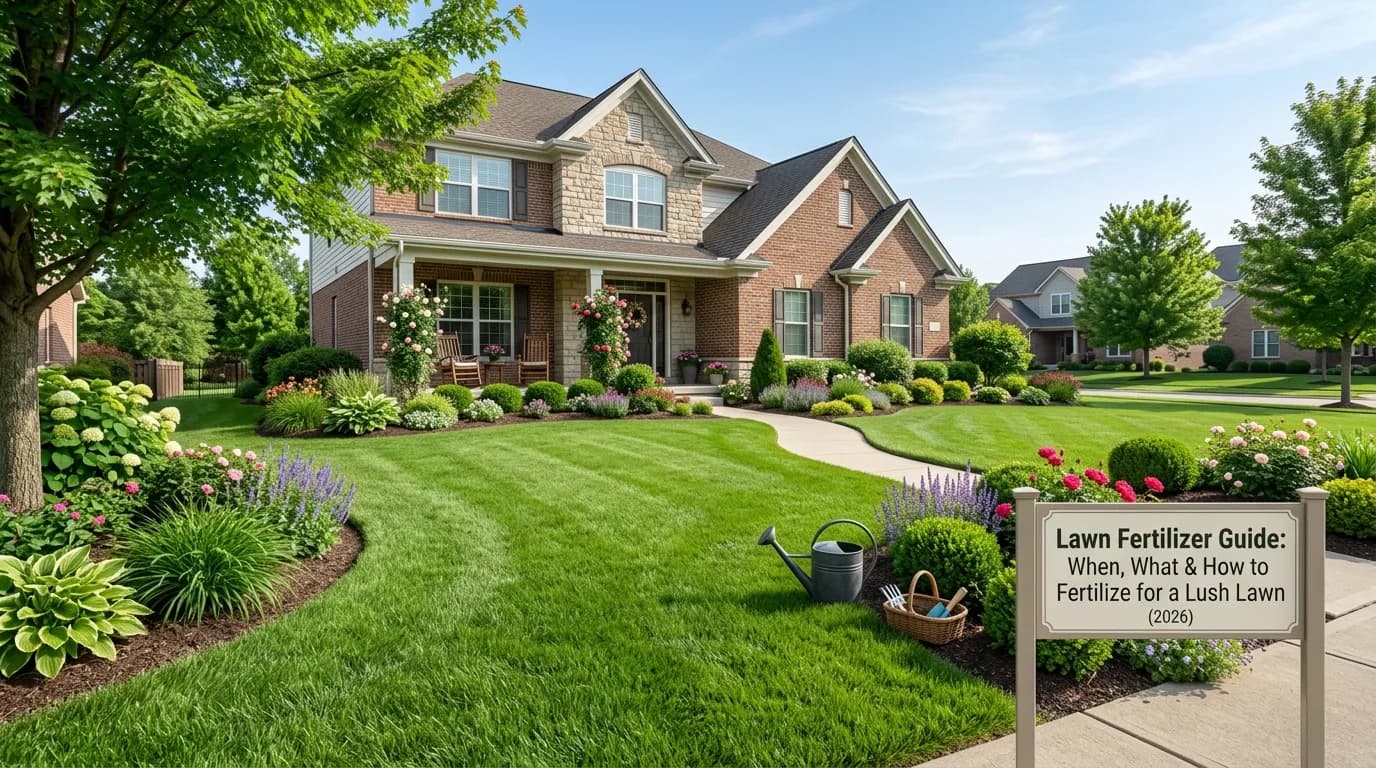
A lush, deep-green lawn doesn't happen by accident — it's the result of feeding the right nutrients at the right time. Yet fertilizing is one of the most misunderstood aspects of lawn care. Too little and the grass stays thin and pale. Too much and you burn the lawn, pollute local waterways, and waste money.
This guide covers everything: what fertilizer numbers mean, which products to choose, when to apply by grass type, and the exact schedule that produces the lawn your neighbors will ask about.
Understanding Fertilizer: The NPK Ratio Explained
Every bag of fertilizer displays three numbers — for example, 30-0-4 or 10-10-10 — separated by dashes. These are the NPK ratio: the percentage by weight of three essential nutrients.
Nitrogen (N) — First Number
Nitrogen drives green growth, leaf density, and overall color. It's the nutrient most responsible for that deep green look. Nitrogen is also the most easily leached from soil, which is why lawns need it most frequently.
Too little: Yellow, thin, slow-growing grass
Too much: Fast, weak growth; increased disease susceptibility; potential burn
Phosphorus (P) — Second Number
Phosphorus supports root development, seed germination, and overall plant establishment. Most established lawns in the U.S. have adequate soil phosphorus — which is why many premium lawn fertilizers show a 0 in the middle (e.g., 30-0-4). Applying excess phosphorus contributes to algae blooms in waterways; many states restrict phosphorus in lawn fertilizers for this reason.
Use phosphorus when: Establishing a new lawn from seed or sod, or when a soil test confirms deficiency.
Potassium (K) — Third Number
Potassium strengthens cell walls, improves drought tolerance, and boosts disease resistance. Think of it as the "immune system" nutrient. It's particularly important in late fall applications when preparing grass for winter.
Signs of deficiency: Brown leaf tips, weak stems, reduced stress tolerance
The 4 Types of Lawn Fertilizer (And When to Use Each)
1. Quick-Release Nitrogen (Synthetic)
Nutrients are immediately water-soluble. The lawn greens up within 3–5 days, but effects only last 4–6 weeks. Higher burn risk if over-applied.
Best for: Quick green-up in spring, correcting obvious nitrogen deficiency
Examples: Scotts Turf Builder, Pennington UltraGreen
Cost: $20–$50 per bag (covers 5,000–15,000 sq ft)
2. Slow-Release Nitrogen (Synthetic)
Nutrients are coated or encapsulated to release gradually over 8–12 weeks. Lower burn risk, longer-lasting results, and more forgiving application.
Best for: Primary feeding applications, low-maintenance programs
Examples: Milorganite (biosolid-based), Scotts Extended Release
Cost: $25–$60 per bag
3. Organic Fertilizers
Derived from natural materials (compost, feather meal, bone meal, kelp, biosolids). Release nutrients slowly as soil microbes break them down. Build long-term soil health. Much lower burn risk.
Best for: Eco-conscious homeowners, lawns with poor soil biology, reducing chemical inputs
Popular options: Milorganite (5-1-0), Dr. Earth Lawn Fertilizer, Espoma Organic
Limitation: Lower nitrogen concentration, so more product needed per application
Cost: $20–$50 per bag (lower coverage area than synthetic)
4. Natural/Liquid Fertilizers
Liquid formulas (concentrates or ready-to-spray) apply quickly and provide rapid uptake. Great for spot treatments, quick color boosts, or foliar feeding.
Best for: Spot corrections, sandy soils with low water retention, iron supplements
Examples: Simple Lawn Solutions, Purely Organic Liquid
Cost: $15–$35 per quart (covers 3,200–6,400 sq ft)
Fertilization Schedule: Cool-Season Grasses
Cool-season grasses: Kentucky bluegrass, perennial ryegrass, tall fescue, fine fescue
Active growing periods: Spring (March–May) and Fall (September–November)
Where they grow: Northern U.S., Pacific Northwest, high elevations
Month-by-Month Cool-Season Schedule
| Timing | Application | Fertilizer Type | Recommended Rate |
|---|---|---|---|
| Early Spring (March–April) | Starter or balanced fertilizer | 30-0-4 or 20-5-10 | 0.75–1 lb N per 1,000 sq ft |
| Late Spring (May) | Optional light feeding | Low-nitrogen (slow-release) | 0.5 lb N per 1,000 sq ft |
| Summer (June–August) | Skip or minimal | None (or iron supplement) | N/A — dormancy stress period |
| Early Fall (September) | Primary fall feeding | Balanced slow-release | 1 lb N per 1,000 sq ft |
| Late Fall (October–November) | Winterizer | High-K, low-N (5-0-20) | 1 lb K per 1,000 sq ft |
Key insight: For cool-season grasses, the most important application of the year is early fall (September). This is when the grass is actively growing, recovering from summer stress, and storing energy for winter survival. A homeowner who only fertilizes once should do it in September.
Fertilization Schedule: Warm-Season Grasses
Warm-season grasses: Bermuda, zoysia, St. Augustine, centipede, bahia
Active growing period: Late spring through summer (May–September)
Where they grow: Southern U.S., Southeast, Gulf Coast, desert Southwest
Month-by-Month Warm-Season Schedule
| Timing | Application | Fertilizer Type | Recommended Rate |
|---|---|---|---|
| Spring green-up (April–May) | First feeding | Quick + slow-release blend | 0.5–1 lb N per 1,000 sq ft |
| Early summer (June) | Summer feeding | Balanced or high-N | 1 lb N per 1,000 sq ft |
| Midsummer (July) | Optional feeding | Slow-release only | 0.5 lb N per 1,000 sq ft |
| Late summer (August) | Last heavy feeding | Balanced | 0.5–1 lb N per 1,000 sq ft |
| Early fall (September) | Light or skip | Low-N if growth continues | 0.25–0.5 lb N per 1,000 sq ft |
| Late fall/winter | Stop | None | N/A — dormancy |
Key insight: Never fertilize warm-season grasses after early September. Late nitrogen promotes soft growth that is highly susceptible to winter kill.
Bermuda exception: Bermuda can handle higher nitrogen rates than other warm-season grasses — up to 1.5 lb N per 1,000 sq ft per application in peak summer.
How Much Fertilizer to Apply: The Math
The fertilizer rate is always expressed as pounds of actual nitrogen (N) per 1,000 square feet, not the weight of the bag.
Formula:
> Bag weight (lbs) × (N% ÷ 100) = lbs of actual N in the bag
> Lbs of actual N per 1,000 sq ft = (bag N lbs ÷ bag coverage sq ft) × 1,000
Example: A 20-lb bag of 30-0-4 covering 10,000 sq ft
> 20 × 0.30 = 6 lbs of actual N in the bag
> 6 ÷ 10,000 × 1,000 = 0.6 lbs N per 1,000 sq ft ✓ (within the 0.5–1 lb target range)
General rule: Never apply more than 1 lb of soluble nitrogen per 1,000 sq ft in a single application. With slow-release products, up to 1.5 lbs N per 1,000 sq ft is generally safe.
How to Apply Lawn Fertilizer: Step-by-Step
Step 1: Test Your Soil
Before buying a single bag, do a soil test. A $15–$25 test from your local cooperative extension service tells you exactly what your soil needs — and what it doesn't. Many homeowners over-apply phosphorus or potassium when they don't need any.
Step 2: Measure Your Lawn
Lawn area in square feet determines how much product to buy. Measure rectangular areas (length × width) and add them up. For irregular shapes, break them into approximate rectangles.
Step 3: Choose the Right Spreader
- Broadcast (rotary) spreader: Best for large lawns. Throws fertilizer in a wide arc. Fast and efficient. Risk of uneven coverage at pattern edges.
- Drop spreader: More precise; drops fertilizer directly below. Better for small or oddly shaped lawns. Slower.
- Hand spreader: Small areas only. Inconsistent coverage.
Step 4: Calibrate the Spreader
Every bag lists the spreader setting (by brand) on the label. Use the recommended setting. If your spreader isn't listed, start with a conservative setting and make two passes at 90° angles (half rate each direction).
Step 5: Apply When Conditions Are Right
- Soil should be moist (not dry, not saturated)
- Grass blades should be dry to prevent granule-sticking and leaf burn
- Avoid application before rain heavy enough to wash product into storm drains (wait 24 hours after heavy rain)
- Avoid application in extreme heat (above 85°F for cool-season, above 95°F for warm-season)
Step 6: Water In
After applying granular fertilizer, water the lawn with 0.25–0.5 inches of irrigation to dissolve the granules and move nutrients toward the root zone. This is the single most important step after application.
Organic vs. Synthetic: Which Is Better for Your Lawn?
| Factor | Organic | Synthetic |
|---|---|---|
| Speed of results | 2–4 weeks | 3–7 days |
| Burn risk | Very low | Moderate–high |
| Soil health | Improves over time | Neutral–negative |
| Cost per application | Higher | Lower |
| Environmental impact | Low | Moderate |
| Ease of use | Forgiving | Requires precise calibration |
| Storage | Limited shelf life | Long shelf life |
The bottom line: If you want fast, dramatic results and are comfortable with precise application, synthetic slow-release is effective and economical. If you want to build long-term soil health, reduce chemical inputs, and have a more forgiving margin of error, organic or hybrid programs are worth the premium.
Best approach for most homeowners: Start with a soil test. Use a quality slow-release synthetic (like Milorganite or Scotts Extended Release) for 1–2 years to establish the lawn, then gradually transition to organic or hybrid options as your soil biology improves.
Best Fertilizers by Grass Type (2026 Picks)
Kentucky Bluegrass / Perennial Ryegrass
Best pick: Scotts Turf Builder Lawn Food (32-0-6) or Jonathan Green Green-Up (29-0-3)
Timing: Early fall (primary), early spring (secondary)
Notes: Responds well to high-N programs; bluegrass benefits most from fall feeding
Tall Fescue
Best pick: Pennington UltraGreen (30-0-4) or Jonathan Green Winter Survival (10-0-20)
Timing: September (primary), November winterizer, light spring
Notes: Drought-tolerant; avoid excess spring nitrogen (promotes disease)
Bermuda Grass
Best pick: Scotts Turf Builder Bonus S (29-0-10) or Lebanon Pro Fertilizer (24-0-11)
Timing: May through August, every 4–6 weeks
Notes: High nitrogen demand; responds well to iron supplements for color deepening
St. Augustine
Best pick: Scotts Turf Builder Southern Gold (29-0-10) or Lesco Professional (16-4-8)
Timing: March–September; 3–4 applications
Notes: Sensitive to excess iron; needs balanced potassium for disease resistance
Zoysia
Best pick: Any balanced slow-release; Milorganite (5-1-0) + potassium supplement
Timing: May–August
Notes: Low-nitrogen demand; over-fertilizing causes thatch buildup and scalping issues
Centipede
Best pick: Centipede-specific low-N fertilizer (15-0-15) or Lebanon 6-2-0
Timing: May and July only
Notes: Centipede is extremely sensitive to too much nitrogen. The #1 mistake: over-fertilizing centipede. Less is more.
Signs Your Lawn Needs Fertilizer
- Pale yellow-green color — especially if uniform across the whole lawn: nitrogen deficiency
- Reddish-purple tinge — especially on new growth: phosphorus deficiency
- Brown leaf tips with otherwise green blades: potassium deficiency or fertilizer burn
- Thin, patchy growth despite adequate water: soil nutrient depletion
- Rapid loss of color 3–4 weeks after rain: nitrogen leached from sandy soil
- Moss or clover invasion: Often indicates low soil fertility
Lawn Fertilizer Mistakes to Avoid
1. Fertilizing Before Rain
Even moderate rainfall can wash nitrogen into storm drains and waterways. Check the forecast; avoid applying 24–48 hours before heavy rain is predicted.
2. Fertilizing on Frost or Frozen Ground
Nutrients won't absorb; runoff risk is high. Wait until soil temps are above 40°F consistently.
3. Spreading Unevenly
Striped lawns — alternating dark and light green bands — are the classic sign of uneven spreader passes. Overlap slightly and maintain consistent walking speed.
4. Fertilizing Summer-Dormant Cool-Season Grass
In hot summers, cool-season grass goes semi-dormant. Applying nitrogen now stresses the plant and promotes disease. Wait until temperatures drop below 85°F consistently.
5. Ignoring Soil pH
Fertilizer is useless if soil pH is off. At pH below 6.0 or above 7.5, nutrients are chemically unavailable to the plant even if they're in the soil. Test pH; lime acidic soil, sulfur alkaline soil.
6. Skipping the Watering Step
Granules sitting on dry soil can cause burn. Always water in within 24 hours of application.
Complete Annual Fertilizer Budget Estimate
| Lawn Size | Annual Fertilizer Cost (Synthetic) | Annual Cost (Organic) |
|---|---|---|
| 1,000 sq ft | $25–$60 | $40–$90 |
| 2,500 sq ft | $60–$120 | $90–$200 |
| 5,000 sq ft | $100–$200 | $175–$350 |
| 10,000 sq ft | $175–$350 | $325–$600 |
| 15,000 sq ft | $250–$500 | $475–$850 |
Based on 3–4 applications per year at standard rates.
Ready to Transform More Than Just Your Lawn?
A healthy lawn is the foundation, but it's your landscape design that creates the complete picture — the trees, beds, pathways, patios, and plant groupings that make your outdoor space feel intentional and beautiful.
[Design your landscape in 60 seconds with Yardcast →](/redesign) Upload a photo of your yard and get 3 AI-generated design concepts showing exactly how your space could look.
FAQ: Lawn Fertilizer
Q: How often should I fertilize my lawn?
A: For cool-season grasses, 2–4 times per year: primarily in fall (September–November), with a light spring application. For warm-season grasses, 3–5 times from April through August. Over-fertilizing is as damaging as under-fertilizing.
Q: What is the best fertilizer for a green lawn?
A: Any high-quality slow-release nitrogen fertilizer with an N ratio of 25–32% will give you deep green color. Look for products containing sulfur-coated urea or IBDU (isobutylidene diurea) for slow, steady release. Milorganite (organic) or Scotts Extended Release are both excellent.
Q: Can I fertilize my lawn in summer?
A: For warm-season grasses, yes — summer is their primary growing season. For cool-season grasses, avoid heavy fertilization in summer. The grass is heat-stressed and extra nitrogen promotes disease (pythium, dollar spot, brown patch). Apply a minimal slow-release product if needed, or wait until September.
Q: What happens if you put too much fertilizer on your lawn?
A: Fertilizer burn — yellow or brown streaks where grass cells desiccate from excessive salt concentration. You'll also see soft, fast growth that's disease-prone. To fix mild burn: water heavily for 3–5 days to dilute and leach the excess. Severe burn may require re-seeding affected areas.
Q: Is it better to fertilize before or after rain?
A: After light rain (or after irrigation when soil is moist) is ideal — the granules dissolve more readily and nitrogen reaches the root zone faster. Avoid applying before heavy rain (over 0.5 inches), which can wash nitrogen off the lawn before it absorbs.
Q: Should I fertilize my lawn before or after mowing?
A: After mowing is slightly better. Mowing first removes any dead material that could block granules from reaching the soil. Wait 24–48 hours after fertilizing before mowing again (let nutrients absorb). Always water in fertilizer before the next mow.
Q: What's the best organic lawn fertilizer?
A: Milorganite (5-1-0) is the most widely trusted organic lawn fertilizer in the U.S. — it's a biosolid-based product that feeds both the lawn and soil microbes. Jonathan Green Organic (5-4-3) and Espoma Organic (8-0-2) are also highly rated. For fast green-up organically, combine liquid fish/kelp emulsion with a granular slow-release product.
Q: How long does it take for lawn fertilizer to work?
A: Quick-release synthetic: visible greening within 3–5 days. Slow-release synthetic: 1–2 weeks for visible results, full effect at 3–4 weeks. Organic: 2–4 weeks (depends on soil temperature — warmer soil = faster microbial activity = faster nutrient release).