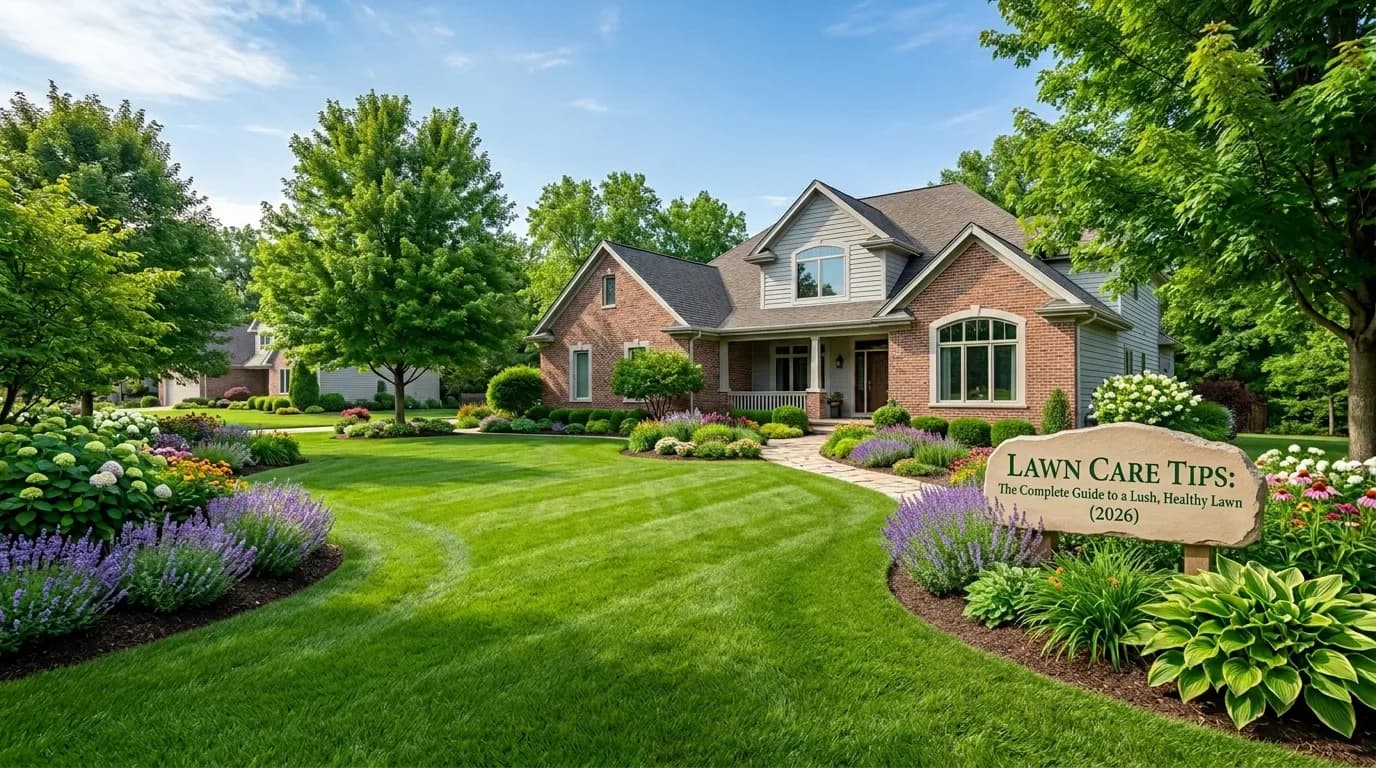
A thick, healthy lawn doesn't happen by accident. It's the result of understanding a handful of key principles — and timing each task correctly. This guide covers every major lawn care category with the specific numbers that make the difference between a lawn that survives and one that thrives.
Mowing: The Foundation of Lawn Health
Never Cut More Than One-Third at a Time
The single most important mowing rule: never remove more than one-third of the blade length in a single cutting. Cutting more than a third stresses the grass, weakens root systems, and opens the door to disease and weed invasion.
What this means in practice:
- If your lawn is mowed to 3 inches, mow again when it reaches 4.5 inches
- During fast spring growth, you may need to mow twice per week
- During summer dormancy, you may go 2–3 weeks between cuts
Mowing Heights by Grass Type
| Grass Type | Ideal Height | Season |
|---|---|---|
| Kentucky Bluegrass | 2.5–3.5 inches | Cool season |
| Tall Fescue | 3–4 inches | Cool season |
| Perennial Ryegrass | 2–3 inches | Cool season |
| Fine Fescue | 2.5–4 inches | Cool season |
| Bermuda | 1–2 inches | Warm season |
| Zoysia | 1–2.5 inches | Warm season |
| St. Augustine | 2.5–4 inches | Warm season |
| Centipede | 1.5–2 inches | Warm season |
| Buffalo Grass | 2–3 inches | Warm season |
Keep Blades Sharp
A dull mower blade tears grass instead of cutting it cleanly. Torn grass leaves ragged, tan tips that make the lawn look brown and stressed, and create entry points for disease. Sharpen blades at least twice per season — spring and midsummer. A sharp blade creates a clean cut that heals quickly.
Mow in the Morning or Evening
Avoid mowing in midday heat when grass is already stressed. Morning mowing (after the dew dries) or evening mowing are both ideal. Wet grass clumps on the mower deck and creates uneven cuts.
Leave Clippings on the Lawn
Grass clippings decompose rapidly and return nitrogen to the soil — a phenomenon called "grasscycling." Leaving clippings reduces fertilizer needs by approximately 25%. The myth that clippings cause thatch is just that — a myth. Thatch is caused by excessive lignin-rich stem tissue, not leaf clippings.
Watering: Deep and Infrequent
The 1-Inch Rule
Most lawns need about 1 inch of water per week, including rainfall. This sounds simple, but the method matters enormously. Two approaches:
Wrong: Watering shallowly every day (produces shallow roots, drought-vulnerable turf, fungal issues)
Right: Watering 1 inch, once or twice per week (promotes deep roots, drought resilience)
How to Measure 1 Inch
Place empty tuna cans or rain gauges across the lawn while running irrigation. When they collect 1 inch, you're done. For most rotary sprinklers, this takes 30–45 minutes. For oscillating sprinklers, 45–60 minutes.
Best Time to Water
Water in early morning (5–9 AM). This allows the water to soak in before midday evaporation and gives the grass blades time to dry before nightfall. Nighttime watering keeps grass wet for 8+ hours, creating ideal fungal disease conditions.
Signs Your Lawn Needs Water
- Grass blades fold lengthwise (the leaf rolls to reduce evaporation)
- Footprints remain visible in the lawn for more than a few minutes (the grass doesn't spring back)
- Grass color shifts from bright green to dull grayish-green
Adjust for Weather and Season
During heat waves and drought, increase to 1.5 inches per week. In cool, rainy spring weather, you may need zero supplemental irrigation. Install a rain sensor on your irrigation controller — they cost $15–$40 and prevent automatic systems from running during or after rain.
Fertilizing: Feed the Soil, Not Just the Grass
Understand the N-P-K Ratio
Every bag of fertilizer shows three numbers — nitrogen (N), phosphorus (P), and potassium (K). For established lawn maintenance, nitrogen drives green growth and is the most important number. A 32-0-10 fertilizer is 32% nitrogen, 0% phosphorus, 10% potassium.
| Nutrient | Function | When Needed |
|---|---|---|
| Nitrogen (N) | Green leafy growth, color | Every 6–8 weeks during growing season |
| Phosphorus (P) | Root development, seed germination | When establishing new lawn or overseeding |
| Potassium (K) | Disease resistance, drought tolerance, cold hardiness | Fall application; stressed lawns |
Fertilizing Schedule by Season
Cool-Season Grasses (Kentucky Bluegrass, Fescue, Ryegrass):
- Early Spring (March–April): Light application — 0.5 lb N per 1,000 sq ft. Kick-starts green-up without promoting lush growth that's vulnerable to disease.
- Late Spring (May): Moderate application — 0.75 lb N per 1,000 sq ft. Last application before summer stress.
- Late Summer (August–September): Most important feeding — 1 lb N per 1,000 sq ft. Rebuilds carbohydrate reserves after summer heat.
- Fall (October–November): Winterizer application — 1 lb N per 1,000 sq ft. Builds roots and cold hardiness.
Warm-Season Grasses (Bermuda, Zoysia, St. Augustine, Centipede):
- Late Spring (April–May): First application — 1 lb N per 1,000 sq ft. After grass breaks dormancy and temperatures are consistently above 70°F.
- Summer (June–July): 0.5–1 lb N per 1,000 sq ft. Active growing season feeding.
- Late Summer (August): Final application — 0.5 lb N per 1,000 sq ft. Stop by September 1 to avoid stimulating tender growth before frost.
Slow-Release vs. Fast-Release Fertilizers
| Type | Pros | Cons | Best Use |
|---|---|---|---|
| Slow-release synthetic | Even feeding, less burn risk, fewer applications | More expensive per lb N | Ideal for most home lawns |
| Fast-release synthetic | Immediate results, cheaper | Burn risk if over-applied, short-lived | Quick green-up, overseeding |
| Organic (compost, milorganite) | Improves soil biology, no burn risk, long-lasting | Lower N percentage, slower results | Building soil health over time |
Soil Testing Before Fertilizing
A $20 soil test from your local extension service (or a mail-in kit) tells you exactly what your soil needs. Over-applying phosphorus causes environmental runoff issues; over-applying nitrogen causes thatch buildup and disease. Test every 2–3 years and fertilize based on actual deficiencies, not guesswork.
Weed Control: Prevent First, Treat Second
Pre-Emergent Herbicides
Pre-emergent herbicides prevent weed seeds from germinating. They don't kill existing weeds — they create a barrier that stops new seeds from sprouting. Apply:
- Spring: When soil temperature reaches 50–55°F consistently (forsythia bloom is the traditional soil temp indicator). Controls crabgrass, annual bluegrass, and other summer annuals.
- Fall: Controls cool-season annuals like annual bluegrass (Poa annua) in warm-season lawns.
Critical: Don't apply pre-emergent if you plan to overseed — it will also prevent your grass seed from germinating.
Post-Emergent Herbicides
Post-emergent herbicides kill weeds that have already emerged. The two main types:
- Selective: Kills broadleaf weeds (dandelions, clover, chickweed) without harming grass — products like Weed-B-Gon or Trimec.
- Non-selective (glyphosate/Roundup): Kills everything — use only for spot-treating bare areas or removing existing lawn before renovation.
Cultural Weed Control
The best weed control is a dense, healthy lawn. Weeds colonize thin, weak turf. Strategies:
- Maintain proper mowing height (taller grass shades out weed seedlings)
- Overseed thin areas in fall to outcompete weeds
- Core aerate to reduce compaction and improve turf density
- Avoid over-watering (many weeds thrive in wet conditions)
Aeration: Breaking Through Compaction
Why Aerate
Over time, foot traffic, mowing equipment, and normal soil settling compact the soil. Compacted soil has fewer air pockets, drains poorly, and makes it hard for grass roots to penetrate deeply. Annual aeration reverses compaction.
Types of Aeration
| Type | Method | Best For |
|---|---|---|
| Core (plug) aeration | Removes soil plugs 2–4 inches deep | Most lawn situations — best results |
| Spike aeration | Pokes holes without removing soil | Very light compaction only; can worsen heavy compaction |
| Liquid aeration | Spray product that loosens soil | Supplement to core aeration; good for between years |
When to Aerate
- Cool-season lawns: Late summer to early fall (August–October). Grass is recovering from summer stress and about to enter its best growing season.
- Warm-season lawns: Late spring to early summer (May–June). Grass is actively growing and can fill in aeration holes quickly.
After Aeration
Leave the soil plugs on the surface — they break down within 2–3 weeks, returning organic matter to the soil. Apply overseeding immediately after core aeration — the aeration holes create ideal seed-to-soil contact.
Overseeding: Thickening a Thin Lawn
Why Overseed
Even a healthy lawn thins over time due to disease, foot traffic, drought, and the natural 3–5 year lifespan of individual grass plants. Overseeding annually (for cool-season lawns) or every few years (warm-season lawns) maintains thick, dense turf that crowds out weeds.
Overseeding Process
- 1Mow short: Cut the lawn to 1.5–2 inches before overseeding so seed reaches the soil.
- 2Core aerate: For best results, aerate immediately before overseeding.
- 3Apply seed: 3–5 lbs per 1,000 sq ft for light overseeding; 6–8 lbs for thin or bare areas.
- 4Topdress: Spread ¼ inch of compost over the seeded area to improve seed-to-soil contact and moisture retention.
- 5Water: Keep the top ½ inch of soil consistently moist until germination (7–21 days depending on species).
- 6Don't apply pre-emergent: Skip pre-emergent in fall if you're overseeding — it will prevent germination.
Seed Selection for Overseeding
Match your seed to your existing turf type. Mixing incompatible grasses creates a patchy, inconsistent look. Buy certified seed with high germination rates — cheap seed often has high weed seed content. For shady areas, choose a shade-tolerant fescue blend.
Seasonal Lawn Care Calendar
| Month | Cool-Season Lawns | Warm-Season Lawns |
|---|---|---|
| January | Dormant — no action needed | Dormant — no action needed |
| February | Sharpen blades, test soil | Sharpen blades, test soil |
| March | Light fertilizer, pre-emergent | Watch for green-up |
| April | Mowing begins, weed treatment | Pre-emergent, first mow |
| May | Final spring fertilizer | First fertilizer, irrigation on |
| June | Raise mowing height for summer | Peak mowing season, fertilize |
| July | Water deeply, minimal fertilizer | Fertilize, watch for chinch bugs |
| August | Aerate, core, overseed | Final fertilizer, start prep |
| September | Primary overseed & fertilizer | Aerate if needed |
| October | Winterizer fertilizer | Last mow before dormancy |
| November | Final cleanup, blade storage | Dormant — no action needed |
| December | Dormant — equipment maintenance | Dormant — no action needed |
Common Lawn Problems and Solutions
Yellow or Pale Green Grass
Causes: Nitrogen deficiency, iron chlorosis, compaction, overwatering
Fix: Soil test first. Nitrogen deficiency → fertilize. Chlorosis in high-pH soil → apply iron sulfate. Compaction → aerate.
Bare or Thin Patches
Causes: Disease, insect damage, heavy foot traffic, shade, drought
Fix: Identify cause before reseeding. Shadow analysis for shade issues. Apply appropriate fungicide for disease. Reseed after fixing the cause.
Moss in the Lawn
Cause: Compaction, poor drainage, low soil pH, heavy shade
Fix: Aerate, improve drainage, lime to raise pH, consider shade-tolerant groundcover in deeply shaded areas.
Mushrooms
Cause: Buried wood decomposing underground (old tree roots, construction debris)
Fix: No treatment kills underground fungal mycelium short of excavation. Remove mushrooms when they appear to prevent spore spread. Eventually the wood source decomposes and mushrooms stop.
Design Your Whole Yard Around Your Lawn
A healthy lawn is just one component of a beautiful property. If you're ready to see what your whole yard could look like — lawn, beds, hardscape, and all — try Yardcast's free AI design tool. Get 3 professional landscape concepts tailored to your exact yard size, style preferences, and budget in under 60 seconds.
FAQ: Lawn Care Questions Answered
<script type="application/ld+json">
{
"@context": "https://schema.org",
"@type": "FAQPage",
"mainEntity": [
{
"@type": "Question",
"name": "How often should I water my lawn?",
"acceptedAnswer": {
"@type": "Answer",
"text": "Water your lawn 1 inch per week, applied in 1–2 sessions rather than daily. Deep, infrequent watering promotes deep root growth and drought resilience. Daily shallow watering creates shallow roots and fungal disease. Use a tuna can or rain gauge to measure — most sprinkler systems need 30–45 minutes per zone to deliver 1 inch."
}
},
{
"@type": "Question",
"name": "When should I fertilize my lawn?",
"acceptedAnswer": {
"@type": "Answer",
"text": "For cool-season grasses (bluegrass, fescue, ryegrass): fertilize in early spring, late spring, late summer, and fall — with the late summer and fall applications being most important. For warm-season grasses (bermuda, zoysia, st. augustine): fertilize from late spring through late summer only. Never fertilize dormant grass."
}
},
{
"@type": "Question",
"name": "What is the best height to cut grass?",
"acceptedAnswer": {
"@type": "Answer",
"text": "Ideal mowing height depends on grass type. Kentucky Bluegrass: 2.5–3.5 inches. Tall Fescue: 3–4 inches. Bermuda: 1–2 inches. Zoysia: 1–2.5 inches. St. Augustine: 2.5–4 inches. Mow higher in summer heat and shade. Never remove more than one-third of the blade in a single cutting."
}
},
{
"@type": "Question",
"name": "When is the best time to overseed a lawn?",
"acceptedAnswer": {
"@type": "Answer",
"text": "Late summer to early fall (August–October) is the best time to overseed cool-season lawns. Soil is warm enough for fast germination, air temperatures are cooling down for strong establishment, and spring weeds aren't competing yet. For warm-season lawns, overseed in late spring (May–June) when soil temperatures are above 70°F consistently."
}
},
{
"@type": "Question",
"name": "How do I get rid of weeds in my lawn without killing the grass?",
"acceptedAnswer": {
"@type": "Answer",
"text": "Use selective post-emergent herbicides (like Weed-B-Gon or Trimec) which kill broadleaf weeds like dandelions and clover while leaving grass unharmed. For prevention, apply pre-emergent herbicide in early spring when soil hits 50°F. Long-term, the best weed control is a thick, healthy lawn — dense turf leaves no room for weeds to establish."
}
},
{
"@type": "Question",
"name": "How often should I aerate my lawn?",
"acceptedAnswer": {
"@type": "Answer",
"text": "Aerate cool-season lawns once per year in late summer/early fall. Aerate warm-season lawns once per year in late spring. Lawns with heavy clay soil, significant foot traffic, or visible compaction may benefit from twice-yearly aeration. Always use core (plug) aeration rather than spike aeration for meaningful results."
}
},
{
"@type": "Question",
"name": "Why is my lawn yellow?",
"acceptedAnswer": {
"@type": "Answer",
"text": "Yellow lawn is most commonly caused by nitrogen deficiency (fertilize with a balanced lawn fertilizer), iron chlorosis in high-pH soils (apply iron sulfate or sulfur to lower pH), overwatering (scale back irrigation), or compaction (core aerate). Get a soil test first — it identifies the specific deficiency and prevents you from applying the wrong product."
}
},
{
"@type": "Question",
"name": "Should I leave grass clippings on the lawn?",
"acceptedAnswer": {
"@type": "Answer",
"text": "Yes. Leaving grass clippings on the lawn (grasscycling) returns nitrogen and organic matter to the soil, reducing fertilizer needs by approximately 25%. Clippings don't cause thatch — thatch comes from excessive stem tissue, not leaf clippings. Only remove clippings if the lawn is diseased or if clippings are so thick they smother the grass."
}
}
]
}
</script>