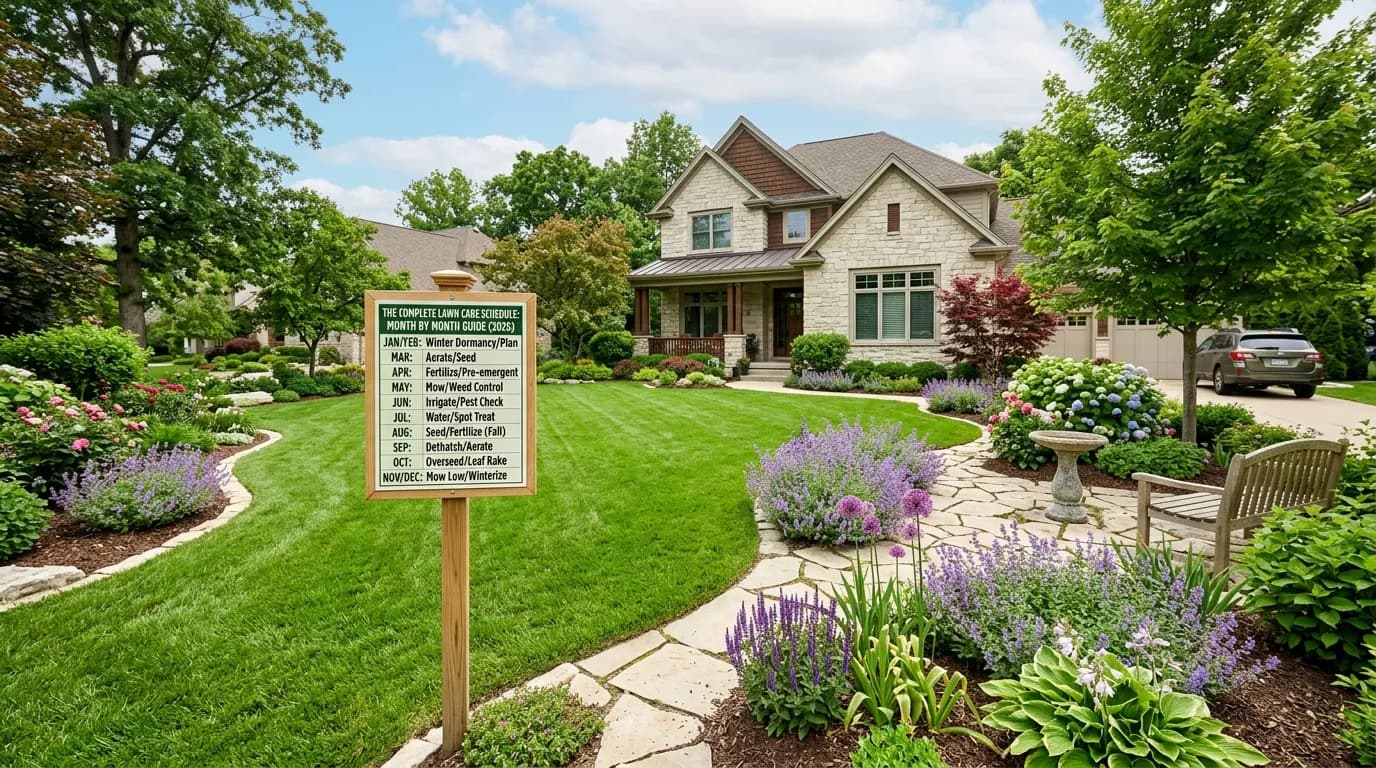
Most homeowners approach lawn care reactively — mowing when it looks shaggy, fertilizing whenever the bag is on sale, and aerating when a neighbor mentions it. The result is a lawn that always looks like it's recovering from something.
The solution is a proper lawn care schedule: a month-by-month plan that puts every task in the right window, matches your grass type to your climate, and stacks inputs so each one amplifies the next. This guide gives you exactly that — a complete annual schedule for both cool-season and warm-season grasses, with regional adjustments for every US climate zone.
Cool-Season vs. Warm-Season Grasses: The Foundational Divide
Before any schedule makes sense, you need to know which grass type you have. The entire calendar flips depending on this.
Cool-season grasses grow actively in spring and fall, go semi-dormant in summer heat, and stay green through mild winters. They're most common in the northern half of the US.
| Grass Type | Best Zones | Looks Best |
|---|---|---|
| Kentucky Bluegrass | 3–6 | Spring + Fall |
| Tall Fescue | 4–7 | Spring + Fall |
| Fine Fescue | 3–6 | Spring + Fall |
| Perennial Ryegrass | 4–7 | Spring + Fall |
Warm-season grasses grow vigorously in summer, go dormant and brown in winter, and are most common in the southern US and transition zone.
| Grass Type | Best Zones | Looks Best |
|---|---|---|
| Bermuda | 7–11 | Summer |
| Zoysia | 6–10 | Summer |
| St. Augustine | 8–11 | Summer |
| Centipede | 7–9 | Summer |
| Bahia | 7–11 | Summer |
If you're unsure which you have, look at it in August: if it's green and lush, it's warm-season. If it looks stressed or thin, it's likely cool-season.
The Complete Optional upgrade Lawn Care Schedule
January & February — Planning Season
Cool-season lawns: Dormant under snow or cold. Do nothing. This is the best time to:
- Test soil pH and nutrients (soil tests are most accurate in winter)
- Service your mower, sharpen blades, change oil and air filter
- Sketch out any spring overseeding or renovation plans
- Order grass seed early — spring supplies sell out
Warm-season lawns: Also dormant, brown, and dormant in most zones. Same planning applies. Avoid foot traffic on frozen or dormant grass — it damages crowns.
Regional note: In zones 9–11 (South Florida, Southern California, Gulf Coast), warm-season grasses may remain active through "winter." Maintain mowing but scale back fertilizing — growth is slower and excess nutrients leach in winter rain.
March — Early Spring Activation
Cool-season lawns: Soil temperature is the trigger — when it reaches 50°F (use a cheap probe thermometer), roots are active and ready for nutrients.
Tasks:
- Apply a pre-emergent herbicide when soil hits 50–55°F to prevent crabgrass germination. Timing is everything — too early and it breaks down before crabgrass germinates; too late and it's ineffective.
- Apply a light fertilizer application (slow-release nitrogen, ¾ lb N per 1,000 sq ft). Don't over-fertilize in early spring — you'll push excessive top growth at the expense of root development.
- Begin mowing once grass actively grows. Start high (3–4 inches for most cool-season grasses) and don't remove more than one-third of the blade in any single mowing.
Warm-season lawns: Still dormant in most zones. Do not fertilize before green-up — applying nitrogen to dormant grass invites weeds. Apply pre-emergent herbicide as soil approaches 65°F.
Plant a spring landscape while you're out there: If your lawn edges look thin or your front yard needs a refresh, Yardcast's AI landscape designer can generate three complete layout options — including edging, beds, and turf areas — in under 60 seconds.
April — Spring Green-Up
Cool-season lawns: Peak spring growth period. This is the most demanding lawn month.
Tasks:
- Mowing: Establish a consistent schedule. Set mower height at 3–3.5 inches. Taller grass shades soil, suppresses weeds, and develops deeper roots.
- Fertilizing: If you didn't apply in March, apply now. Use a balanced slow-release formula.
- Weed control: Spot-treat dandelions and broadleaf weeds with a selective post-emergent herbicide (2,4-D or triclopyr). Avoid lawn-wide spraying in spring — broadleaf control works best above 60°F.
- Bare spot repair: Overseed thin or bare areas now while temperatures are still cool. Rake bare spots, broadcast seed at label rate, top-dress with ¼ inch of topsoil or compost, water daily until germinated.
Warm-season lawns: Green-up begins as daytime temperatures consistently hit 70°F+.
- First fertilization: Apply once the lawn is 50% green. Use a balanced or nitrogen-forward fertilizer (¾–1 lb N per 1,000 sq ft).
- Begin mowing once actively growing. Scalp bermuda and zoysia to ½–1 inch in early spring to remove dead thatch and encourage lateral spread.
May — Full Spring Care
Cool-season lawns: Growth rate slows slightly as temperatures climb.
Tasks:
- Second fertilizer application: Apply if using a split schedule (½ rate in April, ½ rate in May). Skip if you applied a heavy spring dose — you don't need more nitrogen until fall.
- Mowing frequency: Every 5–7 days at consistent height. Don't skip mowing and then cut more than one-third at once.
- Water: Begin supplemental irrigation if April–May rainfall is below 1 inch/week. Lawns need 1–1.5 inches of water per week total (rain + irrigation). Water deeply (30–45 minutes per zone) less frequently rather than shallow daily watering.
Warm-season lawns: Full growth mode.
- Second fertilizer application (optional). Many warm-season lawns do well with a May boost, especially bermuda.
- Increase mowing frequency to every 5–7 days.
June — Early Summer Stress Period
Cool-season lawns: Growth slows as temperatures hit 80°F+. The lawn is entering its summer stress period.
Key rule: stop fertilizing cool-season grass in late May/June. Applying nitrogen in summer heat pushes soft, disease-prone growth. Instead:
- Focus entirely on consistent watering (1–1.5 inches/week)
- Raise mowing height to 3.5–4 inches — taller grass shades roots and reduces heat stress
- Watch for grubs (white C-shaped larvae 3–4 inches deep) — treat in June with a preventive grub control product if your area has history of damage
Warm-season lawns: Peak season — growing fast, looking great.
- Fertilize every 4–6 weeks with a nitrogen-rich formula (¾–1 lb N per 1,000 sq ft)
- Irrigate deeply 2–3 times per week
- Mow frequently to maintain recommended height (Bermuda: ½–1.5 in; Zoysia: 1–2 in; St. Augustine: 3–4 in)
July & August — Peak Summer Management
Cool-season lawns: Survival mode. The goal is to keep the lawn alive and healthy, not push growth.
Tasks:
- Watering: Non-negotiable in summer heat. 1–1.5 inches/week. Water before 10 AM to reduce evaporation and disease pressure.
- Mowing: Keep blades sharp. Dull blades shred grass and increase disease susceptibility. Mow at 3.5–4 inches.
- Optional: Allow controlled dormancy if water is expensive or restricted. Dormant cool-season grass looks brown but usually recovers in fall.
- Grub prevention: Apply grub controls (imidacloprid, chlorantraniliprole) in June–July per label timing.
Warm-season lawns: Continue the June schedule. Watch for chinch bugs in St. Augustine, fall armyworms in bermuda, and brown patch fungus in humid climates.
Mid-article check: If your landscape around your lawn looks neglected — thin beds, dated edging, no focal points — get a free Yardcast AI design preview. Upload a photo, describe your style, and see what your yard could look like in 60 seconds.
September — The Most Important Month for Cool-Season Lawns
September is when cool-season grass wakes back up — and the work you do now determines how your lawn looks for the next 12 months.
Cool-season lawns — Fall is your season:
Aeration (most important fall task):
- Core aerate in early September when soil is moist but not saturated
- Aeration relieves compaction, improves water infiltration, and makes overseeding far more effective
- Rent a core aerator or hire a service — plug aerators (cheap rentals) work; spike aerators do not
Overseeding:
- Overseed immediately after aeration — plugs create perfect seed-to-soil contact
- Broadcast seed at recommended rate for your grass type
- Water daily (keep surface moist) until germination (7–21 days depending on type)
- Timing: September 1–15 in zones 4–5, September 15–October 1 in zones 6–7
Fertilization:
- Apply your most important fertilizer application of the year: a high-nitrogen formula in early September to support fall root development. This is the application that carries the lawn through winter and fuels explosive spring green-up.
- Second application in late October (see below).
Warm-season lawns:
- Begin tapering off fertilizer in early September — stop by mid-September. Late fertilizing pushes soft growth before frost.
- Reduce irrigation as temperatures cool.
- Consider overseeding with perennial ryegrass in zones 7–9 for winter color (optional).
October — Fall Wind-Down
Cool-season lawns:
- Second fall fertilization: Apply a winterizer fertilizer (high potassium, lower nitrogen) in late October–early November. Potassium hardens grass tissue and improves winter hardiness.
- Leaf management: Don't let leaves smother the lawn. Mulch them with the mower if thin; rake or blow if heavy. Thick leaf mats cause snow mold and disease.
- Mowing: Continue until grass stops growing. Do a final mow at 2.5–3 inches going into winter — too long and it mats; too short and it's vulnerable to cold.
Warm-season lawns:
- Dormancy approaching. Stop fertilizing. Reduce mowing frequency.
- Enjoy ryegrass overseeding if you did it in September.
November & December — Winterization
Cool-season lawns:
- Drain and winterize irrigation system before first freeze
- Final mow if needed
- Avoid heavy foot traffic on frost-covered grass
- Store fertilizer and chemicals appropriately for winter
Warm-season lawns: Fully dormant. Same winterization tasks. Some maintenance of dormant lawns with temporary ryegrass cover (if overseeded) through mild winters.
Annual Lawn Care Calendar at a Glance
| Month | Cool-Season Grass | Warm-Season Grass |
|---|---|---|
| Jan–Feb | Dormant; sharpen equipment | Dormant; plan season |
| March | Pre-emergent; light fertilize | Pre-emergent as soil warms |
| April | Spring fertilize; spot-weed; overseed bare spots | Green-up; first fertilize |
| May | Water 1–1.5 in/week; mow at 3.5 in | Fertilize; mow frequently |
| June | Stop fertilizing; raise mowing height | Fertilize monthly; water 2–3x/week |
| July–Aug | Water; mow high; grub control | Peak season care; pest watch |
| September | AERATE + OVERSEED + FERTILIZE | Taper fertilizer; stop mid-month |
| October | Winterizer fertilize; leaf management | Dormancy begins |
| Nov–Dec | Winterize irrigation; final mow | Dormant |
Mowing Height Quick Reference
| Grass Type | Normal Height | Summer Stress Height |
|---|---|---|
| Kentucky Bluegrass | 2.5–3.5 in | 3.5–4 in |
| Tall Fescue | 3–4 in | 4 in |
| Perennial Ryegrass | 2.5–3.5 in | 3.5 in |
| Bermuda | 0.5–1.5 in | 1.5–2 in |
| Zoysia | 1–2 in | 2 in |
| St. Augustine | 3–4 in | 4 in |
| Centipede | 1–2 in | 2 in |
The 1/3 rule: Never remove more than one-third of the grass blade in any single mowing. Cutting more than that scalps the lawn, exposes stems, and sets recovery back weeks.
Fertilizer Schedule Summary
Cool-season grass fertilizer timing (lb nitrogen per 1,000 sq ft):
- 1Early spring (April): 0.5–0.75 lb N
- 2Late spring (May, optional): 0.5 lb N
- 3Early fall (September): 1.0 lb N ← most important
- 4Late fall (October/November): 0.5–0.75 lb N (winterizer)
Warm-season grass fertilizer timing:
- 1After green-up (April/May): 0.75–1 lb N
- 2June: 0.75–1 lb N
- 3July: 0.75–1 lb N
- 4August: 0.75–1 lb N
- 5Stop by mid-September
Water and Irrigation Guide
How much: 1–1.5 inches per week total (rain + irrigation). Use a rain gauge to measure.
When: Water early morning (5–9 AM). Watering at night keeps foliage wet and invites fungal disease.
How: Water deeply and infrequently. One 45-minute cycle per zone (2–3 times per week) is far better than 10-minute daily cycles. Deep watering drives roots down; shallow watering keeps roots near the surface where they're vulnerable to heat and drought.
Signs your lawn needs water: Footprints that don't spring back, bluish-gray tinge to the grass, leaf blades folding lengthwise.
Signs of overwatering: Spongy soil, standing water, persistent mushrooms, fungal disease, runoff.
Ready to Transform the Rest of Your Yard?
A beautiful lawn is the canvas — but beds, borders, trees, and hardscaping are what make a yard truly stunning. If you're working on your lawn and your landscape looks dated, try Yardcast's free AI landscape design preview. Upload a photo of your yard, describe your style and budget, and get three professional AI-generated designs with plant lists, cost estimates, and a phased implementation plan — in under 60 seconds.
FAQ: Lawn Care Schedule
<script type="application/ld+json">
{
"@context": "https://schema.org",
"@type": "FAQPage",
"mainEntity": [
{
"@type": "Question",
"name": "When should I fertilize my lawn?",
"acceptedAnswer": {
"@type": "Answer",
"text": "For cool-season grasses (Kentucky Bluegrass, Fescue, Ryegrass): fertilize in early spring (April), optionally in May, and most importantly in September (largest application) and again in October/November with a winterizer. For warm-season grasses (Bermuda, Zoysia, St. Augustine): fertilize monthly from green-up (April/May) through August. Stop fertilizing cool-season grasses in summer and stop warm-season grasses by mid-September."
}
},
{
"@type": "Question",
"name": "When should I aerate my lawn?",
"acceptedAnswer": {
"@type": "Answer",
"text": "Aerate cool-season lawns in early-to-mid September — this is the most important lawn care task of the year for northern lawns. Aerating during active fall growth allows the lawn to recover quickly and benefits from overseeding at the same time. Aerate warm-season lawns in late spring (May–June) when they're growing vigorously. Avoid aerating during dormancy or summer heat stress."
}
},
{
"@type": "Question",
"name": "When is the best time to overseed a lawn?",
"acceptedAnswer": {
"@type": "Answer",
"text": "The best time to overseed cool-season lawns is early fall — September 1–15 in zones 4–5, September 15–October 1 in zones 6–7. Fall overseeding gives new grass 6–8 weeks to establish before cold, with lower disease pressure and more consistent moisture than summer. Spring is a secondary option but competes with weed germination. Warm-season lawns can be overseeded with perennial ryegrass in fall for winter color."
}
},
{
"@type": "Question",
"name": "How often should I water my lawn?",
"acceptedAnswer": {
"@type": "Answer",
"text": "Lawns need 1–1.5 inches of water per week total (including rain). Water deeply and infrequently — 2–3 times per week for 30–45 minutes per zone is ideal, rather than light daily watering. Water early morning (5–9 AM) to reduce evaporation and disease. In summer heat, cool-season grasses may need up to 2 inches per week to stay green, or can be allowed to go dormant (they recover in fall)."
}
},
{
"@type": "Question",
"name": "When should I apply pre-emergent herbicide?",
"acceptedAnswer": {
"@type": "Answer",
"text": "Apply pre-emergent herbicide for crabgrass control when soil temperature reaches 50–55°F in spring — typically late March in zones 6–7, early April in zones 4–5. A common timing trick: apply when forsythia bushes are in full bloom. A second application 6–8 weeks later improves season-long control. Do not apply pre-emergent if you plan to overseed — it will prevent grass seed germination too."
}
},
{
"@type": "Question",
"name": "What is the best lawn care schedule for Bermuda grass?",
"acceptedAnswer": {
"@type": "Answer",
"text": "Bermuda grass schedule: Apply pre-emergent when soil hits 65°F (early spring). Fertilize after green-up (May) and monthly through August with a nitrogen-rich formula (¾–1 lb N per 1,000 sq ft). Mow at ½–1.5 inches, every 5–7 days during the growing season. Dethatch in spring if thatch exceeds ½ inch. Aerate in May–June. Stop fertilizing by mid-September. Bermuda enters dormancy once nighttime temperatures drop below 50°F."
}
},
{
"@type": "Question",
"name": "How do I fix a patchy or thin lawn?",
"acceptedAnswer": {
"@type": "Answer",
"text": "For cool-season grasses: aerate in September, then broadcast seed over thin areas at the full seeding rate. Rake to improve seed-soil contact, top-dress with ¼ inch of topsoil, and water daily until germination (7–21 days). For warm-season grasses: thin areas fill in through lateral spread if the lawn is healthy — fertilize and water consistently in summer. Sod is faster for large bare areas. Check for underlying problems (compaction, shade, grubs, disease) before reseeding."
}
},
{
"@type": "Question",
"name": "Is it better to water every day or every few days?",
"acceptedAnswer": {
"@type": "Answer",
"text": "Every few days — deeply. Watering daily for short periods creates shallow roots that stay near the surface, making the lawn vulnerable to drought and heat. Watering 2–3 times per week for 30–45 minutes per zone drives roots 6+ inches deep, where soil stays cooler and more consistently moist. The goal is 1–1.5 inches of total water per week. Check by placing an empty tuna can in the irrigation zone — when it's full, you've applied about 1 inch."
}
}
]
}
</script>