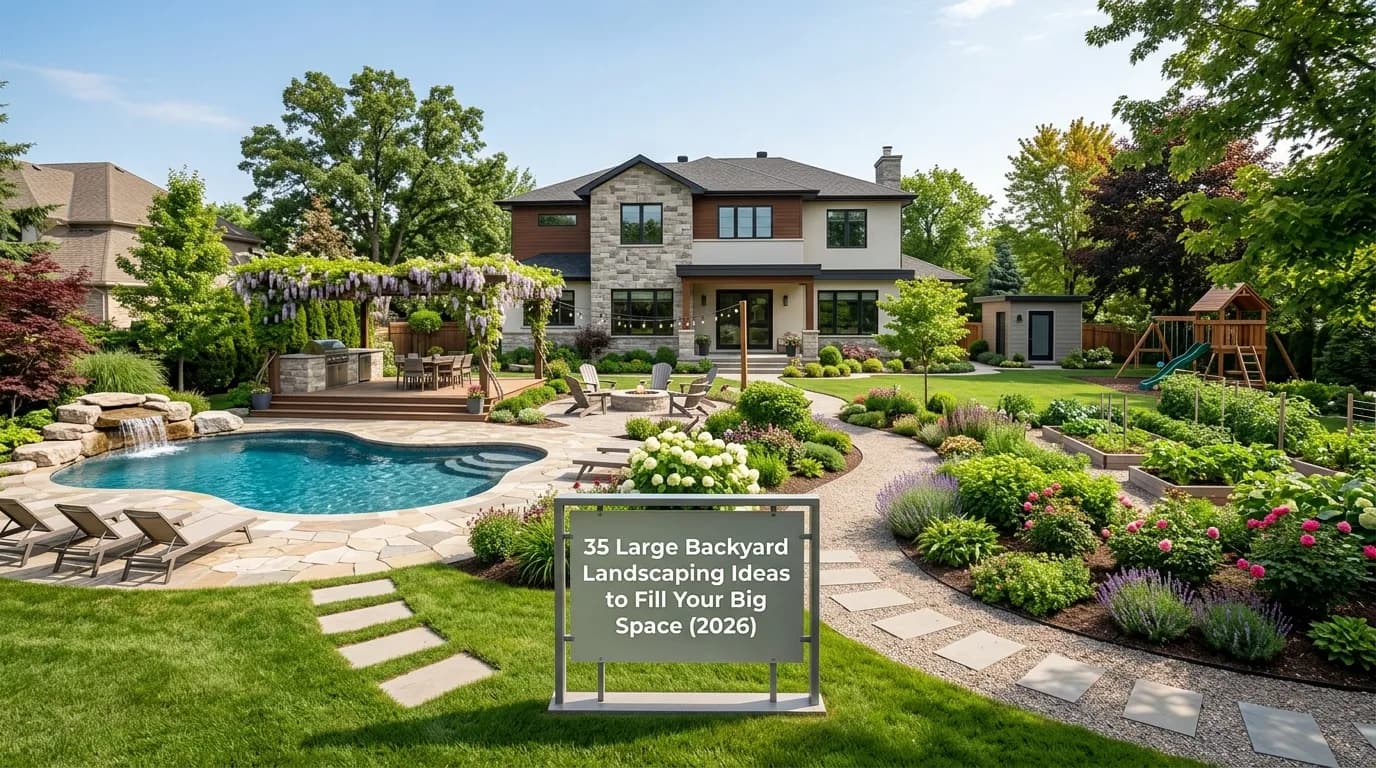
A large backyard sounds like a dream — until you're staring at 5,000 square feet of grass and don't know where to start. Big spaces have their own unique challenges: they can feel empty and disconnected, maintenance becomes overwhelming, and without structure they look more like an abandoned lot than an outdoor estate.
The good news: with the right landscaping strategy, a large backyard becomes your greatest asset. This guide covers 35 of the best large backyard landscaping ideas for 2026 — organized by zone — so you can design a big space that feels intentional, beautiful, and completely usable.
Why Large Backyards Need a Different Design Approach
Small yards are constrained by size. Large yards are constrained by emptiness. The psychological challenge of a big backyard is the opposite of a small one: instead of fitting everything in, you need to create meaning across a lot of open space.
Professional landscape designers approach large yards by breaking them into outdoor rooms — distinct zones with clear purpose, connected by pathways and visual transitions. Think of your backyard like a house: a living room (patio), a dining room (outdoor kitchen), a library (reading garden), a game room (lawn), and a wild zone (natural area or woods edge). Each room has its own character and boundaries.
The result: a yard that feels layered, rich, and purposeful rather than vast and empty.
Zone 1: The Entertainment Hub (Near the House)
The zone directly adjacent to your home is the most used and most viewed. This is where you invest the most per square foot.
1. Large-Format Paver Patio with Outdoor Living Room
For a large backyard, your patio should match the scale of the space. A 20×30 foot or larger patio in large-format concrete pavers (24×24 inch slabs) creates a genuine outdoor living room. Include a sectional sofa, coffee table, side tables, and an outdoor rug. A pergola or motorized louvered roof overhead defines the "ceiling" of the room.
Cost: $15,000–$45,000 installed depending on materials and size
2. Outdoor Kitchen with Island Bar
A large backyard justifies a full outdoor kitchen — not just a built-in grill, but a complete kitchen island with bar seating, refrigerator, side burners, sink, and storage. Use porcelain tile or granite countertop that can handle freeze/thaw cycles. Seat 6–8 at the bar for a true entertainment anchor.
Cost: $12,000–$40,000 for a full outdoor kitchen
3. Recessed Fire Pit Lounge Area
Set apart from the main patio, carve out a separate conversation zone centered on a large fire pit (48–60 inch diameter). Use a recessed design — drop the seating area 18–24 inches below grade with a poured concrete firepit — for a dramatic sunken lounge effect. Add Adirondack chairs, built-in stone benches, and a low stone wall perimeter.
Cost: $5,000–$18,000 depending on materials
4. Transition Garden Between Patio and Lawn
One of the biggest mistakes in large backyards: an abrupt transition from patio to grass with nothing in between. Add a transition planting bed 4–6 feet wide along the patio edge, filled with ornamental grasses, perennials, and flowering shrubs. This softens the edge, adds visual depth, and creates the sense of moving through a designed landscape rather than from hardscape to lawn.
> See how your specific yard would look with these ideas. Generate a free AI landscape design at Yardcast → Upload your backyard photos and get 3 photorealistic designs showing outdoor rooms, planting zones, and entertainment areas — tailored to your exact space.
Zone 2: The Lawn and Recreation Area (Middle Ground)
The middle zone of a large backyard is your multipurpose outdoor living space — flexible enough for lawn games, kids' play, or just open green space.
5. Shaped Lawn Panels (Not Wall-to-Wall Grass)
Instead of a single sea of grass, define the lawn as a shaped panel with curved or geometric borders, edged in steel or natural stone. The negative space of the shaped lawn reads as a designed element rather than default filler. This is the approach used by every professional landscape designer: the lawn is a room with walls (planting beds), not just leftover space.
6. Bocce Ball Court
A regulation bocce ball court is 12×76 feet — well within the capacity of most large backyards. Use crushed oyster shell or decomposed granite surface, bordered with cedar or steel edging, and flanked by a planting border. Bocce is one of the most-used backyard game installations because it works for all ages and all skill levels.
Cost: $1,500–$4,000 DIY; $3,500–$8,000 professionally installed
7. Putting Green
For golf enthusiasts, a synthetic turf putting green (400–800 sq ft) uses space that would otherwise be unused lawn and adds daily-use entertainment value. Professional installations include multiple cup placements, undulation built into the turf for realistic play, and a surrounding rough of ornamental grasses or native plantings.
Cost: $8,000–$20,000 professionally installed
8. Kids' Play Zone with Integrated Landscaping
A large backyard can accommodate a dedicated play zone without sacrificing the overall landscape design. Define the play area with a change in surfacing (rubber mulch, engineered wood fiber, or pea gravel), add a custom play structure, and surround it with a dense shrub border so the play equipment doesn't dominate views from the house. Use fast-growing arborvitae or ornamental grasses to frame and partially screen the play area.
9. Volleyball or Badminton Court
A regulation sand volleyball court (30×60 feet with run-off) fits comfortably in most large backyards. An adjustable net can convert the space to badminton or pickleball. Border the court with ornamental grasses and perennials to integrate it into the landscape design rather than leaving it as bare sand.
Cost: $3,000–$8,000 for a proper sand volleyball court
10. Swimming Pool with Surround Landscaping
If your large backyard doesn't have a pool, it might be the single highest-return investment. In-ground pools in the Sun Belt increase property value by $20,000–$40,000 on average. Design the pool as a destination by surrounding it with a planted buffer: palm trees for tropical effect, ornamental grasses and perennials for naturalistic style, or formal evergreen hedging for a classic estate look. The pool surround — decking material, coping, and planting — is as important as the pool itself.
Cost: $35,000–$80,000 for a pool; $8,000–$20,000 for surround landscaping
Zone 3: The Garden Destination (Far End)
The far end of a large backyard is where you create a destination — a place to walk to that rewards the journey. Without a destination, the far end of a big yard is simply where the lawn ends.
11. Pergola or Pavilion Destination
A freestanding pergola or pavilion at the far end of the yard creates an irresistible destination. Hang a porch swing or install a daybed under it. Train climbing roses, wisteria, or clematis over the structure. Add a low-voltage light string for evening ambiance. This transforms dead lawn into a place people actually go.
Cost: $5,000–$25,000 depending on material and size
12. Orchard or Fruit Garden
A row of 8–12 dwarf or semi-dwarf fruit trees (apple, pear, peach, cherry) creates a destination orchard that's beautiful in spring bloom, productive in summer, and structurally interesting all year. Underplant with a groundcover of strawberries, creeping thyme, or native grasses. Add a simple bench to sit in the orchard. Productive and beautiful.
Cost: $800–$3,000 for trees; $1,500–$5,000 with underplanting and seating
13. Meadow Garden
Replace the far portion of your lawn with a naturalistic meadow — a mix of native grasses and wildflowers that moves in the wind, attracts butterflies and birds, and needs mowing only once per year in late winter. Little Bluestem, Purple Coneflower, Black-Eyed Susan, and Switchgrass make a stunning mix. This dramatically reduces maintenance on the portion of the yard farthest from the house.
Cost: $2,000–$8,000 for seeding and establishment; saves hundreds in annual mowing
14. Water Feature — Pond or Stream
A natural-looking pond (15×20 feet minimum for visual impact) with aquatic plants, boulders, and a waterfall pump creates a destination ecosystem. Stock with goldfish or koi. Add a simple dock or viewing platform. The sound of moving water carries across a large backyard and provides ambiance even when you're not directly at the water.
Cost: $6,000–$25,000 installed by a water garden specialist
15. Cutting Flower Garden
A large, formal cutting garden (400–600 sq ft) with raised beds filled with dahlias, zinnias, sunflowers, snapdragons, and sweet peas gives you fresh flowers for the house all summer. Organize beds with a brick or stone path running between them, a central focal point (sundial, urn, or birdbath), and a seating area at the end. This works as a beautiful destination garden even when you're not cutting.
Zone 4: Structure and Boundaries
Large backyards need strong boundary and structure plantings to feel contained, private, and designed.
16. Evergreen Privacy Screen Along Property Line
Plant a row of fast-growing evergreens — Emerald Green Arborvitae (5-6 feet spacing), Green Giant Arborvitae (8-10 feet spacing), or Sky Pencil Holly (2-3 feet spacing for a narrow column) — along all property lines. This single investment transforms a large open backyard into a private enclosed estate within 3–5 years.
| Plant | Mature Height | Growth Rate | Spacing | 5-gal Cost |
|---|---|---|---|---|
| Green Giant Arborvitae | 40–60 ft | 3–5 ft/year | 8–10 ft | $30–$60 |
| Emerald Green Arborvitae | 12–14 ft | 1–2 ft/year | 4–6 ft | $20–$50 |
| Nellie Stevens Holly | 20–25 ft | 2–3 ft/year | 5–8 ft | $30–$70 |
| American Holly | 25–35 ft | 1–2 ft/year | 8–12 ft | $40–$80 |
| Leyland Cypress | 60–70 ft | 3–4 ft/year | 8–12 ft | $20–$50 |
17. Mixed Layered Border Along Fence Line
Rather than a single-species hedge, create a mixed border against the fence: tall evergreens at the back, then large flowering shrubs (viburnum, lilac, forsythia), then medium shrubs (knockout roses, spirea), then perennials at the front edge. This layered border creates incredible visual complexity and four-season interest.
Cost: $8,000–$20,000 for a full perimeter border on a large property
18. Specimen Shade Trees at Intervals
Place 3–5 large specimen shade trees (Bur Oak, Shumard Oak, Red Maple, Tulip Poplar) at strategic intervals through the backyard. These trees provide summer shade, create vertical scale, and — most importantly — divide the large space into smaller zones. A tree canopy overhead transforms dead open lawn into a shaded outdoor room. Tree placement is one of the highest-value long-term investments in a large yard.
Cost: $150–$600 per tree (15-gallon size); plant in fall for best establishment
Cost Overview: Large Backyard Landscaping
| Project | DIY Cost | Professional Cost |
|---|---|---|
| Full paver patio (400–600 sq ft) | $3,500–$7,000 | $12,000–$30,000 |
| Pergola or pavilion | $3,000–$10,000 | $8,000–$25,000 |
| Privacy hedge planting | $1,500–$4,000 | $4,000–$12,000 |
| In-ground pool | N/A | $35,000–$80,000 |
| Outdoor kitchen | $5,000–$15,000 | $15,000–$40,000 |
| Meadow conversion | $800–$3,000 | $2,500–$8,000 |
| Putting green | $4,000–$8,000 | $10,000–$20,000 |
| Pond/water feature | $1,500–$4,000 | $6,000–$25,000 |
| Full backyard transformation | $20,000–$60,000 | $60,000–$200,000+ |
Phasing Your Large Backyard Landscaping
A full large backyard transformation doesn't need to happen all at once. Phase it over 3–5 years:
Year 1 (Foundation): Privacy hedging along property lines; specimen trees; main patio; lawn shaping. These elements take longest to mature — plant them first.
Year 2 (Structure): Pergola or pavilion destination; transition planting beds; outdoor kitchen or fire pit.
Year 3 (Details): Cutting garden or orchard; meadow conversion; sport court; water feature.
Year 4–5 (Refinement): Fill in gaps, add lighting, install irrigation, add decorative elements.
A phased approach lets you spread costs, learn from the first phase, and adjust plans based on how you actually use the space.
10 More Large Backyard Ideas at a Glance
- 1Formal rose garden with a clipped box hedge border and central stone urn
- 2Outdoor bar shed — a custom built bar structure in a corner of the yard
- 3Movie projector lawn — level lawn area + outdoor projector setup for movie nights
- 4Sensory garden — scented plants, water sounds, and textural surfaces for a multi-sensory experience
- 5Treehouse — if you have a mature tree, a quality treehouse is a landmark landscape feature
- 6Archway tunnel — a series of metal arches over a path, trained with climbing roses or wisteria
- 7Secret garden room — an enclosed planting area accessed through a gate, invisible from the main yard
- 8Beehives and pollinator garden — functional and beautiful, beehives with a surrounding wildflower garden
- 9Clay or gravel tennis/pickleball court — 30×60 feet minimum, the ultimate entertainment investment
- 10Outdoor shower — near the pool or play area, a natural stone outdoor shower surrounded by bamboo screening
- 11Sunken fire pit — recessed 18–24 inches below grade for a dramatic lounge effect
- 12Wildflower strip — replace the lawn edges with a 3–4 foot wildflower border, reducing maintenance while adding beauty
- 13Artisan vegetable garden — raised cedar beds in a geometric pattern with gravel paths, a potting shed, and tool storage
- 14Hammock grove — 3–5 hammock posts (or trees) with hammocks hung between them, a shaded gravel pad underneath
- 15Outdoor yoga/fitness pad — a level 20×20 ft concrete or rubber pad with privacy screening of ornamental grasses
- 16Living fence — espalier fruit trees trained flat against a frame, both ornamental and productive
- 17Night garden — white-flowering plants (white roses, white hydrangeas, white phlox) that glow at dusk, combined with strategic lighting
Frequently Asked Questions About Large Backyard Landscaping
Q: How do I make a large backyard feel less overwhelming and empty?
A: Break the space into zones — outdoor rooms — connected by pathways. Use specimen trees to create overhead canopy and divide the space. Add destinations (a pergola, a garden, a fire pit) at different points so there's always somewhere to walk toward. Define the lawn as a shaped panel with planted borders rather than wall-to-wall grass.
Q: How much does it cost to landscape a large backyard?
A: A meaningful large backyard transformation typically costs $30,000–$100,000 for professional installation of a full design. A phased DIY approach spread over 3–5 years can achieve excellent results for $15,000–$40,000. The highest-value investments are usually: privacy hedging (fast ROI in usability), specimen trees (long-term value), and a quality patio (daily use value).
Q: What plants work best for large backyard borders?
A: Mix large evergreen shrubs (viburnum, lilac, forsythia) for structure with flowering perennials (coneflower, black-eyed Susan, salvia) for seasonal color. Use ornamental grasses (Miscanthus, Panicum) for texture and movement. Place canopy trees (oak, maple) at intervals. The key is layering: canopy tree → large shrub → medium shrub → perennial → groundcover.
Q: How do I create privacy in a large backyard?
A: Fast-growing evergreen hedges are the most effective solution. Green Giant Arborvitae grows 3–5 feet per year and reaches 40 feet — plant them 8–10 feet apart for full screening in 5–7 years. For a more naturalistic screen, use a mixed layered border with evergreens, large shrubs, and ornamental grasses. Tall ornamental grasses like Miscanthus 'Maiden Hair' (6–7 feet) provide seasonal privacy and movement.
Q: Should I replace all my lawn in a large backyard?
A: No — lawn is a valuable outdoor living surface, especially for kids, pets, and games. But you likely have more lawn than you need. The sweet spot: keep a shaped, intentional lawn panel (2,000–3,000 sq ft) for active use and replace the rest with low-maintenance alternatives: meadow planting, ornamental garden beds, hardscape, or productive gardens. This reduces mowing by 40–60% while adding beauty.
Q: What's the best investment for a large backyard with zero landscaping?
A: In order of priority: (1) Specimen shade trees — they take decades to mature, plant immediately. (2) Privacy hedging — transforms the feel of the space immediately. (3) Shaped patio — daily use, highest quality-of-life return. (4) Destination structure (pergola/pavilion) — transforms the far end of the yard from empty grass to purposeful space. (5) Everything else.