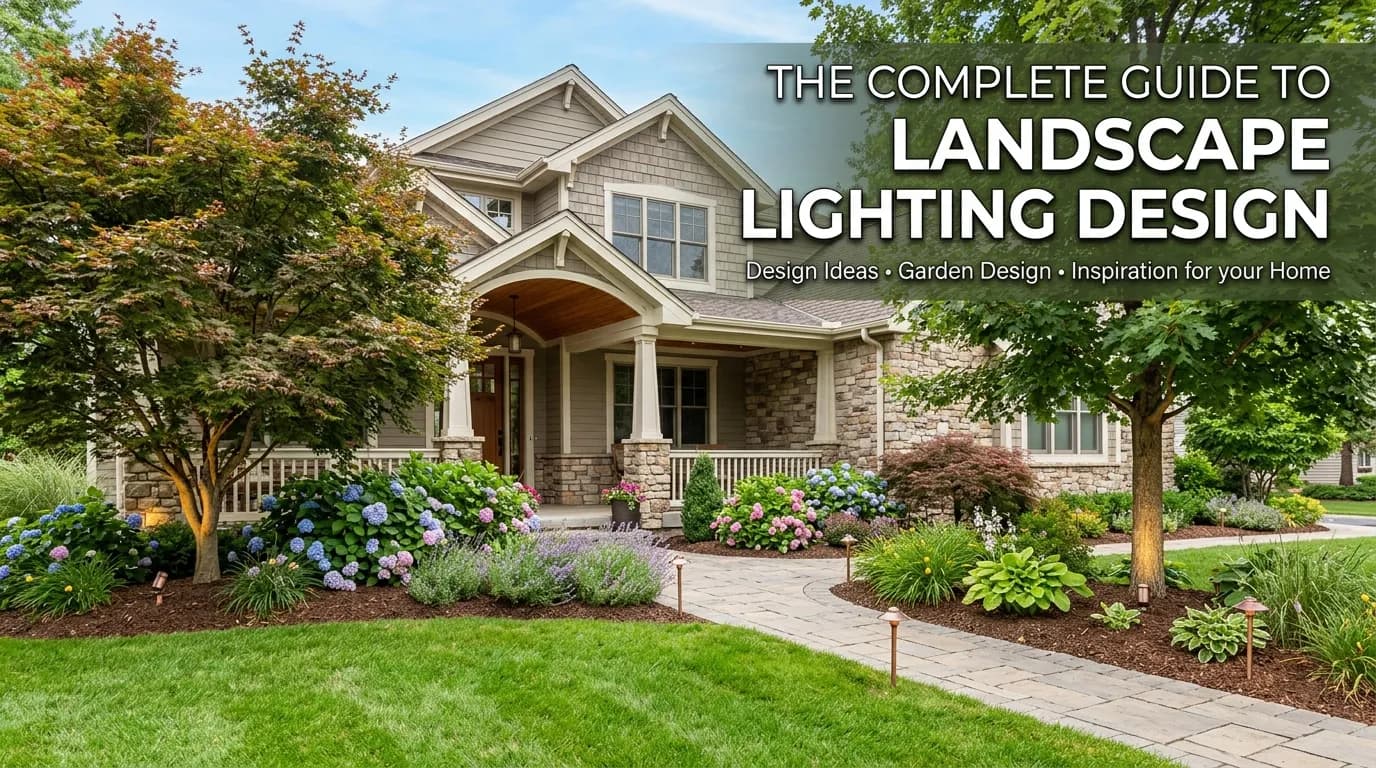
Landscape lighting is the most underrated improvement you can make to your yard. For $500-$2,000 in materials, you can transform your property from invisible after dark to a neighborhood showpiece.
Professional lighting designers charge $1,000-$5,000 for a lighting plan. Here's everything they know — for free.
The 5 Types of Landscape Lighting
1. Uplighting (Accent/Spotlight)
- Points upward from ground level to illuminate trees, architectural features, and specimen plants
- Creates dramatic shadows and highlights bark texture
- Best for: Large trees, stone walls, sculptures, house facades
- Fixtures: In-ground well lights, adjustable spotlights
- Wattage: 8-15W LED per fixture
- Rule: Position 12-18 inches from the trunk base. Use two fixtures at 120° apart for full canopy coverage. Never point directly up — angle 15° off vertical.
2. Path Lighting (Spread Lights)
- Low fixtures that illuminate walkways, steps, and grade changes
- Primary purpose is safety, but done right it creates ambiance
- Best for: Pathways, driveways, garden borders, steps
- Fixtures: Bollard lights, mushroom-cap spreaders, step lights
- Wattage: 2-4W LED per fixture
- Rule: Stagger on alternating sides, 6-8 feet apart. Light the path, not the fixture — downcast and hooded prevents glare.
3. Downlighting (Moonlighting)
- Fixtures mounted high in trees or on structures, pointing downward
- Simulates moonlight filtering through branches
- Best for: Patio areas, seating zones, creating dappled shadow patterns
- Fixtures: Canopy-mount downlights, soffit-mounted floods
- Wattage: 10-20W LED per fixture
- Rule: Mount 15-20 feet high for natural moonlight effect. Use warm white (2700K) for the most realistic look.
4. Silhouette / Backlighting
- Light placed behind a plant or object, aiming toward the viewer
- Creates a dramatic dark outline against a glowing background
- Best for: Ornamental grasses, architectural plants, garden walls
- Fixtures: Wide-beam flood lights hidden behind plants
- Wattage: 8-12W LED
- Rule: The light source must be completely hidden. If you can see the fixture, you've failed.
5. Wash Lighting
- Broad, even illumination of vertical surfaces (walls, hedges, fences)
- Creates depth and makes spaces feel larger
- Best for: Retaining walls, garden walls, evergreen hedges, house walls
- Fixtures: Linear LED strips, wide-beam wall washers
- Wattage: 6-10W per linear foot
- Rule: Position fixtures 12-18 inches from the wall, spaced every 3-4 feet for even coverage.
Color Temperature Guide
Color temperature is measured in Kelvin (K) and dramatically affects the mood:
- 2200K (Candlelight): Ultra-warm amber. Fire pit areas, intimate seating.
- 2700K (Warm White): The standard for residential landscape lighting. Flattering, natural, makes plants look healthy.
- 3000K (Soft White): Slightly cooler. Good for modern/contemporary designs.
- 4000K+ (Cool White): Too harsh for most residential use. Save for security/task lighting.
Rule of thumb: Never mix color temperatures in the same sight line. Pick 2700K and stick with it everywhere.
How Many Fixtures Do You Need?
Common mistake: Over-lighting. Professional lighting is about contrast and shadow, not floodlighting everything.
A typical residential landscape lighting plan:
| Yard Size | Total Fixtures | Transformer Size | Cost (DIY) |
|---|---|---|---|
| Small (under 1,000 sq ft) | 8-12 | 150-300W | $400-800 |
| Medium (1,000-3,000 sq ft) | 15-25 | 300-600W | $800-1,500 |
| Large (3,000+ sq ft) | 25-40 | 600-900W | $1,500-3,000 |
Transformer Sizing
Add up the total wattage of all your fixtures, then multiply by 1.25 (for cable voltage drop). That's your minimum transformer size.
Example: 20 fixtures × 8W average = 160W × 1.25 = 200W transformer minimum
Always go one size up from your calculation to allow for future additions.
Installation Tips
- 112V low-voltage, always. Never use 120V line voltage for landscape lighting. It's dangerous and illegal in most jurisdictions without an electrician.
- 2Direct burial cable — Use 12/2 or 10/2 low-voltage landscape cable. Bury 6 inches deep.
- 3Hub method — Run a main cable from the transformer to a central hub, then branch out to fixtures. This ensures even voltage across all lights.
- 4Timer or photocell — A photocell turns lights on at dusk automatically. A timer gives you control over off-time (save energy after midnight).
- 5LED only — Halogen is dead. LED uses 80% less energy, lasts 50,000+ hours, and runs cool.
The ROI
- Landscape lighting increases perceived home value by 20-30% at night showings
- Real estate agents consistently rank it as a top curb-appeal investment
- Extends outdoor living by 4-6 hours per day in summer
- Deters crime — well-lit homes are 39% less likely to be burglarized
Your Yardcast design pack includes a custom lighting plan with fixture types, quantities, wattage, and exact placement instructions.