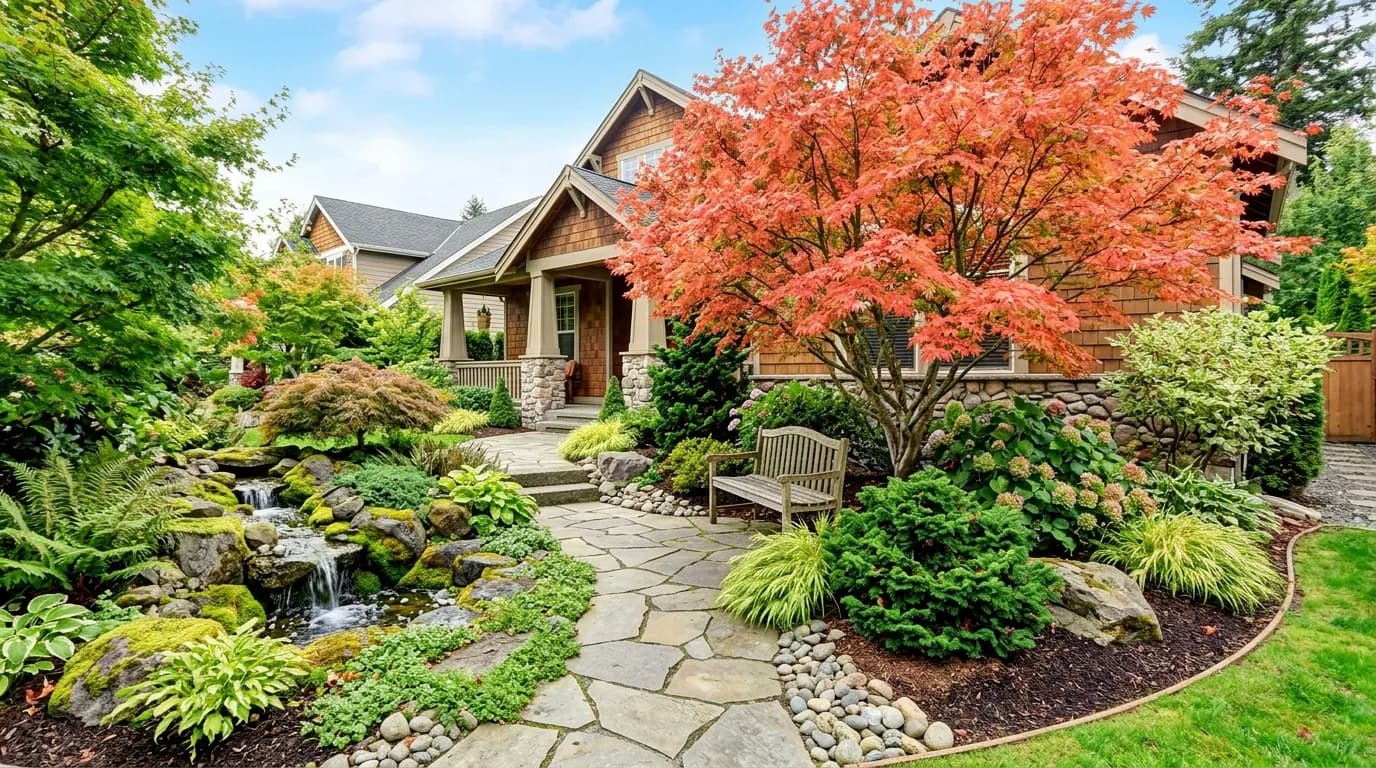
No tree earns its place in a garden like a Japanese maple. With over 1,000 named cultivars, stunning multi-season color, architectural branch structure, and remarkable adaptability, Acer palmatum is the most design-flexible small tree in American horticulture. The right Japanese maple in the right spot can transform a flat suburban yard into something that looks like it belongs in a Japanese garden.
This guide covers 30 Japanese maple landscaping ideas, from focal point plantings to container specimens, woodland garden design, and the best cultivar choices for different landscape roles.
Japanese Maple as Focal Point
1. Single Specimen on a Lawn
A weeping or mounding Japanese maple planted alone in a lawn — surrounded by ground cover or a mulch ring — becomes a living sculpture that anchors the entire yard. Choose a cultivar with outstanding form: 'Tamukeyama' (deep red weeper), 'Seiryu' (upright lace-leaf), or 'Osakazuki' (brilliant fall color). Allow at least 15–20 feet of clearance.
2. Entry Focal Point
A Japanese maple flanking or centered beside a front entry creates an unforgettable first impression. Choose a manageable size (under 12 feet): 'Bloodgood' is the classic choice — reliable red color, strong branching, and exceptional longevity. 'Emperor 1' and 'Fireglow' are better choices in hot climates.
3. Corner Anchor Planting
A Japanese maple at the corner of the house or property anchors the composition and softens architecture. Combine with low evergreen shrubs underneath (azalea, dwarf nandina, Japanese pachysandra) for four-season interest.
4. Garden Center Piece
In a formal or semi-formal garden, a Japanese maple at the center of a circular bed — surrounded by low boxwood hedge, gravel, or mondo grass — creates an elegant focal point. Use an upright cultivar ('Bloodgood', 'Beni Otake') for clear trunk structure.
5. Gateway Tree
Two Japanese maples planted on either side of a garden path or driveway entrance create a natural gateway. Match cultivars for symmetry. 'Bloodgood' is most common. Space 15–20 feet apart to allow branch development.
Japanese Maple in Garden Beds
6. Mixed Shrub Border
Japanese maples layer beautifully with mid-height shrubs. Classic combinations: 'Bloodgood' or 'Emperor 1' behind mountain laurel, rhododendron, or Pieris japonica. The red maple foliage contrasts with the dark evergreen foliage and white/pink spring flowers.
7. Shade Garden Anchor
Most Japanese maples thrive with dappled light — they're ideal anchor plants for shade gardens. Underplant with hostas, astilbe, bleeding heart, ferns, and trillium. The layered shade garden effect (tree canopy → shrub layer → perennial understory → ground cover) creates a woodland atmosphere.
8. Rock Garden Specimen
A weeping or dwarf Japanese maple in or adjacent to a rock garden echoes the aesthetic of traditional Japanese garden design. The contrast of flowing maple foliage against rough stone is especially beautiful. Choose compact cultivars: 'Crimson Queen', 'Garnet', or the ultra-compact 'Coonara Pygmy'.
9. Rain Garden Planting
Japanese maples tolerate periodic moisture and are ideal for the upper slope of a rain garden, where they receive runoff without sitting in standing water. Their fine root system also helps stabilize slopes.
10. Foundation Planting
Upright Japanese maples ('Bloodgood', 'Beni Kawa') 10–15 feet from foundation walls create elegant year-round structure without the root or size concerns of larger trees. Avoid the right-against-the-foundation mistake — Japanese maples need air circulation.
Weeping Japanese Maple Ideas
11. Waterfall Effect Over a Wall
A weeping Japanese maple planted at the top of a retaining wall, staircase, or elevated terrace creates a dramatic cascading effect — the laceleaf branches spill over the edge like water. 'Tamukeyama', 'Crimson Queen', and 'Red Dragon' all excel here.
12. Pond or Water Feature Companion
A weeping maple beside a pond or water feature is the quintessential Japanese garden image. The reflection doubles the visual impact. 'Viridis' (green laceleaf) for a subtle look; 'Tamukeyama' or 'Garnet' for deep red contrast.
13. Weeping Maple on a Mound
Planting a weeping Japanese maple on a slightly raised berm (18–24 inches) improves drainage, elevates the rootball above clay soils, and creates a natural pedestal that shows off the cascading form. Surround with low moss, creeping thyme, or Scotch moss.
14. Staking for Height
Left to their own device, grafted weeping maples mound low to the ground. Staking the central leader upright for the first 5–7 years trains the tree to a taller structure before the branches begin to cascade. This is how Japanese nurseries achieve the classic high-canopy weeping form.
> Want to see how Japanese maples would look in your yard? Generate a free AI landscape design → — upload your photos and get 3 photorealistic designs with plant placement suggestions in 60 seconds.
Japanese Maple Container Ideas
15. Potted Courtyard Specimen
A Japanese maple in a large glazed ceramic pot (24–30 inch diameter minimum) creates a moveable garden anchor for courtyards, patios, and urban spaces. Container culture keeps the tree smaller — a 12-foot tree in the ground stays 4–6 feet in a pot. Use a well-draining, moisture-retentive mix.
16. Deck or Rooftop Garden Container
On elevated decks or rooftop gardens where in-ground planting isn't possible, Japanese maples in containers provide four-season structure. Protect pots from freeze-thaw cycles in Zone 5–6 (wrap pots, move to sheltered garage in deep winter).
17. Bonsai-Style Container Planting
Japanese maples respond exceptionally well to bonsai cultivation — their fine-textured foliage, ramified branching, and attractive bark develop beautifully under proper training. This is beyond casual gardening but worth noting as the highest-art expression of Japanese maple cultivation.
18. Seasonal Container Rotation
In colder climates, Japanese maples can be grown in containers and moved to the porch or garage during the coldest weeks. Their spring unfurling, summer fullness, and fall color become a moveable seasonal event.
Japanese Maple by Color
19. Red Foliage Cultivars
Best red Japanese maples: 'Bloodgood' (reliable red all summer, excellent tolerance), 'Emperor 1' (holds color better in heat than Bloodgood), 'Fireglow' (brilliant red, better for Zones 6b–9), 'Shaina' (compact, dense, reliable red), 'Tamukeyama' (weeping, deep burgundy-red laceleaf).
20. Green Foliage Cultivars
Green maples often outperform red cultivars in hot climates where red pigments bleach to green anyway. Best green cultivars: 'Sango Kaku' (coral bark — stunning winter feature), 'Seiryu' (upright green laceleaf), 'Viridis' (weeping green laceleaf), 'Katsura' (orange-yellow new growth).
21. Variegated and Unusual Foliage
'Butterfly': pink, white, and green tricolor variegation. 'Ukigumo': white and pink variegation with green, called "floating cloud." 'Orange Dream': extraordinary spring orange-yellow. 'Koto No Ito': thread-leaf form with finely divided green leaves turning gold in fall.
Japanese Maple in Complete Garden Styles
22. Japanese Garden Design
In a traditional Japanese garden, Japanese maples are paired with stone lanterns, raked gravel, moss groundcovers, clipped azaleas, bamboo, stepping stones, and water features. Prune to emphasize branch architecture; remove lower limbs gradually to create a high-canopied tree. Underplant with green moss and nothing else for maximum impact.
23. Pacific Northwest Garden
Japanese maples are among the most reliable trees for the Pacific Northwest — the mild, moist climate is nearly ideal for most cultivars. Combine with Japanese pieris, rhododendrons, camellias, ferns, and hostas for a lush Northwest woodland style.
24. Shade-Tolerant Woodland Garden
Japanese maples are shade-tolerant understory trees that evolved under tall forest canopies. They thrive under open deciduous trees like oaks, hickories, and birches. Create a woodland garden with Japanese maple as the primary accent tree, and layer with shade perennials underneath.
25. Contemporary Minimalist Garden
A single Japanese maple as the sole plant element in a contemporary garden of clean lines, stone, and gravel creates maximum drama. Choose an architectural cultivar with strong winter branching: 'Tamukeyama', 'Bloodgood', or a mature 'Sango Kaku' with its brilliant coral winter bark.
Japanese Maple Cost and Planting Guide
| Size | Typical Price | Approximate Age |
|---|---|---|
| 1-gallon (12–18 inches) | $15–$35 | 1–2 years |
| 3-gallon (2–3 feet) | $35–$75 | 2–3 years |
| 5-gallon (3–5 feet) | $60–$120 | 3–4 years |
| 15-gallon (5–7 feet) | $150–$400 | 5–8 years |
| Specimen tree (8–12 feet) | $500–$2,500+ | 10–20 years |
| Mature weeping specimen | $1,000–$5,000+ | 15–25 years |
26. Best Planting Locations
Japanese maples thrive in dappled light to partial shade in most of the country. In the Pacific Northwest and USDA Zones 8–9, they tolerate full sun. In hot climates (Zones 7–9), afternoon shade protection is critical — west-facing exposures in full sun will cause leaf scorch. Give them room to spread: even "dwarf" cultivars can reach 8–10 feet.
27. Soil Prep for Japanese Maples
Japanese maples prefer slightly acidic (pH 5.5–6.5), well-drained, organically rich soil. They're highly intolerant of compacted, wet, or alkaline soils. In clay: raise the planting area 6–12 inches and amend with compost and composted bark. In alkaline soil: acidify with sulfur and use azalea/rhododendron fertilizer.
Companion Planting for Japanese Maples
28. Classic Companions
Low-growing: Ajuga (ground cover), hostas (shade-tolerant foliage), ferns (textural contrast), Hellebores (early spring flowers), Liriope (evergreen edging). Mid-height: Azaleas (spring color + scale match), dwarf nandina, dwarf fothergilla (fall color synergy). Spring bulbs: Muscari, snowdrops, and species tulips naturalize beautifully under Japanese maples.
29. Japanese Garden Companions
In a Japanese-style planting: black pine (Pinus thunbergii), heavenly bamboo, weeping cherry, pine needle azalea (Kurume hybrid), Japanese iris, Mondo grass, moss.
30. Fall Color Companions
Japanese maples paired with other fall performers create the most dramatic autumn display: Fothergilla (yellow-orange-red), 'October Glory' red maple (orange-red), oakleaf hydrangea (burgundy), blueberries (red fall foliage and fruit), witch hazel (yellow-gold).
Japanese Maple Care Essentials
Watering: Deep water weekly the first two years. Established trees are drought-tolerant but prefer consistent moisture. Mulch 3–4 inches to retain moisture and regulate soil temperature.
Fertilizing: Light feeding only. Excess nitrogen produces lush green growth at the expense of fall color and increases disease susceptibility. Use a slow-release low-nitrogen fertilizer (ratio like 4-8-5) once in early spring, or none at all.
Pruning: Japanese maples rarely need pruning if given adequate space. When needed, prune in late summer or early fall — never in spring (invites verticillium wilt). Remove crossing branches and dead wood only. The Japanese approach is to remove entire branches back to the trunk for clean structure, not to "trim" the ends.
Pests and Disease: Verticillium wilt is the most serious problem; avoid by not pruning in spring and not planting in soil where tomatoes or potatoes have recently been grown. Aphids can cause leaf curl on new growth; knock off with a hose. Japanese beetles occasionally damage foliage; hand-pick or use neem oil.
A well-sited Japanese maple requires virtually no care after establishment. The primary work is choosing the right cultivar for the right spot — size, form, color, and climate tolerance — before planting.
Ready to design your Japanese maple garden? Get a free AI landscape design →