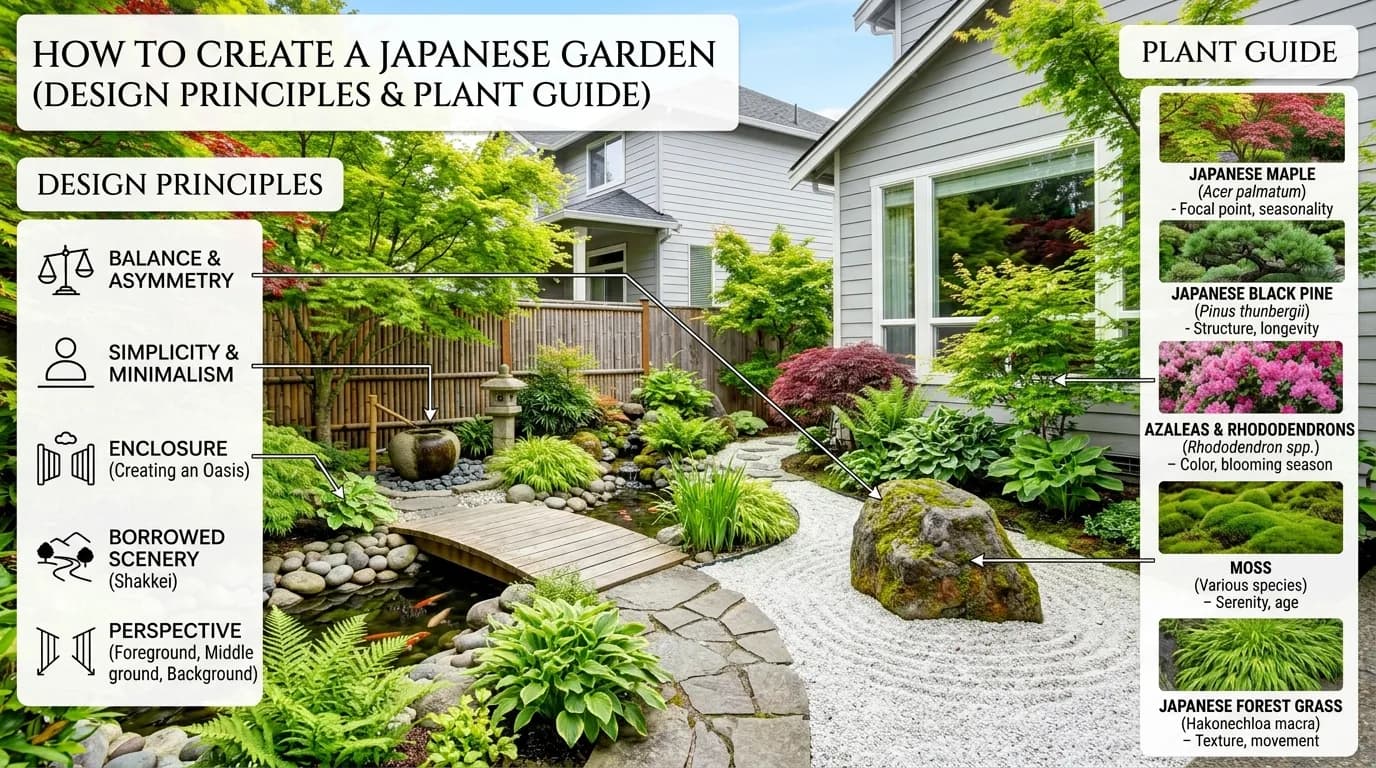
Japanese garden design is the most refined form of landscape art. Every rock, plant, and pathway has meaning. Here's how to create one at home — whether you have an acre or a small side yard.
Core Design Principles
1. Asymmetry Over Symmetry
Nature isn't symmetrical. Japanese gardens avoid mirror-image layouts. Place elements in odd numbers (3 rocks, 5 plants) and off-center.
2. Borrowed Scenery (Shakkei)
Incorporate views beyond your garden — a neighbor's tree, a distant hill, the sky — as part of your composition. Frame these views with your plantings.
3. Enclosure
Create a sense of being in a separate world. Fences, walls, or dense plantings at the perimeter make the garden feel like a sanctuary.
4. Wabi-Sabi
Beauty in imperfection and the passage of time. Moss on stone, weathered wood, a slightly leaning lantern — these are features, not flaws.
5. Ma (Negative Space)
Empty space is as important as filled space. A raked gravel area isn't "empty" — it's the pause between notes in music.
Essential Elements
Rocks (Ishi)
Rocks are the bones of a Japanese garden. They represent mountains, islands, and permanence.
The 3-Rock Arrangement (Sanzon-seki):
- One tall vertical rock
- One medium leaning rock
- One flat horizontal rock
Arranged in a triangular composition. This is the foundation of Japanese rock placement.
Rules:
- Bury rocks 1/3 into the ground (they should look like they've always been there)
- Never stand rocks upright on flat ground
- Choose rocks with interesting shapes, textures, or moss
Water (Mizu)
Water represents life, purification, and the passage of time.
Options:
- Pond (Ike): Still water reflects sky and trees. Even a small container pond works.
- Stream (Ogawa): Recirculating streams with natural stone edges.
- Dry stream (Karesansui): Raked gravel representing water. The most iconic Japanese garden element.
- Tsukubai: A small stone water basin where visitors ritually wash hands. Usually near a tea house.
Stone Lanterns (Tōrō)
Traditional stone lanterns mark paths and add vertical interest. Placed at path turns, near water, or at focal points.
Types:
- Yukimi-dōrō (snow-viewing lantern) — wide-brimmed, placed near water
- Kasuga — tall pedestal style, formal
- Oribe — partially buried, rustic
Paths (Michi)
Paths control the speed and direction of movement through the garden.
- Stepping stones (Tobi-ishi): Irregularly spaced to slow walking pace and direct attention downward
- Gravel paths: Raked in patterns, encourage meditative walking
- Cut stone + natural stone: Formal areas use cut stone; naturalistic areas use rough stone
Plants for Japanese Gardens
Trees
- Japanese Maple (Acer palmatum) — The essential Japanese garden tree. Delicate leaves, stunning fall color. Dozens of cultivars from 6 ft to 25 ft.
- Japanese Black Pine (Pinus thunbergii) — Cloud-pruned pines are iconic. Asymmetrical, sculpted silhouettes.
- Yoshino Cherry (Prunus × yedoensis) — Spring cherry blossoms. Plant where petals will fall onto water or a path.
Shrubs
- Azalea — Cloud-pruned into mounds (karikomi). Evergreen varieties provide year-round structure.
- Japanese Holly — Fine-textured, responds well to shaping.
- Nandina (Heavenly Bamboo) — Airy foliage, red berries in winter.
Groundcovers
- Moss — The dream groundcover for Japanese gardens. Needs shade and moisture.
- Mondo Grass — Dark green, grass-like. Dwarf variety (Ophiopogon japonicus 'Nana') stays 2–4 inches.
- Hakonechloa (Japanese Forest Grass) — Cascading golden grass for shade. Stunning in containers or along paths.
Bamboo
- Clumping bamboo (Bambusa) — Stays in place, forms elegant screens
- AVOID running bamboo (Phyllostachys) unless you install root barriers (it WILL take over your entire yard and your neighbor's)
Garden Styles
Karesansui (Dry Rock Garden)
Raked gravel, carefully placed rocks, minimal or no plants. The most meditative style. Think Ryoan-ji in Kyoto.
Best for: Small spaces, courtyards, side yards
Tsukiyama (Hill Garden)
Miniature hills and ponds creating a landscape in miniature. Paths wind through varied terrain.
Best for: Larger yards with natural topography
Tea Garden (Roji)
A path leading to a tea house. Simple, rustic, with a tsukubai (water basin) and stepping stones. Designed to create a transition from the outside world to the peaceful tea ceremony.
Best for: Side yards, narrow spaces, entrance gardens
Courtyard Garden (Tsuboniwa)
Designed for tiny enclosed spaces — originally the small inner courtyards of Japanese townhouses. A single tree, a few rocks, moss, and a lantern.
Best for: Enclosed patios, atriums, small side yards
DIY Japanese Garden Budget
| Element | Budget | Mid-Range | Premium |
|---|---|---|---|
| 3-rock arrangement | $100–$300 | $300–$800 | $800–$2,000 |
| Gravel area (100 sq ft) | $50–$150 | $150–$400 | $400–$800 |
| Japanese maple | $30–$80 | $80–$250 | $250–$1,000 |
| Stone lantern | $50–$200 | $200–$500 | $500–$2,000 |
| Stepping stones (10) | $50–$150 | $150–$400 | $400–$1,000 |
| Tsukubai | $100–$300 | $300–$800 | $800–$3,000 |
| Bamboo fence (10 ft) | $50–$150 | $150–$400 | $400–$1,000 |
Total budget Japanese garden: $500–$1,500
Mid-range: $1,500–$4,000
Premium: $4,000–$15,000
Maintenance
Japanese gardens are low-maintenance but not no-maintenance:
- Rake gravel weekly (or after rain/wind)
- Prune trees and shrubs 1–2 times per year (Japanese pruning is an art — learn the basics)
- Keep moss moist in dry periods
- Remove fallen leaves from gravel promptly
- Clean water features monthly
Design a Japanese-inspired garden with Yardcast. Our AI generates designs that incorporate authentic elements — rock placement, water features, and plant selection matched to your climate zone.