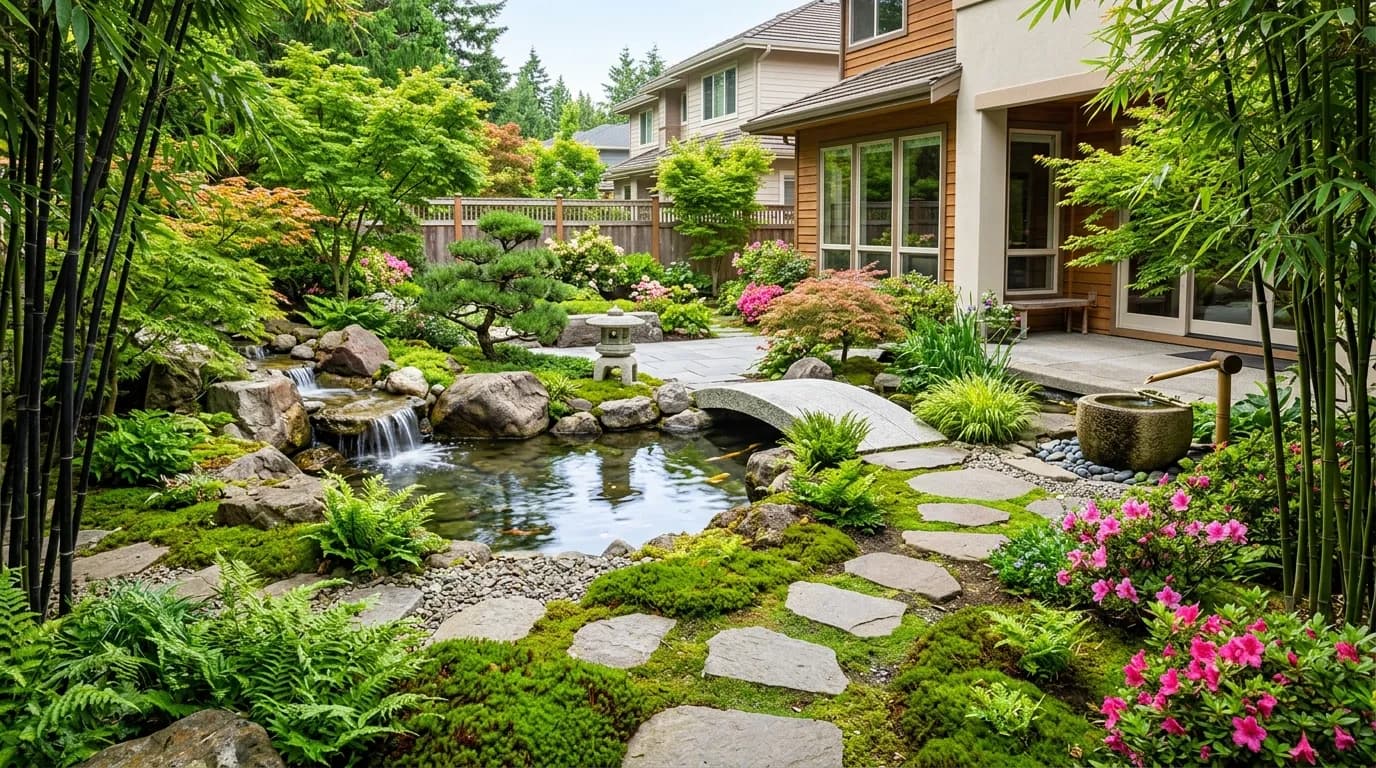
Japanese garden design is one of the most copied and most misunderstood landscape styles. True Japanese garden design isn't about filling a yard with pagodas and stone lanterns — it's a sophisticated design philosophy that uses restraint, symbolism, and natural materials to create spaces for contemplation.
Here's how to bring Japanese design principles into your backyard, at any budget and any size.
The Core Philosophy
Japanese gardens express four key ideas:
Ma (間) — negative space, the pause between elements. Not every inch needs to be planted.
Wabi-sabi — the beauty of imperfection and impermanence. Asymmetry, worn stone, moss.
Borrowed scenery (Shakkei) — incorporating background views (trees, hills, sky) as part of the design.
Circulation — the path through a Japanese garden is the experience. Every step reveals a new composition.
15 Design Elements to Include
1. A Central Water Feature
Water is essential in Japanese garden design. Even a small stone basin (tsukubai) — barely bigger than a birdbath — captures this element without requiring space for a full pond. The sound of water moving through bamboo is profoundly calming.
2. Raked Gravel or Sand
Karesansui (dry landscape) gardens use raked gravel or coarse sand to represent water and direct the eye through the composition. Rake patterns can be maintained with minimal effort.
3. Specimen Stones
Japanese garden design elevates stone placement to an art form. Two or three carefully chosen stones — rough, worn, mossy — placed with intention are worth more than 20 ordinary ones scattered randomly.
4. Japanese Maple
No element says "Japanese garden" more immediately than an Acer palmatum. Available in dozens of cultivars from 4 feet (Crimson Queen weeping) to 25 feet (Sango kaku coral bark). Plant where you can see it from indoors.
5. Bamboo (Clumping Varieties Only)
Always use clumping bamboo (Fargesia or Borinda species) rather than running bamboo. Running bamboo spreads invasively and can reach neighboring properties. Clumping bamboo stays where planted.
6. A Lantern
A single stone lantern placed at the garden's edge or beside a water feature provides vertical structure. Avoid plastic; weathered granite or cast concrete develops a patina over time.
7. A Stepping Stone Path
Irregular, slightly spaced flat stones slow the walk through the garden, creating moments to pause. Space them slightly farther apart than natural stride length — this makes you look down, notice the garden.
8. Low Clipped Hedges
Boxwood, Yew, or Japanese Holly clipped into simple rounded mounds (rather than geometric shapes) create soft counterpoint to the angular stones and gravel.
9. Moss
Moss thrives in shade and moist conditions. In Pacific Northwest and Southeast gardens, it establishes naturally. In drier climates, use moss transplants in consistently shaded areas. Moss softens stone, gives age, and creates silence.
10. Pine Trees
Japanese Black Pine (Pinus thunbergii) is the iconic garden pine — trained and pruned to create an aged, windswept appearance. In Western gardens, Japanese White Pine or Mugo Pine serve the same purpose with less maintenance.
11. Ferns
Japanese Painted Fern, Royal Fern, and Autumn Fern bring softness and movement. In shade gardens, they form the middle layer between moss groundcover and Japanese maple canopy.
12. Ornamental Grasses as Accents
Japanese Forest Grass (Hakonechloa macra) in its golden form ('Aureola') creates cascading pools of warm light in shaded areas. Use it in masses rather than single specimens.
13. Screening for Enclosure
Japanese gardens feel enclosed, inward-focused. A bamboo fence, wooden screen, or tightly planted Arborvitae hedge creates the sense of a world apart. Even a low fence directs attention inward.
14. A Viewing Stone or Specimen Element
Japanese gardens often include a single "discovery" element — a sculptural stone, a carved basin, a single bonsai in a pot — that rewards a closer look.
15. Restraint
The hardest element to include: restraint. A Japanese garden edited to 60% of what you want is closer to the ideal than one with everything you've considered. Subtract rather than add.
Starting Points by Space
Small patio (under 200 sq ft): Gravel garden with 3 stones, one Japanese Maple in a large container, clumping bamboo screen, and a stone basin.
Side yard (200–500 sq ft): Stepping stone path, raked gravel area, 2–3 specimen stones, Japanese Maple, moss, boxwood mounds.
Backyard (500–2,000 sq ft): All of the above plus a small pond or stream, pine tree, bamboo screen, and a traditional stone lantern.
Get a Japanese Garden Design for Your Yard
The principles above are exactly what Yardcast's AI applies when you select the "Japanese Zen" style. Upload your yard photo, choose your style, and see what a designed Japanese garden would look like in your specific space.