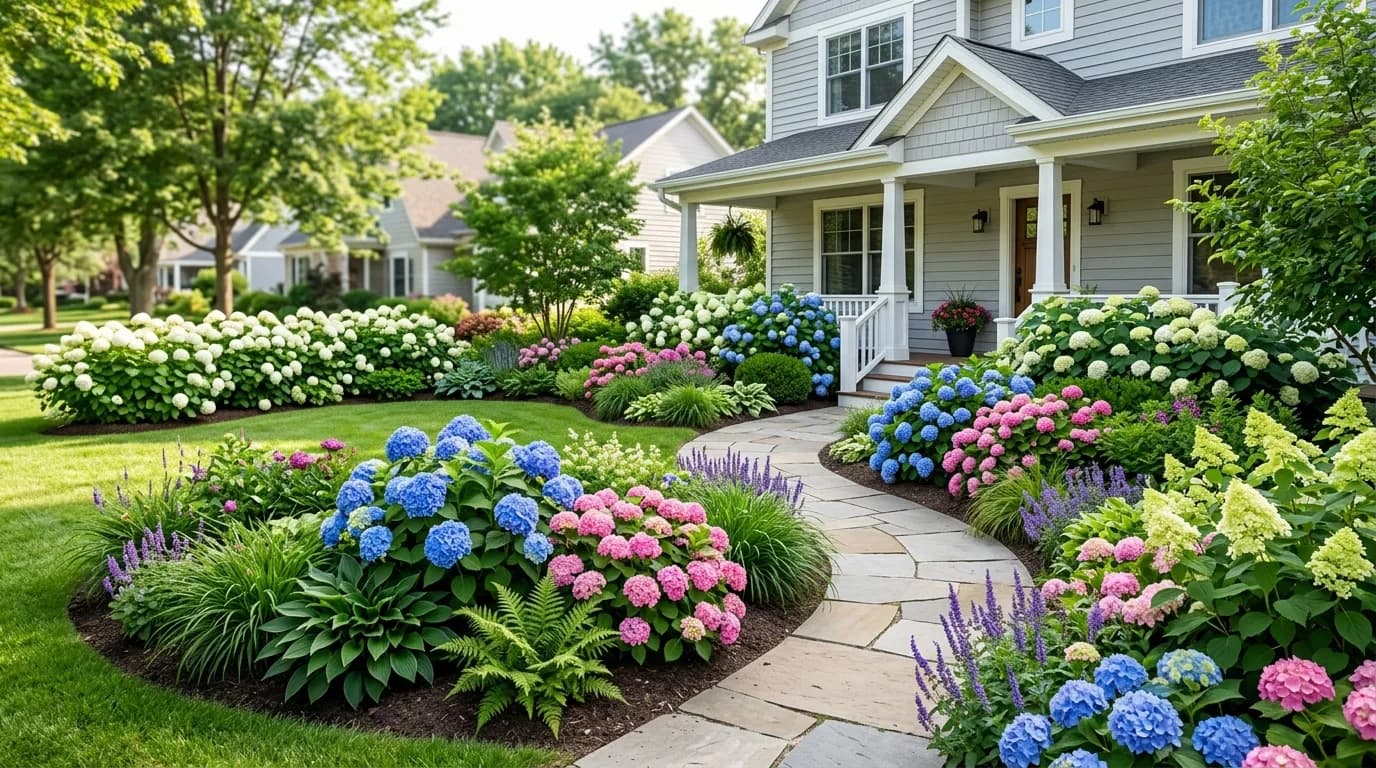
Hydrangeas are the undisputed queens of the summer garden. Their massive blooms — dinner-plate-sized clusters of white, blue, pink, purple, and lime green — deliver months of color from early summer through late fall. They're tough, adaptable, and available in sizes from compact 3-foot foundation shrubs to 8-foot arching specimens that anchor entire garden compositions.
This guide covers the best hydrangea landscaping ideas for every yard type, how to use them as foundation plants, mix them with perennials, and keep them blooming for the longest possible season.
Understanding the Main Hydrangea Types
Before diving into ideas, it helps to know which hydrangea you're working with — they behave very differently.
| Type | Best Known For | Bloom Season | Zone | Sun |
|---|---|---|---|---|
| Bigleaf (macrophylla) | Mophead/lacecap, blue/pink with soil pH | June–Aug | 5–9 | Part shade |
| Panicle (paniculata) | Cone-shaped blooms, sun-tolerant, Limelight | July–Oct | 3–9 | Full sun–part |
| Smooth (arborescens) | Annabelle types, huge white balls, cold-hardy | June–Sept | 3–9 | Part–full shade |
| Oakleaf (quercifolia) | Peeling bark, fall color, shade-tolerant | June–Aug | 5–9 | Part–full shade |
| Climbing (anomala) | Vine form, covers fences/walls | June–July | 4–8 | Part shade |
Rule of thumb: If you want blue blooms, grow bigleaf in acidic soil. If you want bombproof blooms every year regardless of zone or pruning mistakes — grow panicle hydrangeas ('Limelight', 'Quick Fire', 'Bobo').
1. The Classic All-White Foundation Planting
Three to five 'Annabelle' smooth hydrangeas planted 4 feet apart create a bold foundation hedge that delivers massive 12-inch white snowball blooms from June through September. Underplant with white 'Husker Red' Penstemon and white Astilbe for a cohesive all-white scheme that looks luminous even in evening light.
Cost estimate: $40–$80/plant × 5 plants = $200–$400 for plant material
2. Limelight Hydrangea as a Specimen Tree
'Limelight' panicle hydrangeas can be trained as multi-stem trees reaching 8 feet tall. A single specimen at the corner of a foundation bed or as an anchor in a mixed border creates a dramatic focal point from July through November — starting as chartreuse-lime, maturing to cream-white, then flushing antique pink-rose in fall.
Pro tip: Tree-form 'Limelight' is available at most garden centers in 7-gallon containers for $60–$120. It's worth every dollar.
3. The Blue & White Hydrangea Border
Plant Endless Summer 'BloomStruck' bigleaf hydrangeas (which bloom on both old and new wood — solving the "no blooms" problem most people have) alternating with white 'Annabelle' smooth hydrangeas along a fence line. The contrast between electric blue-purple and crisp white is one of the most elegant combinations in gardening.
Soil acidification tip: Water with diluted aluminum sulfate solution (1 tablespoon per gallon) monthly from spring through June to push bigleaf blooms toward blue-purple rather than pink.
4. Hydrangea + Rose Garden
Pair climbing roses on an arbor or fence with mounded bigleaf hydrangeas at its base. Roses bloom May–June; hydrangeas take over July–October. Between them, you have 6+ months of flowers at the same bed focal point. Classic rose colors — apricot, peachy-pink, deep red — combine beautifully with the blue-lavender and white of Endless Summer hydrangeas.
5. Create a Hydrangea Allee
Two parallel rows of 'Incrediball' smooth hydrangeas (the giant-flowered cousin of Annabelle, with foot-wide white blooms on strong stems that don't flop) planted 6 feet apart create a spectacular garden corridor. The massive white blooms arch overhead creating a lush tunnel effect in July–August. Works beautifully as a driveway border, side-yard path, or formal garden axis.
Ready to see how hydrangeas would look in your specific yard? Generate your free AI landscape design at Yardcast → Upload your yard photos and tell the AI you want hydrangeas — it'll place them exactly where they'll thrive for your sun exposure, zone, and home style.
6. Layered Shade Garden with Oakleaf Hydrangeas
Oakleaf hydrangeas (Hydrangea quercifolia) are the unsung heroes of shade landscaping. They bloom in cone-shaped white panicles in June, develop stunning burgundy-red fall foliage, and peel back their cinnamon-colored bark in winter — four-season interest in a single shrub.
Layer them: Oakleaf hydrangeas at 5–8 feet tall, Hostas below at 18–24 inches, Astilbe for mid-summer color, Pachysandra as a weed-suppressing groundcover. This combination thrives in 2–4 hours of filtered shade.
7. Hydrangea + Ornamental Grass Combination
Pair 'Limelight' or 'Quick Fire' panicle hydrangeas with Karl Foerster feather reed grass for a naturalistic planting that looks beautiful from July through winter. The vertical grass contrasts perfectly with the rounded hydrangea form. Both turn gorgeous buff-gold in fall and look stunning with snow in December. This combination works in full sun.
8. Low-Growing Hedge: 'Bobo' and 'Little Lime'
'Bobo' panicle hydrangea (2–3 feet tall) and 'Little Lime' (3–4 feet) are dwarf selections that work as low hedges along walkways, in front of taller foundation plantings, or as front-of-bed anchors. Plant them 3 feet apart for a continuous mounded hedge effect. They're sun-tolerant, cold-hardy to Zone 3, and bloom without any special care.
9. Climbing Hydrangea on a Fence or Wall
Climbing hydrangea (Hydrangea anomala petiolaris) is a slow-starting but ultimately spectacular vine that attaches to wood, masonry, or metal without support. It produces flat lacecap white blooms in June, then develops beautiful peeling tan bark visible all winter. Give it 3–5 years to establish — once it takes off, it's extraordinary.
Note: It's a powerful grower — give it a sturdy structure and expect 30–50 feet eventually.
10. The "Proven Winners" Foundation Planting
The three-plant combination that landscape designers use most often for hydrangea foundation beds:
- 'Incrediball' smooth hydrangea — 3–4 feet, giant white blooms, sun or shade
- 'Tiny Tuff Stuff' mountain hydrangea — 18 inches, lacecap blooms, fits small spaces
- 'Quick Fire' panicle hydrangea — 6–8 feet, blooms June–October, earliest bloomer of all
This combination layers height beautifully: 18 inches, 3–4 feet, 6–8 feet — creating a full, professional-looking foundation planting from one plant family.
Hydrangea Companion Plants That Look Amazing
| Companion | Why It Works |
|---|---|
| Russian Sage (Perovskia) | Steel-blue spikes contrast with pink/white mounds, same sun/zone |
| Roses | Sequential bloom — roses then hydrangeas cover June–October |
| Karl Foerster Grass | Vertical texture against rounded hydrangea form |
| Catmint 'Walker's Low' | Blue-purple spills at hydrangea feet, repeat bloomer |
| Hostas | Bold leaf texture under shade-tolerant hydrangeas |
| Echinacea (Coneflower) | Same summer bloom window, naturalistic combo |
| Astilbe | Feathery texture fills shade garden below oakleaf types |
| Black-eyed Susan | Rustic cottage garden feel, same midsummer bloom |
Why Hydrangeas Don't Bloom (And How to Fix It)
The number-one hydrangea question. Here's the diagnostic:
For bigleaf (macrophylla) hydrangeas — they bloom on OLD wood:
- Pruning in fall or spring removes next year's blooms — never prune
- Cold winter kills flower buds — wrap with burlap in zones 5–6
- Solution: Switch to 'Endless Summer' series, which bloom on both old AND new wood
For smooth and panicle hydrangeas — they bloom on NEW wood:
- Prune however you want, whenever you want — they'll bloom
- If they're not blooming, check sun exposure (need 4–6 hours minimum)
Hydrangea Care: Quick Reference
| Task | When | How |
|---|---|---|
| Pruning panicle/smooth | Late winter or early spring | Cut to 12–18 inches from ground |
| Pruning bigleaf | After bloom or never | Remove only dead stems |
| Fertilizing | April and June | Slow-release 10-30-10 formula |
| Watering | Weekly, deep | 1 inch per week — wilting = thirst, not death |
| Deadheading | Optional | Leave for winter interest; they look beautiful dried |
Cost Guide: Hydrangea Landscaping Budget
| Project | Plants | Materials | Labor | Total |
|---|---|---|---|---|
| 3-shrub foundation planting | $120–$240 | $60–$100 | $200–$400 | $380–$740 |
| Full bed (8 shrubs) | $320–$640 | $150–$300 | $400–$800 | $870–$1,740 |
| Allee (12 shrubs) | $480–$960 | $200–$400 | $600–$1,200 | $1,280–$2,560 |
| Climbing hydrangea + trellis | $80–$150 | $200–$400 | $200–$400 | $480–$950 |
The Most Bulletproof Hydrangeas for Beginners
If you just want hydrangeas that bloom reliably with zero drama:
- 1'Limelight' panicle hydrangea — Zones 3–9, full sun, never needs special care, blooms July–November, dries beautifully. The safest choice in landscaping.
- 1'Incrediball' smooth hydrangea — Zones 3–9, part shade to full shade, giant white blooms on strong stems that don't flop (unlike Annabelle). The second-safest choice.
- 1'Quick Fire' panicle hydrangea — Blooms 6 weeks earlier than any other panicle hydrangea (June rather than July). Great for short-season climates.
- 1'Endless Summer BloomStruck' — The answer to bigleaf's old-wood bloom problem. Repeat-blooms from late spring through frost.
Hydrangea Landscaping: The Bottom Line
Hydrangeas are a landscaping investment that pays back in spades — months of massive color, zero pest problems, easy care, and serious "wow" factor that adds measurable curb appeal. Whether you're planning a single specimen or a full border of 12, the key is matching the right type to your conditions:
- Full sun? → Panicle hydrangeas (Limelight, Quick Fire, Bobo)
- Part shade? → Smooth (Annabelle, Incrediball) or mountain types
- Full shade? → Oakleaf hydrangeas — the shade garden's best friend
- Want blue blooms? → Bigleaf in acidic soil (pH 4.5–5.5), Endless Summer series for reliability
Want to see exactly how hydrangeas would look in your yard — placed in the right spots for your sun, your soil, and your home style? Generate a free AI landscape design preview at Yardcast →