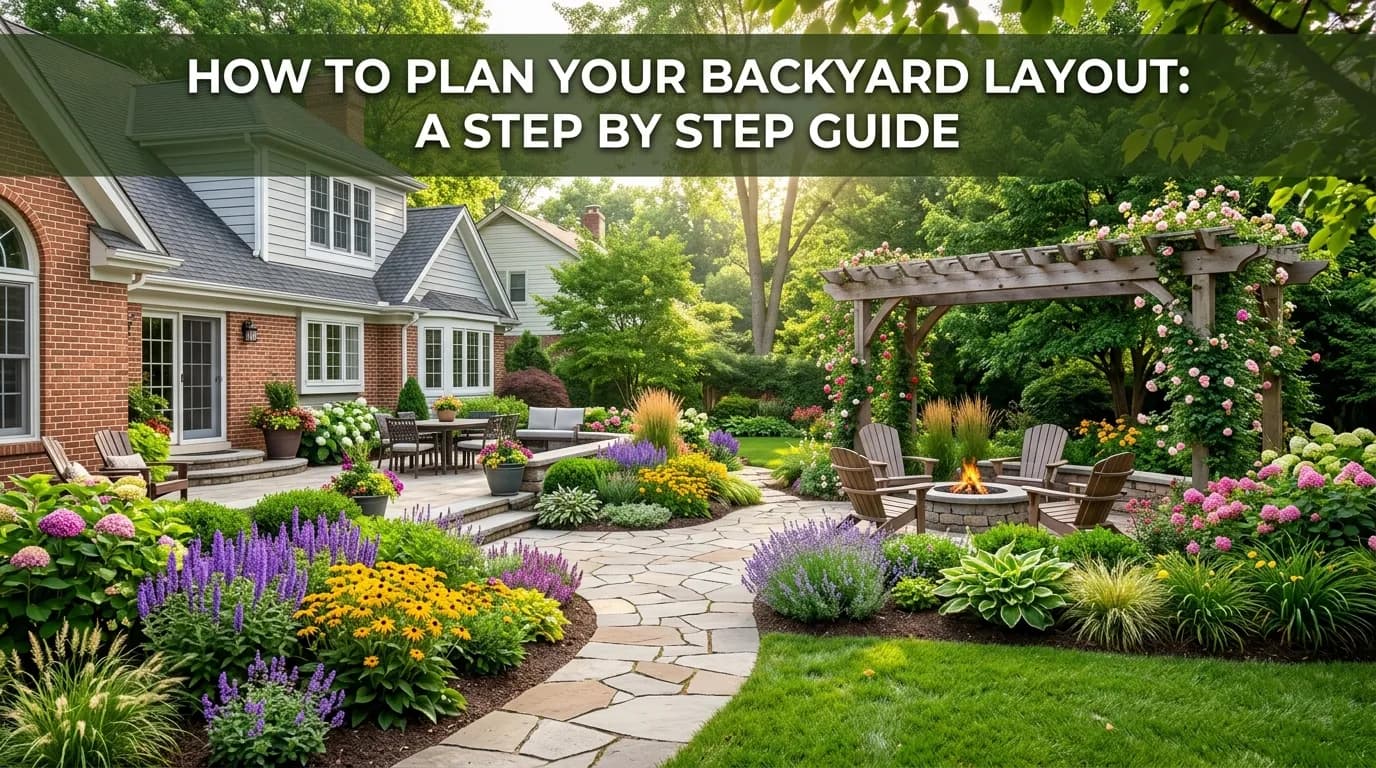
Planning a backyard layout is the step most homeowners skip — and it's why so many yards end up looking like a random collection of plants instead of a cohesive outdoor space. A good layout is designed before a single shovel hits the ground.
This guide walks you through the exact process professional landscape designers use: from measuring your space to sketching functional zones to getting AI-accurate plant placement. By the end, you'll have a clear plan that saves money, prevents costly mistakes, and makes your backyard feel intentional.
Step 1: Measure Everything Before You Plan Anything
You can't plan a backyard on gut feel. Get out a 100-foot tape measure (or use a laser measuring tool) and capture:
- Overall yard dimensions — the length and width of your property line
- Setbacks — how close you can build to fences, property lines, or the house (check local codes — typically 3–5 feet)
- Existing fixed elements — house footprint, garage, AC unit, utility boxes, mature trees
- Problem areas — low spots where water pools, slopes greater than 2%, shaded areas under trees
Sketch this on graph paper. Don't skip this. Eyeballing dimensions leads to buying plants that don't fit, hardscape that's the wrong size, and zones that overlap awkwardly.
Pro tip: Use 1 inch = 5 feet on your sketch. A standard 8.5x11 sheet can represent a 42x55 foot yard at that scale.
Step 2: Identify Your Functional Zones
Every backyard serves multiple purposes. The layout mistakes happen when these zones aren't separated or when they fight each other for space. Most backyards need 3–5 zones:
The Entertaining Zone
This is your primary outdoor living space — usually a patio or deck off the back door. The rule of thumb for sizing: allow 25 square feet per person for the typical gathering. For a family of 4 that occasionally entertains, 200–300 sq ft is ideal.
Place this zone where it:
- Gets shade in the afternoon (when you actually want to be outside)
- Has a direct path from the kitchen
- Has line-of-sight to any play areas if you have kids
The Play or Active Zone
Lawn, swing set, trampoline, cornhole — whatever your household actually uses. If you have kids under 10, lawn is probably your highest priority use of space. If you don't, a full lawn is almost certainly wasted space.
Grass is expensive to maintain. Only keep as much as you need for active use. The rest should become planted beds, gravel, or hardscape.
The Garden or Growing Zone
Vegetable beds, herb gardens, cut flower plots. Place these where they get 6–8 hours of full sun — which is almost always the south or west side of the yard. Don't put them in the shade of the house or large trees.
Raised beds are easier than in-ground planting for most beginners. A standard 4x8 ft bed produces a meaningful amount of food for a family.
The Privacy or Buffer Zone
The perimeter of your yard — typically the fence line. This is where you plant screening shrubs, tall grasses, or hedges to block sightlines from neighbors or the street.
Native evergreen shrubs, arborvitae, or ornamental grasses work well. Avoid planting invasive species that will take over within 3 years.
The Transition Zone
The space between your house and the main yard — often a narrow walkway along the side of the house or the area around the foundation. This zone gets ignored until it looks terrible. Plan it: concrete edging to contain mulch, low shrubs against the foundation, a defined path.
Step 3: Map Sun, Shade, and Wind
Before you assign plants to zones, you need to know what your yard's microclimate looks like. Spend one day tracking the sun:
- Morning (8 AM): Mark which areas are in direct sun
- Midday (12 PM): Mark the sunny areas again
- Late afternoon (4 PM): Final check
Areas in full sun all three times = full sun (6+ hours). Areas in sun only morning and evening = part shade. Areas blocked by the house or large trees = full shade.
Most flowering plants need full sun. Most lawn grass needs 4+ hours. Hostas, ferns, and some groundcovers are your full-shade options.
Also note wind patterns. A yard that gets strong afternoon winds in summer needs windbreak plantings or structures on the prevailing wind side.
Step 4: Plan Traffic Flow First
The number one layout mistake: placing beds and elements where they look nice on paper without thinking about how people actually move through the space.
Ask yourself:
- Where do people walk from the back door to the gate?
- Where will kids run?
- Where do you walk when mowing?
Rule: Any path that gets used daily should be paved or graveled. Dirt paths become mud. Grass paths get worn to dirt. Save yourself the headache and put down stepping stones, gravel, or pavers wherever humans actually walk.
A good backyard layout has one clear primary path through the space — usually from the back door to the main entertaining area — with secondary paths branching off to the garden, gate, and any outbuildings.
Step 5: Place Focal Points and Anchor Elements
Great backyard design has focal points — elements that the eye is naturally drawn to. This is what makes a yard look designed rather than just planted.
Classic focal points:
- A fire pit or outdoor fireplace
- A large specimen tree or ornamental shrub
- A water feature (fountain, pond, pondless waterfall)
- A pergola or arbor with climbing plants
- A sculpture or large planter
The rule: Every major sightline from the house or main seating area should end on a focal point. Look out your back door — what do you see? If it's a fence or AC unit, you need a focal point.
Anchor elements (the bones of the garden) include large shrubs, ornamental trees, and structured plantings that look good year-round. They're the background that makes everything else work.
Getting the layout right is the hardest part. If you'd rather have AI do it from a photo of your actual yard, [try Yardcast's design tool →](/redesign). Upload a photo, tell it your zone priorities and style, and get 3 professional layouts with plant lists and cost estimates in about 60 seconds. Much faster than graph paper.
Step 6: Draft Your Layout (The Simple Way)
You don't need design software. Here's the process:
- 1Redraw your site sketch on a fresh sheet of graph paper
- 2Lightly shade your fixed elements (house, trees, fence)
- 3Draw circles or ovals for each zone — don't worry about being precise, get the proportions right
- 4Draw your primary path as a line through the space
- 5Mark focal points with a star
- 6Label each zone
This is called a bubble diagram in landscape design. Professionals use it to figure out the layout before worrying about specific plants.
Once the bubbles feel right, refine them into defined shapes: rectangles for raised beds, curves for planting beds, straight lines for paths.
Step 7: Choose Your Plant Framework (Then Fill In)
Most homeowners make the mistake of choosing plants before establishing a framework. The framework is:
- Anchor shrubs — 3–5 large shrubs (3–5 ft mature size) that define each bed's structure. These are evergreen when possible.
- Mid-layer perennials — flowers and grasses that bloom at different times through the season
- Low border — groundcovers, low perennials, or ornamental grasses at the front of beds
Plant in odd numbers (1, 3, 5, 7). Repeat the same plant in multiple locations to create cohesion. Avoid planting one of everything — it creates a "plant collection" not a design.
For your region: Plant selection matters enormously. A shrub that thrives in the Southeast will die in Colorado. Make sure every plant you choose is appropriate for your USDA hardiness zone. Yardcast's AI automatically filters plant recommendations to your exact zone when you start your design →.
Common Backyard Layout Mistakes
Too much lawn. Lawn is the most expensive, most maintenance-intensive part of any yard. Only keep as much as you actually use.
Beds too narrow. A 12-inch wide bed against a fence looks like an afterthought. Beds need to be 2–4 feet deep minimum to layer plants and look full.
No edging. Without defined edging, lawn creeps into beds and beds spread into lawn. Spend the money on metal or concrete edging. It's one of the best investments in a landscape.
Planting too close to the house. Most shrubs need 2–3 feet of clearance from the foundation for air circulation and pest prevention. Most homeowners plant too close.
Ignoring scale. That cute 2-gallon shrub at the nursery will be 8 feet wide in 5 years. Read the mature size on the tag before you buy.
What a Professional Backyard Layout Includes
A landscape designer's deliverable typically includes:
- Scaled site plan with dimensions
- Bubble diagram showing zones
- Planting plan with species, quantities, and locations
- Hardscape plan (patio size, path materials, edging type)
- Grading and drainage notes
- Plant schedule with installation notes
You can get this level of detail from an AI design tool now for a fraction of what a landscape architect charges. Yardcast generates all of this → from your yard photos in about 60 seconds — 3 different layout concepts with detailed plant lists, cost breakdowns, and phased implementation plans.
Frequently Asked Questions
How do I layout my backyard myself?
Start with a scaled sketch of your yard dimensions. Identify zones (entertaining, garden, play, privacy). Map sun and shade across the day. Draw your primary traffic path, then add beds and elements around it. Use a bubble diagram to place zones before committing to specific shapes or plants.
What is the best backyard layout?
There's no single best layout — it depends on your lifestyle, climate, and yard size. But almost every great backyard has these in common: a defined primary entertaining area, clear traffic paths, plants that fit the mature size, and at least one focal point per major sightline.
How do I plan my backyard on a budget?
Do the layout work yourself (free). Buy plants in smaller sizes and let them grow (1-gallon plants cost 60% less than 5-gallon). DIY your own raised beds and paths. Save money by starting with the framework plantings (shrubs, structure) and adding perennials and annuals over time. See our budget backyard guide → for 20 specific projects under $1,000 each.
How much does a landscape designer charge for a backyard layout?
A landscape designer charges $70–$150/hour, and a complete backyard design typically takes 15–40 hours — that's $1,000–$6,000 for the plan alone. AI design tools like Yardcast produce a comparable result (photo-based renders, planting plan, cost estimate) for $29.
What is a bubble diagram in landscape design?
A bubble diagram is a quick sketch using circles (bubbles) to represent functional zones in a landscape before committing to specific shapes and plants. It's the first step professionals take to figure out how space will be divided — entertaining vs. garden vs. play vs. privacy zones — without getting lost in details too early.