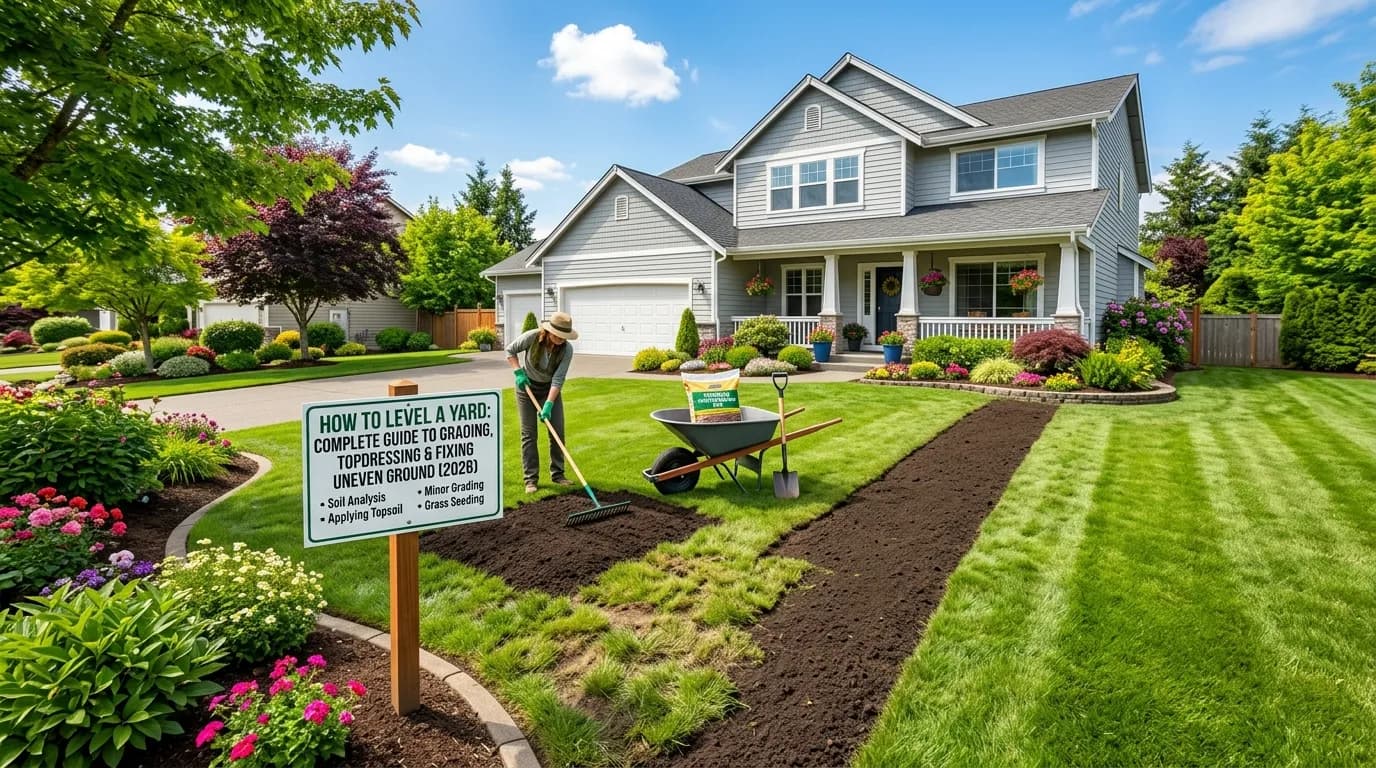
An uneven yard is more than an aesthetic problem — it's a drainage problem, a tripping hazard, a lawn mower's nightmare, and sometimes a foundation threat. Whether you're dealing with shallow dips that pool water after every rain, rough bumpy terrain that scalps during mowing, or a yard that slopes toward the house instead of away from it, the fix is within DIY reach.
This guide covers every scenario: minor surface leveling with topdressing, moderate corrections with fill and sod, and complete yard re-grading for serious drainage issues.
Why Your Yard Is Uneven: The Most Common Causes
Understanding why your yard is uneven determines the right fix. Most uneven yards fall into one of these categories:
Settling and Soil Compaction
Over time, soil compacts under foot traffic, vehicle weight, and the natural weight of saturated soil. Areas that were once level develop depressions. This is especially common in clay-heavy soils.
Fix: Topdressing for shallow depressions; fill and reseed for deeper ones
Buried Debris and Organic Matter
Old stumps, roots, tree debris, and organic material buried during construction decompose slowly, leaving depressions as the ground above settles into the void.
Fix: Excavate and fill the void, compact, then topdress and seed
Improper Grading During Construction
Many homes — especially those built in housing developments — were graded too flat or even slightly toward the foundation. As the yard settles over the first 5–10 years, drainage problems emerge.
Fix: Full re-grading (most involved solution — may require professional help or equipment rental)
Erosion
Heavy rain, irrigation runoff, and foot traffic on slopes erode soil from high areas and deposit it in low areas, creating an increasingly uneven surface over time.
Fix: Re-grade the slope, install erosion control (groundcover, sod, or retaining walls), and address drainage at the source
Frost Heave
In cold climates, soil expands as it freezes and contracts as it thaws, gradually pushing soil upward and creating uneven bumps and ridges.
Fix: Topdressing with a sand-soil mix over multiple seasons
Tools and Materials You'll Need
For Minor Leveling (Topdressing)
- Topdressing mix (sand, topsoil, and compost — details below)
- Metal lawn leveling rake or drag mat
- Push broom or stiff-bristle broom
- Lawn aerator (manual or rental)
- Grass seed (for thin areas)
- Water
Cost: $50–$300 depending on yard size
For Moderate Leveling (Fill and Sod)
- Topsoil or fill dirt
- Shovel and wheelbarrow
- Hand tamper or plate compactor (rental: $60–$120/day)
- Lawn edger
- Sod or grass seed
- Landscape fabric (optional)
Cost: $300–$1,500 depending on area
For Full Re-Grading
- Skid steer or bobcat loader (rental: $300–$600/day)
- Grading rake
- Topsoil (typically 4–6 inches of finish grade)
- Sod or hydroseed
Cost: $1,000–$5,000+ DIY with equipment rental | $2,000–$10,000+ professional
Method 1: Topdressing for Shallow Depressions
Topdressing is the ideal fix for lawns with shallow depressions (less than 2 inches deep), minor bumps, or rough uneven texture. It's the method used by golf courses to maintain perfectly smooth, level turf surfaces.
What Is Topdressing?
Topdressing means spreading a thin layer of a sand-soil-compost blend over an existing lawn. The mix fills low spots, works its way between grass blades into the soil, and gradually levels the surface — without killing or removing the existing grass.
The Best Topdressing Mix
The ideal topdressing for most lawns is a blend of:
- 50–70% coarse sand (not fine play sand, which can create a hardpan layer)
- 20–30% topsoil (screened, not clumpy)
- 10–20% compost (aged; improves soil biology)
Many garden centers sell pre-mixed lawn topdressing. Alternatively, buy the components separately and mix in a wheelbarrow.
Application depth per pass: No more than ½ inch at a time. Applying more than ½ inch smothers grass roots and kills turf.
Step-by-Step Topdressing Process
Step 1: Mow the lawn short
Cut the lawn at its lowest safe setting (about 1.5–2 inches). This allows the topdressing material to make full contact with the soil surface.
Step 2: Aerate first (strongly recommended)
Core aeration (pulling 2–3 inch plugs) creates channels for the topdressing mix to flow into the soil. Without aeration, topdressing tends to sit on top rather than integrating. Rent a core aerator or hire a lawn service for this step ($50–$150 for a typical yard).
Step 3: Mark and measure low spots
Walk the yard in dry conditions — feel with your feet, visually identify low areas, or use a long board (screed) laid on the lawn to identify dips. Mark them with flags or stakes.
Step 4: Apply the topdressing
Shovel or pour the topdressing mix onto the low areas. Start thicker in the deepest depressions, feathering out to nothing at the edges.
Step 5: Level and work in
Use a metal leveling rake, dragmat, or the back of a standard garden rake to spread the material evenly. Work it in small sections. The goal: a smooth transition from the leveled area to the surrounding lawn.
Step 6: Push into the grass
Use a stiff-bristle broom or the back of a steel rake to work the topdressing down between the grass blades. You want to see the grass tips emerging through the layer, not buried under it.
Step 7: Overseed if needed
If the low area had thin or dead grass, sprinkle grass seed after topdressing. Press the seed gently into contact with the material.
Step 8: Water in
Water the area lightly to settle the topdressing and initiate germination if you've seeded. Keep moist for 2–3 weeks while grass fills in.
Repeat as Needed
For depressions deeper than ½ inch, you'll need 2–4 applications over multiple seasons, not a single heavy application. Be patient — this is the correct method.
Method 2: Fill for Moderate Depressions (2–6 Inches Deep)
Depressions deeper than 2 inches are too deep for topdressing. You'll need to introduce fill material.
Step-by-Step for Deeper Depressions
Step 1: Cut and remove sod
Use a flat spade or sod cutter to slice under the sod in the affected area, lifting it in manageable sections (roughly 12 × 18 inches). Set sod aside in the shade, grass-side down, and keep moist.
Step 2: Fill the depression
Add quality topsoil (or a topsoil/compost blend) in 2–3 inch layers. Tamp each layer firmly before adding the next. Work up to approximately ½ inch below the surrounding grade.
Step 3: Topdress the final layer
Finish with a ½-inch layer of the sand-soil-compost topdressing blend for a fine, smooth surface.
Step 4: Re-lay sod or seed
If your original sod is still healthy, re-lay it over the filled area. Press firmly, eliminate air pockets, and tamp with your foot. Water immediately and keep moist for 2–3 weeks.
If sod is damaged, overseed the area with matching grass seed and cover with a thin layer of straw mulch to retain moisture.
Step 5: Keep off the area
Avoid heavy foot traffic on filled areas for 4–6 weeks while grass establishes and soil settles.
Method 3: Re-Grading for Serious Drainage Problems
If water pools near your foundation, your yard has serious negative slope (draining toward the house), or you have multiple large problem areas, you need proper re-grading — not just surface leveling.
The Critical Grading Standard: 6 Inches in 10 Feet
The minimum recommended grade away from any foundation is 6 inches of drop over the first 10 feet. That's a 5% slope — enough to direct water away from the structure without creating erosion on your lawn.
If your yard doesn't meet this standard, water is moving toward your foundation with every rainstorm, creating basement moisture, foundation movement, and potentially thousands of dollars in damage over time.
DIY Re-Grading: Is It Realistic?
For areas over 500 square feet or slopes greater than 6 inches, re-grading realistically requires:
- A skid steer or small bobcat (rental: $300–$600/day)
- 4–6 inches of quality topsoil for finish grade
- Sod or hydroseeding to restore the surface
- Willingness to deal with 2–3 days of heavy work
Total DIY cost: $1,000–$5,000 depending on yard size and topsoil needs
When to Hire a Professional
Hire a grading contractor (not a landscaper — a grading or excavation company) when:
- Water is actively entering your foundation or basement
- The slope issue covers more than 1,000 square feet
- You have underground utilities that must be located and protected
- The grading problem involves retaining walls or drainage structures
Professional re-grading cost: $2,000–$10,000 for a typical residential yard | $5,000–$25,000 for complex grading with drainage structures
Leveling a Bumpy Lawn (Without Depressions)
Some lawns aren't so much low in spots as just generally rough and bumpy — a surface that scalps during mowing and looks rough even when green. This is usually caused by:
- Frost heave (North)
- Large earthworm activity
- Animal burrowing
- Historical buried debris
The fix: A combination of aeration + repeated topdressing over 1–3 seasons, combined with rolling.
Lawn rolling: A water-filled roller (rent for $25–$50/day) filled to 1/3–1/2 capacity can flatten minor bumps in spring when the soil is moist but not saturated. Don't roll dry or saturated ground — you'll compact without leveling.
How to Level Ground for a Patio or Garden Bed
If you're leveling a specific area for a patio, shed, or raised bed — not the entire lawn — the process is different.
Step-by-Step Patio Leveling
- 1Stake and string — establish the desired grade with stakes and mason's line at your target level
- 2Remove sod and topsoil — excavate to 6–8 inches below finished grade (for a gravel base under pavers)
- 3Compact subbase — 4 inches of compacted gravel (3/4-inch crushed stone) creates a stable, draining foundation
- 4Add bedding sand — 1 inch of coarse sand, screeded level
- 5Install pavers — level as you go using a rubber mallet and level tool
- 6Fill joints — polymeric sand swept into joints, compacted, and activated with water
For a simple garden bed: Remove sod, loosen and amend soil 12 inches deep, rake level, and install edging to define the perimeter.
Lawn Leveling Cost Summary
| Project Type | DIY Cost | Professional Cost |
|---|---|---|
| Topdressing (1,000 sq ft) | $50–$200 | $150–$400 |
| Topdressing (5,000 sq ft) | $200–$600 | $500–$1,200 |
| Fill + resod (per 100 sq ft) | $100–$300 | $250–$600 |
| Re-grade with equipment (1,000 sq ft) | $500–$1,500 | $1,500–$4,000 |
| Full yard re-grade (5,000+ sq ft) | $2,000–$6,000 | $4,000–$15,000 |
Design Your Level Yard
Once your yard is level and draining properly, the real design work can begin: where the patio goes, how the planting beds flow, what structures anchor the space. A level yard is a canvas.
[See what your yard could look like with Yardcast →](/redesign) — upload a photo, describe your style, and get 3 AI landscape designs in 60 seconds. Free to preview.
FAQ: How to Level a Yard
Q: How do I level my yard myself?
A: For shallow dips (under 2 inches): use topdressing — spread a ½-inch layer of sand-soil-compost blend, work it in with a rake and broom, aerate first for best results. For deeper depressions: remove sod, add fill in layers, tamp, topdress the top ½ inch, and replace or re-seed. For major drainage or slope issues: you need re-grading with fill equipment.
Q: What is the best mix for topdressing a lawn?
A: A blend of 50–70% coarse sand, 20–30% topsoil, and 10–20% aged compost. Avoid fine play sand (it creates a hardpan layer). Pre-mixed lawn topdressing is available at most garden centers. Never use pure topsoil — it clumps and doesn't work into the lawn surface easily.
Q: Can I just add topsoil to level my lawn?
A: Not directly on top of grass in thick layers. Applying more than ½ inch of topsoil at a time smothers and kills the grass underneath. For shallow leveling, use a proper topdressing mix (not straight topsoil) in ½-inch passes. For deeper depressions, remove the sod first, fill with soil, then topdress the final ½ inch.
Q: How much does it cost to level a yard?
A: DIY topdressing for a 2,000-square-foot lawn: $100–$400. Professional topdressing service: $300–$800. For moderate depression filling: $300–$1,500 DIY, $800–$3,000 professional. Full yard re-grading: $2,000–$6,000 DIY with equipment rental, $4,000–$15,000 professional.
Q: When is the best time to level a lawn?
A: Early spring is ideal for most regions — the soil is workable, temperatures are mild, and there's a full growing season ahead for grass to recover. For cool-season grasses, early fall (September) is also excellent. Avoid leveling in summer heat or when the ground is frozen or saturated.
Q: My yard drains toward my house — how do I fix it?
A: This is a re-grading problem, not a topdressing problem. You need to add soil to build the grade away from the foundation — a minimum 5% slope (6 inches of drop over 10 feet) directed away from the structure. For areas over 500 square feet, consider renting a bobcat or hiring a grading contractor. This is worth fixing properly — negative grading causes foundation moisture and structural damage over time.
Q: Will a lawn roller level my yard?
A: Lawn rollers (water-filled drums) flatten minor bumps and frost heave in spring when soil is moist but not saturated — but they won't fill low spots. Use rolling for bumpy texture issues only, not true depressions. Never roll saturated or dry soil; both cause damage without leveling benefit.
Q: How long does it take for topdressing to work?
A: For shallow depressions filled with ½ inch of topdressing: the surface appears visually level immediately, and grass grows through fully within 3–4 weeks. For depressions requiring multiple passes, expect 1–3 seasons of repeated applications. Patience is required — the correct approach is multiple thin applications, not one thick one.