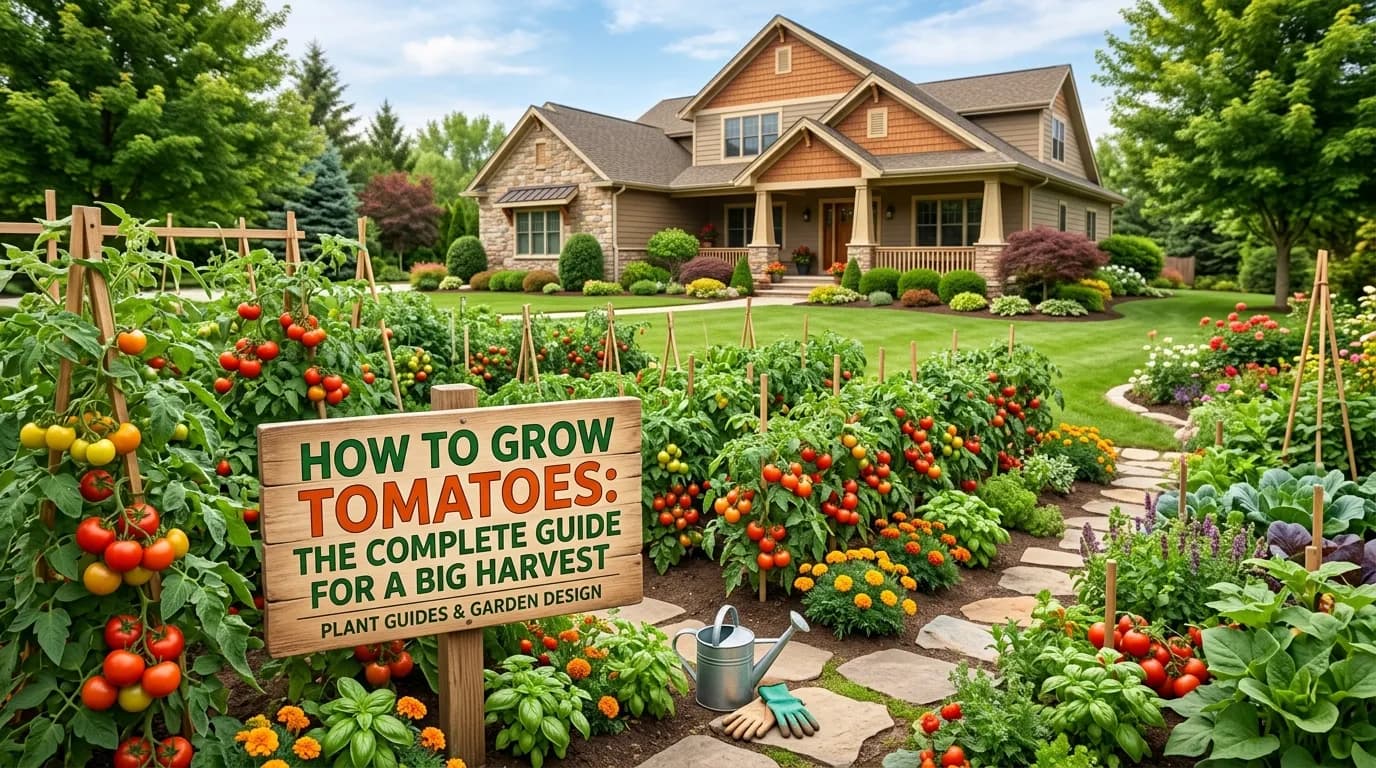
Growing your own tomatoes is one of the most rewarding things you can do in a garden. A sun-warmed tomato straight off the vine is something you simply cannot buy at any grocery store, at any price. But tomatoes have a reputation for being finicky — and that reputation is earned. Get a few key things right, though, and even a beginner can pull in 20–50 pounds of tomatoes from a single plant in a season.
This complete guide covers everything: variety selection, starting from seed versus buying transplants, soil prep, planting depth secrets, watering and fertilizing, pruning for bigger harvests, staking and caging, and diagnosing the problems that trip up most growers. By the end, you'll know exactly what you're doing and why.
Choosing the Right Tomato Variety
The single most important decision you'll make is which tomato to grow. There are over 10,000 named varieties — and they are not interchangeable.
Determinate vs. Indeterminate:
- Determinate (bush) tomatoes grow to a fixed size (3–4 feet), set all their fruit at once over 2–4 weeks, then stop. Good for canning, small spaces, and gardeners who want a single large harvest. Examples: Roma, Patio, Celebrity.
- Indeterminate tomatoes keep growing and fruiting until frost kills them. They can reach 6–8+ feet and produce continuously all season. They need caging or staking and more attention, but reward it with months of continuous harvest. Examples: Cherokee Purple, Sungold, Brandywine, Big Boy.
Best tomatoes by use:
| Variety | Type | Best For | Days to Maturity |
|---|---|---|---|
| Sungold | Indeterminate | Snacking, containers | 57 days |
| Cherokee Purple | Indeterminate | Flavor, slicing | 80 days |
| Roma | Determinate | Sauce, canning | 75 days |
| Celebrity | Determinate | Disease resistance, slicing | 70 days |
| Brandywine | Indeterminate | Best flavor (heirloom) | 85 days |
| Early Girl | Indeterminate | Short seasons, slicing | 52 days |
| Sun Sugar | Indeterminate | Cherry, snacking | 62 days |
| Big Boy | Indeterminate | Large slicers | 78 days |
For short-season climates (zones 3–5): Choose varieties under 65 days to maturity — Early Girl, Glacier, Stupice. Start seeds 8–10 weeks before last frost.
For hot climates (zones 8–10): Choose heat-tolerant varieties — Heatmaster, Solar Fire, Florida 91. Standard tomatoes stop setting fruit when nights stay above 75°F.
Starting from Seed vs. Buying Transplants
Starting from seed gives you access to thousands of varieties (not just the 10–15 at the nursery), costs $2–$4 per packet for 25–30 seeds, and gives you complete control over the plant's health from day one.
Seed starting timeline:
- Start seeds 6–8 weeks before your last frost date indoors
- Use sterile seed-starting mix (not garden soil — it compacts and harbors disease)
- Plant seeds ¼ inch deep, two per cell
- Germination: 5–10 days at 70–80°F soil temperature
- A heat mat dramatically improves germination speed and uniformity
- Once seedlings have 2 sets of true leaves, thin to one per cell and pot up into 4-inch containers
Grow lights matter: A bright south-facing window is rarely enough. Seedlings grown in low light become leggy and weak. LED grow lights set 2–4 inches above seedlings for 14–16 hours/day produce stocky, strong transplants.
Buying transplants is perfectly valid — it saves 6–8 weeks of indoor growing. Look for:
- Stocky, dark green stems (not leggy or yellowish)
- No flowers or fruit already set (early flowering stunts root development)
- No signs of disease (spots, wilting, distortion)
- Check the root ball: lightly rootbound is fine; densely rootbound with circling roots is not ideal
Preparing Your Garden Site
Tomatoes need:
- 6–8+ hours of direct sunlight daily (8+ hours = better production)
- Rich, well-draining soil with a pH of 6.0–6.8
- Consistent moisture — not wet, not dry
- Good air circulation — space plants 24–36 inches apart
Soil preparation is where most tomato problems start and end. Before planting:
- 1Till or loosen soil 12–18 inches deep — tomato roots go down 2–3 feet when given the chance
- 2Incorporate 3–4 inches of finished compost into the top 12 inches
- 3Add 1 cup of balanced slow-release fertilizer (5-10-10 or tomato-specific) per plant
- 4If your soil is heavy clay, add perlite or coarse sand for drainage
- 5If you have rocky, compacted, or poor soil, consider raised beds — they're the single biggest upgrade most vegetable gardeners can make
Want to design a dedicated vegetable garden with raised beds built into your overall yard layout? Yardcast's AI landscape designer can design your entire backyard plan, including raised bed placement, pathways, irrigation zones, and plant selections — in under 60 seconds. See what a professional vegetable garden design looks like for your specific yard.
Planting Tomatoes the Right Way
Here's the technique most gardeners don't know: plant tomatoes deep. Tomatoes are one of the few vegetables that develop roots all along the buried stem — called adventitious roots. The more stem you bury, the bigger the root system, and the more water and nutrients the plant can access.
Planting method:
- 1Dig a trench or deep hole that lets you bury 60–70% of the stem
- 2Strip leaves from the portion that will be underground
- 3Add a handful of bone meal or super phosphate to the planting hole (promotes root development)
- 4Lay the plant at an angle in the trench, with the growing tip pointing up (it will straighten within days)
- 5Backfill firmly, water in deeply, and mulch 3–4 inches around the base immediately (keeping mulch 2 inches away from the stem)
Timing: Plant after your last frost date, when soil temperature is consistently above 60°F. Cold soil stresses tomatoes and sets them back more than a late start.
Hardening off: If you started seeds indoors or bought greenhouse plants, introduce them to outdoor conditions gradually over 7–10 days — starting with 1 hour of outdoor exposure and increasing daily. Skipping this step causes sunscald and wind damage.
Watering and Fertilizing for Maximum Production
Watering rules:
- Tomatoes need 1–2 inches of water per week from rain + irrigation combined
- Water deeply and infrequently — let soil dry to 2 inches between waterings to encourage deep root growth
- Inconsistent watering is the #1 cause of blossom end rot and fruit cracking — keep moisture levels even
- Water at the base of the plant — wet foliage invites fungal disease
- Drip irrigation is the ideal system: delivers water directly to roots, keeps foliage dry, runs on a timer
- Mulch dramatically reduces how often you need to water
Fertilizing schedule:
- At planting: balanced slow-release (5-10-10 or 10-10-10) in the planting hole
- 2–3 weeks after transplant: water-soluble fertilizer (20-20-20) to support establishment
- Once first flowers appear: switch to a bloom-promoting, low-nitrogen formula (5-10-10, 8-32-16, or tomato-specific bloom fertilizer)
- Every 2–3 weeks through the season: continue low-N, high-P fertilizer
- Stop fertilizing 4–6 weeks before your expected first frost date
The high-nitrogen phase is critical: too much nitrogen after flowers appear causes lush foliage and poor fruit set. Your plant looks great; it produces nothing.
Staking, Caging, and Pruning
Support options:
| Method | Best For | Pros | Cons |
|---|---|---|---|
| Florida weave | Rows of indeterminate | Efficient for multiple plants | Requires maintenance |
| Heavy-gauge cage | Indeterminate, container | Minimal labor | Cheap cages collapse under weight |
| Single stake + tie | Indeterminate, small spaces | Simple | Requires weekly attention |
| Tomato tower (rebar) | Indeterminate | Very strong | More setup |
Pruning suckers: Suckers are the side shoots that emerge in the "V" between the main stem and a branch. On indeterminate varieties, letting every sucker grow creates a massive, tangled plant with smaller fruit. Most gardeners prune suckers below the first flower cluster, leaving 1–2 suckers above to create a 2–3 main stem structure. This improves air circulation, keeps fruit off the ground, and often increases overall yield.
Do not prune determinates — you'll remove the fruiting wood and destroy your harvest.
Common Tomato Problems and How to Fix Them
Blossom end rot (BER): Black, leathery patch on the blossom end of fruit. Caused by calcium deficiency — almost always due to inconsistent watering rather than lack of calcium in soil. Fix: even, consistent watering, mulch deeply, and avoid high-nitrogen fertilizers. Calcium sprays treat the symptom but not the cause.
Blossom drop: Flowers fall off without setting fruit. Causes: temperatures above 90°F or below 55°F at night, overfertilizing with nitrogen, water stress. Fix: choose heat-tolerant varieties in hot climates, water consistently, shade cloth at midday in extreme heat.
Fruit cracking: Concentric or radial cracks on fruit. Cause: sudden increase in water after a dry period (classic in late-summer thunderstorms after drought). Fix: even, consistent irrigation, mulching to slow evaporation.
Early blight: Bull's-eye pattern brown spots on lower leaves, progressing up the plant. Remove affected leaves, avoid wetting foliage, apply copper fungicide at first sign. Rotate crops — don't plant tomatoes in the same spot for 3+ years.
Late blight: Water-soaked dark patches on leaves and stems that progress rapidly in cool, wet weather. Very destructive and fast-moving. Use resistant varieties (Mountain Merit, Defiant). Apply preventive copper fungicide in high-risk conditions.
Tomato hornworm: Large green caterpillar up to 4 inches long, nearly invisible against stems. Handpick; Bacillus thuringiensis (Bt) is highly effective. Look for white cocoons on the body — if present, parasitic wasps are already at work; leave those worms in place.
When and How to Harvest
Let tomatoes ripen on the vine — they develop the best flavor in the last days of vine ripening. But you don't have to wait for them to be fully red to pick:
- Pick when they've reached "breaker stage" (50% color change) and ripen indoors on the countertop (never in the refrigerator — cold destroys flavor and texture permanently)
- At end of season, bring in all green tomatoes when frost threatens; wrap individually in newspaper and they'll continue ripening indoors for 4–6 weeks
- Pick regularly — leaving ripe tomatoes on the vine signals the plant to slow production
Signs of peak ripeness: full color for the variety, slight give when gently squeezed, strong tomato fragrance at the stem.
Growing Tomatoes in Containers
Container growing is absolutely viable and increasingly popular for patios, balconies, and small spaces. Keys to success:
- Pot size: Minimum 5-gallon for determinate varieties; 10–15 gallon for indeterminate. Bigger is always better — containers dry out fast.
- Best varieties for containers: Sungold, Tumbling Tom, Patio, Tiny Tim, Bush Early Girl, Glacier
- Soil: Use high-quality potting mix (never garden soil — it compacts). Add slow-release fertilizer at planting.
- Watering: Containers need watering daily in hot weather — sometimes twice. Self-watering containers are a game-changer.
- Fertilizing: Water-soluble fertilizer every 7–10 days, since nutrients leach out with frequent watering
Ready to design a vegetable garden that works beautifully with your overall yard? [Get a free AI landscape design at Yardcast](/redesign) — upload your yard photo and get 3 professional designs with raised bed placement, pathways, and plant selections in under 60 seconds.
FAQ: How to Grow Tomatoes
Q: How much sun do tomatoes need?
A: Tomatoes require a minimum of 6 hours of direct sunlight daily — 8 hours or more produces significantly better yields and flavor. In hot climates (zones 8–10), light afternoon shade (2–3 hours) can reduce heat stress without dramatically cutting production. Never plant tomatoes in a spot with less than 6 hours of direct sun.
Q: When should I plant tomatoes?
A: Plant tomatoes outdoors after your last frost date, when soil temperature is consistently above 60°F. For most of the US: May 1–15 in zones 5–6, April 15–May 1 in zone 7, April 1–15 in zones 8–9. Start seeds indoors 6–8 weeks before transplanting. A soil thermometer is the most reliable guide.
Q: How deep should I plant tomatoes?
A: Plant tomatoes deep — bury 60–70% of the stem. Tomatoes form roots along the buried stem (adventitious roots), so a deeper planting creates a larger root system that accesses more water and nutrients. Dig a trench, lay the plant at an angle with the tip pointing up, strip buried leaves, and backfill firmly.
Q: Why are my tomato leaves curling?
A: Leaf curl has several causes: physiological leaf roll (harmless, common in hot weather), inconsistent watering (fix: even moisture), overfertilizing with nitrogen, or viral disease (mosaic viruses — no cure; remove affected plants). Check for aphids on the undersides of curled leaves, which also cause distortion. Physiological leaf roll affects lower leaves and is nothing to worry about.
Q: How often should I water tomatoes?
A: Water deeply 2–3 times per week rather than shallowly every day. Goal is 1–2 inches total per week including rain. Allow the top 2 inches of soil to dry between waterings. In containers or during heat waves, daily watering (or twice daily) may be needed. Mulching 3–4 inches reduces watering frequency by 40–50%.
Q: What is the best fertilizer for tomatoes?
A: A balanced starter (10-10-10 or 5-10-10) at planting, followed by a low-nitrogen bloom fertilizer (5-10-10, tomato-specific) once flowers appear. High nitrogen causes excessive foliage and poor fruit set. Calcium is important for blossom end rot prevention — look for fertilizers that include calcium, or water consistently (inconsistent watering is the real BER cause).
Q: How do I prevent blossom end rot?
A: Blossom end rot (the black leathery patch on the blossom end) is caused by calcium uptake failure, almost always from inconsistent watering — not calcium-deficient soil. Fix: water deeply and consistently, mulch 3–4 inches to retain moisture, avoid high-nitrogen fertilizers, and don't over-till near plant roots. Calcium sprays provide temporary relief but address symptoms, not the cause.
Q: Can I grow tomatoes in containers?
A: Yes — container tomatoes are very productive with the right setup. Use a minimum 10–15 gallon container for indeterminate varieties (5 gallon for compact determinates), high-quality potting mix, and daily watering in warm weather. Best container varieties: Sungold, Tumbling Tom, Patio, Bush Early Girl. Self-watering containers are highly recommended for anyone who travels or has an inconsistent schedule.