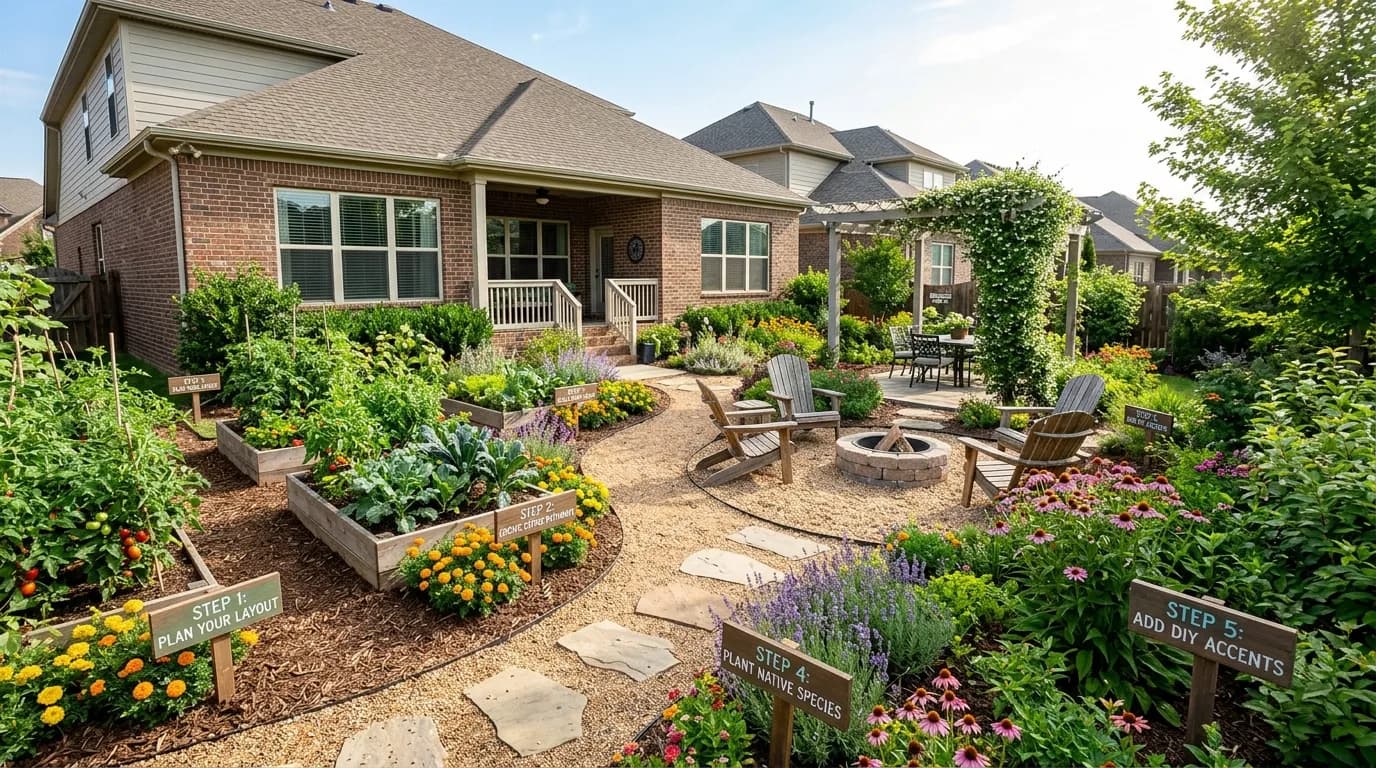
A beautiful backyard doesn't require a landscape architect, a $15,000 budget, or two years of weekends. With a clear plan and smart priorities, most homeowners can design and install a genuinely attractive, functional outdoor space for $500–$2,000. This guide shows you exactly how — from the first sketch to the final mulch layer.
Step 1: Define What You Actually Want From Your Backyard
Before you spend a dollar, spend 30 minutes writing down what matters. This sounds obvious, but skipping it is the #1 reason backyard projects stall or disappoint.
Ask yourself:
- How do I want to use this space? (Relaxing? Entertaining? Kids playing? Gardening? All of the above?)
- What's the biggest problem right now? (Ugly lawn? No seating area? No privacy? Bare dirt?)
- Who uses this space and how often?
- What's my realistic timeline? (One weekend blitz? Phased over a year?)
- What's my hard budget ceiling?
Write the answers down. This document becomes your design filter — every decision gets evaluated against it. If "privacy from neighbors" is your #1 priority, you don't spend $400 on a fire pit until you've solved that.
Step 2: Measure and Map Your Space
You don't need professional software. Graph paper and a tape measure work fine.
- 1Measure the perimeter of your backyard (length × width)
- 2Mark fixed features — the house wall, gates, existing trees, utility boxes, downspouts
- 3Note sun and shade patterns — walk the yard at 9am, noon, and 4pm and mark which areas are full sun, part shade, and full shade
- 4Identify drainage issues — where does water pool after rain? That area needs different plants or a solution (dry creek bed, rain garden)
- 5Measure the distance from windows — you'll want to frame nice views from inside the house
On your map, draw zones: where does a seating area go? Where do you want plantings? Where's the lawn staying? Even a rough pencil sketch gives you a plan to work from.
Pro tip: Use AI landscape design at Yardcast.ai to skip the graph paper step. Upload your yard photos and get three photorealistic design options showing different layouts, plants, and materials — in under 60 seconds. It's free to preview.
Step 3: Prioritize Your Budget (The 70/20/10 Rule)
Here's how to allocate a tight backyard budget:
| Category | % of Budget | What It Covers |
|---|---|---|
| Structure (hardscape) | 50–60% | Patio, path, edging — the "bones" that last 20+ years |
| Plants | 25–35% | Trees, shrubs, perennials, groundcovers |
| Finishing touches | 10–15% | Mulch, lighting, decor, soil amendments |
The hardscape-first approach pays off long-term: a $600 paver patio lasts 25 years; $600 in annuals lasts one season. Get the structure right, then plant around it.
Step 4: How to Layout Your Backyard (The Design Process)
This is the question most homeowners search for: how do I layout my backyard? Here's the method landscape designers actually use:
Start with the Outdoor Room Concept
Think of your backyard as a series of outdoor rooms, each with a purpose. Even a small 20×30 ft yard can have three distinct zones:
- Seating/dining zone — hardscape surface, near the house
- Garden/planting zone — perimeter beds with trees, shrubs, and flowers
- Lawn or open zone — remaining central space (or replace with groundcover)
Create Flow with Paths
A path connecting the back door to the garden or a gate immediately makes a yard feel designed. Even a simple stepping stone path ($2–$4 per stone × 12 stones = $30) adds enormous visual structure. Curved paths feel more natural and make small yards feel larger; straight paths feel formal and clean.
Use the Rule of Thirds
Divide your yard into thirds both horizontally and vertically. Place focal points (a specimen tree, a birdbath, a seating area) at the intersections of those thirds. This is a classical composition principle that works whether you're designing a painting or a backyard.
Frame Your Views
Stand at your back door and look out. That's your primary view — design it intentionally. Place a small ornamental tree or large shrub as a focal point in the middle distance (20–30 ft away). Line the edges with lower plantings. Leave the foreground for your patio or lawn. This simple layered depth creates visual interest.
Want to see these design principles applied to your actual yard? [Get 3 free AI backyard design previews at Yardcast](/redesign) — upload your photos and see your options in 60 seconds.
Step 5: Choose Plants That Don't Drain Your Budget
Plant selection is where most budget backyard projects go wrong. Here's how to keep costs down while getting a lush result:
Buy Small, Plant Right
A 1-gallon perennial costs $5–$8 and reaches full size in 2–3 seasons. A 3-gallon version of the same plant costs $18–$25. For most perennials and ornamental grasses, buy the small size — you won't see a difference after year two.
Exception: Trees. For trees, buy at least a 5-gallon container ($40–$80) or a 1.5-inch caliper balled-and-burlapped specimen. Small tree caliper sizes take 5+ years to provide real structure.
Divide Existing Plants (Free)
If you have any perennials already — hostas, daylilies, ornamental grasses, coneflowers — divide them in spring or fall and transplant the divisions to new beds. One overgrown clump of daylilies can easily become 10–15 plants. Cost: zero.
Best Budget-Friendly Plants by Category
Perennials (come back every year):
- Black-eyed Susan (Rudbeckia) — $4–$7, full sun, blooms all summer
- Purple coneflower (Echinacea) — $5–$8, drought-tolerant, pollinators love it
- Daylily — $3–$6, almost indestructible, multiplies freely
- Salvia — $4–$7, low water, deer-resistant, long bloom season
Shrubs (structure without constant replanting):
- Spirea — $12–$20 per 1-gal, spring blooms, fall color
- Dwarf burning bush — $15–$25, fiery fall color, very tough
- Knock Out Rose — $18–$28, continuous blooms, disease-resistant
- Endless Summer Hydrangea — $20–$35, reliable rebloomer
Ornamental Grasses (low-maintenance anchors):
- Fountain grass (Pennisetum) — $6–$12, graceful, 4-season interest
- Karl Foerster feather reed grass — $8–$15, upright, architectural
- Blue oat grass — $8–$12, blue color, evergreen in many zones
Step 6: DIY vs. Hire Out — Where to Spend and Save
Not everything needs a professional. Here's how to be strategic:
DIY everything:
- Planting beds and all plant installation
- Mulching
- Stepping stone paths
- Edging installation
- Painting fences or sheds
- Raised garden beds
Consider hiring out:
- Concrete patio pours (requires equipment + expertise)
- Large tree removal (safety issue)
- Irrigation system installation (complex, impacts water bills significantly)
- Retaining walls over 18 inches (structural + drainage engineering needed)
A skilled weekend warrior can do most backyard improvements. The things that go badly without expertise tend to involve heavy machinery, major excavation, or structural elements.
Step 7: Build in Phases
The biggest budget backyard mistake is trying to do everything at once. A phased approach lets you spread costs, learn what's working, and adjust the plan as the yard evolves.
Year 1 — Foundation:
- Install patio or seating area
- Plant perimeter trees and large shrubs (they need the most time to grow)
- Add edging and mulch all beds
Year 2 — Infill:
- Add perennials and groundcovers between established shrubs
- Install path or stepping stones
- Add privacy plants if needed
Year 3 — Finishing:
- Add lighting, decorative elements
- Fill in any gaps with divisions of established perennials
- Fine-tune the design based on what you've learned
This phased approach spreads a potential $3,000 project over three years at $1,000/year — and by year three, the year-one plants are mature and the yard looks established.
Sample Budget Breakdown: $1,500 Backyard Makeover
Here's a realistic budget for a 30×40 ft backyard transformation:
| Item | Cost |
|---|---|
| 4 stepping stones + gravel path (40 ft) | $120 |
| Steel edging (80 linear ft) | $85 |
| 12 bags of compost (soil amendment) | $75 |
| 3 cubic yards mulch (bulk delivery) | $90 |
| 2 ornamental grasses (Karl Foerster) | $28 |
| 1 flowering shrub (Knock Out Rose) | $25 |
| 12 perennials (coneflower, salvia, daylily) | $80 |
| 2 flats ground cover (ajuga or creeping thyme) | $60 |
| Outdoor string lights | $35 |
| Total | ~$598 |
That leaves $900 in reserve for contingencies, more plants as you see the space develop, or a small patio kit in year two. This is real: many homeowners dramatically transform their backyards for under $600 in materials if they're doing the labor themselves.
The Fastest Way to Design Your Backyard
The design step used to mean hiring a landscape designer ($75–$150/hour) or spending weeks sketching options. In 2026, there's a better way.
Yardcast's AI landscape designer generates three fully visualized, regionally specific backyard designs from photos of your actual yard — free to preview. You upload your yard photos, answer a few questions about your style and budget, and get professional-quality design concepts in under 60 seconds.
Each design comes with:
- A plant list specific to your USDA hardiness zone
- Budget estimate for materials
- Phased installation breakdown
- A contractor-ready PDF you can take to a nursery or landscaper
It's the fastest way to go from "I don't know where to start" to "here's exactly what I'm building."
Get your 3 free backyard design previews →
Common Budget Backyard Mistakes to Avoid
- 1Buying too many annuals. Annuals are instant color but die at season's end. Spend the budget on perennials that come back and expand year over year.
- 1Skipping edging. Beds without edging look sloppy in two months as grass creeps in. Edging is a one-time cost with years of payback.
- 1Underbuying mulch. You need 3–4 inches for effective weed suppression. Most people apply 1–2 and wonder why they're still weeding. Bulk mulch (by the cubic yard) is 60–75% cheaper than bagged.
- 1Overplanting from the start. Plants at proper spacing look sparse for the first 1–2 seasons. Resist the urge to fill every gap — they'll fill in. Overplanted beds require dividing or removing plants in 3–4 years.
- 1Ignoring drainage. Water that pools in a bed will kill plants. Solve drainage issues (raise beds, amend soil, install a dry creek bed) before planting.
- 1No focal point. Every successful garden has a visual anchor — a specimen tree, a water feature, a distinctive plant. Without one, the eye wanders and the space feels random.
Frequently Asked Questions
See the FAQ section below for detailed answers to the most common questions about budget backyard design.