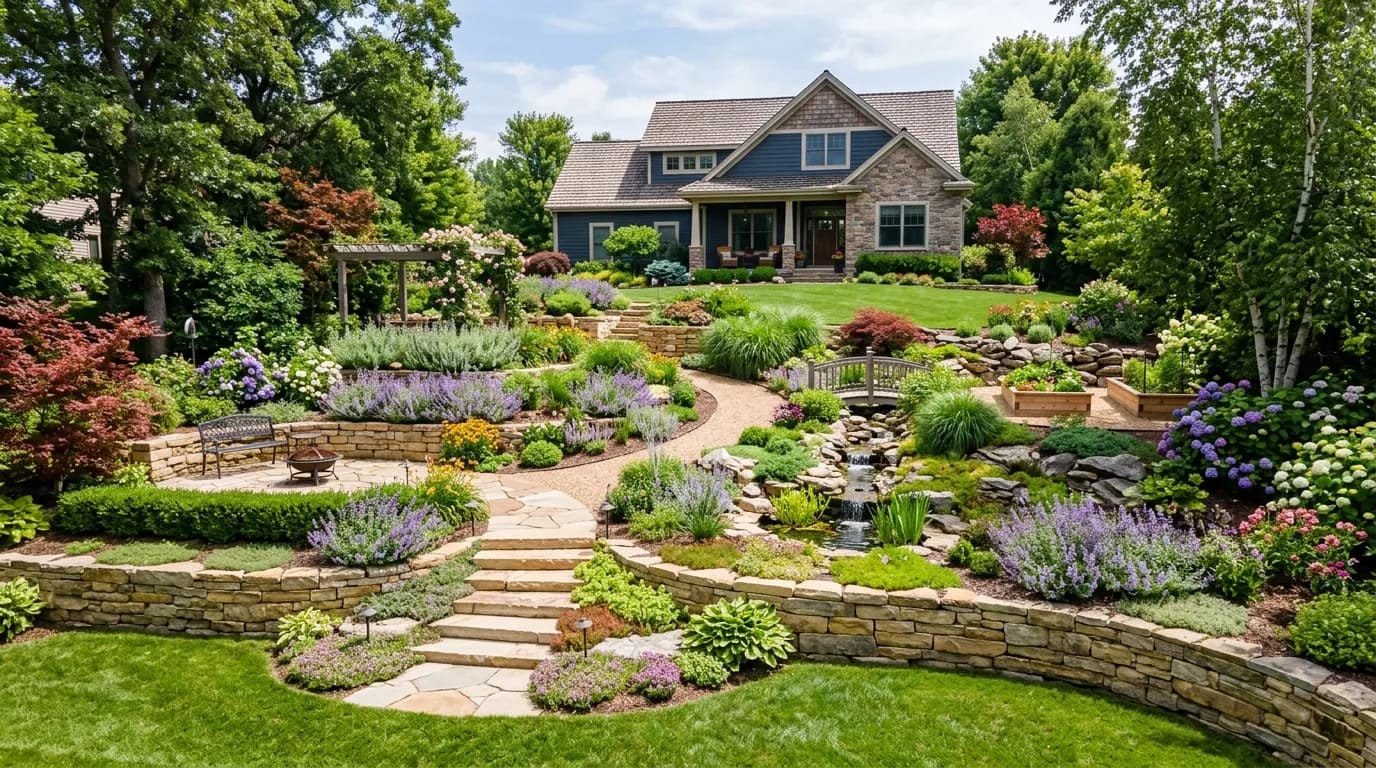
If you have a sloped backyard or front yard, you already know the challenges: erosion after every rain, grass that's nearly impossible to mow safely, water that runs off before it can soak in, and a space that feels unusable. But here's the thing: slopes are actually one of the most beautiful canvases in residential landscaping — if you know how to work with them.
These 25 hillside landscaping ideas range from simple DIY groundcover solutions to dramatic terraced gardens. They solve real problems (erosion, runoff, unusable space) while creating something visually striking.
Before choosing your approach, see what your slope could look like. Generate a free AI design for your yard →
Erosion Control Solutions (Ideas 1–6)
1. Mass Plant With Deep-Rooted Groundcovers
The fastest, most cost-effective way to stop erosion on a slope is to cover it with deep-rooted groundcover plants. Their root systems bind the soil and absorb rainfall before it can wash anything away. The best choices:
- Creeping juniper (Juniperus horizontalis) — evergreen, 12–18" tall, drought-tolerant once established
- Crown vetch — fast-spreading, nitrogen-fixing, excellent for steep slopes
- Cotoneaster dammeri — low-growing, evergreen, produces red berries in fall
- Liriope muscari — grass-like, shade-tolerant, flowers purple in late summer
- Forsythia — vigorous, deciduous, brilliant yellow flowers in early spring
Plant on 18–24 inch centers, apply 3 inches of mulch between plants, and within two seasons the slope will be fully covered.
2. Jute Erosion Control Mat
Before groundcovers establish, bare soil is vulnerable. Jute mesh or coir (coconut fiber) erosion control blankets stabilize the slope during that critical first growing season. Roll them down the slope, pin with biodegradable stakes, and plant through the mesh. The mat biodegrades over 1–2 years as the plants fill in. Cost: $50–$150 per 100 sq ft.
3. Riprap (Decorative Rock) Channel
Create a dry creek bed channel at the base of your slope to capture and redirect runoff. Use large, angular rocks (called riprap) to line the channel — they're heavy enough not to wash away and create a natural-looking drainage feature. Fill the adjacent slope with ornamental grasses and boulders for a coherent design.
4. French Drain System
For serious water management on steep slopes, install a perforated pipe French drain at the base of the slope, sloping away from structures. The pipe captures subsurface water before it causes damage and redirects it to a safe discharge point. This is infrastructure, not decoration, but it's often the prerequisite for any beautiful hillside landscaping to succeed.
5. Willow or Dogwood Planting
Native willows and dogwoods are champion erosion controllers — they grow rapidly, have extremely deep root systems, and thrive in wet soil conditions that might kill other plants. Planted along slopes where water concentrates, they work like a natural sponge. Redosier dogwood (Cornus sericea) also delivers four-season beauty: red stems in winter, white flowers in spring, and red berries in fall.
6. Slope Stabilization With Native Grasses
Native grasses have root systems that penetrate 6–12 feet into the soil — far deeper than lawn grass — making them extremely effective at stabilizing steep slopes. Little bluestem, switchgrass, and sideoats grama are all excellent choices. They require no irrigation after establishment, no fertilizer, and look spectacular in fall as their seed heads catch the light.
Retaining Wall Ideas (Ideas 7–12)
7. Dry-Stack Stone Retaining Wall
A dry-stack stone wall (built without mortar, relying on gravity and careful stone placement) is the most timeless and natural-looking retaining wall option. It allows water to drain freely through the joints, which prevents the buildup of hydrostatic pressure that destroys mortared walls. Use local fieldstone for the most natural look. A 2-foot-tall dry-stack wall costs $25–$40 per linear foot DIY.
Want to see what retaining walls would look like in your yard? Generate an AI design →
8. Stacked Concrete Block Terraces
Concrete retaining wall blocks (Allan Block, Versa-Lok) are engineered for hillside applications, interlocking to create stable walls without mortar. They're available in natural stone textures and can create walls up to 4–6 feet tall without engineering review (check local codes). Use them to create flat terraces from a steep slope — each terrace becomes a planting bed or outdoor living area.
9. Railroad Tie (Timber) Terraces
Pressure-treated landscape timbers or reclaimed railroad ties make excellent terrace walls on gentle slopes. They're easy to work with, relatively inexpensive ($3–$8 per linear foot), and blend naturally into a woodland or cottage garden aesthetic. Note: modern pressure-treated lumber is safe; true railroad ties may contain creosote and shouldn't be used near vegetables.
10. Gabion Basket Walls
Gabion baskets — wire mesh cages filled with rocks — make contemporary, industrial-chic retaining walls that are highly functional. They're self-draining, flexible enough to shift slightly without failing, and can be filled with locally sourced rocks to save cost. They work beautifully in modern, drought-tolerant, and Southwest-inspired designs.
11. Corten Steel Retaining Wall Panels
Weathering steel (Corten) panels create dramatic, ultra-modern retaining walls that develop a beautiful rust patina over time. They pair perfectly with ornamental grasses, architectural succulents, and decomposed granite surfaces. Use them for short retaining runs (2–3 feet) where visual impact matters most.
12. Integrated Seat Wall
Design your retaining walls to double as seating by topping them with a smooth capstone at bench height (18 inches). A stone or concrete seat wall at the top or base of your slope creates gathering space while managing the grade change. This is especially effective at the transition between your patio and a lower lawn area.
Terraced Garden Ideas (Ideas 13–19)
13. Mediterranean Terrace Garden
Create 2–3 terraced planting beds supported by stone retaining walls and plant with Mediterranean staples: lavender, rosemary, sage, ornamental grasses, agave, and olive trees. Gravel mulch between plants echoes the Tuscan countryside and suppresses weeds effectively. Add a stone staircase with creeping thyme growing in the joints.
14. Kitchen Garden Terraces
Terraced slopes are perfect for edible gardens: flat beds are easier to maintain than sloped ones, they drain well, and they get maximum sun exposure if south-facing. Stack 3–5 narrow terraces (4–5 feet wide) supported by timber walls, fill with rich garden soil, and plant vegetables, herbs, and edible flowers. It's both beautiful and productive.
15. Woodland Shade Terrace
On a north-facing slope that gets limited sun, create a woodland shade garden: native ferns, hostas, astilbe, bleeding heart, and hellebores thrive in exactly these conditions. Add wooden step risers made from split logs, moss growing between the cracks, and the occasional large boulder for structure. It looks like a scene from a Pacific Northwest garden.
16. Rain Garden at Slope Base
At the base of your slope, where all the runoff collects, install a rain garden — a shallow depression planted with water-tolerant natives. Black-eyed Susans, swamp milkweed, cardinal flower, and blue flag iris can handle both the flooding that follows a rain event and the dry periods between. It filters runoff before it reaches storm drains and supports pollinators.
17. Stepped Staircase With Plantings
A well-designed staircase through your slope is both functional (safe access) and beautiful. Use natural stone, concrete pavers, or wood risers with slightly oversized treads. Let sedums, creeping thyme, or ajuga spill over the edges of each step. Line the staircase with low-growing shrubs or ornamental grasses on both sides to create a processional experience.
18. Hanging Garden on Steep Slope
For slopes too steep for conventional gardening, use a system of vertical planting pockets or "hanging baskets" secured to the slope with anchors. Each pocket holds a self-watering cell with annuals or trailing perennials. On a 45-degree or steeper slope where nothing else is feasible, this creates a colorful hanging garden effect.
19. Prairie-Style Hillside
On a gentle to moderate slope, plant a prairie meadow: native grasses (little bluestem, prairie dropseed) interspersed with wildflowers (coneflower, black-eyed Susan, wild bergamot, blazing star). Mow once a year in late winter. The result is a swaying, naturalistic meadow that's drought-tolerant, erosion-resistant, and stunning in late summer and fall.
Statement Features for Sloped Yards (Ideas 20–25)
20. Waterfall Feature
A sloped yard is the perfect setting for a recirculating waterfall. The grade change that causes you headaches is exactly what a water feature needs to look natural. Install a small pump, liner, and naturalistic rock arrangement to create a waterfall that flows down your slope into a small pond or basin at the bottom. Budget: $500–$5,000 depending on scale.
21. Outdoor Cinema Terrace
Level one large terrace and convert it into an outdoor theater: a projector mounted to a pergola post, a weather-resistant screen or white painted wall, string lights overhead, and a blanket-friendly gravel or artificial turf surface. This makes the slope an asset — the natural grade change means you can set up rows of seating on the incline with perfect sightlines.
22. Bocce Ball Court on Mid-Terrace
A 12x60 foot level terrace is the ideal footprint for a bocce ball court. Grade one terrace flat, edge it with timber or stone, fill with crushed oyster shell or decomposed granite, and you have a court that's regulation size and aesthetically beautiful. This is a particularly effective choice for Mediterranean and Italian-inspired landscape styles.
23. Rock Garden With Alpine Plants
For steep, dry, south-facing slopes: create a rock garden with arranged boulders and plant alpine and rock garden plants in the crevices. Sedums, sempervivums (hens and chicks), lewisia, and phlox subulata thrive in well-drained, rocky conditions and provide year-round color. This approach works best in USDA zones 4–7 and requires almost zero maintenance once established.
24. Espalier Fruit Trees on Slope Wall
Train dwarf apple, pear, or fig trees flat against your retaining walls as espaliers — an ancient technique of training trees in a flat, two-dimensional pattern. Espaliers look spectacular, produce real fruit, take up minimal depth, and disguise an otherwise utilitarian wall. They require annual pruning training but are far easier than a conventional orchard.
25. Illuminated Nightscape
What makes a hillside garden truly spectacular is thoughtful lighting. Use in-ground uplights at the base of specimen trees, step lights recessed into stair risers, path lights along the staircase edges, and a few well-placed spotlights aimed at your most dramatic plants or boulders. The grade change means lighting on a slope can create the kind of dramatic shadows and silhouettes that flat yards can't achieve.
Choosing the Right Approach for Your Slope
Gentle slope (1–10%): Almost any standard landscaping works — just add a layer of 3-inch mulch to slow runoff. Groundcovers, native grasses, and perennial beds all work well.
Moderate slope (10–30%): Retaining walls and terracing start to pay off here. Groundcovers are essential to prevent erosion on unretained areas. Stairs become necessary for safe access.
Steep slope (30%+): Engineering matters here. Retaining walls need to be properly designed, drainage must be managed, and plant selection is limited to deep-rooted groundcovers and shrubs. A landscape architect consultation is worthwhile at this grade.
The best way to evaluate which approach works for your specific slope? Generate a design visualization. See your hillside landscaping before committing to anything →
Frequently Asked Questions
What is the best plant for a steep slope?
The best plants for steep slopes have deep, spreading root systems and can withstand drought stress. Top choices: creeping juniper, crown vetch, cotoneaster, liriope, native switchgrass, and forsythia. For rocky slopes, sedums and sempervivums excel.
How do I landscape a slope cheaply?
The most cost-effective approach is mass planting deep-rooted groundcovers. Buy plants in flats (much cheaper per plant than individual pots), plant on 18-inch centers, mulch heavily between plants, and water regularly for the first season. Once established, groundcovers require minimal ongoing investment.
How do you stop a hill from eroding?
Short term: apply jute erosion control mat and mulch. Medium term: plant deep-rooted groundcovers. Long term: install retaining walls to create level terraces, which dramatically reduce the velocity of water flowing downhill and the erosion it causes.
Do I need a retaining wall on my slope?
Not always. Slopes under 30% grade can often be managed with groundcovers alone. Steeper slopes, slopes near structures, or slopes where water concentration is a problem typically benefit from retaining walls. Any wall over 4 feet tall generally requires a permit and engineering review.
What are the best retaining wall materials for a hillside?
Dry-stack natural stone is the most beautiful and self-draining. Concrete interlocking blocks (Allan Block, Versa-Lok) offer the best combination of cost, strength, and DIY-friendliness. Timber/landscape timbers are the most affordable. Gabion baskets are the most modern-looking.
Can I plant a vegetable garden on a slope?
Yes — terraced slopes are actually excellent for vegetable gardens. Create flat terraces using retaining walls, fill with quality garden soil, and the south-facing exposure that slopes often provide gives you even more sun than a flat garden. The drainage is typically excellent too, which vegetables prefer.