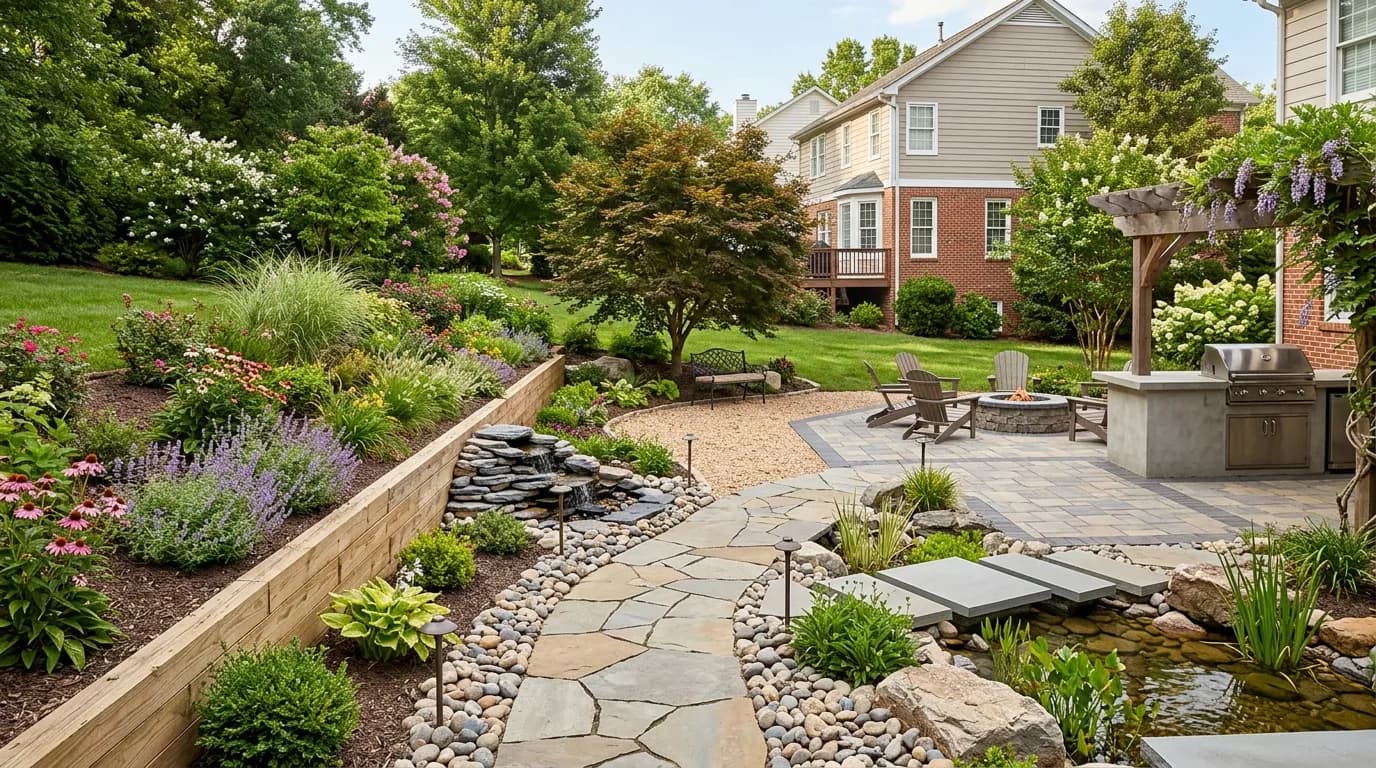
Hardscaping is the foundation every great landscape is built on. While plants add color and life, it's the patios, pathways, walls, and structures that give your outdoor space its shape, flow, and functionality. Done right, hardscaping adds significant property value, creates outdoor rooms you actually use, and dramatically reduces long-term maintenance compared to all-lawn yards.
This guide covers 35 hardscaping ideas across every category — from budget-friendly gravel paths to statement stone patios — with material comparisons, cost ranges, and design tips for every style and yard size.
What Is Hardscaping?
Hardscaping refers to the non-living elements of landscape design: any paved, built, or structural feature in your outdoor space. It includes:
- Patios and decks — the primary outdoor living surface
- Walkways and pathways — connecting zones and directing foot traffic
- Retaining walls — managing grade changes and preventing erosion
- Driveways — the arrival experience and curb appeal anchor
- Steps and staircases — elevation transitions
- Edging and borders — defining beds and creating clean lines
- Fire pits and outdoor fireplaces — entertainment focal points
- Pergolas and arbors — overhead structure and shade
- Water features — ponds, fountains, waterfalls
Good hardscaping provides the "bones" of your landscape — the permanent structure that softscaping (plants, lawn, mulch) fills in around.
Patio Hardscaping Ideas
The patio is the most used and highest-ROI hardscape element in most residential yards. Studies show a well-designed patio recovers 80–100% of its cost at resale.
1. Concrete Paver Patio
Interlocking concrete pavers are the most popular residential patio material for good reason: they're durable (40+ year lifespan), relatively affordable ($8–$20/sq ft installed), and come in dozens of colors, sizes, and patterns.
Best patterns: Running bond, herringbone, basketweave, random ashlar. Herringbone locks the surface and prevents shifting — ideal for driveways and high-traffic patios.
Cost: $8–$20/sq ft installed | DIY possible with proper base preparation
2. Natural Flagstone Patio
Flagstone — irregular pieces of natural stone like bluestone, slate, limestone, or travertine — creates an organic, timeless look that feels genuinely different from manufactured materials. Each piece is unique.
Styles: Irregular joints with ground cover (thyme, clover) growing between stones for a cottage feel; tight-cut joints with polymeric sand for a formal/modern look.
Cost: $15–$35/sq ft installed | DIY possible for dry-lay; wet-set requires more skill
3. Stamped Concrete Patio
Stamped concrete replicates the look of stone, brick, or wood at a lower material cost. Patterns are pressed into wet concrete, then colored with integral pigment and/or surface stain.
Best for: Large patios where real stone would be cost-prohibitive. Creates a uniform look ideal for modern/contemporary styles.
Cost: $12–$25/sq ft installed | Requires professional installation
4. Brick Patio
Reclaimed or new brick creates a warm, classic look that ages beautifully. Brick is durable, low-maintenance, and improves with time as it develops patina.
Design tip: Use used brick for a cottage/traditional look; modern concrete brick in gray or charcoal for a more contemporary result.
Cost: $10–$25/sq ft installed | DIY possible
5. Gravel or Decomposed Granite Patio
The most budget-friendly patio option. Decomposed granite (DG) compacts into a solid surface and drains perfectly — zero pooling. Gravel stays loose but provides excellent drainage and informal character.
Best for: Dry climates; zones 8–10 where Mediterranean and Southwestern styles feel at home. Works well for fire pit areas or dining areas in low-formality spaces.
Cost: $2–$6/sq ft installed | Very DIY-friendly
6. Porcelain Tile Outdoor Patio
Large-format porcelain tile (24"×24" or 24"×48") creates a sleek, contemporary look that's extremely durable and stain-resistant. Available in looks that convincingly replicate stone, wood, and concrete.
Best for: Modern, Mediterranean, and resort-style homes. Works especially well in warm climates (Zones 8–11).
Cost: $15–$40/sq ft installed | Requires professional installation on a proper concrete base
7. Composite or Wood Deck
For homes where grade changes make a traditional patio difficult, or where an elevated outdoor living space is desired, a deck is the answer. Composite decking (TimberTech, Trex) has largely replaced wood for its zero-maintenance profile.
Cost: $15–$40/sq ft for composite | $10–$25/sq ft for treated lumber deck
> Want to see how a patio would look in your specific yard? Yardcast's AI designs include a full hardscape plan showing patio size, material, and layout in context with your landscaping. See 3 free design concepts for your yard →
Pathway and Walkway Hardscaping Ideas
8. Stepping Stone Path
Individual stepping stones (natural flagstone, cast concrete, or thick pavers) set in lawn or groundcover create an inviting, informal path. Space stones 18–24" apart — the comfortable stride distance for most adults.
Cost: $3–$15/sq ft of path area | Easy DIY
9. Gravel Garden Path
Pea gravel or decomposed granite between edging creates a low-cost, visually clean path that drains instantly and never heeds to refinishing.
Pro tip: Add landscape fabric under gravel only if the area is weed-prone. Otherwise, skip it — fabric breaks down and makes future renovation harder.
Cost: $2–$6/sq ft | Easy DIY
10. Concrete Paver Walkway
A formal paver walkway from street to front door is one of the highest-ROI hardscape projects for curb appeal. Use a consistent bond pattern and edge restraints to keep the path defined.
Cost: $8–$20/sq ft | DIY possible
11. Brick-Edged Garden Path
Red or charcoal brick soldiers (bricks set vertically on edge) create a classic formal path edge between lawn and garden beds. Inexpensive and extremely long-lasting.
12. Natural Stone Staircase
Where grade changes require steps, natural stone slabs or dry-stacked stone risers create a timeless transition. Thick limestone or bluestone slabs set into the slope look expensive but can be DIY-installed with proper preparation.
Cost: $200–$600 per step installed
Retaining Wall Hardscaping Ideas
13. Dry-Stacked Stone Wall
Fieldstone or quarried stone stacked without mortar creates a beautiful, structural wall that drains naturally and supports plants in the joints. Properly built dry-stack walls last 50–100 years.
Best for: Walls under 3 feet; garden bed borders; gentle grade transitions
Cost: $20–$40/sq ft of wall face | DIY possible for walls under 3 feet
14. Segmental Retaining Wall Block
Allan Block, Versa-Lok, and similar interlocking concrete block systems are the most popular DIY retaining wall solution. They're engineered for structural stability, available everywhere, and produce a clean, consistent look.
Cost: $15–$30/sq ft | DIY possible for walls under 4 feet; over 4 feet requires engineering in most municipalities
15. Timber Retaining Wall
Railroad ties or landscape timbers create an informal, rustic retaining wall. Modern pressure-treated 6×6 timbers are resistant to rot and insects. Not appropriate for formal or modern styles.
Cost: $10–$20/sq ft | DIY friendly
16. Gabion Baskets
Wire mesh baskets filled with stone create a modern, industrial retaining wall that's structural, permeable, and visually interesting. Popular in contemporary and Pacific Northwest-style landscapes.
Cost: $20–$40/sq ft | DIY possible for experienced builders
Driveway and Entry Hardscaping Ideas
17. Exposed Aggregate Concrete Driveway
Decorative aggregate (pebbles, stones) exposed in the top layer of concrete creates a textured, slip-resistant, visually rich surface that holds up to 30+ years with minimal maintenance.
Cost: $8–$16/sq ft | Professional installation required
18. Stamped Concrete Driveway
Like stamped concrete patios, stamped driveways replicate the look of stone or brick at lower cost than real material. Excellent for continuity between driveway and front walk.
19. Permeable Paver Driveway
Permeable interlocking concrete pavers (PICP) allow water to drain through the surface, reducing stormwater runoff and eliminating puddles. Often required or incentivized in municipalities with stormwater management programs.
Cost: $12–$25/sq ft | Professional installation recommended
20. Crushed Granite or Gravel Driveway
For rural, farmhouse, or cottage-style properties, a well-maintained gravel driveway with defined edging is attractive, extremely durable, and costs a fraction of paved options.
Cost: $1–$4/sq ft for material | Needs edging and periodic topping
Fire Feature Hardscaping Ideas
21. In-Ground Fire Pit
A simple round in-ground fire pit — either precast concrete or dry-stacked stone — creates a natural gathering focal point. Most municipalities require it to be 10–15 feet from structures.
Cost: $200–$1,500 DIY | $800–$4,000 professionally built
22. Raised Stone Fire Pit
A raised circular or square fire pit with seating-height walls (18–24") doubles as perimeter seating. Built from natural stone or retaining wall block, it's a durable, multi-functional focal point.
Cost: $1,000–$5,000 | DIY possible
23. Gas Fire Table or Fire Pit
Gas fire features require no wood, no smoke, and turn on with a switch. They're increasingly popular as municipalities restrict wood-burning. Requires a gas line run by a licensed plumber.
Cost: $2,000–$8,000 installed | Professional gas line: $500–$2,000
24. Outdoor Fireplace
A full outdoor fireplace is a significant investment but creates an architectural anchor for your patio that dramatically increases usable outdoor time in cooler months. Often built from brick, stone, or stucco.
Cost: $3,000–$15,000 | Professional installation required
Overhead Structure Hardscaping Ideas
25. Freestanding Wood Pergola
A pergola creates overhead structure without a solid roof — perfect for defining an outdoor room while allowing light and air circulation. Plant climbing vines (wisteria, trumpet vine, climbing roses) for seasonal shade.
Cost: $3,000–$12,000 installed | DIY kits available from $800–$3,000
26. Aluminum or Vinyl Pergola
Zero-maintenance, weather-resistant, and available in kits that can be assembled by a determined homeowner. Not as beautiful as wood but far lower maintenance.
Cost: $2,000–$8,000
27. Louvered Pergola
Motorized louvered pergolas (like those by Renson, Sunair, or Struxure) let you adjust sunlight and ventilation from your phone. They're a premium option becoming increasingly popular in warm climates.
Cost: $8,000–$25,000 | Professional installation required
28. Attached Patio Cover
An attached cover (solid or lattice) connected to the house provides consistent shade and creates a seamless indoor-outdoor transition. Often permits are required.
Cost: $4,000–$15,000
Water Feature Hardscaping Ideas
29. Pondless Waterfall
A pondless waterfall — where water cascades over stones into a hidden reservoir below grade — provides the sound and visual appeal of a water feature with none of the maintenance of a koi pond.
Cost: $3,000–$10,000 | DIY possible for experienced builders
30. Recirculating Fountain
A millstone, urn, or boulder fountain requires minimal water and electricity, creates ambient sound, and fits in even the smallest patio or garden corner.
Cost: $500–$3,000 | Easy to DIY with a kit
31. Natural Swimming Pond
A growing trend in naturalistic and eco-conscious landscapes, natural swimming ponds use plants rather than chemicals to purify water. They look like a natural feature but function as a swimming pool.
Cost: $30,000–$80,000 | Professional installation required
Edging and Border Hardscaping Ideas
32. Steel Landscape Edging
Thin steel edging creates a sharp, permanent border between lawn and garden beds. It holds back grass roots, requires no maintenance, and gives modern landscapes their signature clean lines.
Cost: $1–$3/linear ft material | DIY friendly
33. Brick or Cobble Mowing Edge
A border of brick or granite cobbles set flush with lawn grade creates a mowing edge — the mower wheels ride on the border, eliminating the need for string trimming along beds.
Cost: $6–$15/linear ft | DIY possible
34. Concrete Curbing
Machine-poured continuous concrete curbing creates a seamless, permanent edge between lawn and beds or driveway and landscape. Extremely durable and low maintenance.
Cost: $6–$12/linear ft | Professional machine installation
35. Natural Stone Border
Larger stones — 6-12" diameter fieldstone or flagstone pieces — set along bed edges create an informal, naturalistic border suited to cottage and woodland garden styles.
Cost: $2–$8/linear ft | Easy DIY
Hardscaping Cost Guide
Here's a quick reference for planning your hardscape budget:
| Feature | Low Cost | High Cost | Notes |
|---|---|---|---|
| Concrete paver patio (200 sq ft) | $1,600 | $4,000 | Installed |
| Flagstone patio (200 sq ft) | $3,000 | $7,000 | Installed |
| Gravel pathway (50 linear ft) | $150 | $400 | Installed |
| Retaining wall (20 linear ft, 3 ft high) | $2,000 | $6,000 | Installed |
| In-ground fire pit | $300 | $4,000 | DIY to pro |
| Wood pergola (12×16 ft) | $3,500 | $12,000 | Installed |
| Concrete driveway (500 sq ft) | $3,500 | $8,000 | Installed |
| Pondless waterfall | $3,000 | $10,000 | Installed |
How to Plan Hardscaping for Your Yard
Start with function, not aesthetics. Ask yourself: Where do we actually spend time outside? Where do we need to walk? What's the main problem we need to solve (lack of usable space, erosion, ugly foundation, no privacy)?
Consider proportions. A patio should be sized for how you use it. An outdoor dining table for 6 needs at minimum a 12×16 ft patio. A conversation seating area needs 10×12 ft minimum.
Plan drainage first. Hardscape surfaces need to slope away from structures (minimum 1% grade = 1" drop per 8 feet of run). Address drainage problems before laying any surface.
Think about the scale of softscaping you want to maintain. More hardscape = less lawn and fewer garden beds = less maintenance. If your goal is a low-maintenance yard, hardscape more aggressively.
Phase it. Do the permanent structural elements first (retaining walls, drainage, driveway). Then patios and paths. Then fire features and pergolas. Plants and lighting fill in last.
> Want to see exactly how hardscaping would look in your yard? Yardcast's AI generates photorealistic landscape designs showing your specific property with patios, paths, walls, and plantings — all customized to your style and budget. Generate your free preview in 60 seconds →
Hardscaping vs. Softscaping: Finding the Right Balance
The best outdoor spaces balance hard and soft elements. A yard that's all hardscape feels hot, harsh, and uninviting. A yard that's all lawn and plants can be beautiful but lacks the structure needed for outdoor living.
General guidelines:
- Front yards: 40–60% hardscape (driveway, walkways, porch), 40–60% softscape
- Backyard entertaining spaces: 50–70% hardscape on the patio/living areas, 30–50% softscape in perimeter beds and lawn
- Cottage and natural garden styles: lean toward more softscape
- Modern and Mediterranean styles: lean toward more hardscape
The ideal balance depends on your goals, your maintenance tolerance, your climate, and how you actually use your outdoor space.
FAQ: Hardscaping Ideas
Q: What is the cheapest hardscaping material?
A: Gravel (pea gravel, decomposed granite, or crushed stone) is consistently the least expensive hardscaping material, typically $2–$6/sq ft installed. Decomposed granite is particularly popular because it compacts into a solid surface that feels more refined than loose gravel.
Q: Does hardscaping add value to a home?
A: Yes. A well-designed patio returns 80–100% of its cost at resale, and overall landscape improvements (including hardscaping) are estimated to add 5–15% to home value. Curb appeal-focused hardscaping like a new walkway, driveway edging, or front entry paving has some of the highest ROI.
Q: What hardscaping can I do myself?
A: Homeowners with basic construction skills can successfully DIY gravel paths, stepping stone paths, basic paver patios (under 300 sq ft), dry-stacked stone walls under 3 feet, and fire pits. Projects requiring excavation equipment, engineering, permits, or gas/electrical work should be left to professionals.
Q: How long does hardscaping last?
A: Properly installed concrete pavers last 30–50 years. Natural stone can last 50–100 years. Concrete (non-decorative) lasts 25–40 years before cracking becomes an issue. Treated lumber lasts 20–30 years. All materials require proper base preparation — poor base prep is the #1 cause of premature hardscape failure.
Q: Do I need a permit for hardscaping?
A: It depends on your municipality and the scope of work. Retaining walls over 4 feet almost always require a permit. Structures like pergolas and outdoor fireplaces typically require permits. Simple patios, pathways, and fire pits often don't — but check your local building department before starting.
Q: What hardscaping works best for small yards?
A: In small yards, go vertical and multifunctional. A small patio with raised planter walls that double as seating, a recirculating fountain, and vertical trellises maximizes use of limited space. Choose compact materials (smaller paver formats, fine gravel, or polished concrete) that don't visually overwhelm a small area.
Q: How do I start a hardscaping project?
A: Start by sketching your yard and marking existing features, then identify zones (where do you want to sit, dine, cook, play?). Measure your proposed patio or path areas, then get 2–3 contractor quotes along with material costs to DIY. Or use an AI design tool to see what different hardscape configurations would look like before committing to anything.
Q: What hardscaping material requires the least maintenance?
A: Concrete pavers, porcelain tile, and natural stone require minimal maintenance (occasional cleaning, periodic sand joint refilling for pavers). Gravel requires occasional topping every 3–5 years. Wood requires staining or sealing every 2–3 years and eventually replacement. Composite decking is as maintenance-free as hardscape gets.