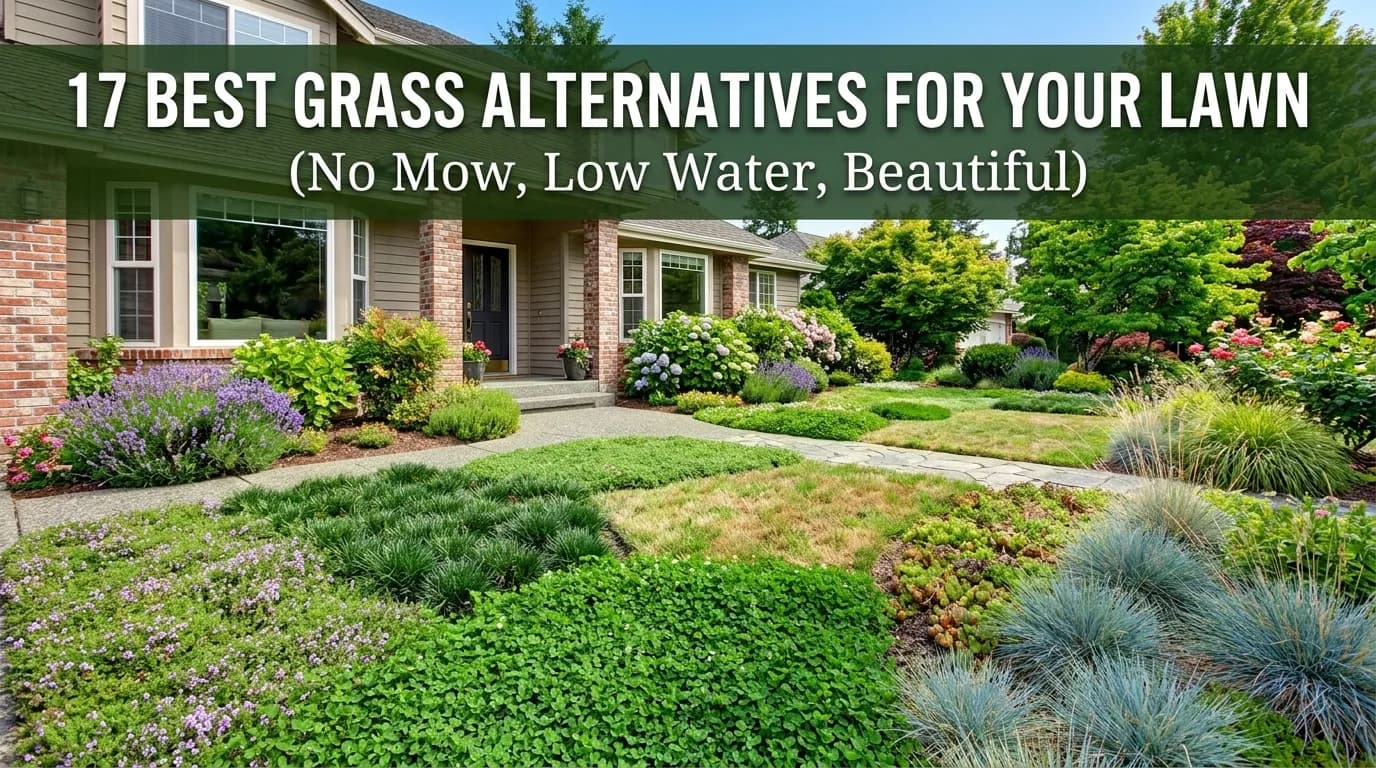
The American lawn is one of the biggest agricultural crops in the country — roughly 40 million acres of turf grass, consuming 9 billion gallons of water per day, 800 million pounds of pesticides per year, and requiring 3 billion hours of mowing annually. And for most homeowners, the result is a yard that looks okay at best and requires constant attention to keep it from going brown, weedy, or patchy.
There's a better way. Grass alternatives range from dense groundcovers that look like a lawn without the mowing, to gravel and hardscape combinations, to wildflower meadows, to mixed native plant systems that genuinely outperform turf in every metric except "looks like traditional grass."
This guide covers the 17 best grass alternatives for front and back yards, organized by use case, climate, and aesthetic — with real cost data and maintenance expectations for each.
[See what your yard could look like without grass →](/redesign) Upload a photo and get three AI-generated design concepts showing exactly what grass alternatives look like in your space. Free to preview.
Why Replace Your Lawn?
The numbers on traditional turf are brutal once you look at them closely:
| Cost Category | Annual Turf Lawn | Grass Alternative |
|---|---|---|
| Watering | $200–$800/yr | $0–$100/yr |
| Mowing (service) | $800–$1,500/yr | $0 |
| Fertilizer | $100–$300/yr | $0–$50/yr |
| Pesticide/herbicide | $100–$400/yr | $0–$100/yr |
| Total annual cost | $1,200–$3,000/yr | $0–$250/yr |
Over 10 years, replacing a lawn with a well-chosen alternative can save $10,000–$25,000 — not counting your own time.
Beyond cost, lawns are increasingly restricted by local ordinances. Dozens of California municipalities now ban new lawns entirely. Nevada paid homeowners up to $3/sq ft to remove existing turf. Florida restricts lawn watering. This trend is accelerating nationwide as drought conditions expand.
Groundcover Grass Alternatives (Look Like a Lawn)
These are the most popular grass alternatives because they mimic the look and feel of a traditional lawn — green, low, and uniform — without the maintenance.
1. Creeping Thyme (Thymus serpyllum)
Best for: Full sun, dry climates, foot traffic areas, rock gardens
Water needs: Very low (once established)
Mow required: Never
Traffic tolerance: Moderate
USDA Zones: 4–9
Creeping thyme spreads 12–18 inches wide per plant, stays under 3 inches tall, and blooms in pink-purple in early summer. It smells wonderful when walked on, handles light foot traffic well, and tolerates drought as well as any groundcover.
Cost: $0.50–$1.50 per plant (plants 6–12 inches apart); full coverage takes 1–2 seasons.
2. Clover Lawn
Best for: Full sun to partial shade, any climate, sustainable-focused homeowners
Water needs: Low
Mow required: Never or 2–3× per year
Traffic tolerance: High
USDA Zones: 3–10
White Dutch clover was actually a standard component of lawn seed mixes until the 1950s, when herbicide companies started selling products that killed it (and rebranded it as a weed to sell more product). It fixes nitrogen from the air — meaning it actually improves soil over time, requires zero fertilizer, stays green in drought, and blooms prolifically for pollinators.
Micro-clover (Trifolium repens 'Pipolina') is a smaller-leaved, less aggressive variety that blends seamlessly with remaining grass and looks more traditional.
Cost: ~$15–$25 per 1,000 sq ft seeded; seed can be mixed with existing lawn seed.
3. Buffalo Grass (Bouteloua dactyloides)
Best for: Warm climates, Great Plains, low rainfall areas
Water needs: Very low (native prairie grass)
Mow required: 2–4× per year (or never if you like the natural look)
Traffic tolerance: Moderate to high
USDA Zones: 3–9
Buffalo grass is a native North American prairie grass that was here long before irrigated turf grass arrived. It goes dormant and tan in winter (like many turf grasses), greens up with spring rains, and survives on natural rainfall in most of the country without any supplemental irrigation once established.
Cost: ~$200–$400 per 1,000 sq ft sodded; seed is cheaper but takes longer to establish.
4. Moss Lawn
Best for: Shade, moist climates, acid soil, Pacific Northwest, Eastern woodland settings
Water needs: Moderate (needs moisture to stay green)
Mow required: Never
Traffic tolerance: Low (avoid heavy foot traffic)
USDA Zones: varies by species
If you live in a shade-dominated yard and have spent years fighting to keep grass alive, moss is your answer. A moss lawn feels like walking on a carpet, requires zero mowing, zero fertilizer, and in a naturally moist climate, zero supplemental watering. It's genuinely zero-maintenance once established.
The key: moss won't work in full sun. But in woodland lots, north-facing slopes, and under tree canopies, it's extraordinary.
Cost: Transplanting existing moss is free. Plugs or sheets run $0.50–$2.00/sq ft.
5. Blue Star Creeper (Isotoma fluviatilis)
Best for: Pacific Coast, mild climates, between pavers, partial shade
Water needs: Low to moderate
Mow required: Never
Traffic tolerance: Moderate
USDA Zones: 6–9
Blue star creeper is a dense, spreading groundcover with tiny blue star-shaped flowers that bloom spring through fall. It fills cracks between pavers beautifully, forms a tight carpet in planting areas, and requires almost no maintenance beyond initial watering while establishing.
Cost: $3–$6 per plant; space 6 inches apart for quick coverage.
Wildflower and Meadow Alternatives
6. Native Wildflower Meadow
Best for: Large areas, naturalistic aesthetics, pollinator habitat, full sun
Water needs: Very low (after year 1)
Mow required: 1× per year (late winter or early spring cut)
Traffic tolerance: Very low
USDA Zones: All (use regionally appropriate species mixes)
A wildflower meadow is the most dramatic transformation possible — converting mowed turf into a dynamic, seasonal, wildlife-supporting landscape that looks different every month and gets better every year.
Year 1 is the hardest: wildflower meadows need weeding until the desired species establish and start outcompeting weeds. Years 2 and beyond require only a single annual cut in late winter to reset the cycle.
Cost: $0.10–$0.50 per sq ft seeded (regional native mixes); significantly cheaper than maintaining turf long-term.
The critical detail: Use regionally appropriate native species mixes. A California native mix is completely wrong for the Midwest. Buy from local native plant nurseries or regional seed companies who sell zone-correct mixes.
Want to visualize what a meadow, groundcover, or no-lawn yard looks like on your actual property? [Get three AI-designed concepts for your specific yard at Yardcast →](/redesign)
7. No-Mow Fescue Mix
Best for: Cool climates, shady yards, homeowners who want a "lawn look" without the work
Water needs: Low to moderate
Mow required: 2–4× per year (or let it grow to 4–6 inches naturally)
Traffic tolerance: Moderate
USDA Zones: 3–7
Fine fescues (creeping red, chewings, hard, sheep fescue) are cool-season grasses that, when left to grow, develop a natural meadow look at 4–6 inches without looking neglected. Mow once in spring and once in fall if you want a tidier appearance. No mow fescue mixes use 60–75% less water than Kentucky bluegrass.
Cost: ~$30–$60 per 1,000 sq ft seeded.
8. Native Prairie Grass Mix
Best for: Midwest, Great Plains, large properties, ecological restoration
Water needs: Very low (zero once established)
Mow required: 1× per year
Traffic tolerance: Low
USDA Zones: 3–8
Native prairie grasses — little bluestem, prairie dropseed, sideoats grama, buffalo grass, blue grama — form dense, self-maintaining plant communities that require zero inputs once established. Many states and municipalities offer cost-share programs that pay part of the conversion cost.
Little bluestem is the standout choice: it turns a stunning copper-red in fall, provides winter bird habitat, and tolerates clay, sand, drought, and flooding.
Hardscape + Low-Plant Alternatives
9. Decomposed Granite with Accent Plants
Best for: Desert Southwest, California, dry climates, modern aesthetics
Water needs: None (for the gravel); minimal for accent plants
Mow required: Never
Traffic tolerance: High (paths and open areas)
Cost: $2–$5 per sq ft installed
Decomposed granite (DG) is finely crushed granite that compacts into a firm, walkable surface. In a desert or Mediterranean-style yard, it becomes the "floor" of the landscape, with drought-tolerant shrubs, ornamental grasses, succulents, and perennials planted in defined beds or scattered naturally through the gravel.
Pair it with: agave, palo verde, desert marigold, Mexican feather grass, red yucca, and salvia for a water-wise, zero-maintenance landscape.
10. Gravel and River Rock
Best for: Low-maintenance goals, slopes and drainage problem areas, parking areas
Water needs: None
Mow required: Never
Traffic tolerance: Varies by gravel size
Cost: $1.50–$4 per sq ft for materials
River rock and gravel come in dozens of sizes and colors. For front yards, a combination of medium-sized stones (1–2 inch) with planted beds and larger boulders as focal points creates a naturalistic, maintenance-free landscape.
Key installation detail: Use woven landscape fabric (not plastic sheet) under any gravel installation. Plastic traps water and creates anaerobic conditions that kill any plants you try to grow nearby. Woven fabric suppresses weeds while allowing drainage.
11. Permeable Pavers
Best for: High-traffic areas, driveways, patios that adjoin lawn areas
Water needs: None
Mow required: Never
Traffic tolerance: Very high
Cost: $8–$20 per sq ft installed
Permeable pavers allow rainfall to pass through into the soil beneath — they don't create runoff like solid concrete. Use them for: driveways, parking areas, paths, and patios. Between each paver, plant low groundcovers like creeping thyme, Irish moss, or blue star creeper that fill the gaps and soften the look.
Low-Growing Shrub and Perennial Alternatives
12. Dwarf Mondo Grass (Ophiopogon japonicus 'Nana')
Best for: Shade to partial shade, Southern gardens, under trees
Water needs: Low to moderate
Mow required: Never (evergreen, stays 2–4 inches)
Traffic tolerance: Low
USDA Zones: 6–10
Mondo grass isn't a grass at all — it's a grass-like perennial in the lily family. The dwarf variety stays 2–4 inches tall, spreads slowly to form a dense carpet, is evergreen in mild climates, and handles shade better than almost anything.
Cost: $3–$6 per plant; space 4–6 inches apart.
13. Sedum / Stonecrop Carpet
Best for: Full sun, dry climates, slopes, rocky soils
Water needs: Very low
Mow required: Never
Traffic tolerance: Low
USDA Zones: 3–9
Sedum groundcovers (Sedum spurium, Sedum acre, Sedum kamtschaticum) form dense, succulent mats in a range of colors — green, bronze, red, gold. They're nearly indestructible in sunny, dry conditions and produce flowers in late spring. Excellent for slopes, parking strips, and anywhere turf grass fails.
Cost: $1–$4 per plant; space 12 inches apart.
14. Liriope / Lily Turf
Best for: Shade, slopes, Southern and mid-Atlantic gardens
Water needs: Low to moderate
Mow required: Once per year (cut back in late winter)
Traffic tolerance: Low to moderate
USDA Zones: 5–10
Liriope is a grass-like perennial that forms dense clumps, tolerates deep shade, produces purple flower spikes in late summer, and has berry-like fruit in fall and winter. It handles slopes well (prevents erosion), tolerates drought once established, and requires only a single hard cut in late winter to stay tidy.
Regional Best Picks
| Climate / Region | Top Grass Alternative Choices |
|---|---|
| Desert Southwest | Decomposed granite + agave/salvia, buffalo grass, sedum |
| California (water restrictions) | DG + native perennials, clover, no-mow fescue, buffalo grass |
| Pacific Northwest | Moss lawn, creeping thyme, native fern + groundcover mix |
| Southeast | Liriope, dwarf mondo grass, centipedegrass, clover |
| Midwest / Great Plains | Buffalo grass, native prairie mix, little bluestem, no-mow fescue |
| Northeast | Clover, creeping thyme, no-mow fescue, wildflower meadow |
| Mountain West | Buffalo grass, creeping thyme, sedum, native prairie mix |
How to Replace Your Lawn: Step-by-Step
Step 1: Kill the existing turf (choose your method)
- Solarization (summer only): cover with clear plastic for 6–8 weeks. Free, works well in hot climates, takes time.
- Sheet mulching: layer cardboard (free from appliance stores) covered with 4–6 inches of wood chips. Great for areas where you'll plant groundcovers. Takes 2–3 months.
- Herbicide: a single glyphosate application kills most turf in 7–14 days. Controversial but fast and effective.
Step 2: Amend the soil
Unless you're installing gravel or pavers, loosen the top 4–6 inches of soil and add compost (1–2 inch layer raked in) before planting.
Step 3: Install your alternative
- Groundcovers from plugs: plant 6–12 inches apart and water consistently for the first growing season.
- Seed (clover, wildflowers, no-mow fescue): spread seed, rake lightly, water daily for 2–3 weeks until germination.
- Gravel/hardscape: install landscape fabric, add gravel at correct depth, add edging.
Step 4: Manage the transition year
Year 1 is about establishment. Water consistently, hand-pull weeds that compete with new plants, and be patient. Almost every grass alternative looks thin in year 1 and established by year 2.
Step 5: Maintain (minimal)
Once established, most grass alternatives require: no mowing (or 1–2× per year), no fertilizer, and watering only during extended drought. Annual maintenance drops to a small fraction of turf care.
Cost Comparison: Turf vs. Top Alternatives
| Alternative | Install Cost (per 1,000 sq ft) | Annual Maintenance | 10-Year Total |
|---|---|---|---|
| Traditional turf (keep) | $0 | $1,200–$3,000/yr | $12,000–$30,000 |
| Clover seed | $20–$40 | $0–$50/yr | $520–$540 |
| Creeping thyme plugs | $300–$600 | $0–$25/yr | $300–$850 |
| No-mow fescue seed | $40–$80 | $50–$100/yr | $540–$1,080 |
| Decomposed granite | $2,000–$5,000 | $50–$100/yr | $2,500–$6,000 |
| Native wildflower meadow | $200–$600 | $25–$50/yr | $450–$1,100 |
| Permeable pavers | $8,000–$20,000 | $0–$50/yr | $8,000–$20,500 |
Ready to Design Your Lawn-Free Yard?
The hardest part isn't choosing an alternative — it's visualizing what it will look like in your specific yard, with your house, your existing trees, and your soil conditions.
Yardcast generates three different landscape design concepts from a photo of your yard, showing exactly how no-lawn alternatives, native plantings, groundcovers, or hardscape combinations look in your actual space — not a generic stock photo.
[See your grass-free yard in 60 seconds → yardcast.ai/redesign](/redesign)
Upload a photo, answer a few questions about your climate and style, and get three complete design concepts — including plant selections, cost estimates, and implementation steps.
FAQ: Grass Alternatives for Lawn
Q: What is the best grass alternative for a lawn?
A: The best grass alternative depends on your climate and goals. For a lawn-like look with minimal maintenance, clover and no-mow fescue are the top choices. For maximum water savings, creeping thyme or native groundcovers. For zero maintenance, decomposed granite with drought-tolerant plants. For shade, moss lawn or dwarf mondo grass.
Q: What can I replace my lawn with that looks like grass?
A: Micro-clover, no-mow fescue mixes, and buffalo grass look most like traditional turf while requiring far less maintenance. Creeping thyme can also create a dense, low carpet that reads as "lawn" from a distance and smells amazing underfoot.
Q: What is the cheapest grass alternative?
A: Clover seed is by far the cheapest grass alternative — roughly $15–$25 per 1,000 sq ft. It's also one of the best performers: drought-tolerant, nitrogen-fixing, low-growing, and great for pollinators. Wildflower seed mixes run $0.10–$0.50 per sq ft and are also very affordable.
Q: What can I use instead of grass that doesn't need mowing?
A: Creeping thyme, clover, sedum, blue star creeper, moss, and dwarf mondo grass all grow low enough to never need mowing. Wildflower meadows need a single annual cut. All of these require far less maintenance than any turf grass.
Q: Are grass alternatives allowed in HOAs?
A: Many HOAs have rules about lawn appearance. Before converting, check your CC&Rs. Many HOA rules are evolving — especially in water-restricted states — to allow or even require water-wise lawn alternatives. Some HOAs have specific rules about groundcovers, gravel, and meadow plantings. It's worth presenting a design concept to your HOA board to get buy-in before installing.
Q: How do I get rid of grass and replace it with groundcover?
A: The easiest methods: (1) Sheet mulch — cover with cardboard, top with 4–6 inches of wood chips, plant groundcover plugs through the cardboard layer. (2) Solarize — cover with clear plastic in summer for 6–8 weeks to bake the grass. (3) Scalp and smother — cut grass to 1 inch, cover with cardboard, plant through it. Avoid tilling if possible — it brings weed seeds to the surface.
Q: What's the most water-efficient lawn alternative?
A: Native plant groundcovers adapted to your specific region require the least water because they evolved for your local rainfall patterns. In the West, creeping manzanita, penstemon, and native grasses. In the South, liriope and native fescues. In the Midwest, buffalo grass and prairie natives. In the Northeast, wild ginger, pachysandra, and native gingers.
Q: How long does it take for grass alternatives to establish?
A: Most groundcover plugs achieve full coverage in 1–2 growing seasons. Seed-grown alternatives (clover, wildflowers, fescue) germinate in 7–21 days and reach full density in one season if conditions are good. The first year requires the most attention — consistent watering and weed management. Year 2 onward is when low-maintenance reality kicks in.