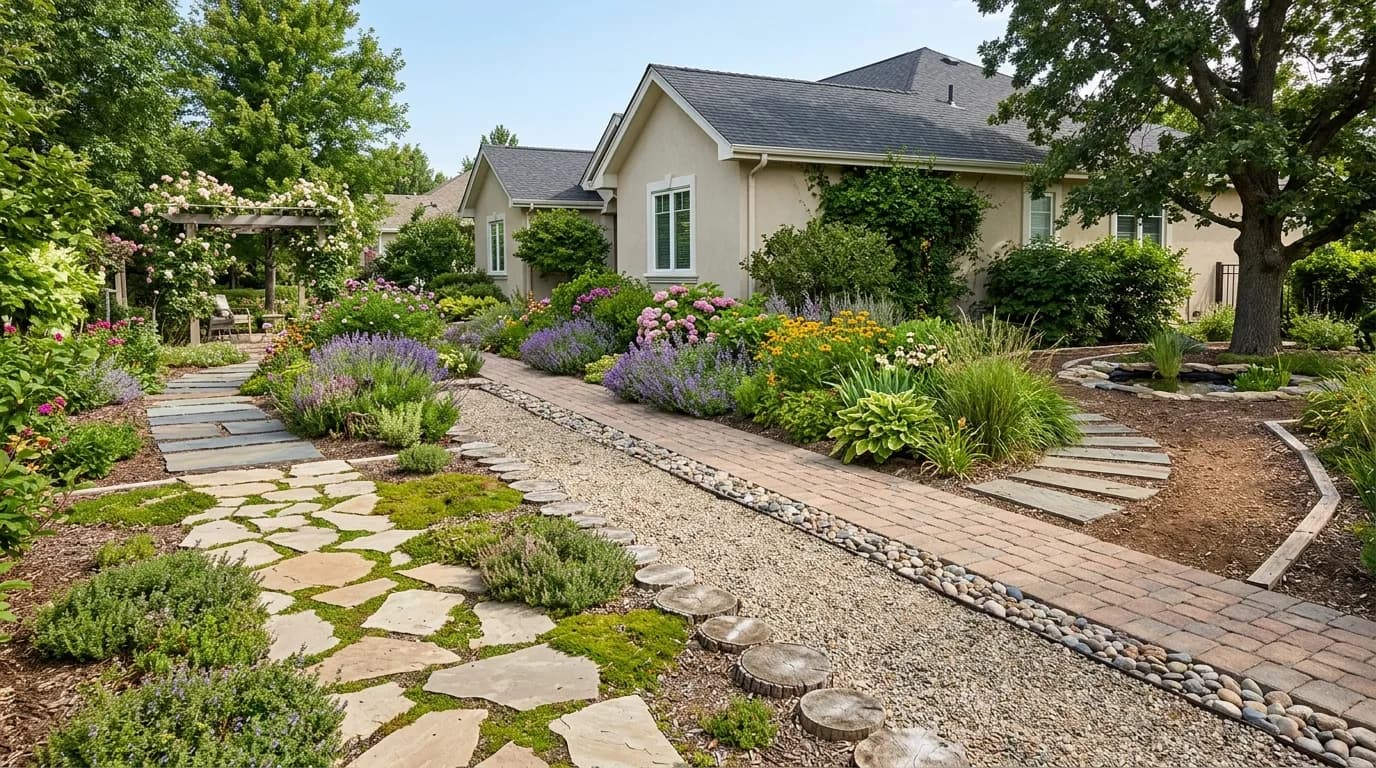
Of all the landscape elements you can add to a garden, paths have the highest ratio of impact to cost. A well-designed path makes a small garden feel larger, transforms a utilitarian route into a design feature, and guides the eye through plantings in a way that makes everything look more intentional.
But garden paths are also one of the most frequently done wrong: paths that are too narrow, materials that don't match the home's style, curves that go nowhere, or steps that feel unnatural to walk. This guide covers 30 garden path ideas with the design principles, materials, and installation details to get them right the first time.
Garden Path Design Principles
Before choosing materials or layout, understand what makes a path work:
Width: A comfortable single-person path is 36 inches wide. A path meant for two people to walk side-by-side needs 48–60 inches. Front walkways (the path from the street to your front door) should be a minimum of 48 inches — narrow front walks feel unwelcoming.
Curves: Curves should follow the natural desire line — where people would naturally walk if there was no path. A curve that requires people to step off the path to shortcut it is a failed curve. "Lazy curves" (very slight curves with no purpose) look worse than a straight path.
Grade: Paths should slope slightly (1/4 inch per foot) away from structures for drainage. Steps on slopes should be wide and shallow — a comfortable step is 14–16 inches deep with a 6–7 inch rise.
Edges: The cleaner the edge, the more intentional the path looks. Steel edging, stone borders, or precisely cut sod edges define paths clearly. Soft edges (planted with thyme or other ground covers) look good too, but require maintenance to prevent spreading.
Stepping Stone Path Ideas
1. Large Flat Limestone Stepping Stones
Irregular limestone slabs set flush with the ground are one of the most timeless and versatile garden path materials. Their natural variation — warm cream, tan, and gray tones — works with virtually every landscape style. Space stones 18–24 inches apart (centered on the average adult stride). Set in compacted gravel for drainage to prevent rocking.
2. Concrete Stepping Stones with Moss Growth
Cast concrete stepping stones take on a completely different character once moss colonizes their surface — which happens naturally in shaded, moist areas. Accelerate moss growth by brushing stones with a slurry of yogurt or buttermilk and moss fragments. Within one growing season, plain concrete becomes a moss-covered artifact.
3. Flagstone Stepping Stones in Lawn
Setting flat flagstones flush with the lawn surface — so the mower can pass right over them — is the most practical approach for frequently walked lawn paths. Use stones thick enough to stay stable (at least 2 inches) and set them just below grass level so they don't catch the mower deck. Natural flagstone options include bluestone, Tennessee crab orchard, and Pennsylvania bluestone.
4. Reclaimed Granite Cobblestones
Old granite cobblestones (often salvaged from urban street renovations) create beautifully textured paths with deep historical character. Set cobblestones in sand with tight joints, or space them with planted thyme or sedum between them. Their rounded tops are comfortable underfoot and their gray-blue color works beautifully with both traditional and contemporary planting schemes.
5. Cedar Round Stepping Stones
Cross-sections cut from cedar logs — 3–4 inches thick, 12–18 inches in diameter — create naturalistic woodland path stepping stones. They're perfect for a cottage garden, woodland garden, or backyard path under a tree canopy. Cedar's natural rot resistance gives these about 5–8 years of service before they start to decay, at which point they simply become garden mulch.
6. Concrete Circle Stepping Stones with Pea Gravel
Cast 18-inch diameter concrete circles (DIY with simple plywood molds) and set them in a pea gravel pathway. The contrast between smooth concrete circles and loose pea gravel is contemporary and clean. This combination handles drainage beautifully and is very forgiving to install — gravel fills in around any irregularly shaped or placed stones.
Gravel and Decomposed Granite Path Ideas
7. Decomposed Granite Path with Steel Edging
Decomposed granite (DG) is the most popular low-maintenance path material for dry climates: it's affordable ($1–$3 per sq ft for materials), installs easily, drains immediately, stays cool underfoot, and looks attractive in rustic, modern, and Mediterranean designs. The key: use stabilized DG (bound with a polymer binder) to prevent scattering, and install crisp steel edging on both sides.
8. Pea Gravel Path with Timber Borders
Pea gravel (1/4 to 3/8 inch rounded gravel) has a satisfying crunch underfoot and looks beautiful in cottage and informal gardens. The drawback is scatter — pea gravel migrates out of the path without solid borders. Use 4x4 or 6x6 pressure-treated timbers as borders, staked into the ground. The warm wood tones contrast beautifully with the gray-white gravel.
9. Crushed Granite with Stepping Stones
Combine a crushed granite base path with occasional large stepping stones set directly into the gravel. This hybrid approach gives you the clean look of gravel but with a "solid" surface for wet-weather walking. Set the stepping stones slightly proud of the gravel surface (1/2 inch above) so they're easy to find and use.
10. Black Lava Rock Path
Black lava rock creates one of the most dramatic path effects available: a bold, dark surface that makes plants pop with contrast. Particularly stunning against silver-foliage plants (artemisia, lamb's ear, dusty miller) or bright tropical colors. It stays cool in summer heat, drains perfectly, and is featherlight to install. Best in contemporary, tropical, or desert-modern designs.
Brick and Paver Path Ideas
11. Classic Herringbone Brick
The herringbone pattern (bricks laid at 45-degree angles to each other) is the most elegant and the most dimensionally stable brick pattern — the interlocking geometry prevents individual bricks from shifting. Use reclaimed Chicago common brick for the warmest, most authentic look. Set in compacted gravel base without mortar for DIY-friendly installation.
12. Running Bond Brick Path
The simplest brick pattern (each row offset by half a brick) is also the most casual and cottage-garden-appropriate. A 36-inch wide running bond brick path through a flower garden is a timeless classic. Edge with a single soldier course of upright bricks for a clean formal edge. Cost: $8–$15/sq ft installed.
13. Concrete Paver Path in Charcoal
Large format concrete pavers (24x24 inch) in charcoal or dark gray create strikingly contemporary paths. Set on a sand base with minimal joints and tight fitting, they look almost like a continuous concrete surface. Pair with ornamental grasses, agaves, or sculptural perennials for a modern minimalist garden design.
14. Permeable Concrete Paver Path
Standard concrete pavers shed water. Permeable pavers (open joint pavers or spidered concrete units) allow water to pass through the joints into a gravel sub-base, where it absorbs into the ground. This is increasingly required by municipalities for hardscaping projects. Permeable paver systems look identical to traditional pavers but perform much better environmentally.
15. Tumbled Belgian Block Path
Belgian block (roughly cut granite cobblestone, tumbled to knock off sharp edges) makes elegant, slightly rustic paths that look like they belong in an old European garden. Their irregular size makes them easier to cut and fit around curves than standard brick. Tumbled Belgian block also makes beautiful edging for other path types.
Before you commit to a path material and layout, see it on your actual yard. [Try Yardcast's AI landscape design tool](/redesign) — upload photos of your garden and get 3 complete design concepts showing paths, plantings, and hardscape integrated together. Free to preview.
Flagstone and Natural Stone Path Ideas
16. Random Flagstone Walk
An irregular flagstone walkway — flat stones of varying sizes and shapes puzzle-fit together — is one of the most classic garden path styles. It works in cottage, English garden, woodland, and Mediterranean designs. Use a dry-set installation (sand or gravel base, no mortar) for DIY projects; mortar-set for formal, permanent installations. Natural stone options: Pennsylvania bluestone, Tennessee crab orchard, Arizona flagstone, slate.
17. Bluestone with Grass Joints
Large 24x24 or 24x36 inch cut bluestone pavers set with 2-inch grass joints (lawn planted between them) is one of the most refined garden path looks available. The precise geometry of the cut stone contrasted with soft, living grass joints is architecturally sophisticated. Used extensively in formal English-style gardens and contemporary residential landscapes.
18. Fieldstone Path with Thyme Joints
Set fieldstones (rough, uncut stones gathered or purchased) in a gravel base and plant creeping thyme in the joints. As the thyme grows in, it softens the edges, releases fragrance when walked on, and makes the path look decades old. Creeping thyme tolerates moderate foot traffic and stays low enough (1–2 inches) not to compete with the stones.
19. Slate Stepping Stones in Mulched Bed
Large pieces of natural slate — flat, dark gray-green, with natural cleave lines — make elegant stepping stones through a mulched planting bed. Their thin profile (1–1.5 inch) and flat surface set them apart from thicker flagstones. Slate is softer than granite or limestone, so avoid heavy traffic applications; it works beautifully in a lightly used garden path.
20. Arizona Buff Sandstone Path
In hot, dry climates (Southwest, California, Colorado), Arizona buff sandstone is the regionally appropriate path material. Its warm cream-to-tan color integrates naturally with desert plants (agave, palo verde, ironwood, desert willow). Set pieces in decomposed granite for a seamless desert landscape. The sandstone naturally weathers and develops patina that improves with age.
Wood and Composite Path Ideas
21. Ipe Hardwood Boardwalk
For low-lying areas, a deck-style boardwalk path built from ipe hardwood or composite decking boards creates a striking, elevated path. Particularly effective over wet areas, shallow ponds, or ground cover plantings where you don't want to disturb the plants. Use composite for areas with prolonged water contact; ipe for drier elevated situations.
22. Cedar Chip Path
Simple cedar wood chips spread 3–4 inches deep make the most naturalistic and cheapest woodland garden path. Cedar chips are aromatic, naturally pest-repellent, and look perfectly at home in a woodland, shade, or cottage garden setting. They compact over time and need topping off annually. Install landscape fabric underneath to prevent weed breakthrough. Cost: $0.50–$1.50/sq ft.
23. Composite Decking Board Path
Lay composite deck boards perpendicular to the path direction — like a wooden boardwalk — on a simple gravel base. The result is a contemporary, clean-lined path that handles moisture beautifully. Use aluminum hidden fasteners for a cleaner top face without visible screws. Particularly effective in modern and Scandinavian-influenced garden designs.
Formal and Specialty Path Ideas
24. Allée of Trees Lining a Path
An allée — a formal avenue of matching trees planted at regular intervals flanking a central path — is the most grand garden path design. Common allée trees: hornbeam (deciduous, lime green, formal), pleached lime or beech (espalier hedge forms), Italian cypress (columnar evergreen, Mediterranean), or crabapple (spring flowers, wildlife value). Requires space (minimum 60-foot path) but creates a transformative effect.
25. Gravel Path with Box Hedge Borders
A gravel path flanked by low clipped boxwood (Buxus) hedges — 18–24 inches high — is the classic formal garden path. The precise geometry of clipped boxwood against loose gravel creates beautiful tension between the formal and informal. This combination works in every climate where boxwood thrives and is the foundation of classic French, Dutch, and English formal garden styles.
26. Mosaic Tile Garden Path
In enclosed courtyard gardens, Mediterranean-style spaces, or as an accent path, hand-set ceramic or stone mosaic tiles create extraordinary visual richness. Use cement backer board as a substrate, set tiles in thinset, and grout with a contrasting color. Mosaic paths are labor-intensive (budget $25–$75/sq ft) but create an irreplaceable character in intimate garden spaces.
27. Moonlight Path: White Gravel or Stone
Design a garden path specifically to be beautiful at night: use white or light gray gravel, white limestone stepping stones, or light-colored concrete — all of which reflect moonlight and low-level landscape lighting dramatically. Plant the borders with white-flowering plants (white phlox, white agapanthus, white gaura) for a moon garden path that's breathtaking on a full-moon evening.
28. Dry Creek Bed Path
A dry creek bed that doubles as a path — a depression filled with river rock and boulders designed to look like a natural streambed — creates one of the most organic, naturalistic garden features. It solves drainage problems while creating a beautiful path. Use a mix of large (4–8 inch) boulders at the edges and smaller (1–3 inch) river rock in the channel. Add water-loving plants (sedges, iris, cardinal flower) at the edges.
29. Stepping Stone Path Through Water Feature
Set large stepping stones through a shallow water garden, pond, or reflecting pool for a path that creates drama and encourages exploration. Stones should be stable (set on concrete footings), slightly above water level, and spaced to fit a natural stride. The reflections off the water surface make this one of the most visually spectacular path types.
30. Edible Path with Herb Borders
Design a garden path through the vegetable or herb garden as an experience: pave with flat flagstones and plant aromatic herbs in the joints and borders — thyme, chamomile, and mint (in contained pots) underfoot; rosemary, lavender, and sage along the sides. Walking through an edible path engages all the senses and makes the kitchen garden a destination rather than just a productive area.
Garden Path Plant Guide
The plants adjacent to a path define its character as much as the path material itself.
Formal path edges: Clipped boxwood, lavender cotton (Santolina), germander (Teucrium), or low ornamental grasses in repeated masses.
Cottage path borders: A mix of self-seeding annuals and perennials — foxglove, hollyhock, catmint, geranium, aquilegia, alchemilla, and sweet William.
Woodland path edges: Ferns, hostas, astilbe, heuchera, Solomon's seal, trillium, native ginger, and wild ginger as ground cover.
In the path joints: Creeping thyme (tolerates foot traffic), Corsican mint (fragrant, delicate), Irish moss (shade), baby tears (shade, moist), Elfin thyme (very low growing), Mazus reptans (small violet flowers).
Garden Path Cost Comparison
| Material | DIY Cost | Installed Cost | Lifespan |
|---|---|---|---|
| Cedar chips | $0.50–$1.50/sq ft | $1–$3/sq ft | 1–3 years |
| Pea gravel | $1–$3/sq ft | $3–$6/sq ft | Indefinite |
| Decomposed granite | $1.50–$4/sq ft | $4–$8/sq ft | Indefinite |
| Stepping stones (concrete) | $2–$5/sq ft | $5–$10/sq ft | 20+ years |
| Brick (dry-set) | $3–$8/sq ft | $8–$15/sq ft | 25+ years |
| Flagstone (dry-set) | $5–$12/sq ft | $10–$20/sq ft | 30+ years |
| Concrete pavers | $4–$10/sq ft | $8–$18/sq ft | 30+ years |
| Cut bluestone | $8–$18/sq ft | $15–$35/sq ft | 50+ years |
| Ipe boardwalk | $10–$25/sq ft | $20–$45/sq ft | 40+ years |
Ready to plan your complete garden path and landscape design? [Try Yardcast's free AI design tool](/redesign) — upload photos of your yard and get 3 AI-generated designs showing paths, plantings, structures, and lighting all working together. Free to preview, 60 seconds to generate. See your garden transformed before you move a single stone.