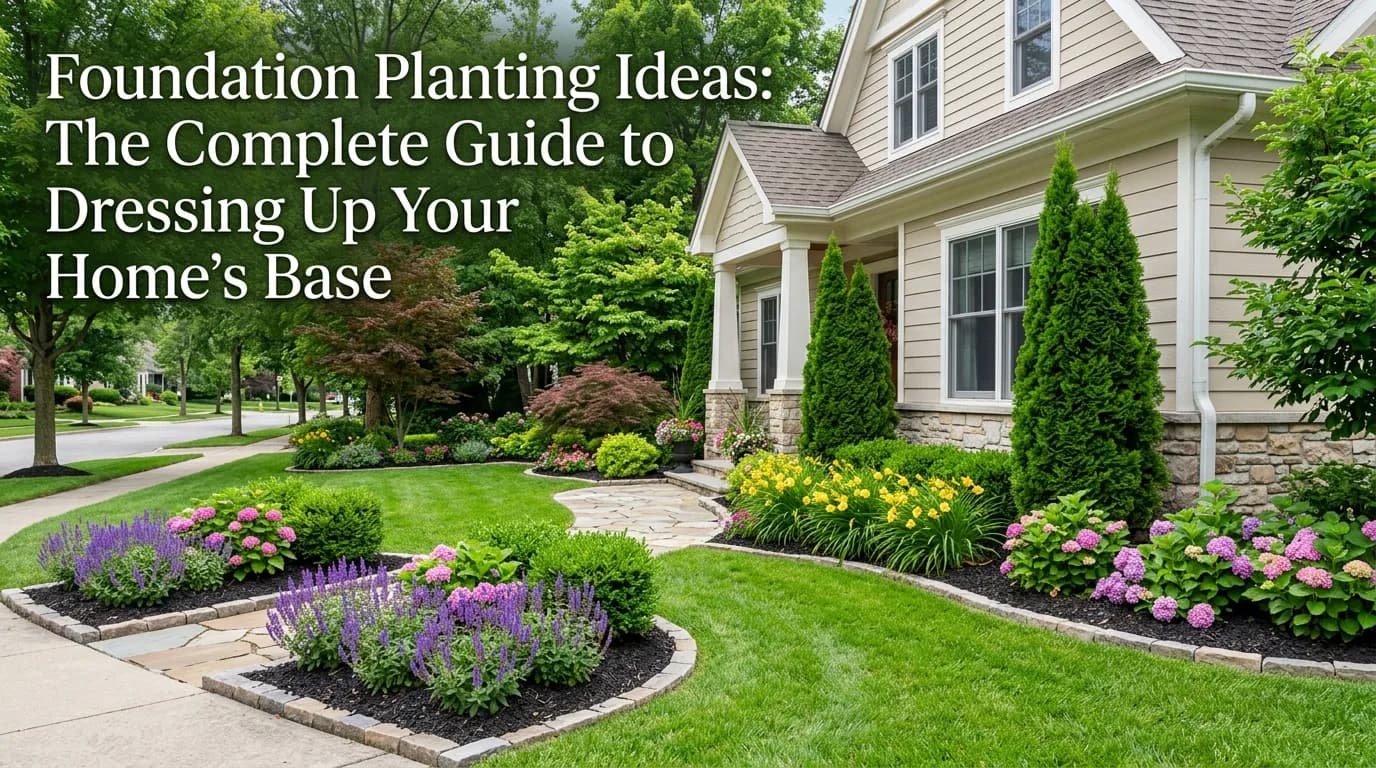
Foundation planting is the practice of placing plants along the base of your home's exterior walls. Done well, it softens the transition between structure and landscape, adds color and texture, and makes your house look like it belongs on the land rather than sitting on top of it. Done poorly — the wrong plants, the wrong spacing, too close to the foundation — it creates maintenance nightmares and a house that looks suffocated by vegetation.
This guide covers everything: the rules, the best plants by sun condition and zone, the most common mistakes (and how to avoid them), and a budget breakdown for a complete front foundation makeover.
Before you pick a single plant, the smartest move is to see the finished look before committing. Generate a free AI landscape design for your home →
The 6 Rules of Foundation Planting
These six rules separate foundation plantings that look professionally designed from those that look like an afterthought.
Rule 1: Match Mature Size to Wall Height
This is the most violated rule in residential landscaping. The shrub in the 3-gallon pot at the nursery looks perfect next to your 8-foot wall — and in 7 years it's covering your windows and siding. Always read the mature height and spread on the label and design for what the plant will become, not what it is today.
General guide:
- Windows: plant nothing that matures taller than the windowsill
- Between windows: 2/3 of wall height works well (6-foot shrub against a 9-foot wall)
- Corners: taller plants work here — they anchor the house without blocking views
Rule 2: Plant Away from the Foundation
The standard minimum is 3 feet from the foundation wall. This protects your foundation from moisture damage, allows air circulation (reducing mold and rot), and gives roots room to develop horizontally rather than pressing against concrete. Larger shrubs need 4–5 feet of clearance.
Rule 3: Create a Layered Profile
A flat line of identical shrubs at the same height is the most common foundation planting error. Professional designs use three layers:
- Back layer (against house): Taller shrubs or small trees (4–8 ft at maturity)
- Mid layer: Medium shrubs and mounding plants (2–4 ft)
- Front edge: Low groundcovers, perennials, or low-mounding shrubs (under 18 inches)
This layered profile creates depth, softens the hard line of the foundation, and ensures every plant is visible.
Rule 4: Anchor the Corners
The corners of your house are where the eye naturally goes. Use your tallest plants — columnar or upright forms — at corners to "anchor" the house to the ground and frame the facade. Avoid the mistake of centering all your drama at the front door and leaving corners bare.
Rule 5: Use Odd Numbers and Groups
Plant in groups of 3, 5, or 7. Never two (looks accidental) and never a perfectly even row. Grouping creates visual rhythm and mirrors how plants grow naturally. Three Korean Spice viburnums at one corner, five Endless Summer hydrangeas across the front — this is the pattern professional designers use.
Rule 6: Include Year-Round Structure
At least 40–50% of your foundation plantings should be evergreen. This ensures your house looks polished in winter when everything else has died back. Mix evergreens (structure) with deciduous flowering shrubs (seasonal drama) for a planting that works in every season.
Best Evergreen Foundation Plants
Evergreens form the backbone of any great foundation planting. They hold structure through winter, provide year-round color, and require minimal care once established.
| Plant | Mature Size | Sun | Zones | Best Use |
|---|---|---|---|---|
| Emerald Green Arborvitae | 10–15 ft × 3–4 ft | Full sun | 2–7 | Corner anchors, vertical accents |
| Sky Pencil Holly | 8–10 ft × 2 ft | Sun–part shade | 6–9 | Tight corners, narrow spaces |
| Boxwood 'Green Gem' | 2–3 ft × 2–3 ft | Sun–part shade | 4–9 | Front edge, low hedges |
| Inkberry Holly 'Shamrock' | 4–5 ft × 4 ft | Sun–full shade | 3–9 | Native, wet tolerant |
| Dwarf Mugo Pine | 3–5 ft × 5–8 ft | Full sun | 2–7 | Rock-solid structure, low maintenance |
| Dwarf Alberta Spruce | 6–8 ft × 3–4 ft | Full sun | 2–8 | Formal entries, slow-growing |
| Blue Star Juniper | 2–3 ft × 3–4 ft | Full sun | 3–9 | Drought tolerant, blue texture |
| Steeds Upright Holly | 10–12 ft × 4 ft | Sun–part shade | 5–9 | Tall screen, dense habit |
| Japanese Holly 'Sky Sentry' | 6–8 ft × 3 ft | Sun–part shade | 5–9 | Narrow upright, no shearing needed |
Top pick for most homeowners: Emerald Green Arborvitae at the corners + Boxwood 'Green Gem' along the front edge. This combination works in zones 4–7, requires almost no pruning, and looks great year-round.
Best Flowering Shrubs for Foundation Beds
Flowering shrubs add seasonal color and often fragrance to the structural evergreen framework. Plant these in the mid-layer or mixed with evergreens.
For Sun (6+ hours)
Knockout Rose — The most reliable flowering shrub in American horticulture. Blooms from May through frost, disease resistant, drought tolerant after establishment. Mature size: 3–4 ft. Zones 4–9. Plant 4–5 of them in a sweeping curve for maximum impact.
Endless Summer Hydrangea — Reblooming hydrangea that flowers on both old and new wood, solving the "late freeze killed the buds" problem of classic bigleaf hydrangeas. Blue or pink blooms from June through September (color depends on soil pH). Mature size: 3–5 ft. Zones 4–9.
Spirea 'Double Play Candy Corn' — Brilliant orange-red new foliage fades to yellow, then green. Pink flowers in summer. Compact (2–3 ft), easy to grow, no serious pest issues. Perfect for a pop of color next to the front door.
Weigela 'Sonic Bloom Red' — Reblooming weigela with hot-pink trumpets that attract hummingbirds. Blooms in spring and continues reblooming all summer. Mature size: 4–5 ft. Zones 4–8.
For Part Shade (3–6 hours)
Mountain Laurel — Gorgeous late spring blooms in white, pink, or red. Native to eastern North America. Evergreen, deer resistant, and thrives in the dappled shade of a north-facing or east-facing foundation. Mature size: 6–8 ft. Zones 4–9.
Virginia Sweetspire 'Little Henry' — White bottlebrush flowers in June, brilliant red-orange fall color. Native, deer resistant, tolerates wet or dry soil. Compact (3–4 ft). Zones 5–9.
Oakleaf Hydrangea — Massive white flower clusters in June–July, peeling cinnamon bark in winter, incredible burgundy fall color. A four-season plant that handles deep shade better than almost any flowering shrub. Mature size: 6–8 ft. Zones 5–9. 'Pee Wee' stays at 4 ft for tighter spaces.
Korean Spice Viburnum — Possibly the most fragrant shrub in horticulture. Pink buds open to white flower clusters with an intoxicating clove-spice scent in April–May. Red berries in fall attract birds. Mature size: 5–7 ft. Zones 4–7. Plant this near the front door where you'll walk past it daily.
> 🌿 See what these plants look like on your actual house before you buy a thing.
> Get 3 AI-generated foundation planting designs for your home →
> Upload your front yard photo, answer 4 questions. Free preview in 60 seconds.
Foundation Planting by Sun Condition
Full Sun (6+ hours) — South or West Facing
Full-sun foundation beds bake in summer heat, which desiccates many plants. Choose sun-lovers that are also drought tolerant once established.
Complete design:
- Corners: Emerald Green Arborvitae or Sky Pencil Holly (vertical accent)
- Mid layer: Knockout Rose, Weigela, or Spirea — 3–5 plants in curves
- Front edge: Blue Star Juniper, Creeping Phlox, or Coneflower (perennial)
- Accent: Ornamental grass (Karl Foerster or Shenandoah switchgrass) for vertical drama
Part Shade (3–6 hours) — East Facing
East-facing foundations get morning sun and afternoon shade — one of the best conditions for flowering shrubs. Most ornamentals thrive here.
Complete design:
- Corners: Incrediball Hydrangea (huge white pompom blooms, 5–6 ft) or Oakleaf Hydrangea
- Mid layer: Korean Spice Viburnum, Mountain Laurel, Virginia Sweetspire
- Front edge: Hostas (mass planting of one variety for a clean, modern look), or Coral Bells (Heuchera) for color
Full Shade (fewer than 3 hours) — North Facing
North-facing foundation beds present the biggest design challenge: most ornamentals won't bloom without enough sun. Focus on foliage interest and reliable structure.
Complete design:
- Corners: Inkberry Holly 'Shamrock' (native, evergreen, tolerates wet soil) or Carissa Holly
- Mid layer: Oakleaf Hydrangea (blooms even in deep shade), Leucothoe fontanesiana (arching evergreen, burgundy winter color), or Aucuba japonica (gold-flecked foliage)
- Front edge: Mass planting of hostas ('Sum and Substance' or 'Blue Angel' for maximum impact), Astilbe for mid-summer color, or Pachysandra for year-round groundcover
The 5 Most Common Foundation Planting Mistakes
1. Planting too close to the foundation. Plants 12–18 inches from the house look fine for 2 years. Then they press against siding, trap moisture, and invite rot and pests. Minimum: 3 feet. For large shrubs: 4–5 feet.
2. Using fast-growing shrubs without a plan. Burning bush, forsythia, and overgrown spirea planted 3 feet apart become 6-foot walls that cover windows within 5 years. Either choose slow growers or commit to an annual pruning schedule.
3. Ignoring winter. A foundation planting that looks stunning in summer can look dead and depressing in January if there are no evergreens. Aim for at least 50% evergreen content — they carry the design year-round.
4. Matching the wrong plant to the condition. Sun-lovers planted on north-facing walls won't bloom, stretch toward light, and look terrible within 3 seasons. Always match plant requirements to actual site conditions. If you're not sure, pay attention to how long direct sun hits the wall at midday in summer.
5. Planting everything at the same height. A flat hedge of identical shrubs eliminates any sense of depth or design. The layered profile — tall back, medium middle, low front — is the single change that most transforms foundation plantings from amateur to professional.
Foundation Planting Cost Breakdown
| Scope | What's included | Typical cost |
|---|---|---|
| Simple front entrance | 3–5 shrubs, mulch, edging | $200–$600 DIY |
| Full front foundation | 12–20 plants, 2 corner anchors, edging, 3-inch mulch | $800–$2,500 DIY |
| Contractor install (basic) | Same as above, professional labor | $2,500–$6,000 |
| Premium with hardscaping | Stone bed edging, boulder accents, lighting, full planting | $6,000–$15,000 |
Where to spend vs. save:
- Spend on: Corner anchor plants (arborvitae, hollies, magnolias) — they're permanent and set the whole tone. Don't cheap out here.
- Save on: Mid-layer shrubs — buy 1-gallon sizes and let them grow. The difference between 1-gallon and 3-gallon plants disappears within 2–3 seasons.
- DIY: Mulching, edging, and plant installation are all beginner-friendly tasks. Save the contractor budget for hardscaping.
Plant cost estimates:
- Small shrubs (1-gallon): $8–$15
- Medium shrubs (3-gallon): $25–$45
- Large shrubs (5-gallon): $50–$80
- Corner anchors (Emerald Green Arborvitae, 4–5 ft): $35–$60 each
- Knockout Rose (3-gallon): $25–$35
- Endless Summer Hydrangea (3-gallon): $30–$45
Your Next Step
Great foundation planting starts with understanding your site — which direction your foundation faces, how many hours of sun it gets, and what the mature sizes of your house's proportions demand. Then it's about choosing the right structural evergreens, layering in flowering shrubs for seasonal interest, and staying disciplined about spacing.
The single best thing you can do before buying a single plant? See what the finished result looks like on your actual house.
→ Upload your front yard photo and get 3 AI foundation planting designs in 60 seconds
Free preview. $29 for the full plant list, cost estimate, and PDF.