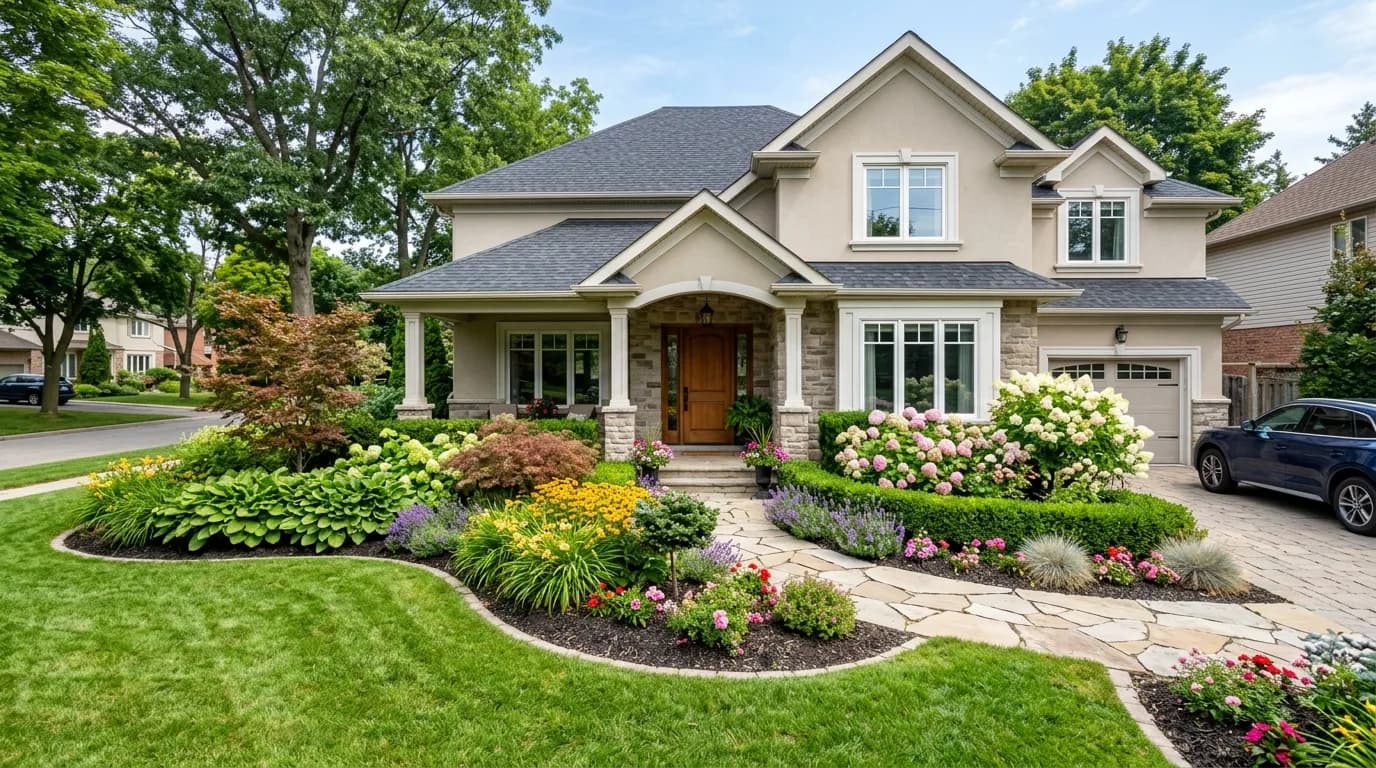
The strip of soil between your house and the lawn is one of the most important — and most misunderstood — planting spaces in any yard. Get foundation landscaping right and it frames your home beautifully, improves drainage, and reduces energy costs. Get it wrong and plants can trap moisture against your siding, crack your foundation, or block windows and airflow.
This guide covers everything you need to know about landscaping around your house foundation: best plants, safety rules, design principles, and a complete planting plan by home style.
Why Foundation Landscaping Matters
Foundation plantings do four things simultaneously:
Curb appeal. The right plants soften a harsh transition between house and ground — a bare foundation looks raw; a well-planted one looks finished and intentional.
Energy efficiency. Shrubs planted 3–5 feet from the foundation create a buffer of still air that can reduce heating and cooling costs by up to 15%.
Drainage protection. The right groundcovers and mulch direct water away from the foundation instead of pooling against it — the leading cause of basement moisture problems.
Pest reduction. Keeping plants trimmed away from the house reduces the "bridge" that rodents, ants, and other insects use to enter the home.
The #1 Foundation Landscaping Rule: 3-Foot Clearance
Never plant anything closer than 18 inches from your foundation — 3 feet is better. This applies to everything: shrubs, perennials, groundcovers, and mulch. Here's why:
- Moisture. Plants trap moisture against siding and foundation walls, causing rot, mold, and in porous masonry, structural damage over time.
- Root pressure. Roots grow toward moisture — and your foundation walls hold it. Aggressive roots (trees, bamboo, large shrubs) can exert enormous pressure over decades.
- Pest pathways. Any plant touching your house is a highway for insects and rodents.
- Airflow. Plants pressed against siding trap humidity and block the airflow that keeps wood and paint healthy.
The 3-foot rule isn't just about safety — it often looks better. A small gap of mulch between plants and foundation creates a clean visual line that makes plantings look more intentional.
What NOT to Plant Near Your Foundation
Trees. Any tree should be planted at least as far from the foundation as its mature canopy spread — usually 20–40+ feet. Even small ornamental trees cause problems: roots probe foundation cracks seeking water, and canopy debris accumulates against walls.
Invasive or aggressive shrubs. Forsythia, burning bush, common barberry, and English laurel grow fast and large. They'll overwhelm a foundation bed within a few years.
Plants with aggressive roots. Bamboo (running types), wisteria, Virginia creeper, and trumpet vine can damage masonry over time.
Plants requiring constant wet soil. Astilbe, ligularia, and moisture-lovers planted near foundations tend to hold water against the wall. Save them for rain gardens and low spots.
Tall plants under windows. This seems obvious but is constantly done: tall shrubs planted under windows block light, become security concerns, and require constant cutting back. Use plants whose mature height is below the window sill.
Not sure what will look right on your property? Get 3 AI landscape designs from Yardcast → — upload photos of your yard and receive a professional design with plant lists matched to your climate zone and home style.
Best Foundation Shrubs by Situation
For Full Sun Foundations (south and west-facing)
Dwarf Boxwood (Buxus sempervirens 'Green Velvet' or 'Green Mountain') — Classic, evergreen, deer-resistant, stays compact. Zone 5–9. Mature size: 2–3 feet x 2–3 feet. Plant 2 feet from foundation, 3 feet apart.
Spirea (Spiraea japonica 'Goldmound' or 'Magic Carpet') — Colorful foliage, June flowers, low maintenance. Zone 3–8. Mature size: 2–3 feet x 3 feet.
Knockout Rose — Blooms May–frost, disease-resistant, nearly maintenance-free. Zone 5–9. Mature size: 3–4 feet x 4 feet. Plant 4 feet from foundation.
Dwarf Mugo Pine (Pinus mugo 'Mops') — Evergreen structure, slow-growing, no pruning needed. Zone 2–7. Mature size: 3 feet x 4 feet in 10 years.
Russian Sage (Perovskia atriplicifolia) — Silver foliage, lavender flowers July–October, extremely drought-tolerant. Zone 4–9. Mature size: 3–4 feet x 4 feet.
For Shady Foundations (north and east-facing)
Dwarf Inkberry Holly (Ilex glabra 'Compacta') — Native, evergreen, black berries for birds, tolerates wet soil. Zone 4–9. Mature size: 4 feet x 4 feet.
Mountain Laurel (Kalmia latifolia) — Native, spectacular May flowers, shade-tolerant. Zone 4–9. Mature size: 4–6 feet.
Pieris japonica — Evergreen, white spring flowers, shade-tolerant. Zone 4–8. Mature size: 3–6 feet.
Oakleaf Hydrangea (Hydrangea quercifolia) — Native, shade-tolerant, fall color, exfoliating bark. Zone 5–9. Mature size: 4–6 feet x 6 feet.
Hellebore (Helleborus x hybridus) — Shade perennial, late-winter to spring flowers, evergreen foliage. Zone 4–9. Height: 18 inches. Excellent edging plant.
For Wet or Poor Drainage Foundations
Poor drainage near foundations is common and creates a tough planting challenge. These plants tolerate periodic wet feet:
- Sweet Pepper Bush (Clethra alnifolia) — Native, fragrant summer flowers, fall color. Zone 3–9. 4–6 feet.
- Virginia Sweetspire (Itea virginica) — Native, fall color, adaptable. Zone 5–9. 3–5 feet.
- Cardinal Flower (Lobelia cardinalis) — Native perennial, brilliant red, hummingbirds. Zone 2–9. 3–4 feet.
Foundation Planting Design Principles
The Tiered Planting Rule
Professional foundation plantings use three tiers:
- 1Tall anchor plants (4–6 feet) at corners and flanking doors — these "attach" the house to the ground visually
- 2Mid-height shrubs (2–3 feet) filling the long runs between corners
- 3Low edging plants or groundcovers (6–18 inches) at the front, softening the transition to lawn or path
This structure looks balanced from the street at any scale of home.
Matching Plant Scale to House Scale
A common mistake: planting shrubs that will eventually grow taller than the first-floor windows. Always research mature size (not the size at the nursery) and match it to the window height above grade. A 4-foot window sill means your mid-tier shrubs should top out at 3–3.5 feet.
For large homes, larger shrubs (6–8 feet) at corners look proportionate. For a ranch or cottage, keep everything under 4 feet.
Odd Numbers and Irregular Spacing
Plant in groups of 3 or 5. Space irregularly (closer together in some spots, wider in others) for a natural look. Evenly spaced identical plants in a row look institutional, not residential.
Evergreen Backbone + Seasonal Color
Use evergreen shrubs (boxwood, hollies, junipers) as the permanent framework — they provide structure year-round. Fill in with perennials and annuals for seasonal color: daffodils in spring, daylilies in summer, asters in fall. This approach looks great every month.
Foundation Planting Depth Guide
| Distance from Foundation | What to Plant |
|---|---|
| 0–12 inches | Mulch only; keep clear of all plants |
| 12–24 inches | Low groundcovers (pachysandra, ajuga, sedum) or bulbs |
| 24–36 inches | Compact perennials (hellebore, daylily, coneflower) |
| 3–5 feet | Dwarf shrubs (compact boxwood, dwarf spirea, dwarf nandina) |
| 5–8 feet | Medium shrubs (knockout rose, inkberry holly, pieris) |
| 8+ feet | Large shrubs; never plant trees closer than 15–20 feet |
Foundation Landscaping by Home Style
Colonial/Traditional: Formal boxwood topiaries flanking the front door, symmetrical yew hedges along the foundation, standard roses at corners. Evergreen backbone with seasonal annuals in beds.
Craftsman/Bungalow: Native plants, flowering shrubs (spirea, weigela), ornamental grasses at corners, lavender edging. Mix of evergreen and deciduous.
Ranch/Mid-Century Modern: Low, horizontal lines match the architecture. Ornamental grasses, dwarf junipers, agave in warm climates, low ornamental shrubs. Avoid anything tall that fights the horizontal roofline.
Cottage/English Garden: Roses, clematis on the porch posts, lavender edging, hellebores and foxgloves along the north face, hollyhocks at corners. Relaxed and slightly informal.
Contemporary/Minimalist: Architectural plants — dwarf Alberta spruce, boxwood spheres, ornamental grasses (Karl Foerster), agave, clipped hedges. Strong geometry, limited color palette.
Step-by-Step: Planting a New Foundation Bed
1. Mark and measure. Establish a bed that extends 4–6 feet from the foundation on the house-facing side. Use a garden hose to mark a gently curved front edge.
2. Test soil and drainage. Dig a 12-inch hole and fill with water. If it drains in 1–2 hours, drainage is good. If it sits for 6+ hours, amend with compost and grit, or install a French drain before planting.
3. Remove existing grass. Cut out sod with a flat spade and dispose of it (don't till it in — the buried grass re-sprouts).
4. Amend soil. Work 2–3 inches of compost into the top 6 inches of soil. Add lime if soil is very acidic (below pH 5.5).
5. Plant back to front. Install tall anchor plants at corners first, then medium shrubs, then edging plants. Position everything before digging any holes.
6. Mulch. Apply 2–3 inches of shredded wood mulch or pine bark. Pull it back 3–4 inches from plant stems and from the foundation wall.
7. Water and wait. Water deeply at planting (1–2 gallons per shrub). For the first season, water deeply once a week in the absence of rain. After the first year, most established shrubs need minimal supplemental watering.
Foundation Landscaping Cost Guide
| Project Scope | DIY Cost | Professional Install |
|---|---|---|
| Basic planting (6–8 shrubs) | $200–$500 | $800–$2,000 |
| Full front foundation (20–30 shrubs) | $600–$1,500 | $2,500–$6,000 |
| Full perimeter (all sides) | $1,500–$4,000 | $6,000–$15,000 |
| With drainage improvement | Add $300–$800 DIY | Add $1,500–$4,000 pro |
Costs vary widely by region, plant selection, and site prep required. Native plants are typically cheaper to maintain long-term.
Want a professional foundation planting plan for your home? Generate your free AI landscape design at Yardcast → — upload photos of your house exterior, describe your goals, and get 3 photorealistic designs with a full plant list sized and spaced correctly for your home.