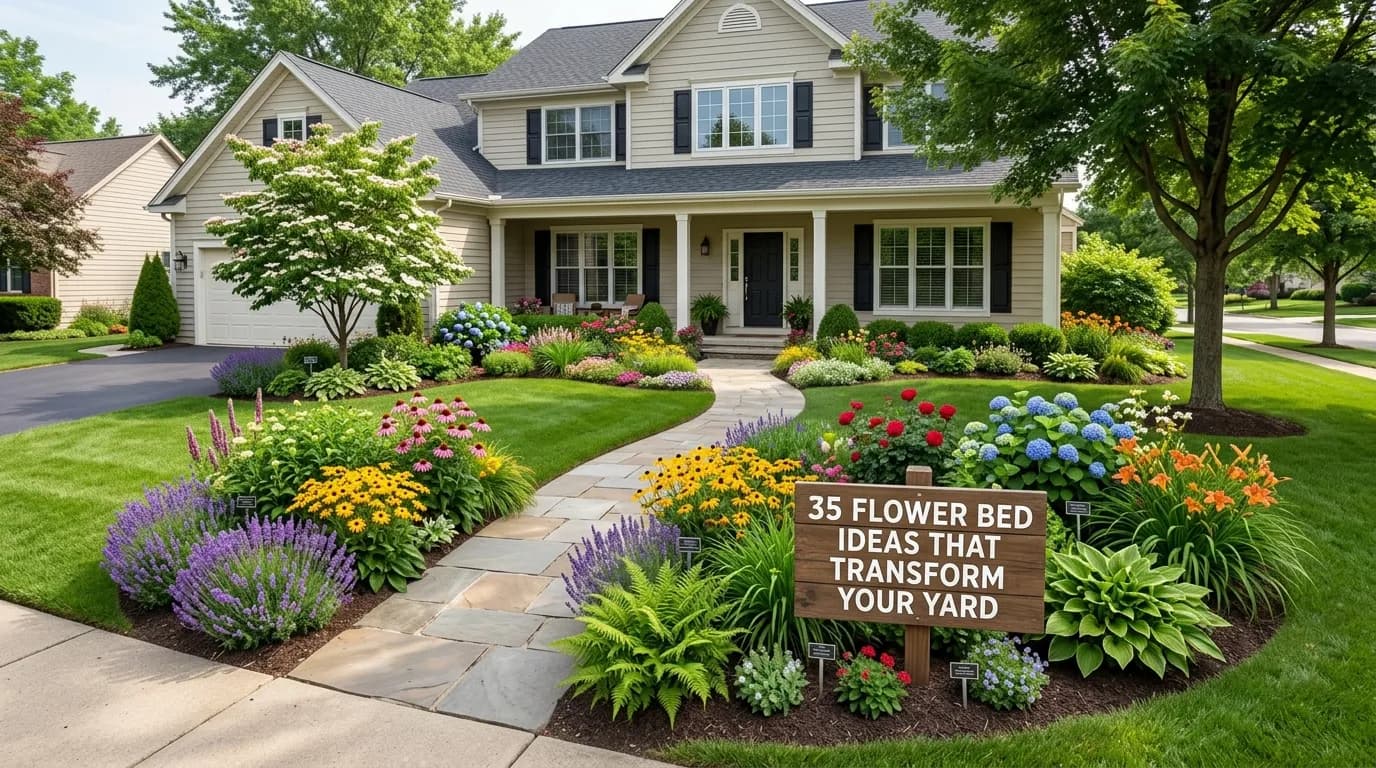
Flower beds are the single fastest way to transform a yard's look. A well-designed bed frames your home, adds year-round color, attracts pollinators, and — done right — can actually reduce maintenance compared to maintaining a large lawn. Whether you're starting from bare soil or renovating overgrown beds, these 35 ideas are ranked by the visual impact they deliver.
Front Yard Flower Bed Ideas
Your front yard flower beds are your home's curb appeal engine. These ideas maximize that first impression.
1. The Foundation Planting Bed
The most common front yard bed wraps around the base of your house. The goal: soften the hard line between foundation and lawn while framing windows and the front door. Use a three-layer approach: tall evergreen shrubs against the house, mid-height flowering shrubs in the middle, and low groundcovers or perennials at the edge.
Best plants: Boxwood (structure), Drift Roses (color), Liriope (edging)
2. Curved Front Border
Replace a straight-edged bed with a sweeping S-curve along your front walkway or property edge. Curves are universally more appealing than straight lines and make a yard look professionally designed. Install steel or aluminum edging to hold the shape permanently.
3. The Entry Focal Bed
Create a bold planting island at the base of your driveway or at the edge of your walk. Use a single architectural plant as a centerpiece — a Knockout Rose standard, a dwarf Japanese Maple, or a clipped boxwood ball — surrounded by a carpet of annuals or perennials.
4. Cottage-Style Mixed Border
Layer a mix of ornamental grasses, flowering perennials, and annuals for an intentionally loose, romantic look. Heights should vary from 6 inches to 4–5 feet. Cottage borders look complex but are forgiving — there's no wrong placement.
Best plants: Echinacea, Salvia, Nepeta, Ornamental Grasses, Rudbeckia
5. Formal Symmetrical Beds
For colonial, Georgian, or traditional homes: mirror-image beds flanking the front door or walkway. Symmetrical plantings signal order and care. Use identical plants on both sides — shaped boxwoods, standard roses, or topiary forms.
Backyard Flower Bed Ideas
Backyard beds serve different purposes: privacy, beauty, habitat, or creating garden rooms. Get a custom backyard design →
6. Perimeter Privacy Border
A deep (6–10 ft wide) perennial border along your fence line fills the space, creates privacy from neighbors, and gives you a canvas for year-round color. Layer from tall in back (ornamental grasses, tall perennials) to short in front.
7. Island Bed in Lawn
Cut an organic kidney or teardrop shape out of your lawn and create a freestanding planting island. This breaks up a plain lawn and creates visual interest from every angle. Use a single specimen tree or large shrub as a focal point.
8. Shade Garden Bed Under Trees
Most homeowners ignore the dry shade under established trees. Fill it with shade-tolerant woodland plants: Hostas, Heuchera, Astilbe, Ferns, and Epimedium create a beautiful groundcover layer that actually thrives where grass fails.
9. Cut Flower Garden
Design a dedicated bed for cut flowers — zinnias, dahlias, sunflowers, cosmos — that gives you fresh bouquets all season. Arrange in rows for easy harvesting. Include successional planting (new plants every 2–3 weeks) for continuous blooms.
10. Pollinator Meadow Bed
Replace a section of lawn with a native wildflower and prairie planting. Coneflower, Black-eyed Susan, Milkweed, and Joe-Pye Weed support butterflies and bees while requiring minimal maintenance once established.
🌿 Ready to visualize your flower bed design?
[Get 3 AI-generated landscape designs using photos of your actual yard — free preview →](/redesign)
Upload a photo of your yard and see your flower bed ideas rendered photorealistic in 40 seconds. Includes a full plant list, spacing guide, and cost estimate.
Raised Flower Bed Ideas
Raised beds solve drainage, soil quality, and accessibility issues while adding structure to your landscape.
11. Tiered Raised Beds
Step down from a slope with two or three terraced raised beds. Each tier plants differently — herbs and vegetables up top, ornamental perennials in the middle, groundcovers at the base. Tiered beds are highly photogenic and solve erosion problems simultaneously.
12. Wood Frame Rectangle Beds
Classic 4×8 foot raised beds built from cedar, redwood, or composite lumber are the backbone of kitchen gardens. Plant with edible flowers (nasturtiums, borage, calendula) alongside vegetables to make them ornamental as well as productive.
13. Galvanized Steel Raised Beds
Corrugated metal raised beds have become a landscaping design statement. Tall (24–36 inch) galvanized beds with a rusted patina look stunning in modern and farmhouse styles, warm up faster than soil in spring, and last 20+ years.
14. Stone Wall Planting Bed
Stack dry-laid fieldstone or block into a low retaining wall and plant behind it. The stone anchors the bed visually, retains heat for cool-season plants, and gives the garden an established look from day one.
Low Maintenance Flower Bed Ideas
The best flower bed is one that looks great without demanding every weekend.
15. Native Plant Bed
Design an entire bed around plants native to your region. Native perennials are adapted to your exact rainfall, soil, and climate — they require no irrigation once established, rarely get diseased, and support local wildlife. A well-designed native bed is virtually maintenance-free after Year 2.
Research your zone's natives: Use our free design tool to find plants matched to your ZIP code →
16. Ornamental Grass Border
Ornamental grasses are arguably the lowest-maintenance garden plants that still look spectacular. Grasses like Feather Reed Grass, Blue Oat Grass, or Muhly Grass provide motion, winter interest, and structure with virtually no care beyond a single annual cutback.
17. Ground Cover Tapestry
Replace high-maintenance annual flower beds with a tapestry of low groundcovers: creeping thyme between flagstone, sedums on slopes, ajuga in shade, and liriope as edging. These fill in over 2–3 years and then maintain themselves.
18. Drought-Tolerant Xeriscape Bed
Gravel mulch, rock, ornamental stone, and drought-tolerant plants (Lavender, Russian Sage, Ice Plant, Agave) create beds that are beautiful in summer and essentially zero-care. The secret: weed barrier + 2–3 inches of decorite rock or pea gravel as mulch.
19. Evergreen Structure Bed
Build a bed around a foundation of evergreen shrubs (boxwood, holly, skip laurel, nandina) that look good year-round. Supplement with flowering perennials for seasonal color, but the bed always has a neat, polished look even in winter.
Small Space Flower Bed Ideas
Small yards and tight spaces need creative solutions.
20. Strip Bed Along Driveway
Narrow beds (12–18 inches wide) along both sides of a driveway soften the hardscape and add color without using much space. Use columnar plants (pencil hollies, Italian cypresses) for vertical interest without horizontal spread.
21. Container Garden Cluster
Group 5–7 containers of varying heights on a patio, deck, or entry area. Treat the containers as a flower bed — using the thriller/filler/spiller planting formula in each pot. Move containers seasonally for always-changing displays.
22. Window Box Gardens
Window boxes attached to the front of your home or deck railings add flower bed impact in zero ground space. Change plantings three times a year: cool-season annuals in spring, tropicals in summer, ornamental kale and mums in fall.
23. Vertical Trellis Bed
Install a free-standing or fence-mounted trellis and plant climbing roses, clematis, or mandevilla in a narrow bed at its base. A 12-inch bed with a 6-foot trellis delivers dramatic floral impact in a footprint smaller than a bathtub.
Flower Bed Design Principles
Choosing the Right Edging
The edge defines a flower bed as clearly as a picture frame defines a painting. Options:
- Steel edging: Clean, modern, professional look; holds curves; lasts 20+ years
- Plastic edging: Affordable; can look cheap; breaks down in sunlight
- Stone or brick edging: Classic and permanent; highest cost; most formal look
- Paver border: Doubles as a mowing strip so edging frequency drops dramatically
- No edging: Only works with heavy mulch and frequent trimming
The Three-Layer Rule
Every flower bed looks better with three layers of plant height:
- 1Back layer: 3–5 feet tall (shrubs, tall grasses, large perennials)
- 2Middle layer: 1–3 feet tall (medium perennials, roses, ornamental grasses)
- 3Front layer: Under 12 inches (groundcovers, low perennials, edging plants)
Color Harmony Basics
- Monochromatic: One color family in varying shades — calm, sophisticated, hard to mess up
- Complementary: Colors opposite on the wheel (purple/yellow, orange/blue) — vibrant, energetic
- Analogous: Colors adjacent on the wheel (red/orange/yellow) — harmonious, natural
When to Plant What
- Spring beds: Plant cool-season annuals (pansies, snapdragons) after last frost; perennials and shrubs in April–May
- Summer beds: After last frost, fill with zinnias, petunias, lantana, marigolds
- Fall beds: Plant spring-blooming bulbs (tulips, daffodils) in October; add mums for immediate fall color
- Winter interest: Keep ornamental grasses, dried seed heads, and evergreens through winter
Flower Bed Planning Checklist
Before you dig, ask:
- [ ] What's the sun exposure? (Full sun = 6+ hours; Partial = 3–6 hours; Shade = under 3 hours)
- [ ] What are your soil conditions? (Clay, sandy, loamy, rocky?)
- [ ] What's your hardiness zone? (Determines which plants survive your winters)
- [ ] What's your maintenance tolerance? (Low: natives and evergreens; Medium: perennials; High: annuals)
- [ ] What's your budget? ($50–$200 per 50 sq ft for DIY; $500–$2,000 installed per 100 sq ft)
- [ ] What function does this bed serve? (Curb appeal, privacy, habitat, cutting garden, etc.)
Skip the guesswork — [upload your yard photos and get 3 AI-designed flower bed plans with a full plant list for your specific climate zone →](/redesign)
FAQ: Flower Bed Ideas
See structured FAQ below for quick answers to the most common questions.