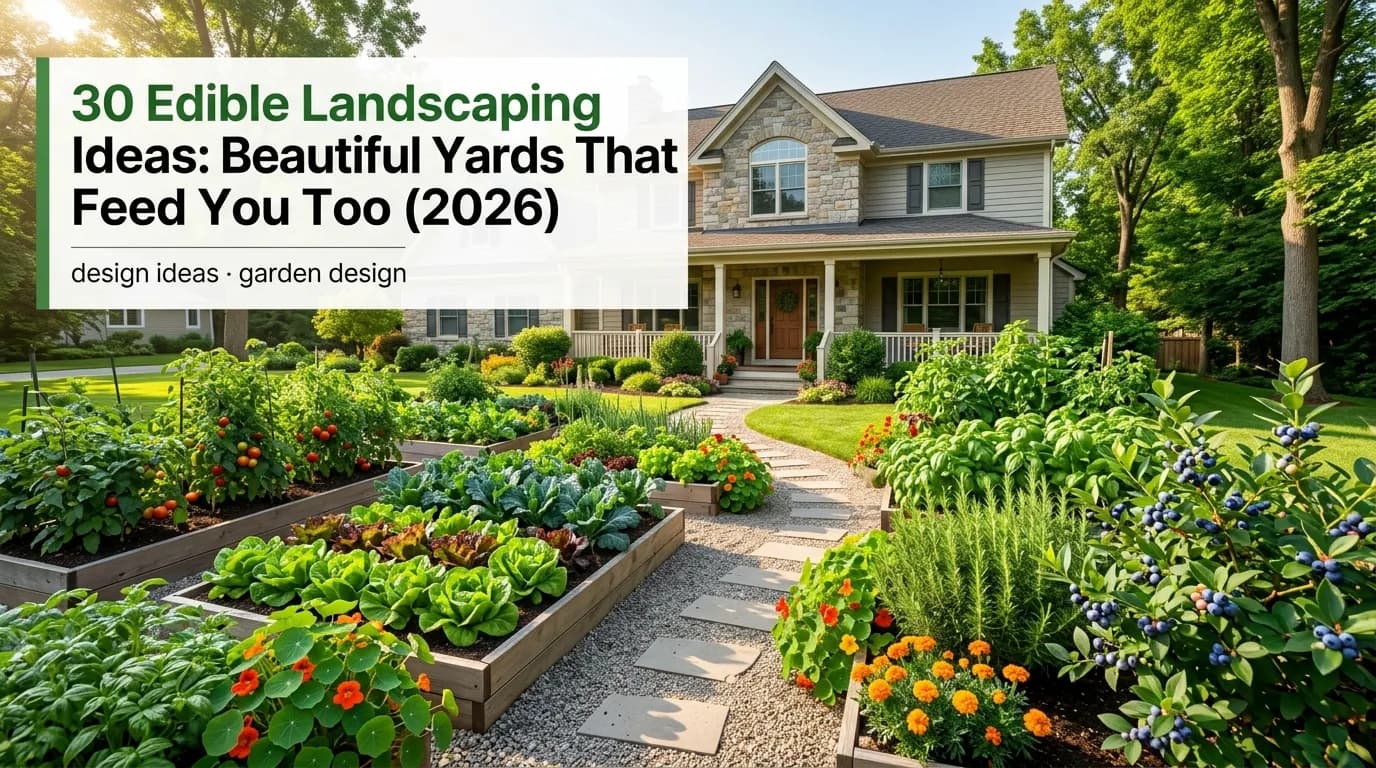
Edible landscaping is one of the fastest-growing trends in residential gardening — and for obvious reasons. Why grow a yard full of plants you can't eat when you could have one that feeds your family, supports pollinators, looks beautiful, and costs less to maintain than a conventional ornamental landscape?
The modern edible landscape doesn't look like a vegetable patch. It looks like a designed garden — with structure, color, texture, and seasonal interest — except everything growing in it is useful. Blueberry bushes stand in for ornamental shrubs. Kale and Swiss chard add bold color where impatiens would go. Fruit trees cast dappled shade over a patio. Herbs fill the gaps between stones.
This guide covers 30 edible landscaping ideas across every scale, from a single raised bed to a full front yard food forest — plus design principles, plant lists, cost guides, and everything you need to start.
What Is Edible Landscaping?
Edible landscaping (sometimes called "foodscaping") integrates edible plants into designed landscapes, treating food plants as ornamental elements rather than hiding them in a back corner. The result is a yard that functions as both a beautiful garden and a productive growing space.
The approach covers a spectrum:
- Integrated edibles: Food plants mixed into ornamental borders (herbs among perennials, fruiting shrubs as hedges)
- Ornamental kitchen garden: A potager-style design where vegetables are grown in decorative raised beds with paths, trellises, and cutting flowers
- Food forest: A layered system of canopy fruit trees, understory berry shrubs, herbaceous perennials, and groundcover edibles that mimics the structure of a forest
- Full edible landscape: The entire yard — front and back — planted for maximum food production with aesthetic design principles applied throughout
30 Edible Landscaping Ideas
Edible Shrubs as Foundation Planting
1. Blueberry bushes as hedges. Highbush blueberries (Vaccinium corymbosum) are stunning ornamental shrubs: white bell flowers in spring, lush green foliage in summer, brilliant red-orange fall color. Plant in a row as a hedge (they need 2+ for cross-pollination) — and harvest pounds of berries from the same plants that look like a designed foundation shrub. Zones 4–7.
2. Currant and gooseberry as border shrubs. Black, red, and white currants (Ribes spp.) are compact (3–5 ft), ornamental, extremely cold-hardy (zones 3–7), and extraordinarily productive. Red currants especially are beautiful with pendulous translucent red berry clusters and maple-like leaves that turn orange in fall.
3. Elderberry as a structural specimen. American elderberry (Sambucus canadensis) or Black Lace elderberry (Sambucus nigra 'Eva') reaches 8–12 feet and provides dramatic structure, fragrant cream flower clusters in early summer, and dark purple berries in late summer for elderflower cordial and elderberry syrup. Black Lace is one of the most ornamental shrubs available, period.
4. Dwarf apple or pear espalier. Espalier fruit trees — trained flat against a wall or fence in a fan, cordon, or Belgian fence pattern — produce full-sized fruit in minimal space while creating living art. A south-facing fence espaliered with apple or pear is productive, beautiful, and efficient.
5. Fig as a patio specimen. A potted or in-ground fig tree (Ficus carica) with its bold architectural leaves, sinuous branches, and ability to produce two crops annually is one of the most useful landscape plants. Hardy to zone 7 in-ground, or grow in containers and overwinter indoors in colder zones.
6. Pomegranate as an ornamental shrub. In zones 7–11, pomegranate (Punica granatum) is a multi-stemmed deciduous shrub or small tree with brilliant orange-red flowers in summer, shining green summer foliage, and spectacular fruit. Dwarf varieties like 'Nana' stay under 4 feet and work as container plants.
Vegetables as Ornamentals
7. Swiss chard and kale in the flower border. Rainbow Swiss chard with stems in crimson, yellow, orange, and white is genuinely beautiful in a mixed border — bolder than most ornamental plants and productive for 10+ months. Lacinato kale with its blue-green corrugated leaves adds textural drama to any planting.
8. Artichoke as an architectural statement. Globe artichoke (Cynara cardunculus) grows 4–6 feet tall and wide with dramatic silver-grey deeply cut foliage and vivid purple thistle-like blooms if you let them bolt. One plant commands an entire bed. A single artichoke in a large terracotta pot or as a bed focal point earns immediate visual impact.
9. Climbing beans on a trellis. Scarlet runner beans with their vivid red flowers and rapid climbing habit are among the most ornamental of the edible climbers. Train on an obelisk, tripod, or formal trellis at the back of a border — the color rivals any flowering annual while feeding you.
10. 'Bright Lights' cosmos + edible flower border. Design a full cutting garden / edible flower border combining: nasturtiums (peppery leaves + flowers, both edible), calendula (edible petals, medicinal), borage (vivid blue star flowers, cucumber taste), chamomile (tea flowers), and violas — all edible, all beautiful.
11. Purple-leaved 'Red Jewel' strawberry as groundcover. Everbearing strawberry varieties used as a groundcover instead of pachysandra or ajuga — they spread, suppress weeds, produce fruit, and display white flowers in spring. Not as dense as a conventional groundcover, but useful in part-sun areas.
> Want an edible landscape design for your specific yard? Yardcast generates photorealistic edible and food-garden landscape designs with a full plant list matched to your climate zone, a phased installation plan, and a 44-page contractor-ready PDF. Preview 3 custom designs free in 40 seconds.
Fruit Trees for Structure and Shade
12. Multi-grafted apple tree. A multi-grafted tree carries 3–4 different apple varieties on a single rootstock — providing the cross-pollination apples need while occupying only one planting space. A 10-foot tree in the center of a mixed border becomes the garden's seasonal anchor: spring blossom, summer shade, fall harvest, winter structure.
13. Serviceberry (Amelanchier) as the perfect edible shade tree. Often planted purely as an ornamental 4-season tree (white spring flowers, dark blue-purple June berries, orange-red fall color, attractive winter bark), serviceberry is also genuinely edible — the berries taste like blueberry-almond hybrids and ripen in June before most birds find them.
14. Citrus grove along a south-facing fence. In zones 8–11, a row of dwarf citrus (Meyer lemon, Clementine mandarin, Kumquat) in large terracotta containers or in-ground along a south wall creates both a productive grove and a fragrant, evergreen design element. Citrus blossom scent in late winter is among the most intoxicating in horticulture.
15. Espaliered pear as a living fence. A Belgian fence espalier — multiple pear trees trained diagonally to form a diamond pattern — creates a living wall that works as a property boundary, a privacy screen, a windbreak, and a fruit source simultaneously. Takes 3–5 years to establish but lasts 50+ years.
Herb Garden Design
16. The knot garden with herbs. A classic knot garden of clipped herbs — rosemary, boxwood, and lavender forming an interlocking low hedge pattern — is one of the most elegant formal garden elements. It's also entirely edible. Design it as a centerpiece for a kitchen terrace or formal front garden.
17. Herb spiral. A raised spiral structure of stacked stones or timbers creates multiple microclimates in a single planting: drier at the top (Mediterranean herbs: rosemary, thyme, oregano), moister and shadier at the base (parsley, cilantro, mint). Highly practical, visually interesting, and a conversation-starting garden feature.
18. Fragrant herb border along a path. Plant creeping thyme, low-growing rosemary, and chamomile between pathway stepping stones — they release fragrance when brushed or lightly walked on, handle occasional foot traffic, and stay naturally low. One of the most sensory-rich path planting strategies.
19. Cut-and-come-again herb containers. Group 5–7 large terracotta pots of different culinary herbs on a kitchen terrace or back patio — one each of basil, flat-leaf parsley, chives, thyme, rosemary, and mint. The grouping functions as both a productive kitchen garden and an ornamental container display.
20. Wild garlic groundcover under deciduous trees. Ramsons / wild garlic (Allium ursinum) naturalizes beautifully under deciduous trees in part shade, carpeting the ground with glossy green leaves and white star flowers in early spring before the canopy leafs out. Every part is edible with a mild garlic flavor.
The Potager (Kitchen Garden) Design
21. The classic French potager layout. A potager (from potage, French for soup) is a kitchen garden designed as a formal ornamental space: raised beds arranged in geometric patterns, separated by formal gravel or brick paths, edged with low boxwood or parsley borders, with a focal point (trellis, obelisk, or ornamental pot) at the intersection of the paths. The goal: as beautiful as a parterre, as productive as a market garden.
22. Raised cedar beds as the design bones. Three to five cedar raised beds (4 x 8 feet, 12–18 inches tall) arranged symmetrically with 18-inch gravel paths between them creates structure that works year-round — even when beds are bare in winter. Add tall trellises at the back of each bed for vertical growing: cucumbers, beans, indeterminate tomatoes.
23. Four-square bed rotation system. The classic kitchen garden divides into four equal beds: one for brassicas (kale, cabbage, broccoli), one for legumes (beans, peas), one for roots (carrots, beets, parsnips), one for alliums (onions, garlic, leeks). Rotate each year for pest and soil health. The four-square pattern is inherently beautiful and functional.
24. Cutting garden integrated with the food garden. One dedicated cutting flower bed in the kitchen garden — dahlias, zinnias, lisianthus, cosmos — brings fresh flowers into the house while blending seamlessly with the edible design. Position it as the most visible bed for maximum ornamental impact.
Front Yard Edible Landscapes
25. Fruit tree as the front yard specimen tree. Replace a conventional ornamental tree (Bradford pear, Callery pear) with an edible alternative: crabapple, serviceberry, persimmon, or a semi-dwarf apple. You get the same 4-season interest, shade, and visual structure — plus food.
26. Front yard berry hedge replacing a fence. A row of highbush blueberries, rugosa roses (rose hips are edible and beautiful), or beach plum along the front property line functions as an ornamental hedge while providing edible harvest. Far more interesting than a Leyland cypress hedge.
27. Edible front yard groundcovers. Creeping thyme, strawberries, and clover (mildly edible, nitrogen-fixing, pollinator-friendly) can replace conventional groundcovers across a front yard. Lower maintenance than turf, pollinator-friendly, and a conversation piece in the neighborhood.
28. Espalier along the front house wall. A south or west-facing front wall is often the warmest microclimate on the property. Use it: espalier an apple, pear, or fig in a fan or fan-cordon pattern against the facade. Maximum production from minimum space, and it looks architectural.
Food Forest Design
29. The 7-layer food forest. A food forest replicates the structure of a natural woodland using entirely edible or useful plants:
- Canopy: Large fruit trees (apple, pear, walnut)
- Understory: Semi-dwarf fruit trees (plum, cherry, serviceberry)
- Shrub: Berry bushes (blueberry, currant, gooseberry, elderberry)
- Herbaceous: Perennial vegetables and herbs (asparagus, horseradish, comfrey, rhubarb)
- Groundcover: Strawberries, creeping thyme, nasturtium
- Vine: Grape, kiwi, climbing beans
- Root: Garlic, Jerusalem artichoke, daikon radish
A small 20 x 30 ft food forest can support a significant portion of a family's fruit and vegetable needs while requiring less maintenance annually than a conventional lawn.
30. Pollinator-edible border. Design a border that works double-duty: every plant is either edible or specifically valuable to pollinators. Borage, phacelia, comfrey, echinacea, anise hyssop, calendula, and lemon balm form a border that's beautiful, wildlife-supporting, and harvestable for herbal teas, tinctures, and fresh eating.
Edible Landscaping Cost Guide
| Feature | DIY Cost | Professional Cost |
|---|---|---|
| Single raised cedar bed (4x8 ft) | $80–150 | $300–500 |
| 4-bed potager garden (fully built) | $400–700 | $1,500–3,000 |
| Semi-dwarf apple or pear tree | $35–75 | $200–400 installed |
| Blueberry hedge (100 ft) | $300–600 | $1,500–2,500 installed |
| Herb spiral | $150–300 | $600–1,200 |
| Food forest (500 sq ft, year 1) | $800–1,500 | $4,000–8,000 |
| Full front yard edible conversion | $2,000–4,500 | $8,000–18,000 |
Getting Started: Your Edible Landscape Plan
The best edible landscape starts with one high-impact choice: replace one conventional ornamental plant with an edible equivalent. A blueberry instead of a spirea. Thyme instead of mondo grass between stepping stones. An apple instead of a Bradford pear.
From there, each year you can layer in more edibles until the landscape is as productive as it is beautiful. There's no end state — edible landscapes evolve as you learn what your microclimate supports, what you love to harvest, and what flavors you want at your back door.
Design your edible landscape with Yardcast → — upload your yard photos and get 3 photorealistic edible landscape designs with a full plant list, harvest calendar, phased planting plan, and 44-page contractor PDF. Free preview in 40 seconds.