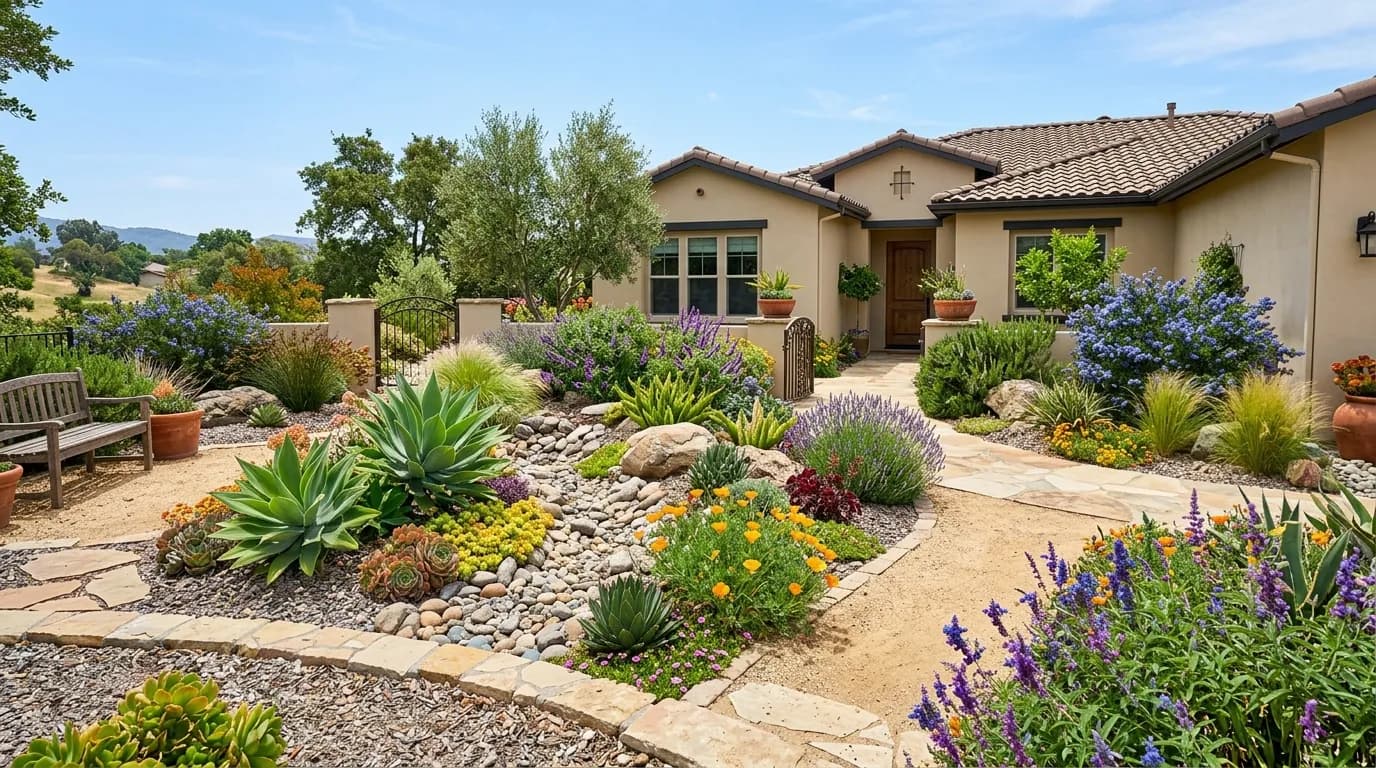
California homeowners are rethinking the lawn. Between water restrictions, rising utility bills, and years of drought, the traditional green carpet has become both expensive and increasingly outlawed. But here's what the water agencies don't advertise: drought-tolerant landscaping isn't a sacrifice. Done right, it's more beautiful, more interesting, and more alive than any lawn.
This guide covers 27 plants proven to thrive in California's Mediterranean climate, 8 design strategies that work from San Diego to Sacramento, and everything you need to get started.
Why California Landscaping Requires a Different Approach
California has a Mediterranean climate: wet winters (November–April), bone-dry summers (May–October). It's the opposite of most of the country where plants get summer rain. Native California plants evolved for exactly this pattern — they grow in winter, bloom in spring, and go dormant (but don't die) through the summer drought.
The problem? Most residential landscaping was designed for the Midwest or East Coast — with plants that need summer water. Replace those plants with California-adapted species and your irrigation needs drop 60–80% almost immediately.
The window for planting: October through December is the best time to plant drought-tolerant California gardens. Plants establish roots through the winter rainy season and enter their first dry summer already anchored and resilient.
8 Design Strategies for California Drought Landscaping
1. Lose the Lawn
A traditional lawn uses more water than any other landscape element — typically 40–60% of outdoor water use. Replacing even half your lawn with drought-tolerant plants reduces your outdoor water use by 25–30%.
California's turf removal rebate programs will pay you $1–$3 per square foot to remove it. A 1,000 sq ft front lawn replacement can generate $1,000–$3,000 in rebates before you spend a dime on plants.
Lawn alternatives by look:
- Natural/native: decomposed granite + native plant islands
- Green groundcover: Dymondia margaretae or Kurapia
- Modern: concrete + gravel + specimen plants
- Meadow: California native grass seed mix (unmowed)
2. Plant in Zones by Water Need
Hydrozoning groups plants by water requirement on separate irrigation zones. Your entry walk (medium water plants for curb appeal) runs independently from your back hillside (zero-water natives). This prevents overwatering drought-tolerant plants and underwatering the ones that need more.
Zone 1 (near house, high visibility): 1–2× per week in summer
Zone 2 (mid-yard, accent areas): 2× per month in summer
Zone 3 (slopes, back areas): Rainfall only after establishment
3. Drip Irrigation Only
Spray heads lose 30–50% of water to evaporation and wind drift. Drip irrigation delivers water directly to roots with 90%+ efficiency. For drought-tolerant gardens, a simple drip system with a smart timer (like Rachio or Rain Bird) that accounts for weather dramatically reduces water use versus spray systems.
4. Mulch Everything 3–4 Inches Deep
In California's heat, bare soil loses moisture incredibly fast. A 3–4 inch layer of wood chip mulch (not rock) reduces evaporation by 70%, moderates soil temperature by 10–15°F, and suppresses weeds. Use coarse wood chips from tree services (often free) — avoid fine bark dust that compacts and repels water.
Important: Keep mulch 2 inches away from plant stems to prevent crown rot.
5. Create a Defensible Space Design
In fire-prone areas, your plant selection and layout are life-safety decisions. The California Board of Forestry recommends Zone 0 (0-5 ft from house): non-combustible hardscape and succulents only. Zone 1 (5-30 ft): low-growing, fire-resistant plants with separation between plants. Zone 2 (30-100 ft): native plants thinned and maintained.
Many native California plants are actually fire-adapted — they're not fireproof, but they don't carry fire the way ornamental grasses and chaparral shrubs do. Ceanothus, Toyon, and Ribes are all fire-resistant choices.
6. Use Decomposed Granite (DG) Strategically
Decomposed granite is the quintessential California hardscape material — permeable, affordable ($30–$60 per yard), and it looks right in both modern and natural designs. Use it:
- As a low-maintenance mulch under drought-tolerant plants
- For paths and open areas that don't need grass
- Mixed with stabilizer for high-traffic areas (DG compacts to a firm surface)
- As the ground layer of a native plant garden
DG reflects heat, so pair it with larger boulders and shade plants in hot interior valleys.
7. Add Boulders and Rocks
California's natural landscapes are defined by granite boulders, sandstone outcroppings, and rocky slopes. Incorporating native stone into your garden doesn't just look right — it creates habitat (lizards, beneficial insects), adds thermal mass that moderates temperature, and provides permanent structure that never needs replacement.
Use odd numbers (3, 5, 7) of boulders. Partially bury each one 1/3 of its height for a natural look. Cluster smaller rocks around larger ones the way you'd see them in nature.
8. Design for Year-Round Interest
California native gardens can bloom 10–11 months a year with the right plant selection. Design your bloom succession:
- Winter/Early Spring: Flannel Bush, Wild Lilac, Manzanita
- Spring: California Poppy, Penstemon, Clarkia
- Late Spring: Salvia, Ceanothus, Matilija Poppy
- Summer: Buckwheat (Eriogonum), Hummingbird Sage, Yarrow
- Fall: Toyon berries, Aster, Deer Grass seed heads
Ready to see what a drought-tolerant design looks like in YOUR California yard? [Generate a free AI preview →](/redesign)
27 Drought Tolerant Plants for California
California Natives (Best Long-Term Performers)
1. California Lilac (Ceanothus species)
The most versatile California native shrub. 65+ species ranging from groundcovers (6 inches) to large shrubs (12 feet). Blue to purple flowers in late winter through spring. Full sun, excellent drainage, zero summer water once established. Deer resistant. No pruning needed. Plant in fall only — does NOT transplant well in heat.
2. Manzanita (Arctostaphylos species)
Architectural shrubs with mahogany bark, white/pink urn-shaped flowers in winter, and red berries. Size range: 1 foot ('Emerald Carpet') to 15 feet. Accepts zero summer water after the first year. One of the most fire-resistant California natives. Needs excellent drainage — does not tolerate clay.
3. California Poppy (Eschscholzia californica)
The state flower. Self-sowing annual that naturalizes easily. Orange, yellow, cream, and pink cultivars available. Plant from seed in fall or let it self-seed. Blooms February–May, goes dormant in summer heat. Rake dry soil in September and it returns.
4. Toyon (Heteromeles arbutifolia)
The 'Hollywood' plant — gives Hollywood, CA its name. Evergreen shrub/small tree to 15 feet. White flowers in June, bright red berries December–February (major wildlife food source). Full sun to part shade, drought tolerant, fire resistant, deer resistant. Excellent as a screen or specimen.
5. Cleveland Sage (Salvia clevelandii)
Intensely fragrant (camphor-sage scent), blue-purple flowers from May–July that attract hummingbirds and bees. 3–5 feet tall. One of the most deer-resistant plants in existence. Zero summer water. Excellent for hillsides and slopes. 'Allen Chickering' is a superior cultivar.
6. Deer Grass (Muhlenbergia rigens)
California's best native ornamental grass. 3–4 feet, fountain-shaped, tan seed plumes in fall. Extremely drought tolerant — grows in full sun or light shade. Excellent for slopes, erosion control, and mass planting. Stays evergreen in mild winters.
7. Buckwheat (Eriogonum species)
Hugely diverse California native genus with 200+ species. Flowers range from white to cream, yellow, pink, and red. Long summer bloom period (when little else is flowering). Attracts more native bee species than almost any other plant. Requires zero summer water — actively harms from overwatering. 'Blanche Sanderson' and 'Shasta Sulfur' are garden-worthy cultivars.
8. Flannel Bush (Fremontodendron californicum)
Spectacular yellow flowers cover the plant April–June. Grows fast to 12–15 feet. Needs zero summer water — this cannot be overstated. Excess irrigation kills it. Perfect for dry slopes. Short-lived (10–15 years) but stunning. Wear gloves — stem hairs irritate skin.
9. California Fuchsia (Epilobium canum)
Tubular orange-red flowers from August through frost — when almost nothing else is blooming. Primary late-season hummingbird plant in California. 1–2 feet, spreading. Full sun, zero summer water, spreads by rhizomes (give it room). 'Catalina' is a large, robust cultivar.
10. Matilija Poppy (Romneya coulteri)
Stunning 6-inch white flowers with yellow centers in May–June. Plants reach 5–8 feet. One of the most dramatic California natives. Spreads by rhizomes into large colonies — give it a dedicated area. Zero water once established. Cut to the ground each winter.
Mediterranean Plants (Water-Wise, California-Appropriate)
11. Lavender (Lavandula angustifolia, L. stoechas)
Mediterranean native that loves California's climate. 'Phenomenal' and 'Provence' are the most heat and humidity tolerant. Full sun, excellent drainage, zero-to-minimal summer water. Blooms May–July. Attracts pollinators. Deer resistant. Cut back by 1/3 after bloom to maintain compact form.
12. Rosemary (Salvia rosmarinus)
Culinary herb that becomes a substantial landscape shrub in California. 'Tuscan Blue' grows to 5 feet, 'Prostratus' groundcover form excellent on slopes. Full sun, minimal water, excellent fire resistance. Blooms blue-purple October–February.
13. Cistus (Rock Rose)
Mediterranean native with large single flowers in white, pink, and purple. 2–5 feet. Blooms spring. Needs excellent drainage, full sun, zero summer water. One of the best plants for dry, rocky, inhospitable spots. Short-lived (7–10 years) but seeds freely.
14. Salvia (Mediterranean types)
S. apiana (White Sage — California native), S. greggii (Autumn Sage — Texas/Mexico), S. leucantha (Mexican Bush Sage). All extremely drought tolerant, deer resistant, hummingbird magnets. Autumn sage flowers in summer–fall when few things bloom.
15. Agave
Architectural statement plants that need essentially zero water after establishment. Agave americana (large, to 6 feet across), A. attenuata (spineless — best for high-traffic areas), A. parryi (compact, cold hardy). Plant once, enjoy for decades. The plant blooms once then dies (offsets survive).
Groundcovers and Low-Growing Plants
16. Dymondia margaretae (Silver Carpet)
The best lawn replacement for full sun California gardens. Grows to 2–3 inches, spreads to form a solid mat. Silver-gray leaves with yellow flowers in summer. Tolerates light foot traffic. Very drought tolerant once established. Does not tolerate heavy clay or shade.
17. Ceanothus 'Valley Violet' (groundcover form)
Low-growing Ceanothus to 2 feet, spreading to 10+ feet. Covered in blue-purple flowers in spring. Zero summer water. Use on slopes, cascading over walls, or as a large-scale groundcover. More aggressive than Dymondia — give it room.
18. Creeping Rosemary (Salvia rosmarinus 'Prostratus')
Same drought tolerance as upright rosemary with a groundcover habit. 1–2 feet tall, spreads 6–8 feet. Cascades beautifully over walls and slopes. Blooms blue in winter. Excellent fire-resistant groundcover.
19. Yarrow (Achillea millefolium)
Native to California and extremely adaptable. White wildflower species or cultivated varieties in yellow, pink, and red. Spreads via rhizomes to create a groundcover. Full sun, drought tolerant, deer resistant, attracts beneficial insects. Can be mowed to a low groundcover.
Trees for California Drought Gardens
20. California Pepper Tree (Schinus molle)
Weeping branches, feathery compound leaves, pink peppercorn clusters in fall. Fast growing to 30 feet. Extremely drought tolerant — one of the few truly large shade trees that needs no irrigation once established. Some cities restrict planting (check locally).
21. Palo Verde (Parkinsonia species)
Desert tree with green bark that photosynthesize even when leafless. Yellow flowers in spring. 15–30 feet. Minimal water, full sun. Excellent choice for interior valleys and desert-adjacent areas. 'Desert Museum' is a thornless hybrid.
22. Australian Willow (Geijera parviflora)
Elegant weeping form, small white flowers, looks like a willow but incredibly drought tolerant. 25–35 feet. Excellent street or patio tree. Full sun, minimal water after establishment. No invasive issues.
23. Western Redbud (Cercis occidentalis)
California native small tree with bright magenta flowers on bare branches in late winter. One of California's most spectacular early spring bloomers. 10–18 feet. Very drought tolerant. Full sun to part shade. Brilliant fall color.
Putting It All Together: Design Examples
Front Yard Replacement ($3,000–$8,000 installed)
Remove lawn → Install DG with compactum stabilizer → Plant Ceanothus groundcover along parkway → Add 3 Cleveland Sage shrubs with rock groupings → Border with California Poppy seed for spring color → Install drip system on timer → Mulch 3 inches throughout.
Water use: 80% less than the lawn it replaced. In many California municipalities, this qualifies for $1,000–$3,000 in turf removal rebates.
Slope Stabilization ($2,000–$5,000 installed)
Plant top of slope with Manzanita (holds soil with deep roots) → Mid-slope with Ceanothus groundcover varieties → Bottom edge with California Fuchsia and Buckwheat → Add erosion control matting during first rainy season → Install drip system for establishment period (remove or reduce after year 2).
Backyard Native Garden ($5,000–$15,000 installed)
Create 3–5 distinct zones → Center focal point: large Toyon or Western Redbud → Screening perimeter: California Lilac + Cleveland Sage → Mid-garden: Buckwheat + Deer Grass + California Fuchsia drifts → Ground layer: Yarrow + California Poppy (seeded) → Path through garden: decomposed granite with stepping stones → Lighting: uplights on focal trees.
Get a Design Built for California
California's drought-tolerant landscaping has its own rules — plant palette, timing, irrigation strategy, and compliance with local water restrictions all matter. A generic design from a non-California designer often results in the wrong plants, wrong timing, and a dead garden after the first summer.
Start your AI design → — upload a photo of your yard, answer questions about your California location (Northern vs. Southern CA, coastal vs. inland), and get 3 photorealistic designs with a California-specific plant list in about 60 seconds.
Your design includes an irrigation zone map, phased planting schedule, and turf removal tips so you can maximize available rebates.