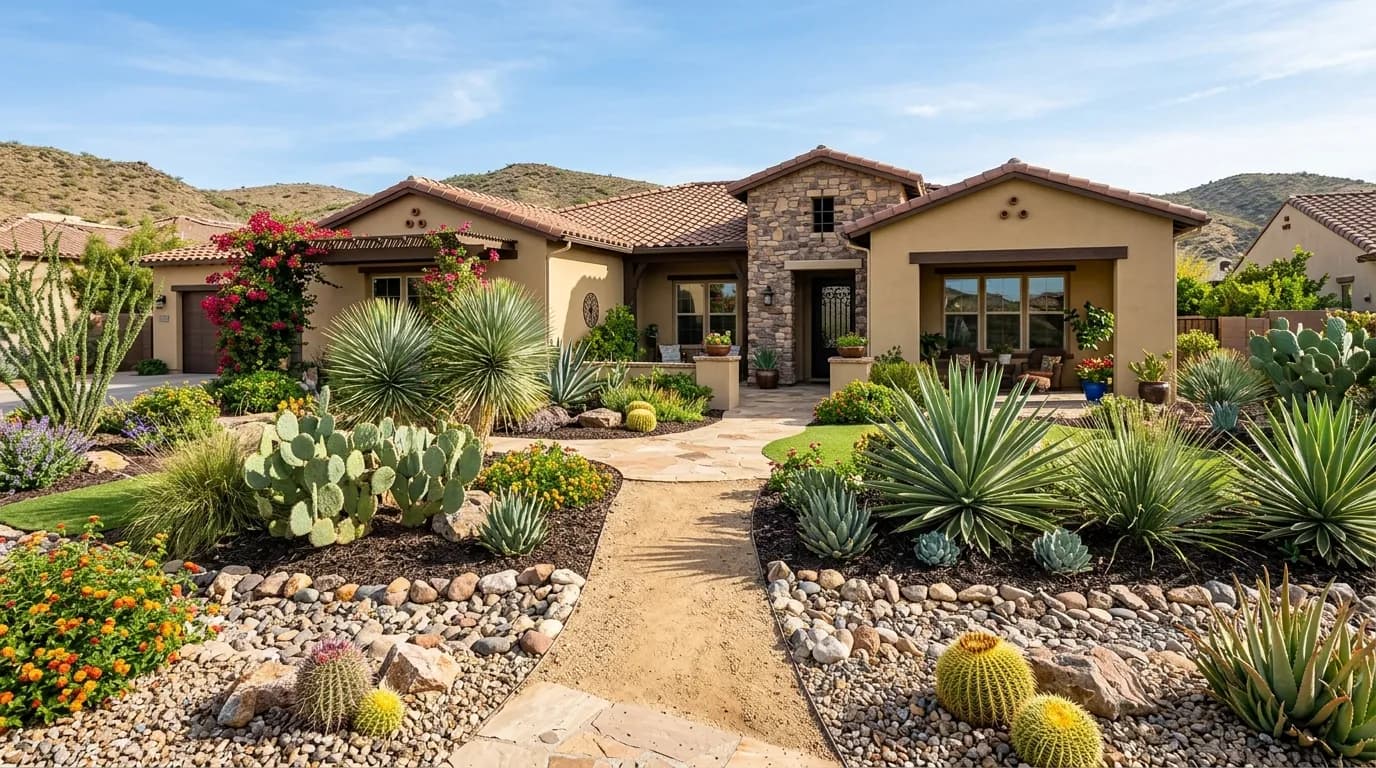
Desert landscaping has never been more popular — and for good reason. Water costs are rising, drought restrictions are tightening, and the best-looking yards in Phoenix, Tucson, Las Vegas, Albuquerque, and El Paso aren't fighting the climate. They're working with it.
The secret: desert landscaping done right is actually easier to maintain than a traditional grass lawn, dramatically cheaper to water, and — with the right design — genuinely beautiful every single month of the year.
This guide covers 30 desert landscaping ideas for front yards, backyards, and every space in between.
What Makes a Great Desert Landscape
Before we get to ideas, a quick principle: great desert landscaping isn't about putting rocks and cacti in a yard. That's the cheap version that looks flat and sad after two years.
Great desert landscapes have three things:
- 1Textural contrast — spiky agave next to soft ornamental grass, boulders beside flowing groundcovers
- 2Year-round color — desert plants bloom in rotation; a well-designed desert yard has color in every season
- 3Water-wise hardscaping — gravel, decomposed granite, flagstone, and permeable pavers that direct water to plants rather than running it off
Desert Landscaping Ideas for Front Yards
1. Gravel Garden with Specimen Boulders
Replace your front lawn with decomposed granite in a warm tan or rust color, then place 3–5 large boulders (18–36 inches) as anchors. Plant a large Agave or Saguaro at the highest point. Add accent grasses around the base of each boulder. The result looks architectural and expensive — and the only maintenance is occasional raking.
2. Desert Cottage Style
Layer low-growing flowering perennials like Desert Marigold, Globe Mallow, and Texas Sage around a central Desert Willow or Palo Verde tree. This "soft desert" approach is lush and colorful — blooming yellow, orange, purple, and pink from April through November — with none of the water demand.
3. Cactus Garden with Colored Gravel
Create a dedicated cactus garden using contrasting gravel colors: black lava rock as a border, pale tan decomposed granite as fill, and red gravel as an accent around a central statement cactus (Saguaro, Barrel, or Organ Pipe). Vary cactus heights dramatically — 2-inch pads next to 8-foot columns — for striking silhouettes.
4. Southwest Courtyard Entry
Define your entry with a low adobe-style wall (real or faux), terracotta pots overflowing with Bougainvillea, a Palo Verde tree providing dappled shade, and a simple flagstone path. This is the quintessential Tucson/Santa Fe front yard — and it photographs beautifully.
5. Native Plant Meadow
Replace turf with a mix of native wildflowers and grasses seeded directly into cleared ground: Desert Bluebells, California Poppy, Desert Marigold, Globe Mallow, Penstemons, and Desert Sage. In spring this becomes a rolling carpet of color. After seed is established, it's truly maintenance-free — water it once to establish, then rainfall takes over.
Desert Backyard Ideas
6. Desert Living Room
Create an outdoor living space using permeable pavers for a patio, surrounded by tall ornamental grasses (Muhly Grass, Desert Spoon) that create a privacy screen. Add a pergola with a climbing Desert Willow or Yellow Bells. String lights overhead. The result is a comfortable, shaded outdoor room that doesn't feel hot and exposed.
7. Dry Creek Bed Feature
A dry creek bed is the single most effective landscaping feature in a desert yard. It:
- Channels and directs water during monsoons or heavy rain
- Looks beautiful year-round as a design feature
- Requires zero maintenance
- Creates a natural-looking linear element that organizes the whole yard
Build it with rounded river rock (not angular crushed rock) in 3 sizes: large anchor rocks at bends, medium fill rocks in the channel, and small pea gravel as filler. Line banks with native grasses and flowering shrubs.
8. Desert Fire Pit Area
A flagstone or decomposed granite circle around a central fire pit, surrounded by Desert Spoon, Feather Grass, and a few scattered Barrel Cacti makes for a dramatic evening space. Low-voltage landscape lighting installed at ground level around the perimeter makes this look absolutely stunning after dark.
9. Succulent Tapestry Garden
A flat panel of contrasting succulents — laid out in drifts of color and texture — creates an almost carpet-like effect. Combine blue Agave with green Aloe, bronze-tinted Echeveria, and silver-leaved Dudleya. This is best as a dedicated bed rather than scattered across the yard.
10. Swimming Pool Desert Oasis
Surround a pool with tropical-adjacent desert plants that create the "oasis" effect: Phoenix Palm (Date Palm), Queen Palm, Bougainvillea climbing a wall, Bird of Paradise, Cannas, and pots of Agave. The effect is a lush resort feel that uses a fraction of the water of traditional pool landscaping.
🌵 Want to see these designs in your yard?
[Upload a photo and get 3 AI desert landscape designs in 60 seconds →](/redesign)
Yardcast's AI generates photorealistic designs layered directly onto your property photos — with plant lists matched to your ZIP code, cost estimates, and a contractor-ready PDF. Preview free.
Desert-Friendly Plant Guide
Structural Anchors
These are the focal points that give a desert landscape its backbone:
- Saguaro Cactus — The iconic Arizona giant. Slow-growing (1 inch/year), long-lived, architectural. Plant established specimens for immediate impact.
- Blue Agave — Massive, sculptural rosettes in silver-blue. Blooms once spectacularly, then dies (but sends up offsets).
- Desert Spoon (Dasylirion wheeleri) — Globe of spiky silver-gray leaves, 5–6 ft across. Evergreen structural anchor.
- Palo Verde — The best desert tree. Yellow-green bark, airy canopy, brilliant yellow spring blooms. Drought-proof once established.
- Desert Willow — Fast-growing, blooms pink/purple all summer, attracts hummingbirds. Best blooming desert tree.
Color and Flowering Plants
- Desert Marigold — Yellow daisy flowers, blooms April through November. Seeds prolifically.
- Globe Mallow — Orange, pink, red, or white blooms, very long season. Deer-resistant.
- Texas Sage (Leucophyllum) — Purple flowers after monsoon rain, silver foliage year-round. Drought-proof.
- Red Yucca — Coral flower spikes on tall stems, hummingbird magnet, evergreen.
- Bougainvillea — Blazing magenta, orange, or purple. Needs wall or structure. Blooms best when stressed.
- Desert Zinnia — Tiny white daisies, extremely drought-tolerant, blooms May through October.
Groundcovers and Low Plants
- Trailing Lantana — Ground-hugging, purple/yellow flowers, covers slopes quickly.
- Santa Barbara Daisy — White and yellow daisies, evergreen, blooms nearly year-round.
- Blackfoot Daisy — Native, white flowers with yellow centers, blooms April–November.
- Damianita — Golden yellow flowers, compact mounding form, very drought-tolerant.
Ornamental Grasses
- Muhly Grass — Pink cloud of flowers in fall. One of the most spectacular fall plants in any climate.
- Mexican Feather Grass — Fine, airy texture; moves beautifully in breeze.
- Deer Grass — Large, tidy clump; native to Southwest; year-round structure.
Desert Landscaping Design Principles
Work With Your Slope
Most desert properties have some grade change. Use it:
- Put large boulders on higher ground — they look natural and anchor the slope
- Run dry creek beds downhill to manage water flow
- Plant groundcovers on slopes to prevent erosion
- Terrace steep slopes with low flagstone walls
Color the Hardscape
The hardscape (rocks, gravel, pavers) makes up 60–70% of a desert landscape's visual surface. Choosing well here matters enormously:
- Decomposed granite in tan, rust, or gray creates a natural desert floor
- Black lava rock is bold and modern — great around specimen plants
- Flagstone in warm buff or sandstone tones looks timeless
- Pea gravel in a lighter shade creates contrast in beds and dry creek beds
Layer Your Heights
A flat desert landscape looks like a parking lot. Height variation is everything:
- High (6–15 ft): Trees (Palo Verde, Desert Willow, Mesquite), tall Saguaro
- Mid (2–6 ft): Large Agave, Yucca, Bougainvillea, Texas Sage, Ocotillo
- Low (6–24 in): Penstemon, Blackfoot Daisy, Globe Mallow, Desert Marigold, groundcovers
Design for After Dark
Desert living is outdoor living — and desert evenings are spectacular. Design your yard to be used at night:
- Low-voltage path lights along flagstone walkways
- Uplights at the base of tall cacti (the shadows are incredible)
- String lights over patios
- Fire pit as a gathering focal point
Desert Landscaping Costs
DIY desert front yard (1,200 sq ft):
- Decomposed granite (6 tons): $180–$360
- Boulders (5 medium): $200–$500
- Plants (15–20 specimens): $300–$800
- Drip irrigation: $150–$400
- Total: $830–$2,060
Contractor-installed desert yard:
- Small front yard: $3,000–$8,000
- Full backyard: $8,000–$25,000
- Complex design with pool area: $20,000–$60,000
Use Yardcast's cost estimator to get a more precise breakdown based on your yard size, chosen plants, and region.
FAQ: Desert Landscaping Ideas
See below for detailed answers to the most common desert landscaping questions.