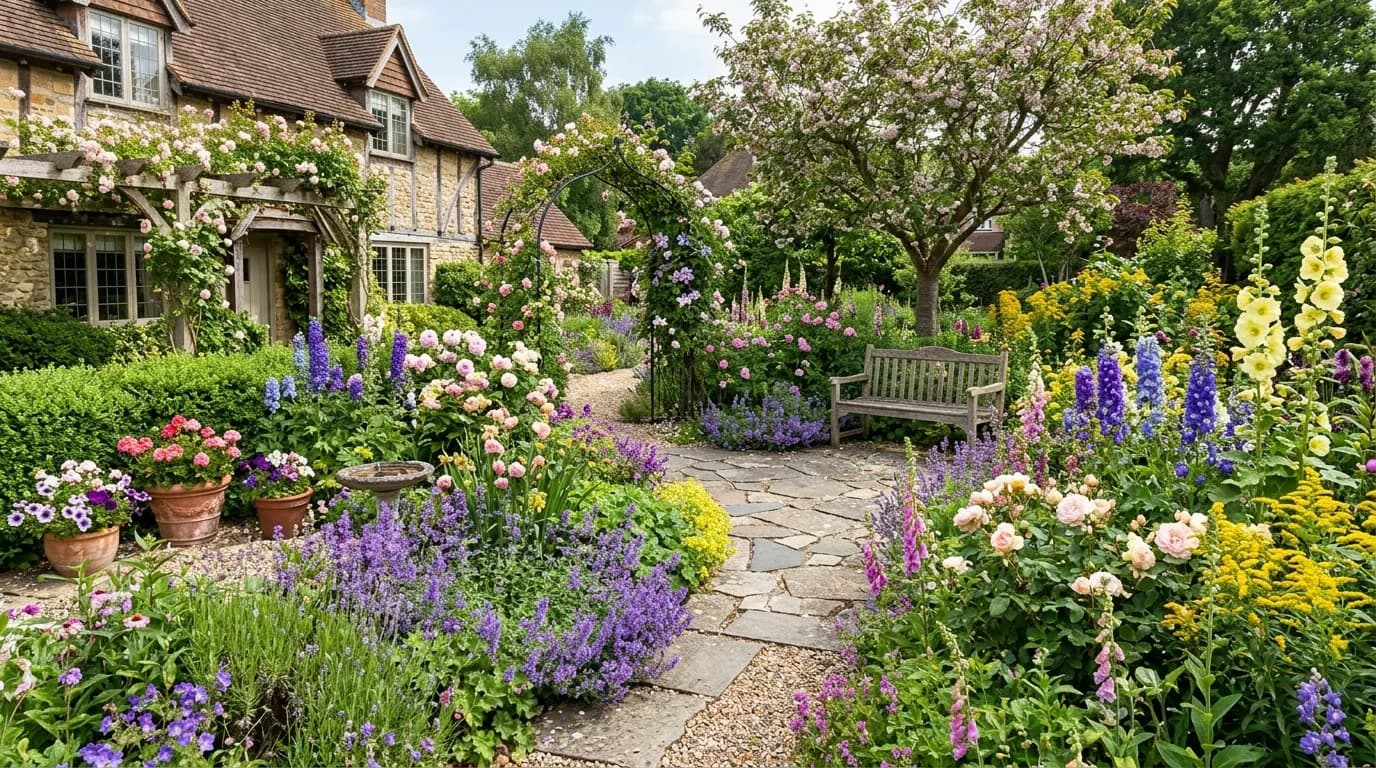
The cottage garden is the most beloved landscape style in the English-speaking world — and the most forgiving. Unlike formal gardens that require geometric precision, cottage gardens thrive on abundance, informality, and a little bit of beautiful chaos.
The aesthetic: plants spilling over paths, roses climbing fences, lavender billowing against a stone wall, sweet peas threading through a picket fence. The philosophy: more is more.
Best of all, cottage gardens are one of the lowest-maintenance landscape styles available — once established. The plants self-seed, self-organize, and reward neglect with more blooms.
Here are 28 cottage garden ideas to transform your yard.
What Is a Cottage Garden?
The cottage garden style originated in rural England — originally the gardens of working-class cottagers who grew a mix of edible herbs, vegetables, fruit, and flowering plants together in productive abundance. Over time the style became highly ornamental, and today's cottage garden aesthetic emphasizes:
- Dense, layered planting — no visible soil (or almost none)
- Mixed planting — flowers, herbs, roses, vegetables, grasses together
- Informal structure — curves, not straight lines; overflowing, not clipped
- Fragrance — roses, lavender, sweet peas, stocks, lilacs
- Year-round interest — something blooming in every month
- Vertical elements — climbing roses, clematis, sweet peas on arches and fences
The style works in any climate — there's a cottage garden tradition in the Pacific Northwest, New England, the Upper Midwest, and the British Isles. Even Southern and Texas gardeners can achieve the look with heat-tolerant substitutes.
Cottage Garden Ideas for Front Yards
1. Picket Fence with Climbing Roses
The iconic cottage garden look: a white picket fence covered in climbing roses (Rosa 'New Dawn', 'Eden', or 'Joseph's Coat'), underplanted with Catmint spilling over the base, and Foxgloves rising above. Plant Lavender along the walkway. This approach costs $300–$600 in plants but looks like a $10,000 garden within two years.
2. Cottage Garden Path
Replace a straight concrete walkway with a curving flagstone or brick path, letting plants — Creeping Thyme, Alchemilla (Lady's Mantle), Lobelia — grow between and over the stones. This "loose path" look is quintessentially cottage and extremely easy to maintain.
3. Rose Arch Entry
Install an arbor or arch over your front gate and plant two climbing roses (one on each side). 'New Dawn' (pale pink, very vigorous) and 'Zephirine Drouhin' (deep pink, thornless, fragrant) are classics. Underplant with Alliums, Catmint, and Salvia. Within 3 years you'll have a showstopper entrance.
4. Cottage Cottage Front Border
A deep mixed border (5–8 ft) against your house foundation, planting from back to front: Hollyhocks and Delphiniums at the wall, then Roses, Phlox, and Foxgloves, then Catmint, Geranium, and Astilbe in front, then Alchemilla and Creeping Thyme at the edge. The house wall becomes a backdrop for a romantic tapestry.
5. Wildflower Meadow Front Yard
Remove lawn and seed with a wildflower mix: Cornflowers, Poppies, Ox-eye Daisy, Cornflower, Field Scabious, Yarrow. This is the no-mow, ultra-low maintenance version of the cottage garden that works beautifully as a front yard in neighborhoods that permit it. Annual cost: near zero after year one.
Cottage Garden Backyard Ideas
6. Cutting Garden
Dedicate a section of the backyard to a cutting garden — rows of flowers grown specifically for picking. Classic cottage cutting flowers: Peonies, Sweet Peas, Zinnias, Larkspur, Salvia, Rudbeckia, Cosmos, and Dahlias. Arrange in rows 18 inches apart for easy harvesting. The "productive garden" feel is very cottage.
7. Kitchen Herb and Flower Mix
Blend edible and ornamental plants: Rosemary next to Roses, Lavender next to Strawberries, Borage (blue flowers, edible) next to Sage. This blurring of the ornamental and productive is one of the original cottage garden traditions. It's also one of the most practical — you get beauty AND fresh herbs.
8. Seating Nook with Flower Tunnel
Create an arched tunnel of metal or wood over a garden path leading to a seating area, then plant Roses, Clematis, Sweet Peas, and Jasmine to cover it. The destination — a simple bench or bistro table — is surrounded by blooms and fragrance. This is aspirational garden design at a very affordable cost ($200–$600 for the structure, another $150–$300 for plants).
9. Cottage Shade Garden
For north-facing or tree-shaded backyards: Hostas (bold foliage), Astilbe (feathery plumes in pink/white/red), Bleeding Heart (arching spring bloomer), Foxgloves (tall biennial), Solomon's Seal (arching stems, tiny white bells), and ferns create a woodland cottage effect. Add Geranium cranesbill and Hellebores for ground-level color.
10. Vegetable and Flower Potager
A potager is a French kitchen garden that blurs vegetables, herbs, and flowers into a deliberate design. Raised beds arranged in a grid, surrounded by low box hedging (or willow edging), with a central focal point (sundial, birdbath, terracotta pot). Plant Tomatoes with Basil, Cabbages with Nasturtiums, Climbing Beans on a teepee with Sweet Peas. Beautiful, productive, and completely in the cottage tradition.
🌸 Want to see a cottage garden design for your yard?
[Upload a photo and get 3 AI cottage garden designs in 60 seconds →](/redesign)
Choose "Cottage Garden" or "Wild Romantic" style and Yardcast generates photorealistic designs with a full plant list, cost estimate, and PDF — all specific to your climate zone. Preview free.
Essential Cottage Garden Plants
Signature Cottage Flowers
- Roses — No cottage garden without them. Best cottage varieties: Rosa 'Gertrude Jekyll' (deep pink, intensely fragrant), 'Iceberg' (white, reliable, masses of blooms), 'Graham Thomas' (golden yellow), 'Zephirine Drouhin' (thornless, climbing, deep pink).
- Delphinium — Towering blue, purple, or white spires. The most vertical cottage plant. Stake in windy locations.
- Foxglove (Digitalis) — Biennial (blooms year 2, then self-seeds). Tall columns of speckled tubular flowers. Beloved by bees.
- Hollyhock — Old-fashioned staple. Plant against fences and walls. Self-seeds prolifically once established.
- Peony — Long-lived (50+ years), fragrant, ruffled blooms in white, pink, and red. Blooms for 2–3 weeks in June; spectacular foliage rest of season.
- Sweet Pea — Annual climber with intensely fragrant flowers in pink, purple, white, and red. Plant on fences, arches, and netting. Cut frequently to extend bloom.
Supporting Cast
- Catmint (Nepeta) — Lavender-blue flowers, silver-gray foliage. Blooms May through October. Spills beautifully over path edges.
- Alchemilla mollis (Lady's Mantle) — Scalloped leaves that hold dew drops; chartreuse frothy flowers. Perfect edging plant.
- Salvia — Many species; blue, purple, or red. Long blooming. Extremely versatile.
- Campanula (Bellflower) — Blue or white bell-shaped flowers. Self-seeds prolifically.
- Astilbe — Feathery plumes for shade spots. Blooms in June–July.
- Geranium (Cranesbill) — True geraniums (not pelargoniums). Mounding, long-blooming, self-seeds. Extremely tough.
Climbers and Vines
- Clematis — Hundreds of varieties, bloom from April–September in succession. Pair with roses on the same support.
- Climbing Hydrangea — For shaded walls. Slow to establish, spectacular once mature.
- Jasmine — Intensely fragrant. Best in Zones 7+.
- Wisteria — Spectacular but aggressive; needs a very sturdy support and annual pruning.
Cottage Garden Design Principles
The Rule of Abundance
Cottage gardens look sparse and sad when underplanted. The goal is lush coverage — plants touching their neighbors, spilling over paths, filling every vertical surface. Plant 20% more than you think you need.
Embrace Self-Seeding
The best cottage gardens are partly self-designed — plants self-seed into gaps, creating combinations the gardener never planned. Encourage this by:
- Allowing spent flowers to set seed before deadheading
- Not mulching so thickly that seeds can't reach soil
- Welcoming "volunteers" that appear in unexpected spots
Repeat Key Plants
For cohesion in a "chaotic" planting, repeat 2–3 key plants throughout the entire space. Catmint is the classic repeated edge plant — planted everywhere, it unifies even the most diverse cottage planting. Roses repeated at intervals. Alliums popping up throughout.
Don't Fear Imperfection
Cottage gardens require the gardener to let go of control. A Japanese Beetle chewed some leaves? Fine. The hollyhock leaned sideways? Let it. The Catmint is spreading into the path? Good — cut it back and use the cuttings elsewhere. This willingness to embrace imperfection is what makes cottage gardens so restorative to garden in.
Cottage Garden Cost Guide
DIY cottage front border (200 sq ft):
- Roses (3 shrub, 1 climbing): $80–$180
- Perennials (15 plants): $120–$300
- Annuals/biennials (seeds): $20–$40
- Mulch + soil amendment: $40–$80
- Total: $260–$600
Contractor-installed cottage garden:
- Small front yard conversion: $2,500–$6,000
- Full backyard cottage garden: $6,000–$20,000
The good news: cottage gardens reward patience more than spending. A $300 DIY investment looks better in Year 3 than a $3,000 contractor install in Year 1.
Get a free AI design to plan your cottage garden →