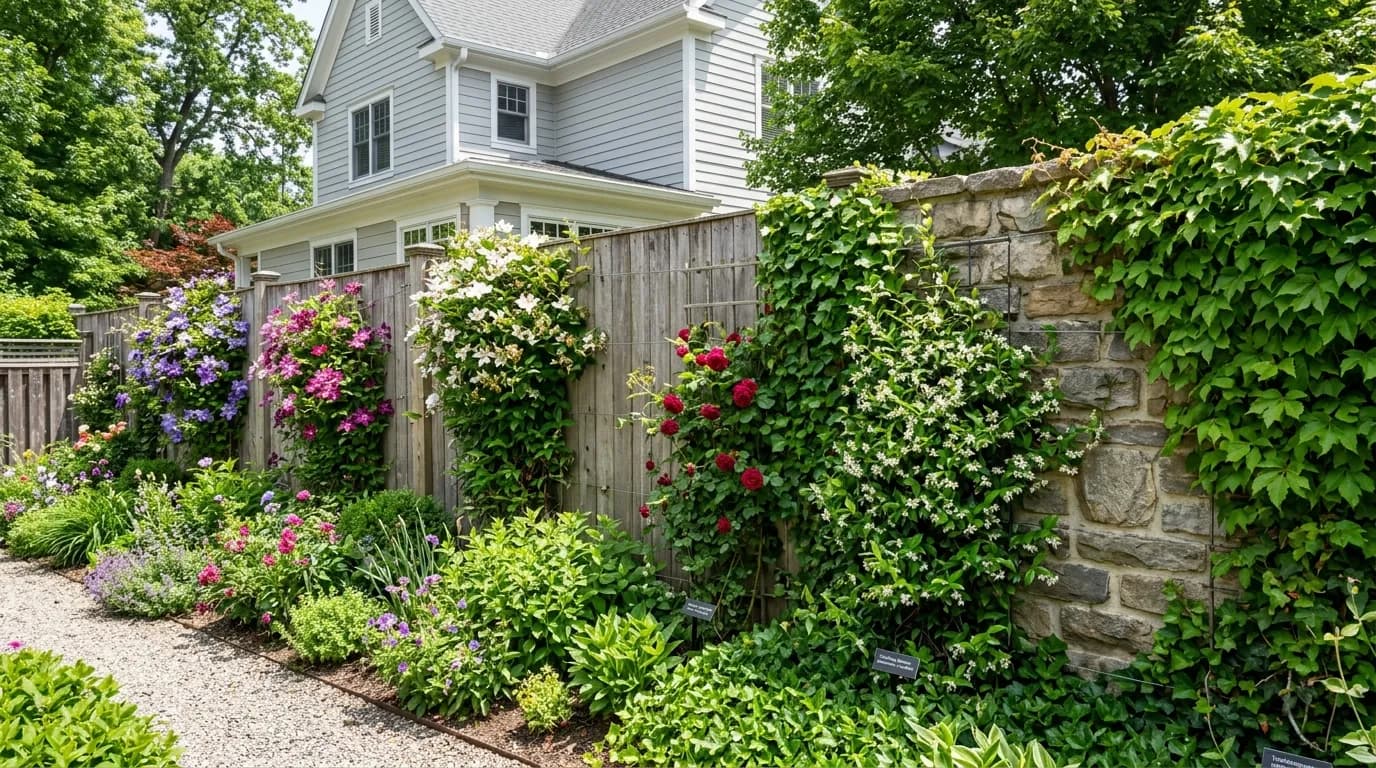
A bare fence is one of the most wasted opportunities in residential landscaping. A 60-foot fence line is 60 feet of vertical growing space — essentially a free, pre-built trellis that most homeowners ignore. The right climbing plant can transform that expanse from a boundary marker into a living, flowering, privacy-creating feature that adds thousands of dollars of value to your property.
This guide covers 35 of the best climbing plants for fences and walls, organized so you can quickly find the right one for your climate, fence type, sunlight, and design goal. Whether you want fast coverage, seasonal flowers, year-round privacy, or a low-maintenance option that basically takes care of itself — it's in here.
[Want to see climbing plants on YOUR fence before you plant? Generate a free AI design preview →](/redesign)
The 5 Types of Climbing Plants (How They Attach)
Before choosing a plant, understand how it climbs — because that determines what kind of support it needs and whether it can damage your fence.
- 1Twiners — wrap their stems around supports (wisteria, morning glory, honeysuckle). Need something to wrap around: wire, twine, lattice, or thin slats.
- 2Tendril climbers — grow small coiling tendrils that grab onto supports (clematis, sweet pea, passion flower). Work well on wire grids and chain link.
- 3Scramblers — use thorns or hooks to cling to rough surfaces and lean through other plants (climbing roses, bougainvillea). Need ties to direct them on smooth fences.
- 4Self-clinging — stick directly to flat surfaces with adhesive pads or aerial roots (climbing hydrangea, English ivy, Virginia creeper). Will grip and climb any surface without support — including solid wood fences.
- 5Wall shrubs — not true climbers, but grow upright against walls when trained with ties (pyracantha, espalier apple). Need regular tie-in to remain against the surface.
Annual Climbing Vines: Fast Coverage This Season
Annual climbers complete their life cycle in one growing season, then die. They're the fastest way to cover a fence — often 15–20 feet in a single summer — and they're ideal if you want seasonal variety or are still deciding on a permanent planting scheme.
1. Morning Glory (Ipomoea purpurea) — Zones 2–11 (annual)
The most prolific fence-covering annual available. Grows 10–15 feet in a single summer, covered in trumpet-shaped flowers in blue, purple, pink, white, or bicolor from midsummer through frost. Direct-sow seeds after last frost (soak overnight first to speed germination). Nearly indestructible. Cost: $2–$4 per seed packet.
2. Scarlet Runner Bean (Phaseolus coccineus) — Zones 2–11 (annual)
Vivid scarlet flowers, handsome deep-green foliage, and edible beans. Grows 8–15 feet. Best fast-coverage option that also produces food. Great for children's gardens. Sow directly in warm soil. Cost: $3–$5 per packet.
3. Black-Eyed Susan Vine (Thunbergia alata) — Zones 2–11 (annual)
Orange and yellow flowers with dark centers smother a 6–8 foot vine all summer. Grows in full sun or partial shade — one of the few annual climbers that performs in partial shade. Cost: $3–$6 per packet or $4–$8 per plant.
4. Sweet Pea (Lathyrus odoratus) — Zones 2–11 (cool-season annual)
Intensely fragrant flowers in every shade of pink, purple, white, and bi-color. Best as a spring-to-early-summer climber; declines when heat sets in. Sow outdoors in early spring (or fall in zones 8–10). 6–8 feet. Cost: $3–$5 per packet.
5. Cypress Vine (Ipomoea quamoclit) — Zones 2–11 (annual)
Delicate, feathery, fern-like foliage with tiny scarlet star-shaped flowers beloved by hummingbirds. More refined look than regular morning glory. Self-seeds readily. 10–15 feet. Cost: $2–$4 per packet.
Best Perennial Flowering Climbers
These come back every year, require less replanting, and develop more impressive flowering displays over time as they establish their root systems.
6. Clematis — Multiple Species — Zones 3–9
The undisputed queen of flowering climbers. Hundreds of varieties in every color — from the iconic purple 'Jackmanii' to the dusky pink 'Nelly Moser', the deep red 'Ernest Markham', and the tiny white-scented flowers of Sweet Autumn Clematis (C. terniflora). Growth rate: 8–12 feet for most large-flowered varieties; Sweet Autumn can reach 20–30 feet. Pruning is the key to success — Group 1, 2, or 3 depending on variety. Best fence choice: 'Jackmanii' (purple, zones 4–9, easy pruning Group 3). Cost: $15–$35 per plant.
7. Climbing Roses — Multiple Varieties — Zones 4–11
Nothing beats a fence covered in climbing roses for pure romantic impact. Best choices by climate:
- 'New Dawn' — Blush pink, 20 feet, disease-resistant, zones 5–9. The most popular climbing rose in America.
- 'Don Juan' — Deep red, fragrant, 10–12 feet, zones 5–9. Best red climber.
- 'Cecile Brunner' — Tiny pink flowers in enormous clusters, nearly thornless, zones 6–9.
- 'Cl. Iceberg' — White, repeat blooming, 10–15 feet, zones 5–11. Best for hot climates.
Cost: $25–$60 per plant. Requires ties on most fence types; thorns help on rough wood.
8. Honeysuckle (Lonicera spp.) — Zones 3–11
The fragrance stops you in your tracks. 'Scentsation' (L. periclymenum) has the strongest perfume of any honeysuckle — yellow flowers aging to orange, outstanding from a distance. 'Major Wheeler' is a non-invasive native cultivar (zones 4–9) with brilliant red-orange tubular flowers that hummingbirds adore. 10–15 feet. Cost: $10–$20 per plant. *Avoid Japanese honeysuckle (L. japonica) — it's invasive in many states.
9. Wisteria (Wisteria spp.) — Zones 4–9
Jaw-dropping cascades of purple, blue, or white flowers in late spring are incomparable. But wisteria is powerful — it will damage weak fences and requires a sturdy support. American Wisteria (W. frutescens) cultivars 'Amethyst Falls' and 'Blue Moon' are far less aggressive than Asian species and bloom reliably. Both are zones 4–9. Give them a robust metal fence post, pergola, or trellis — not lightweight wood slats. Cost: $25–$50 per plant.
10. Trumpet Vine (Campsis radicans) — Zones 4–10
One of the most beautiful native climbers: vivid orange-red trumpet flowers beloved by hummingbirds from midsummer through frost. Attaches by aerial roots — will climb any surface. Tolerates heat, drought, and poor soil. 20–40 feet at maturity. The downside: it spreads vigorously by underground runners. Contain it by mowing around the base. Cost: $15–$30 per plant.
11. Passion Flower (Passiflora spp.) — Zones 5–11
Among the most exotic-looking flowers you can grow — elaborate purple and white alien-looking blooms from midsummer through fall. Native Maypop (P. incarnata, zones 5–9) is more cold-hardy than tropical varieties. Grows 15–20 feet in warm conditions. Self-seeds and can spread; easy to control. Cost: $10–$20 per plant.
12. Virginia Creeper (Parthenocissus quinquefolia) — Zones 3–9
The spectacular fall color choice. Deep green in summer turns blazing crimson-red in fall. Self-clinging adhesive pads mean zero support required — it will cover any flat surface. 30–50 feet at maturity. Fast-growing (2–3 feet per week in summer). Low maintenance. Cost: $10–$20 per plant. Note: Can damage old or soft wood fence surfaces over time.
Best Evergreen Climbers for Year-Round Privacy
These climbers retain their foliage through winter, providing a continuous green screen on your fence.
13. Climbing Hydrangea (Hydrangea anomala petiolaris) — Zones 4–8
The premium choice for shade. Spectacular lacy white flowers in June cover a mature plant, followed by attractive fall foliage. Self-clinging — climbs up to 60–80 feet on mature specimens. The downside: slow for the first 2–3 years while establishing roots. After that, dramatic annual growth. Best planted once, left to mature for decades. Cost: $20–$40 per plant.
14. Star Jasmine (Trachelospermum jasminoides) — Zones 7–10
Powerfully fragrant white star-shaped flowers in late spring, glossy evergreen foliage year-round. Grows 20–30 feet with support, or use as a sprawling 2-foot groundcover. One of the best choices for Southern California, Texas, and the Gulf Coast. Cost: $15–$30 per plant.
15. English Ivy (Hedera helix) — Zones 4–9
Dense, fast-growing, and evergreen. Excellent for creating complete fence coverage. However, English ivy is invasive in many states — check your region's invasive species list before planting. Where non-invasive alternatives are available (Boston ivy, Virginia creeper), use those instead. Cost: $5–$15 per plant.
16. Euonymus (Euonymus fortunei 'Emerald Gaiety') — Zones 5–9
White-variegated evergreen foliage that turns pink in winter. Self-clinging, slow-growing, and very low maintenance. Stays more compact than most climbers (8–12 feet). Excellent for covering a section of fence with minimal pruning. Cost: $10–$20 per plant.
17. Pyracantha (Firethorn) — Zones 5–9
Not a true climber, but trains beautifully as a wall shrub (espaliered against a fence). White spring flowers followed by brilliant orange or red berry clusters that persist through winter. Thorns make it an excellent security barrier. Zones 5–9. 10–15 feet. Cost: $20–$40.
Fast-Growing Climbing Plants: Maximum Coverage Quickly
If you want fence coverage in the shortest time possible, these are your options.
| Plant | Growth Per Year | Max Size | Zones |
|---|---|---|---|
| Virginia Creeper | 10–15 ft/yr | 50 ft | 3–9 |
| Morning Glory | 10–15 ft/season | 15 ft | Annual |
| Trumpet Vine | 6–10 ft/yr | 40 ft | 4–10 |
| Wisteria | 8–10 ft/yr | 30 ft | 4–9 |
| Honeysuckle | 5–8 ft/yr | 20 ft | 3–11 |
| Climbing Hydrangea | 1–2 ft/yr (est.) then 5–6 | 60 ft | 4–8 |
| Sweet Autumn Clematis | 10–15 ft/season | 30 ft | 5–9 |
[See which fast-growing climbers work in your climate zone with a custom AI design →](/redesign)
Mid-Article CTA: See Your Fence Transformed
Before you buy a single plant, it helps to visualize the result. Yardcast generates photorealistic AI landscape designs based on your actual yard photos — including how climbing plants would look on your specific fence. Upload a photo, answer 4 quick questions, and see your fence covered in clematis, climbing roses, or star jasmine — in under 60 seconds.
[→ Generate My Free Fence Design Preview](/redesign)
Climbing Plants by Climate Zone
Zones 3–4 (Very Cold — Minnesota, North Dakota, Upper Midwest)
Best choices: 'Blue Moon' wisteria, 'Jackmanii' clematis, Virginia creeper, native honeysuckle 'Major Wheeler', climbing roses 'New Dawn'. Annual climbers (morning glory, sweet pea) work well as warm-season fillers.
Zones 5–6 (Cold — Chicago, Denver, Kansas City, Mid-Atlantic)
Widest selection available. Add: climbing hydrangea, trumpet vine (contain runners), pyracantha, passion flower (P. incarnata), 'Don Juan' climbing rose.
Zones 7–8 (Moderate — Pacific Northwest, Mid-South, Northern California)
Add: star jasmine, 'Cl. Iceberg' rose, bougainvillea (zone 8), *Carolina jessamine (Gelsemium sempervirens)* — fragrant yellow spring flowers, zones 7–9.
Zones 9–10 (Warm — Southern California, Arizona, Texas Gulf Coast, Florida)
Add: bougainvillea (best in zones 9–11), cat's claw vine (Macfadyena unguis-cati — fast, yellow flowers, but very aggressive; contain carefully), Lady Banks' rose ('Lutea' — nearly thornless, massive spring flower display, 20+ feet, zones 8–10), bower vine (Pandorea jasminoides) — white/pink trumpet flowers.
Zone 11 (Tropical — South Florida, Hawaii)
Allamanda, bougainvillea in massive sizes, blue butterfly bush (Rotheca myricoides), trumpet vine varieties.
Best Climbing Plants by Fence Type
Wood Privacy Fence: Choose self-clinging types carefully — adhesive root-climbers can trap moisture and accelerate wood rot. Best: clematis (uses tendrils, no adhesive), climbing roses (trained with ties), morning glory (annual, no damage), wisteria (twiner, but ensure fence is robust).
Chain Link Fence: Perfect for tendril climbers and twiners. Chain link provides ready support in every direction. Best: morning glory, sweet peas, clematis, black-eyed Susan vine, scarlet runner bean, passion flower.
Metal/Steel Fence (Ornamental Iron): Roses look spectacular trained onto ornamental iron. Also excellent: clematis, honeysuckle, wisteria (with strong vertical wires added between horizontal bars).
Concrete or Masonry Wall: Self-clinging types excel here. Best: climbing hydrangea, Virginia creeper, Boston ivy (Parthenocissus tricuspidata, zones 4–8) — gorgeous glossy leaves turn brilliant red in fall. Avoid English ivy on masonry in humid climates — it can penetrate grout over decades.
How to Train Climbing Plants on a Fence
For twiners and tendril climbers on a wooden fence: Install 14-gauge galvanized wire in horizontal runs, 18 inches apart, with eye-hooks. Costs about $40 for a 30-foot fence run. This gives the plant something to grip without you needing to monitor every stem.
For wall shrubs and roses: Use plastic-coated wire ties or flexible rubber ties to attach new growth to the fence every 2–3 weeks during the growing season. Check ties annually — old ties can girdle stems.
For self-clingers: Simply plant them at the fence base and guide the first stems toward the surface. Once the first adhesive pads grip, the plant takes over. Clean the fence surface first (brush off old paint flakes, dirt) so pads can adhere.
Planting distance from fence: Plant climbing plants 6–12 inches away from the fence base, not directly against it. This ensures good air circulation, prevents moisture buildup, and gives the roots room to develop without competition from the fence posts.
Cost Guide: Climbing Plants for Fences
| Category | Per Plant | For 30-ft Fence Run | 5-Year Result |
|---|---|---|---|
| Annual seeds | $2–$5 | $10–$25 | Replant each year |
| Perennial climbers (small) | $12–$20 | $60–$200 | Full coverage |
| Perennial climbers (premium) | $25–$60 | $150–$600 | Established, dramatic |
| Wire support system | — | $40–$80 | One-time |
| Total budget fence | — | $50–$100 | Annual coverage |
| Total established planting | — | $250–$700 | Permanent coverage |
For a 30-foot fence at 3-foot spacing, you need 10 plants. At 6-foot spacing (for large growers like wisteria or Virginia creeper), 5 plants.
Invasive Species Warning
Several popular climbing plants are invasive in large parts of the US and should be avoided:
- Japanese honeysuckle (L. japonica) — invasive in 26 states
- English ivy (Hedera helix) — invasive in Pacific Northwest and Southeast
- Oriental bittersweet (Celastrus orbiculatus) — invasive in Eastern US
- Porcelain berry (Ampelopsis brevipedunculata) — invasive in Eastern US
- Chinese/Japanese wisteria (W. sinensis, W. floribunda) — invasive in Southeast
- Cat's claw vine (Macfadyena) — invasive in California and Southeast
Always choose native or non-invasive alternatives where available. Virginia creeper, native wisteria, and 'Major Wheeler' honeysuckle are safe choices that perform as well or better than their invasive counterparts.
Designing Your Fence Planting as Part of a Whole-Yard Plan
The most beautiful fence planting isn't designed in isolation — it's chosen to complement the rest of your landscape: echoing the colors of adjacent perennial borders, providing the vertical layer your design needs, or framing a view toward a focal point deeper in the yard.
Yardcast's AI landscape design tool shows exactly how climbing plants integrate with your complete outdoor design. Upload photos of your fence and yard, choose your style (cottage, modern, tropical, Mediterranean, or natural), and get 3 photorealistic designs showing your space fully planted and transformed — complete with specific plant recommendations, quantities, spacing, and cost estimates.
Free to preview. $29 for the full plant list, cost breakdown, and contractor-ready PDF pack.