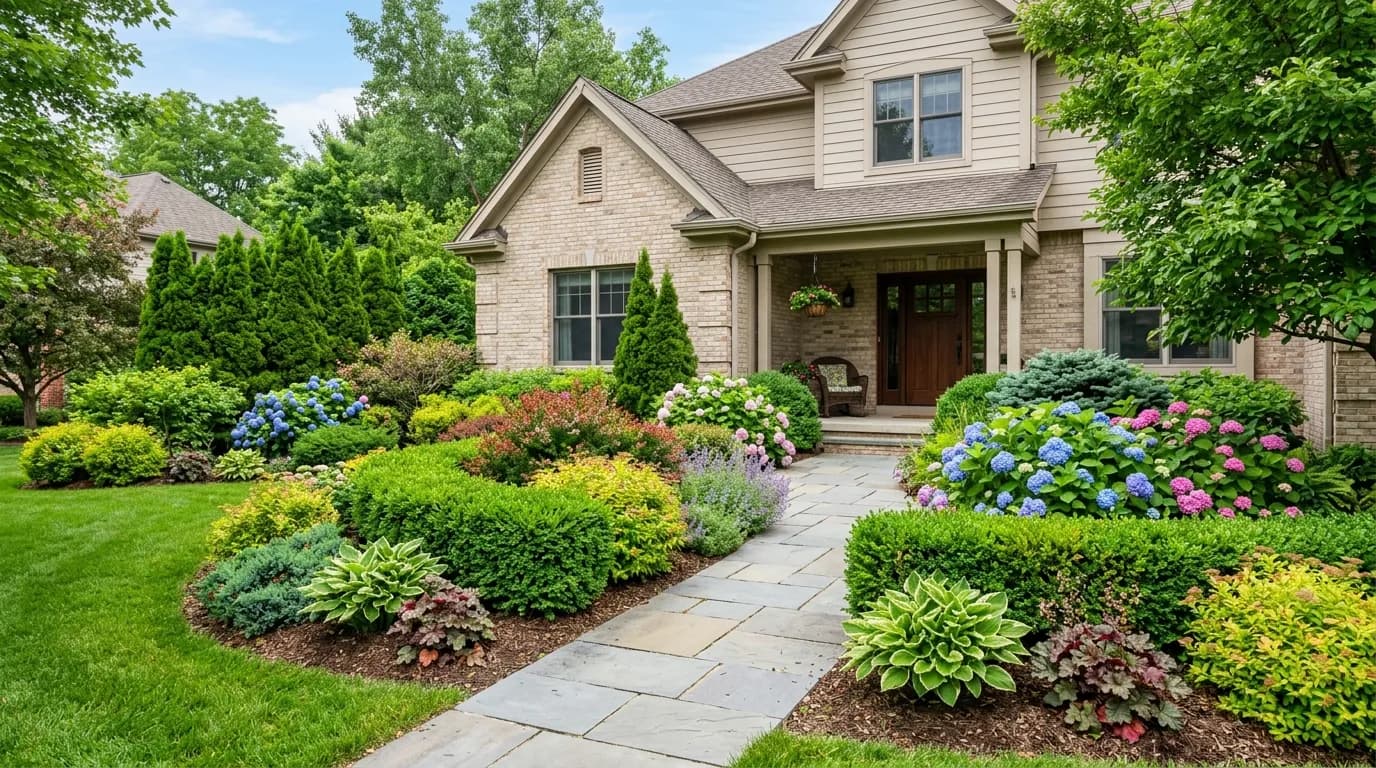
Shrubs are the workhorses of the landscape. Unlike perennials that disappear in winter or annuals you replant every year, the best landscaping shrubs earn their place permanently — providing structure, privacy, seasonal color, and year-round backbone to any yard design.
But with thousands of shrub species and cultivars available, choosing the right ones for your specific landscape is genuinely difficult. The wrong shrub planted in the wrong spot becomes a maintenance nightmare, blocking windows, crowding walkways, or struggling against your climate. The right shrubs, chosen carefully, establish quickly and then essentially take care of themselves.
This guide covers the 25 best shrubs for landscaping organized by purpose — from foundation plants to privacy hedges to flowering specimen shrubs — with climate information, mature sizes, and specific cultivar recommendations.
Why Shrubs Are the Foundation of Great Landscaping
Before we get to the list, it's worth understanding why shrubs matter so much. A landscape without shrubs typically looks:
- Flat and unfinished — no mid-height layer between ground level and tree canopy
- Barren in winter — no evergreen structure when perennials die back
- Maintenance-intensive — filling space with annuals costs money every year
- Without privacy — trees don't screen sightlines at 5–8 feet the way shrubs do
The best landscape designs use shrubs in three ways: as foundation plantings against the house, as hedges and screens along property lines, and as accent specimens in beds and borders. The 25 shrubs below cover all three uses.
Best Evergreen Shrubs for Year-Round Structure
1. Boxwood (Buxus spp.)
Size: 1–12 feet (varies by cultivar) | Zones: 4–9
Boxwood is the most versatile evergreen shrub in the landscape. It takes shearing perfectly, holds its shape indefinitely, and provides year-round dark green color. Use it for formal clipped hedges, topiary shapes, or natural balls in a foundation planting.
Best cultivars: 'Winter Gem' (hardy to zone 4, compact); 'Green Velvet' (2–3 feet, very cold hardy); 'Sky Pencil' holly is a good lookalike for narrow spaces.
Caution: Boxwood blight is a serious fungal disease spreading across the US. In affected regions, consider Japanese holly (Ilex crenata) as a nearly identical substitute.
2. Arborvitae (Thuja occidentalis)
Size: 10–60 feet depending on cultivar | Zones: 3–8
Arborvitae is the most popular evergreen screening shrub/tree in America for good reason: it's deer-resistant (mostly), cold-hardy, fast-growing, and requires zero pruning if you choose the right cultivar for your space.
Best cultivars for privacy screening: 'Emerald Green' (10–15 feet tall, 3–4 feet wide — ideal for tight spaces); 'Techny' (15 feet, very cold-hardy); 'Green Giant' (40 feet, fastest-growing privacy tree).
3. Skip Laurel (Prunus laurocerasus 'Schipkaensis')
Size: 6–10 feet | Zones: 6–9
Skip laurel has large, glossy evergreen leaves that look refined in any landscape. It grows quickly (2 feet per year when young), tolerates shade and clay soil, and makes a superb informal or clipped hedge.
Why landscapers love it: Tolerates more shade than almost any other fast-growing privacy shrub. Works under or near large trees where other hedges struggle.
4. Inkberry Holly (Ilex glabra)
Size: 5–8 feet | Zones: 4–9
Inkberry is a native American evergreen holly that handles wet soil, full sun, and deep shade — all without complaint. It forms a rounded shrub with small glossy leaves and black berries loved by birds. 'Shamrock' is a compact cultivar that stays 3–4 feet.
5. Dwarf Japanese Holly (Ilex crenata)
Size: 2–6 feet | Zones: 5–9
Fine-textured, dense, and nearly identical to boxwood in appearance — but resistant to boxwood blight. 'Compacta' and 'Helleri' stay under 3 feet. Ideal boxwood replacement for formal hedges and foundation plantings.
Best Flowering Shrubs for Seasonal Color
6. Knockout Rose (Rosa 'Radrazz' and related)
Size: 3–4 feet | Zones: 4–9
Knockout roses revolutionized rose growing for homeowners. They bloom continuously from late spring through fall, require no deadheading, resist black spot disease, and tolerate neglect. Available in red, pink, coral, white, and yellow. Plant en masse for stunning color or as a flowering hedge.
7. Hydrangea (Hydrangea spp.)
Size: 3–12 feet depending on species | Zones: 3–9
Hydrangeas produce the showiest blooms of any garden shrub — enormous mophead flowers in blue, pink, white, or purple.
Best species for landscaping:
- 'Incrediball' smooth hydrangea (H. arborescens) — giant white blooms, zones 3–9, very cold-hardy
- 'Endless Summer' bigleaf hydrangea — reblooms all summer, blue in acidic soil
- 'Limelight' panicle hydrangea (H. paniculata) — lime-green to pink blooms, zones 3–9, tolerates sun
- 'Little Quick Fire' — compact 3-foot version of 'Quick Fire', zones 3–9
8. Spirea (Spiraea spp.)
Size: 2–5 feet | Zones: 3–9
Spirea is a tough, affordable, incredibly free-flowering shrub that earns its keep in any landscape. 'Anthony Waterer' produces bright pink clusters all summer. 'Goldflame' has orange-gold spring foliage plus pink flowers. 'Snowmound' covers itself in white spring blooms.
9. Weigela (Weigela florida)
Size: 2–6 feet | Zones: 4–9
Weigela produces trumpet-shaped flowers in red, pink, or white in spring and reblooms lightly through summer. Newer cultivars like 'Wine and Roses' add dark purple foliage for year-round interest beyond flowers. Low-maintenance, pest-free, and deer-resistant.
10. Lilac (Syringa vulgaris)
Size: 6–15 feet | Zones: 3–7
Classic lilac's fragrant purple flowers in late spring are legendary, but many gardeners don't realize modern reblooming lilacs like 'Bloomerang Purple' flower in spring and again in late summer. Lilacs require cold winters (zones 3–7) and alkaline to neutral soil for best performance.
> Want to see exactly which shrubs would look best in your specific yard? Generate a free AI landscape design at Yardcast → Upload your yard photos, describe your style, and get 3 photorealistic designs showing how shrubs, trees, and groundcovers would actually look in your landscape — with plant lists and cost estimates included. 100% free preview.
Best Shrubs for Foundation Plantings
The shrubs directly against your house need to stay in scale, look good year-round, and complement your architecture. These are the best foundation planting shrubs:
11. Dwarf Mugo Pine (Pinus mugo 'Mops')
Size: 3–5 feet | Zones: 2–7
A true low-maintenance foundation shrub — after establishment, it needs almost nothing. Dark green needles year-round, no pest problems, drought-tolerant once established. Stays compact without pruning.
12. Nandina (Nandina domestica)
Size: 3–8 feet (compact cultivars available) | Zones: 6–10
Nandina is a four-season performer: feathery green/red foliage through spring and summer, brilliant red fall color, white spring flowers, and red berries through winter. 'Compacta' stays 4–5 feet; 'Firepower' stays 2 feet. Excellent for warm-climate foundation plantings.
Note: Nandina is invasive in some southeastern states — check local regulations before planting.
13. Dwarf Alberta Spruce (Picea glauca 'Conica')
Size: 6–8 feet over 20 years | Zones: 2–8
The ultimate slow-growing foundation evergreen. Its perfect cone shape requires zero pruning and provides year-round green structure. Grows just 2–4 inches per year — plant it knowing it will look great for decades without growing out of bounds.
14. Dwarf Burning Bush (Euonymus alatus 'Compactus')
Size: 8–10 feet | Zones: 3–8
In autumn, burning bush earns its name — the most intense scarlet red fall color of any common shrub. It's a four-season plant: green foliage in summer, extraordinary red fall color, attractive corky winter stems, and spring white flowers.
Caution: Euonymus alatus is invasive in many eastern states. 'Compactus' is less vigorous but still restricted in some areas. Check local invasive species regulations.
Best Shrubs for Privacy Hedges
15. Green Giant Arborvitae (Thuja 'Green Giant')
Size: 40–60 feet | Zones: 5–9
The fastest privacy screen available — growing 3–5 feet per year when young. Plant 5–6 feet apart for solid screening within 3–4 years. Dark green, pyramidal, no pests, deer-resistant, never needs pruning.
16. Leyland Cypress (× Cuprocyparis leylandii)
Size: 60–70 feet | Zones: 6–10
Even faster than Green Giant — Leyland cypress grows 3–4 feet per year and creates dense privacy quickly. Best for zones 6–10 where arborvitae struggles. Requires shearing to stay at a manageable height.
17. Viburnum (Viburnum spp.)
Size: 6–12 feet | Zones: 2–9
Viburnums are underused in American landscapes. The Arrowwood viburnum (V. dentatum) is a native shrub that forms a dense, four-season hedge: white flower clusters in spring, blue-black berries in fall, and fiery red fall foliage. 'Chicago Lustre' and 'Blue Muffin' are excellent compact cultivars.
18. Holly (Ilex spp.)
Size: 6–50 feet depending on species | Zones: 3–9
American holly (I. opaca) and its many cultivars form dense evergreen privacy screens with bright red berries. 'Nellie Stevens' is the most popular large holly for privacy — fast-growing, dense, and beautiful. Requires both male and female plants for berry production (one male pollinates 6–10 females).
Best Low-Maintenance Shrubs for Beginners
19. Forsythia (Forsythia × intermedia)
Size: 6–10 feet | Zones: 4–8
Forsythia requires almost zero care and rewards with a explosion of yellow flowers in early spring — often the first bloom in the landscape after a long winter. Cut it back hard every 3–5 years to keep it shapely. 'Lynwood Gold' and 'Northern Gold' are among the most cold-hardy.
20. Potentilla (Potentilla fruticosa)
Size: 2–4 feet | Zones: 2–7
Potentilla blooms from late spring through hard frost with cheerful flowers in yellow, white, orange, or pink. It is rock-hardy, drought-tolerant, deer-resistant, and never needs serious pruning. 'Goldfinger' (yellow) and 'Abbotswood' (white) are the standards.
21. Spiceberry Beautyberry (Callicarpa americana)
Size: 4–6 feet | Zones: 5–10
Nothing else produces quite the visual statement of beautyberry's clusters of iridescent purple berries in fall. They look almost artificial. Easy care — cut it back to 12 inches in late winter and it grows back vigorously every year.
22. Russian Sage (Perovskia atriplicifolia)
Size: 3–5 feet | Zones: 4–9
Technically a perennial subshrub, Russian sage provides airy silver-blue stems and lavender flowers from midsummer through fall with almost zero care. Drought-tolerant, deer-resistant, and stunning when planted in masses. Cut to 6 inches every spring.
Best Shrubs for Specific Situations
23. Itea (Itea virginica) — Best for Wet Soil
Size: 3–5 feet | Zones: 5–9
Most shrubs hate wet feet. Virginia sweetspire thrives in moist soil, tolerates full shade, and delivers outstanding fall color in red, orange, and purple. 'Henry's Garnet' is the standard selection.
24. Mahonia (Mahonia aquifolium) — Best for Deep Shade
Size: 3–6 feet | Zones: 4–9
Oregon grape holly handles dry, deep shade under large trees where almost nothing else grows. Evergreen holly-like foliage, yellow spring flowers, and blue-purple berries. 'Compacta' is a well-behaved cultivar at 3 feet.
25. Yucca (Yucca filamentosa) — Best for Dry, Sunny Spots
Size: 3–4 feet foliage, 8-foot flower spike | Zones: 4–11
Yucca thrives in full sun and terrible, dry soil where other shrubs struggle. Its bold spiked foliage adds dramatic texture to any landscape. 'Color Guard' features gold-striped foliage. Extremely low-maintenance once established.
How to Choose the Best Shrubs for Your Yard
When selecting shrubs, evaluate these factors:
1. Hardiness zone — USDA zone determines what survives your winters. Find your zone at planthardiness.ars.usda.gov.
2. Mature size — The most common landscape mistake. A shrub labeled "compact" may still reach 6–8 feet. Measure your available space, find the mature width of the shrub, and plant accordingly.
3. Sun exposure — Full sun (6+ hours), part sun (3–6 hours), or full shade. Most flowering shrubs need full sun. Many evergreens tolerate shade.
4. Soil conditions — Clay, sandy, wet, or dry. Most shrubs prefer well-draining, average soil. Some (itea, inkberry) tolerate wet sites; others (yucca, potentilla) prefer dry.
5. Maintenance expectations — Be honest about how much time you'll spend. Formal hedges require regular shearing; naturalistic shrub masses need almost nothing.
Shrub Landscaping Cost Guide
| Shrub Type | Cost per Plant | Installation Cost (10 plants) |
|---|---|---|
| Small shrubs (1-gal) | $8–$20 | $200–$400 |
| Medium shrubs (3-gal) | $25–$60 | $500–$900 |
| Large shrubs (5-gal+) | $50–$150 | $800–$2,500 |
| Instant hedge (B&B) | $100–$400 | $2,000–$8,000 |
| Professional design + install | — | $2,500–$15,000+ |
See Your Shrub Design Before You Plant
The biggest mistake in shrub landscaping is buying plants on impulse and placing them without a plan. Shrubs planted too close crowd each other, block windows, and create expensive removal projects within 5–10 years.
Yardcast's AI landscape design tool shows you exactly how shrubs, trees, and groundcovers would look in your yard before you commit a dollar. Upload your photos, describe your goals (privacy? color? low-maintenance?), and receive 3 photorealistic designs complete with plant lists, spacing guides, and cost estimates — completely free to preview.
Stop guessing at plants in the garden center. [See your designed landscape at Yardcast →](/redesign)