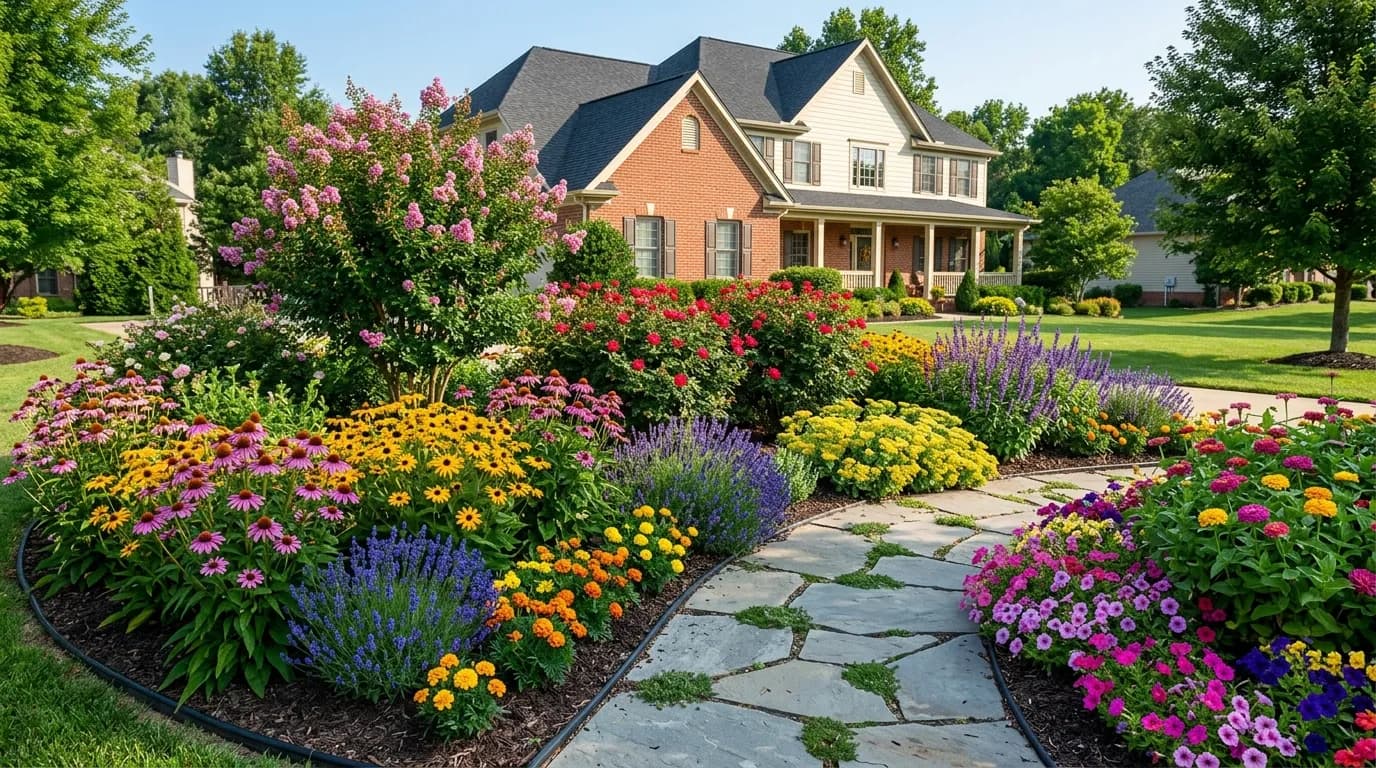
Full sun sounds like a gardener's dream — and it can be. But plant the wrong things in that blazing south-facing bed and you'll spend the summer watching stressed plants turn brown and bolt by July. Plant the right ones, and you'll have a landscape that looks better as temperatures rise, while your neighbors' shady gardens struggle to show color.
This guide covers 35 of the best plants for full sun — organized by type, with bloom times, water needs, USDA hardiness zones, and design pairing tips so you can build a cohesive, high-performance sun garden.
What counts as full sun? Six or more hours of direct sunlight per day. Most of these plants actually prefer 8+ hours and will perform better in heat as long as water is managed correctly.
Best Perennials for Full Sun
Perennials are the backbone of a sun garden — they come back every year, spread over time, and reduce long-term maintenance. Here are the top performers:
1. Black-Eyed Susan (Rudbeckia hirta)
Zones: 3–9 | Bloom: June–October | Height: 2–3 ft | Water: Low–medium
The workhorse of the American perennial garden. Golden-yellow daisy flowers with dark centers bloom for months without deadheading. Self-seeds freely, forming large naturalized drifts over time. Drought-tolerant once established — perfect for dry, hot spots where nothing else thrives.
2. Coneflower (Echinacea purpurea)
Zones: 3–9 | Bloom: June–August | Height: 2–4 ft | Water: Low–medium
Native prairie perennial with pink, white, orange, and yellow cultivars. Loved by pollinators throughout summer and by goldfinches in fall (leave seed heads for wildlife). Extremely heat and drought tolerant. Mix cultivars for a colorful, naturalistic meadow effect.
3. Salvia (Salvia nemorosa)
Zones: 4–8 | Bloom: May–September | Height: 18–36 in | Water: Low
One of the longest-blooming perennials for full sun. Upright spikes in purple, blue, pink, and white. Cut back after first flush for a second and sometimes third bloom. Deer-resistant and a magnet for hummingbirds and bees. Pairs beautifully with ornamental grasses and yellow daisies.
4. Catmint (Nepeta × faassenii)
Zones: 3–8 | Bloom: May–September | Height: 1–2 ft | Water: Low
Silvery-blue foliage with lavender-purple flowers — one of the most reliable edging perennials available. Shear in mid-summer for a fresh flush of blooms. Extremely drought-tolerant and deer-resistant. 'Walker's Low' is the most popular cultivar for its mounding habit and non-stop bloom.
5. Coreopsis (Coreopsis grandiflora)
Zones: 3–9 | Bloom: May–September | Height: 18–24 in | Water: Low
Bright yellow, daisy-like flowers that bloom all summer with minimal care. Drought-tolerant, deer-resistant, and attracts butterflies. 'Moonbeam' (pale yellow, fine-textured) and 'Zagreb' (compact, golden) are excellent cultivars. Great filler between larger perennials.
6. Russian Sage (Perovskia atriplicifolia)
Zones: 4–9 | Bloom: July–October | Height: 3–5 ft | Water: Low
Airy, silver-white stems and lavender-blue flowers that billow beautifully in the wind. One of the best late-summer performers for hot, dry sites. Exceptional with ornamental grasses and yellow-flowering plants. Deer-resistant and virtually indestructible once established.
7. Yarrow (Achillea millefolium)
Zones: 3–9 | Bloom: June–September | Height: 2–3 ft | Water: Low
Flat-topped flower clusters in white, yellow, red, and pink above feathery, aromatic foliage. One of the most drought-tolerant perennials available — thrives in poor, dry soil where more demanding plants fail. Spreads moderately; divide every 2–3 years to keep vigorous.
8. Daylily (Hemerocallis)
Zones: 3–9 | Bloom: May–August (varies by cultivar) | Height: 1–4 ft | Water: Low–medium
Thousands of cultivars in every color except true blue. Each flower lasts one day, but a well-established clump produces dozens of blooms over weeks. Repeat-blooming varieties like 'Stella de Oro' and 'Happy Returns' extend the season further. Extremely adaptable and nearly indestructible.
9. Blanket Flower (Gaillardia × grandiflora)
Zones: 3–9 | Bloom: June–frost | Height: 18–24 in | Water: Low
Bold, bicolor flowers in red, orange, and yellow — the colors of sunset. One of the longest-blooming perennials for hot, dry conditions. Prefers poor, well-drained soil; too much water or fertilizer actually reduces blooming. 'Arizona Sun' and 'Goblin' are compact, reliable cultivars.
10. Agastache (Agastache spp.)
Zones: 5–9 | Bloom: July–October | Height: 2–4 ft | Water: Low
Hummingbird magnet with spikes of tubular flowers in orange, pink, purple, and red. Licorice-scented foliage is deer-resistant. Thrives in hot, dry conditions and attracts enormous numbers of bees and butterflies. 'Blue Fortune' and 'Kudos Coral' are excellent performers in most regions.
Ready to Design Your Full-Sun Garden?
Knowing which plants to use is only half the battle — arranging them well is what separates a plant collection from a real landscape design.
[Get 3 AI-generated landscape designs for your sunny yard at Yardcast](/redesign). Upload your yard photos, tell us your sun exposure, climate zone, and style — and you'll have photorealistic designs showing exactly how your full-sun plants could look arranged in your actual space. Free to preview, takes 60 seconds.
Best Annuals for Full Sun
Annuals provide maximum color all season long — plant them to fill gaps between perennials in their first year or to add intense seasonal color to borders and containers.
11. Zinnia (Zinnia elegans)
Season: Summer–frost | Height: 12–36 in | Water: Low–medium
The easiest, most colorful annual you can grow from seed. Sow directly where you want them in late May — they germinate in 5–7 days and bloom non-stop until frost. Available in almost every color. Excellent for cutting, attracts butterflies, and self-seeds freely. 'Benary's Giant' and 'Cut & Come Again' are top picks.
12. Marigold (Tagetes spp.)
Season: Spring–frost | Height: 6–36 in | Water: Low–medium
Marigolds earn their "workhorse" reputation: deer- and rabbit-resistant, long-blooming, heat-tolerant, and useful as a pest deterrent in vegetable gardens. Deadhead to extend bloom. French marigolds (compact, 6–12 in) are best for borders; African marigolds (tall, 18–36 in) are best for bold masses of color.
13. Portulaca (Portulaca grandiflora)
Season: Summer | Height: 4–8 in | Water: Very low
The succulent annual for blistering hot, dry conditions where nothing else survives. Jewel-bright flowers in red, pink, orange, yellow, and white close at night and on cloudy days. Thrives in sandy, rocky soil. No fertilizer needed — excessive nutrients reduce flowering.
14. Lantana (Lantana camara)
Season: Summer–frost | Height: 1–4 ft | Water: Low
Clusters of tiny flowers that change color as they age, creating a multicolor effect on each cluster. Extraordinary heat tolerance — actually blooms more as temperatures rise. Attracts huge numbers of butterflies. Can be perennial in zones 8–11; grown as annual elsewhere.
15. Mexican Sunflower (Tithonia rotundifolia)
Season: Summer–frost | Height: 4–6 ft | Water: Low–medium
Bold, velvety orange flowers on statuesque plants that create a dramatic back-of-border display. Monarch butterflies are attracted from miles away. Heat and drought tolerant. Sow seeds directly after last frost; plants establish quickly in full sun and poor soil.
Best Shrubs for Full Sun
Shrubs provide permanent structure, year-round interest, and require far less maintenance than perennials or annuals once established.
16. Knockout Rose (Rosa 'Radrazz')
Zones: 5–9 | Bloom: May–frost | Height: 3–4 ft | Water: Low–medium
Revolutionized rose growing by being almost disease-free — no black spot, no fungicide sprays. Blooms continuously all season without deadheading. Available in red, pink, coral, yellow, and white. One of the best-selling plants in American garden history for good reason.
17. Butterfly Bush (Buddleja davidii)
Zones: 5–9 | Bloom: July–frost | Height: 4–8 ft | Water: Low
Massive panicles of fragrant flowers in purple, pink, white, and red that attract dozens of butterfly species simultaneously. Prune hard in early spring for best bloom. Note: invasive in some Pacific Northwest and mid-Atlantic states — check local regulations before planting. 'Lo & Behold' series are sterile, non-invasive dwarf cultivars.
18. Spirea (Spiraea spp.)
Zones: 3–8 | Bloom: May–July | Height: 2–8 ft | Water: Low–medium
Fast-growing, reliable flowering shrubs with cascading white or pink flowers in late spring. 'Goldflame' has colorful orange-red new growth that turns yellow then green. 'Anthony Waterer' is a dependable compact form with pink flowers and good fall color. Extremely adaptable to soil and climate conditions.
19. Blue Mist Shrub (Caryopteris × clandonensis)
Zones: 5–9 | Bloom: August–September | Height: 2–3 ft | Water: Low
Late-season blue flowers are rare in the shrub world — Blue Mist is one of the best. Compact, tidy habit with silver-green aromatic foliage. Blooms when most other shrubs have finished, bridging the gap between summer and fall. 'Dark Knight' has the deepest blue flowers.
20. Potentilla (Potentilla fruticosa)
Zones: 2–7 | Bloom: June–frost | Height: 2–4 ft | Water: Low
One of the most cold-hardy flowering shrubs available, and among the longest-blooming. Small, buttercup-like flowers in yellow, white, orange, or pink appear all season. Thrives in poor, dry soil. Perfect for northern gardens where many flowering shrubs struggle.
21. Smoke Bush (Cotinus coggygria)
Zones: 4–8 | Bloom: June–July (foliage interest year-round) | Height: 10–15 ft | Water: Low
Grown primarily for its extraordinary foliage — purple, burgundy, or chartreuse depending on cultivar — and the wispy, smoke-like seed heads in summer. 'Royal Purple' (deep burgundy) and 'Golden Spirit' (chartreuse) are striking focal points. Prune hard for colorful new growth; leave unpruned for the smoke-effect bloom.
Full Sun Garden Design: 5 Principles That Work
1. Layer by Height
Place tall plants (4+ ft) at the back or center, medium (2–4 ft) in the middle, and low (under 2 ft) at the front edge. This ensures every plant is visible and creates a lush, full look even when some plants are between bloom cycles.
2. Repeat Colors for Cohesion
Rather than one of every plant, buy 3–5 of each and repeat the same colors throughout the border. A drift of purple salvia at the front left, middle, and back right creates visual flow and makes the planting look designed rather than collected.
3. Mix Bloom Times
No garden looks good if everything blooms in June and nothing blooms in August. Combine early bloomers (peonies, iris) with mid-season (coneflower, rudbeckia) and late-season (agastache, asters, ornamental grasses) for interest from May through November.
4. Include Foliage Interest
Plants don't have to be in bloom to look good. Silver foliage (catmint, Russian sage), burgundy (smoke bush, 'Royal Purple' heuchera), and chartreuse (gold-leafed spirea) provide color and interest all season, not just during their bloom window.
5. Group in Odd Numbers
Groups of 3, 5, or 7 plants look more natural than pairs or evenly-spaced rows. Triangular groupings of the same plant placed at irregular intervals throughout a border create rhythm and cohesion.
Watering Full Sun Plants: What You Actually Need to Know
Most full sun perennials are drought-tolerant once established — but that establishment period (the first growing season after planting) is critical. Water new transplants deeply every 2–3 days for the first 4–6 weeks. After that, most of the plants on this list need watering only during extended dry spells (2+ weeks without rain).
| Plant Type | Water Needs | Notes |
|---|---|---|
| Native perennials (coneflower, rudbeckia, agastache) | Very low once established | Established plants often survive on rainfall alone |
| Ornamental grasses | Low | Water every 2 weeks in first season; rainfall sufficient after |
| Flowering shrubs (spirea, potentilla) | Low–medium | Weekly watering in summer heat for first 2 seasons |
| Annuals (zinnia, marigold) | Medium | 1 inch per week; mulch heavily to retain soil moisture |
| Roses (Knockout type) | Low–medium | Weekly deep watering; avoid wetting foliage |
Mulch is your best investment for a sun garden. A 3-inch layer of shredded wood mulch around all plantings reduces watering frequency by 50%, keeps soil temperatures 10–15°F cooler, and suppresses weeds. Reapply annually in spring.
Top 10 Companion Planting Combinations for Full Sun
The best-looking sun gardens use plants that enhance each other:
- 1Purple salvia + yellow coreopsis — Cool-warm color contrast, blooms together all summer
- 2Russian sage + ornamental grasses — Airy texture contrast, both extremely drought-tolerant
- 3Knockout roses + catmint — Classic cottage pairing; catmint softens the rose's stiff habit
- 4Black-eyed Susan + coneflower — Native prairie combination; self-seeds to create naturalistic drifts
- 5Lantana + portulaca — Ultimate heat and drought duo for hot, exposed beds
- 6Agastache + butterfly bush — Hummingbird and butterfly magnet; long-blooming late summer to frost
- 7Smoke bush + ornamental grasses — Bold foliage contrast; year-round structure
- 8Spirea + blanket flower — Spring structure + summer-long color at the front of the border
- 9Yarrow + Russian sage — Drought-tolerant companions with contrasting flower form
- 10Zinnia + Mexican sunflower — Maximum summer color from easiest-to-grow annuals
Wondering how these plants would actually look in your yard? [Try Yardcast's free AI landscape designer](/redesign) — upload your yard photos and get 3 photorealistic designs showing exactly how sun-loving plants could be arranged in your specific space. It takes 60 seconds and it's free to preview.