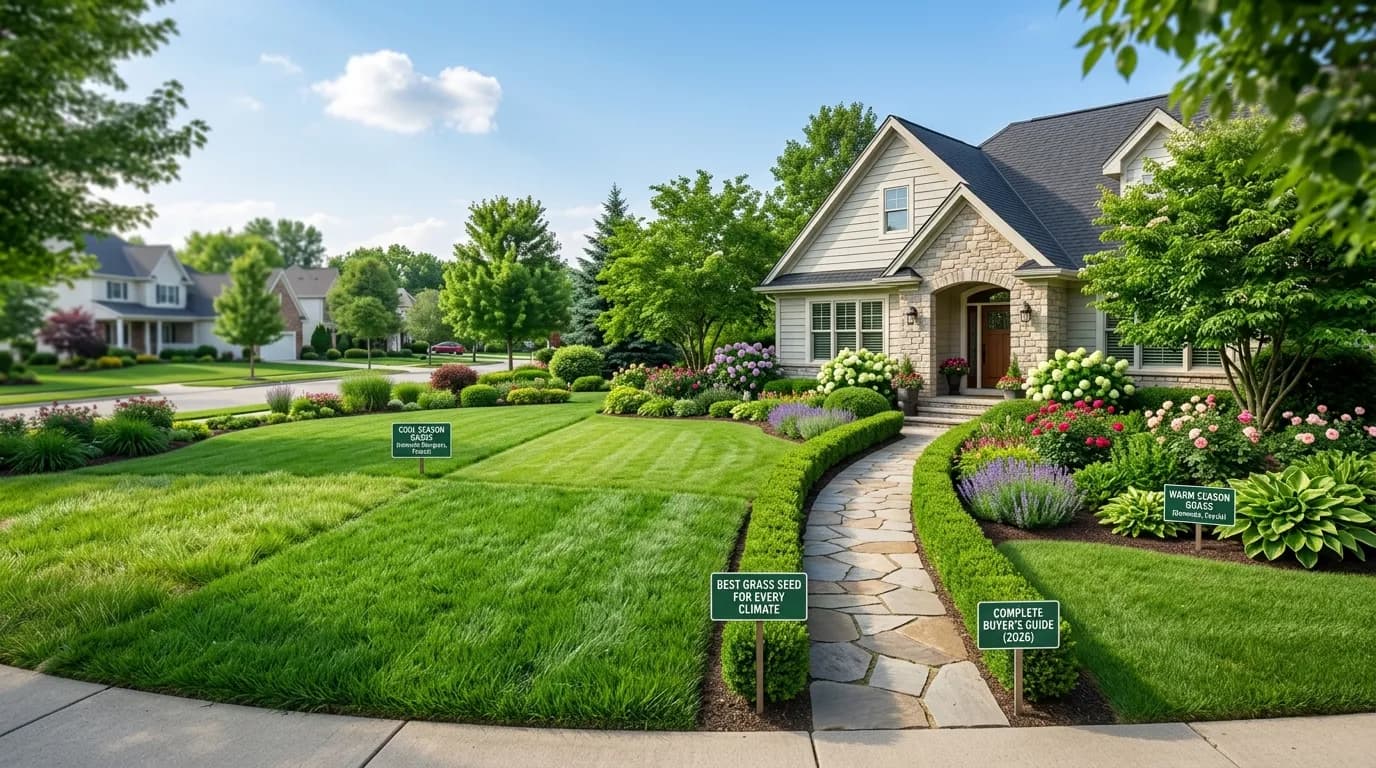
Choosing the wrong grass seed is one of the most common — and most expensive — lawn mistakes homeowners make. Buy a cool-season mix for Georgia and it'll die by July. Buy a shade mix for a full-sun yard and you'll have a patchy disaster by midsummer. This guide eliminates the guesswork.
We'll cover every major grass type, ranked by real-world performance in each climate zone, plus the best specific products for shade, full sun, high traffic, drought, and fast germination.
Cool-Season vs. Warm-Season Grass: What's the Difference?
The single most important factor in choosing grass seed is whether you live in a cool-season or warm-season climate — not brand, not price.
Cool-season grasses thrive in Zones 3–7 (most of the Northeast, Midwest, Pacific Northwest, and Mountain West). They grow most aggressively in spring and fall, go partially dormant in summer heat, and stay green through frost. Key species: tall fescue, Kentucky bluegrass, perennial ryegrass, fine fescue.
Warm-season grasses thrive in Zones 7–11 (the South, Gulf Coast, California, Arizona, Florida). They peak in summer heat, brown and go dormant in winter, and green up again in spring. Key species: Bermuda, Zoysia, St. Augustine, Centipede, Bahia.
The transition zone (Zone 6–7: Virginia, Tennessee, Kansas, Colorado foothills) is the hardest to seed — too hot for cool-season grasses in summer, too cold for warm-season grasses in winter. Tall fescue and Zoysia are the two best performers in this zone.
Best Grass Seed for Cool-Season Climates (Zones 3–7)
| Grass Type | Best For | Germination | Shade Tolerance | Traffic Tolerance |
|---|---|---|---|---|
| Tall Fescue | Most homeowners | 7–12 days | Medium-High | High |
| Kentucky Bluegrass | Premium lawns | 14–21 days | Low | Very High |
| Perennial Ryegrass | Quick cover, overseeding | 7–10 days | Medium | High |
| Fine Fescue | Shade, low maintenance | 7–12 days | Very High | Low-Medium |
Tall Fescue is the workhorse of cool-season lawns. Modern turf-type tall fescue cultivars (TTTF) are nothing like the coarse, clumpy tall fescue of 20 years ago — today's varieties are fine-textured, drought-tolerant, and shade-adaptable. It's the default recommendation for most homeowners in Zones 4–7.
Top-rated cultivars: Titan RX, Rebel IV, Crossfire II, Dynasty.
Kentucky Bluegrass produces a dense, self-repairing lawn that's the standard for premium Northern lawns. The trade-off: slow germination (2–3 weeks), poor shade tolerance, and moderate drought susceptibility. Most bags labeled "Kentucky Bluegrass" are actually blends of 3–5 cultivars for improved disease resistance.
Top-rated cultivars: Midnight, Avalanche, Moonshine.
Perennial Ryegrass is the fastest-germinating permanent grass — visible in 7 days, mow-ready in 21–28 days. It's often mixed with bluegrass (for rapid establishment) or used alone for overseeding thin lawns. Weak point: poor drought and heat tolerance past Zone 6.
Fine Fescue (creeping red, chewings, hard, sheep fescue) is the champion of shade. Under trees where no other grass survives, fine fescue keeps growing. Bonus: extremely low nitrogen needs — it stays green without heavy feeding.
Best Cool-Season Grass Seed Blends
For most cool-season homeowners, a TTTF blend + 10–20% perennial ryegrass is the ideal all-purpose mix. The ryegrass germinates fast and holds the soil while fescue establishes, then fescue takes over long-term.
For shady lawns (under 4 hours direct sun): go with a fine fescue blend — 70% creeping red + 30% hard fescue is the proven formula.
Ready to see how your new lawn will look before you seed a single square foot?
Get a free AI landscape preview for your yard →
Best Grass Seed for Warm-Season Climates (Zones 7–11)
| Grass Type | Best For | Germination | Shade Tolerance | Drought Tolerance |
|---|---|---|---|---|
| Bermuda | Sun, high traffic, heat | 10–21 days | Very Low | Very High |
| Zoysia | Moderate traffic, transition zone | 14–21 days | Medium | High |
| Centipede | Low maintenance, Southeast | 14–21 days | Low-Medium | Medium |
| Bahia | Roadsides, rough areas, Florida | 14–21 days | Low | High |
| Buffalograss | Great Plains, drought | 14–30 days | Very Low | Very High |
Bermuda grass is the dominant warm-season grass for a reason: it's the most heat-tolerant, the most traffic-tolerant, and recovers from damage faster than almost any other turf. A Bermuda lawn in Atlanta can take a garden party every weekend. Downside: it needs full sun (6+ hours minimum), goes brown in winter below Zone 9, and spreads aggressively into flower beds.
Common seeded varieties: Sahara, Princess 77, Blackjack.
Zoysia is the premium choice for homeowners who want a thick, carpet-like lawn with moderate shade tolerance. It's slower to establish than Bermuda but denser once established, requires less mowing, and handles the transition zone better than any other warm-season grass.
Popular seeded varieties: Zenith, Compadre.
Centipede grass is the "lazy lawn" grass of the Southeast — low nitrogen needs, slow growth (less mowing), and solid pest resistance. It's lighter green than other grasses and can look yellow if over-fertilized (iron deficiency is common). Perfect for low-maintenance homeowners in Zones 7–9.
Bahia grass is rugged, cheap, and nearly indestructible — but coarse, with visible seed heads that pop up constantly. Best for rough areas, slopes, and utility spaces where appearance is secondary to coverage.
Best Grass Seed by Specific Need
Best Grass Seed for Shade
- 1Fine fescue blend (cool-season) — tolerates 3–4 hours dappled sun
- 2St. Augustine (warm-season, vegetative — not seeded) — best shade-tolerant warm-season option
- 3Tall fescue (cool-season) — tolerates 4–5 hours sun
- 4Centipede (warm-season) — more shade-tolerant than Bermuda or Zoysia
Best Grass Seed for Full Sun
- 1Bermuda (warm-season) — thrives in blazing heat
- 2Kentucky bluegrass (cool-season) — classic premium sunny lawn
- 3Buffalograss (warm-season, Great Plains) — native prairie grass, incredible drought + full sun
- 4Tall fescue blend (cool-season) — excellent sunny performance with less irrigation than bluegrass
Best Grass Seed for High Traffic
- 1Bermuda — fastest recovery from damage
- 2Perennial ryegrass — hardest cool-season grass
- 3Tall fescue — deep roots resist compaction
- 4Zoysia — slow to recover but incredibly dense when undamaged
Best Grass Seed for Drought
- 1Bermuda — can go semi-dormant and bounce back
- 2Buffalograss — designed for the arid Great Plains
- 3Zoysia — excellent drought dormancy
- 4Tall fescue — deepest roots of any cool-season grass (4–6 feet), accesses subsurface moisture
Best Grass Seed for Fast Results
- 1Annual ryegrass — germinates in 5–7 days (not permanent, but fastest green)
- 2Perennial ryegrass — 7–10 days, permanent
- 3Tall fescue — 7–12 days
- 4Bermuda — 10–14 days (warm soil required)
How to Seed or Overseed a Lawn: Step-by-Step
Getting the right seed is half the battle. Application determines whether you get 90% germination or 40%.
Step 1: Test your soil. Most grass seed struggles because pH is off. Target pH 6.0–7.0 for most grasses. A $15 soil test from your county extension office is worth it.
Step 2: Prepare the seedbed. For new areas: till 4–6 inches, remove debris, grade to slope away from the house. For overseeding: mow existing grass short (1–1.5 inches), dethatch if thatch exceeds ½ inch, core aerate for best results.
Step 3: Spread seed. Use a calibrated spreader — hand-spreading creates uneven coverage. Make two passes at half the rate in perpendicular directions.
Step 4: Establish seed-to-soil contact. Rake lightly or use a lawn roller to press seed into the soil surface. This is the most important step for germination rates.
Step 5: Fertilize at seeding. Use a starter fertilizer (high phosphorus, e.g., 18-24-12) at seeding time. Regular lawn fertilizers are too high in nitrogen for seedlings.
Step 6: Water consistently. New seed must stay moist until germination. Water 2–3 times daily (10 minutes each) for the first 2–3 weeks. Once established, water deeply (1 inch) once or twice per week.
Grass Seed Cost Guide
| Grass Type | Price per 5 lb bag | Covers (new seed) | Cost per 1,000 sq ft |
|---|---|---|---|
| Tall fescue blend | $25–$45 | 700–1,000 sq ft | $25–$40 |
| Kentucky bluegrass | $30–$55 | 1,500–2,500 sq ft | $15–$25 |
| Perennial ryegrass | $20–$35 | 700–1,000 sq ft | $20–$35 |
| Fine fescue blend | $20–$35 | 800–1,200 sq ft | $20–$30 |
| Bermuda (hulled) | $20–$40 | 2,500–5,000 sq ft | $8–$20 |
| Zoysia | $35–$65 | 2,000–4,000 sq ft | $15–$25 |
Pro tip: "Coated" or "prill-coated" seed has a clay coating that holds moisture and improves germination in dry conditions. Worth the 10–15% price premium if you're seeding in late summer or if you have sandy soil.
Grass Seed Mistakes to Avoid
Buying based on price alone. Cheap seed bags are often loaded with filler species and low germination rates. Check the seed tag (required by law): look for varieties with 85%+ germination rate, under 0.5% weed seed content, and under 2% other crop seed.
Ignoring soil temperature. Air temperature doesn't matter — soil temperature does. Cool-season grass needs soil above 50°F to germinate; warm-season grass needs above 65°F. Buy a cheap soil thermometer; don't guess.
Skipping starter fertilizer. Seeding without phosphorus is leaving germination on the table. Phosphorus drives root development in seedlings.
Seeding too heavily. More seed does not mean better germination. Overcrowded seedlings compete for light and nutrients. Follow the bag rate.
Letting the seed dry out. This kills germination progress instantly. If you seed and it doesn't rain, you must water multiple times daily until the seedlings are 1 inch tall.
Design Your New Lawn Before You Seed
Choosing the right grass seed is one piece of the puzzle. A complete landscape plan tells you exactly where to seed, where to install hardscaping, where to add planting beds, and how the whole yard flows together — before you spend a dollar on materials.
Preview your AI landscape design for free →
Upload your yard photos and get 3 photorealistic designs with a complete planting plan — including lawn areas, plant lists, and a phased cost estimate. It takes 60 seconds and you only pay $29 if you love what you see.
Frequently Asked Questions
What is the best grass seed overall?
For most homeowners in Zones 4–7: a quality turf-type tall fescue blend. It handles sun, partial shade, moderate traffic, and drought better than any single-species option, and it germinates fast enough to establish before winter.
Is expensive grass seed worth it?
Premium grass seed ($40–$70 per bag) typically contains elite cultivars with better disease resistance, finer texture, and improved drought tolerance. For a 2,000 sq ft lawn, the difference between cheap and premium seed is $30–$60 total — absolutely worth it for a lawn you'll maintain for 10+ years.
Can I mix grass seed types?
Yes — many professional mixes combine grass types deliberately. Cool-season: tall fescue + perennial ryegrass (fast establishment + long-term durability) is a proven combination. Don't mix cool-season and warm-season grasses — they have completely incompatible seasonal cycles.