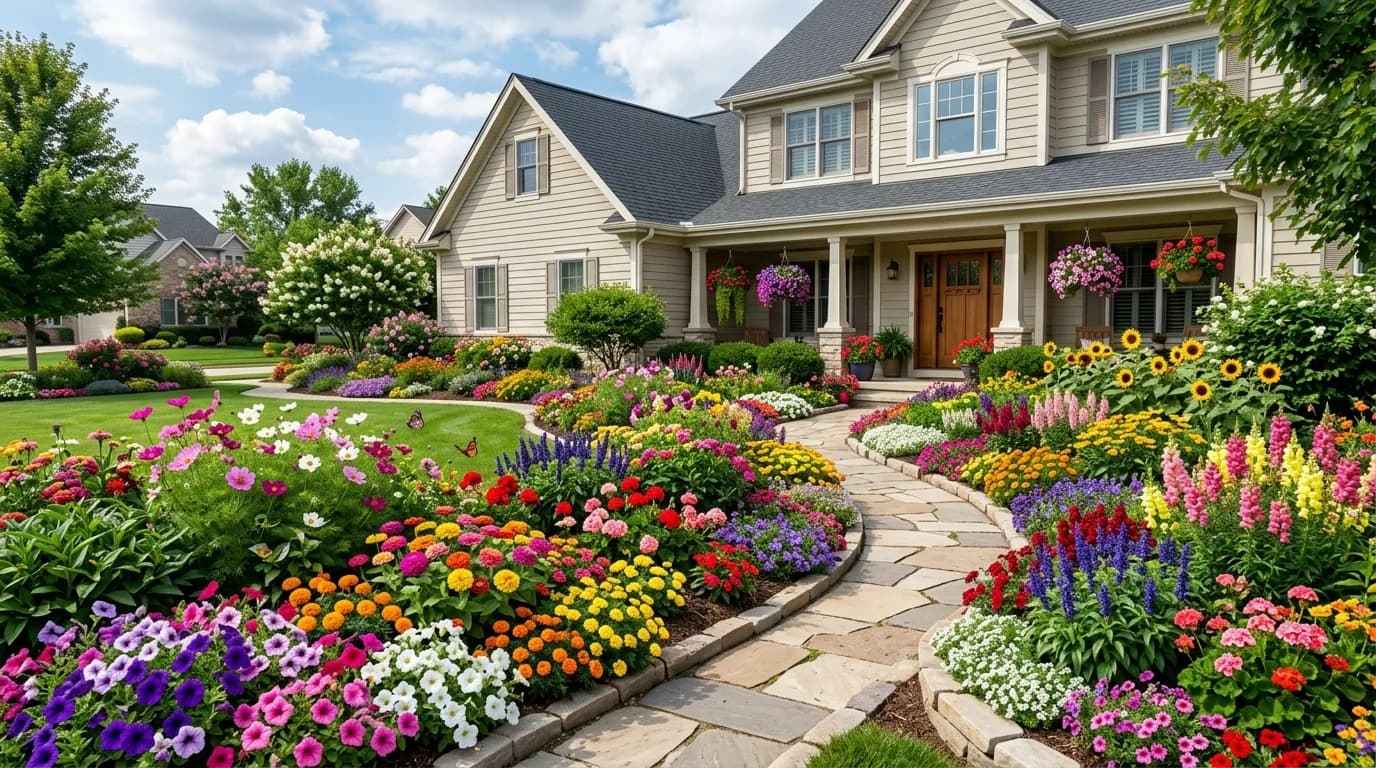
Annual flowers are the secret weapon of every great garden. Unlike perennials that take a few seasons to hit their stride, annuals bloom all-out from planting to frost — and in one growing season they can completely transform a dull yard into something that stops traffic. The catch? You need to pick the right varieties for your conditions. The wrong annual in the wrong spot will sulk, stretch, or fry by July.
This guide covers 30 of the best annual flowers, organized by sun exposure, heat tolerance, and what they do best. Every one of these will thrive when planted in the right conditions — and every one links naturally to the kind of layered, designed landscape you'll find in a Yardcast AI design.
Why Annual Flowers Are Essential for Any Yard
Perennials build your garden's bones. Shrubs give it structure. But annuals are what makes it sing. They:
- Fill gaps while perennials establish in their first season
- Provide season-long color that most perennials can't match
- Let you change your garden's look every year
- Attract pollinators and beneficial insects
- Are often cheaper per plant than perennials (and nurseries offer them in bulk flats)
The key is matching the right annual to your specific conditions. Here's your complete guide.
Best Annual Flowers for Full Sun (6+ Hours)
1. Zinnia (Zinnia elegans)
The workhorse of the summer annual world. Zinnias bloom from June until hard frost without stopping — the more you cut them, the more they flower. Available in every color except blue: scarlet, orange, coral, pink, white, yellow, lime green, bi-colors. Heat-lovers that thrive even in the hottest summers.
Best varieties: Benary's Giant (for cutting), Profusion (compact, disease-resistant), State Fair (massive 5-inch blooms)
Height: 12–36 inches depending on variety | Zones: All | Water: Low-medium
2. Marigold (Tagetes spp.)
Perhaps the most reliable annual on this list. French marigolds (compact, 8–12 inches) and African marigolds (tall, 18–36 inches) both deliver non-stop golden, orange, and burgundy blooms. Pest-repelling properties make them ideal companions in vegetable gardens.
Best for: Borders, vegetable garden edges, mass color | Deer-resistant: Yes
3. Petunias (Petunia × hybrida)
Few annuals cascade as dramatically as wave petunias in a container or raised bed. Upright varieties work as bold border plants. Colors range from pure white to midnight black-purple, with stunning bi-colors and veined varieties.
Watch for: Needs deadheading on older varieties; wave types self-clean. Water consistently — drought stress causes bloom drop.
4. Lantana (Lantana camara)
Unbeatable for heat, drought, and butterfly attraction. Lantana blooms relentlessly in the hottest summers when other annuals flag. Multi-color flower clusters open yellow and age to orange, pink, and red on the same head.
Note: Perennial in Zones 9–11, annual elsewhere. Toxic to pets if ingested.
5. Vinca / Catharanthus (Catharanthus roseus)
The heat-and-humidity champion. Vinca outperforms most annuals in the hot, humid summers of the South. Self-cleaning blooms mean no deadheading. Excellent in beds, borders, and containers.
Best colors: Brilliant white, hot pink, coral, deep red, pale lavender
6. Cosmos (Cosmos bipinnatus)
Feathery, airy cosmos bring a wildflower quality to formal beds. Incredibly easy from seed direct-sown into beds. Pink, crimson, white, and bi-color blooms on tall stems are excellent for cutting and pollinators.
7. Portulaca (Moss Rose)
Built for the hottest, driest spots in your yard. Portulaca shrugs off heat that wilts everything else, producing jewel-colored flowers in the morning light (they close at noon — plan accordingly). Perfect for dry slopes, rock gardens, and spots between pavers.
8. Cleome (Spider Flower)
Tall (3–5 feet), dramatic, and unforgettable. Cleome's spiky pink, white, and purple flowers tower above other annuals and self-seeds prolifically. A single plant can produce a dozen seedlings for next year.
Best Annual Flowers for Part Shade (3–6 Hours Sun)
9. Impatiens (Impatiens walleriana)
The classic shade annual for good reason — impatiens produces non-stop color in dappled or moderate shade where most annuals fail. Avoid areas with impatiens downy mildew pressure; opt for SunPatiens® in those regions (see #10).
10. SunPatiens® (Impatiens × hybrida)
A game-changer — impatiens that tolerate full sun as well as shade, and are completely resistant to downy mildew. Vigorous growers that fill a space quickly with 4-inch blooms in white, orange, pink, and magenta.
11. Begonia (Begonia semperflorens and Begonia × tuberhybrida)
Fibrous begonias are virtually indestructible in partial shade — non-stop blooms, minimal maintenance, and remarkably drought-tolerant for a shade plant. Tuberous begonias offer enormous, rose-like blooms in the same conditions.
12. Coleus (Plectranthus scutellarioides)
Technically grown for foliage, not flowers, but coleus delivers more visual impact than most flowering annuals. Modern varieties range from chartreuse to near-black, with electric bi-colors and patterns. Some varieties now tolerate full sun.
Why it matters: Coleus lets you create color and pattern in deep shade where nothing else blooms.
13. Torenia (Wishbone Flower)
Underused and underrated. Torenia blooms in deep shade where most annuals give up, with two-toned tubular flowers that mimic miniature snapdragons. Heat-tolerant and self-cleaning.
Best Annual Flowers for Cottage and Cutting Gardens
14. Snapdragon (Antirrhinum majus)
Cool-season champions that peak in spring and fall. Snapdragons are beloved for their tall spikes of two-lipped flowers in virtually every color, their sweet fragrance, and their excellence as cut flowers. Plant in early spring (or fall in warm climates) for best performance.
15. Lisianthus (Eustoma grandiflorum)
Often mistaken for roses in floral arrangements, lisianthus produces multi-layered blooms in lavender, deep purple, pink, white, and cream. Slow to start but spectacular from July through frost. Plant seedlings — growing from seed requires 5+ months.
16. Statice (Limonium sinuatum)
The best dried flower from an annual garden. Statice produces papery, everlasting blooms in purple, blue, pink, yellow, and white that dry on the plant and hold their color for months. Plant in full sun with excellent drainage.
17. Sweet Alyssum (Lobularia maritima)
A low-growing carpet of tiny fragrant flowers, sweet alyssum is invaluable as a filler at the front of borders, spilling from containers, or threading between stepping stones. White is the most fragrant; purple and pink varieties add color.
18. Bachelor's Button / Cornflower (Centaurea cyanus)
Electric cornflower blue is rare in annuals — bachelor's button delivers it without compromise. Easy from seed, attractive to pollinators, excellent as a cut flower. Also available in pink, white, and burgundy.
Best Annual Flowers for Containers and Hanging Baskets
19. Calibrachoa (Million Bells)
Miniature petunia-shaped flowers in extraordinary profusion, excellent for hanging baskets and container edges. Self-cleaning and heat-tolerant. Pairs beautifully with trailing verbena and upright salvias.
20. Bacopa (Sutera cordata)
A delicate cascading trailer covered in tiny white or pink flowers, bacopa adds soft texture to any mixed container. Prefers consistent moisture and cool conditions — best in spring, fall, and mild summers.
21. Lobelia (Lobelia erinus)
Intensely blue trailing lobelia is incomparable in mixed baskets when you need that specific electric blue. Also available in white and purple. Cool-season plant that tends to decline in heat — shear back in midsummer for fall rebloom.
22. Scaevola (Fan Flower)
Excellent heat tolerance makes scaevola a better choice than lobelia for hot climates. The distinctive fan-shaped blue or pink flowers trail beautifully from hanging baskets and containers.
Best Annual Flowers for Wildlife and Pollinators
23. Sunflower (Helianthus annuus)
Every landscape should have at least a few sunflowers. Beyond their iconic visual impact, they're one of the top plants for attracting bees, goldfinches, and other seed-eating birds. Modern varieties range from 18-inch multi-branching dwarf types to 10-foot giants.
24. Borage (Borago officinalis)
Under-planted and over-effective. Borage's electric blue star flowers attract bumblebees more consistently than almost any other annual. Edible flowers, excellent companion plant for tomatoes. Self-seeds prolifically.
25. Phacelia (Phacelia tanacetifolia)
The underdog pollinator plant. Phacelia is documented to attract more bee species than almost any other annual. Lavender-purple coiled flower clusters and ferny foliage make it attractive in naturalistic plantings.
26. Tithonia (Mexican Sunflower)
Tall (4–5 feet), heat-loving, and covered in vivid orange-red sunflower-like blooms from July through frost. Absolute magnet for monarch butterflies and swallowtails. Direct-sow after last frost in full sun.
Best Cool-Season Annual Flowers (Spring & Fall)
27. Pansy (Viola × wittrockiana)
The quintessential cool-season annual. Pansies tolerate light frost, produce a staggering range of colors and face patterns, and thrive when temperatures stay between 40–65°F. Plant in fall for winter and early spring color (zones 7+) or in early spring everywhere.
28. Dianthus (Annual Pink)
Sweet-scented dianthus produces profuse flowers in red, pink, white, and bi-colors from early spring through early summer. Heat eventually shuts them down — treat as a cool-season annual and replace with heat-tolerant varieties in midsummer.
29. Nigella (Love-in-a-Mist)
A cottage garden classic that must be direct-sown in early spring (or fall in mild climates). Feathery foliage surrounds sky-blue, white, or pink blooms, which are followed by ornamental seed pods. Self-seeds freely for a naturalized look.
30. Larkspur (Consolida ajacis)
Tall spikes of delicate blue, purple, pink, and white flowers that are outstanding as cut flowers and in cottage garden borders. Direct-sow in fall (zones 7+) or very early spring — larkspur blooms before summer heat arrives.
How to Plan Your Annual Flower Garden
The best annual gardens layer plants by height: tall specimens (sunflowers, cleome, tithonia) at the back or center, medium-height bloomers (zinnias, marigolds, cosmos) in the middle, and low mounding or trailing varieties (alyssum, portulaca, calibrachoa) at the edges.
Color repetition creates rhythm — plant the same three or four varieties in multiple spots through a bed rather than using every variety once.
Pair with perennials: Annual flowers are most impactful when planted with a backbone of perennials and shrubs. The annuals fill the gaps and provide the color fireworks; the perennials provide the structure that makes the design look intentional.
🌿 See How These Flowers Would Look in Your Yard
An AI landscape design will show you exactly how annual flower beds, borders, and containers would look in your actual outdoor space — with a full plant list, quantities, and cost estimate. No generic stock images — your yard, transformed, in 40 seconds.
Frequently Asked Questions About Annual Flowers
What are the easiest annual flowers for beginners?
Marigolds, zinnias, and sunflowers are the most beginner-friendly annual flowers — they're nearly impossible to fail with, grow fast from seed, and produce months of flowers without deadheading (though deadheading increases production). All three thrive in average soil with moderate water and full sun.
What annual flowers bloom all summer?
Zinnias, marigolds, vinca, lantana, portulaca, SunPatiens, begonias, and calibrachoa are all reliable all-summer bloomers in most climates. The key is adequate sun (most need 6+ hours), consistent watering during establishment, and removing spent flowers to keep production high.
What annual flowers do well in heat and humidity?
Vinca (catharanthus), lantana, zinnia, marigold, portulaca, and SunPatiens® are the top performers in hot, humid conditions. They're especially reliable in the Southeast and Gulf Coast states where high humidity causes many other annuals to develop fungal problems.
Can I grow annual flowers in containers?
All the annuals on this list grow well in containers. Use a quality potting mix (not garden soil), choose a pot large enough for the root system, and water more frequently than in-ground plants — containers dry out 2–3x faster. Calibrachoa, bacopa, trailing verbena, scaevola, and sweet alyssum are particularly excellent for container edges and hanging baskets.
How late can I plant annual flowers?
Most warm-season annuals need at least 10–12 weeks from planting to frost to deliver a satisfying season of color. In most US climates, the last practical planting date for warm-season annuals is mid-July. Cool-season annuals (pansies, snapdragons, dianthus) can be planted in late summer for fall and winter color.
Do annual flowers need fertilizer?
Annual flowers benefit significantly from fertilizer because they're putting enormous energy into continuous flowering. A slow-release granular fertilizer worked into the soil at planting, followed by a liquid fertilizer every 2–3 weeks through the season, will produce dramatically more flowers than unfertilized plants. Container annuals particularly need regular feeding since nutrients leach out with watering.
What annual flowers attract butterflies and hummingbirds?
Top butterfly annuals: lantana, zinnia, tithonia, borage, phacelia, and verbena. For hummingbirds: salvia (especially red varieties), impatiens, nicotiana, fuchsia, and petunias. Including at least 3–4 pollinator-friendly annuals in every planting makes the garden feel alive and active.