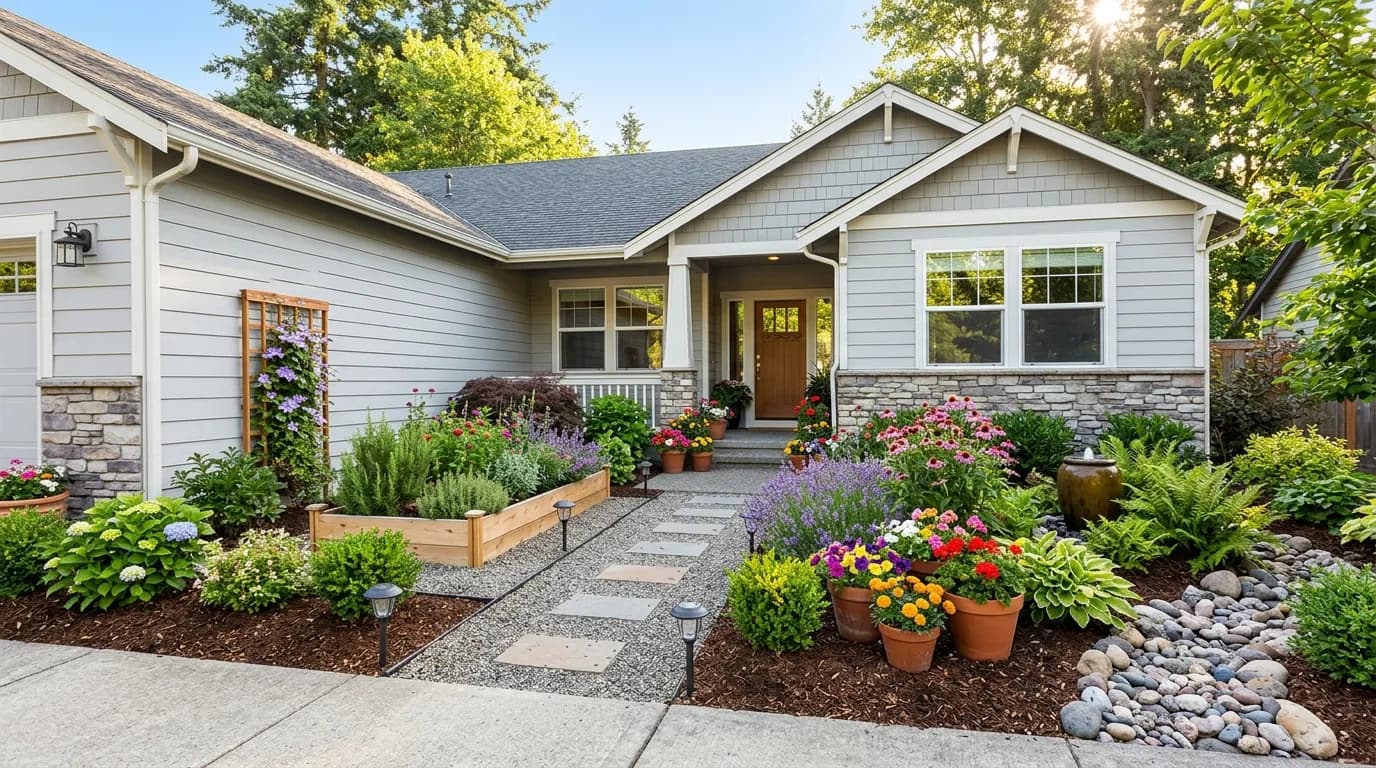
You don't need years of experience or a landscape architecture degree to have a yard that turns heads. The truth is, most great landscaping comes down to a handful of proven ideas executed consistently. If you're new to landscaping, this guide gives you 25 concrete starting points — each one simple enough to do your first weekend.
Before you dig anything, the smartest move is visualizing the end result. See what your yard could look like with an AI design →
Start With the Basics (Ideas 1–5)
1. Define Your Lawn Edges
Crisp edges between lawn and garden beds are the single fastest way to make your yard look professionally maintained. Rent a bed edger for $35/day, cut a clean 3-inch trench along all bed borders, and watch your yard transform in an afternoon. Clean lines signal "this person cares," which makes everything else look better by association.
2. Add a 3-Inch Mulch Layer
Fresh mulch does more work than any other $50 you'll spend on landscaping. It suppresses weeds, retains moisture (reducing watering by 30–50%), regulates soil temperature, and makes beds look polished. Use brown or black hardwood mulch for a classic look; cedar for natural pest resistance.
3. Plant a Trio of Evergreen Shrubs at Your Entrance
Three identical shrubs flanking your front door create instant symmetry and year-round structure. Boxwood, Emerald Green Arborvitae, and Sky Pencil Holly are all beginner-proof. Buy them in 1-gallon pots, plant them 2 feet from the house and from each other, and water weekly for the first month.
4. Install Solar Path Lights
Landscape lighting sounds expensive and complicated — until you discover solar path lights. No wiring, no electrician. Stake them along your walkway and they charge themselves all day and light up automatically at night. A set of 8 costs $30–$50 and takes 20 minutes to install. The visual impact is disproportionate.
5. Power Wash Everything
Before spending a dollar on plants, rent a pressure washer ($50/day) and blast your driveway, sidewalks, and house exterior. Removing years of grime reveals the natural color and texture underneath. This single step can make an average yard look exceptional — for almost no money.
Planting Ideas That Actually Work (Ideas 6–12)
6. Build a Simple Raised Bed
Raised beds are beginner landscaping on easy mode. They give you perfect soil (you control it), great drainage, and a clean, defined look. Build a 4x8 foot bed from cedar 2x6 lumber — it takes about 2 hours and costs $60–$80 in materials. Fill it with a mix of topsoil, compost, and perlite. Plant perennial herbs or ornamental grasses for low-maintenance beauty.
7. Create a Pollinator Island
Take a neglected corner of your yard and turn it into a pollinator garden. Plant native wildflowers like coneflowers, black-eyed Susans, and milkweed. These plants are near-impossible to kill, bloom reliably, attract butterflies and bees, and require zero irrigation after their first season. A 4x6 foot pollinator patch costs about $40 in plants and transforms an eyesore into a conversation piece.
8. Use the Rule of Three for Planting
Beginners often plant in pairs or long, even rows — which looks unnatural. Instead, always plant in odd numbers: 3, 5, or 7 of the same plant grouped together. This mirrors how plants grow in nature and looks far more professional. Three knockout roses, five ornamental grasses, seven perennial salvia — all of these create visual rhythm that even professional landscapers rely on.
9. Add a Dwarf Tree as a Focal Point
Every great landscape has at least one "wow" plant — something that draws the eye and anchors the whole design. Dwarf trees are perfect for this: they have visual impact without eventually taking over. Good options for beginners include Dwarf Japanese Maple (gorgeous red foliage, $40–$80), Serviceberry (spring flowers + fall berries), and Dwarf Mugo Pine (evergreen, sculptural, virtually indestructible).
10. Plant Groundcover Under Trees
The area under trees is the #1 problem zone in most yards — nothing grows well there because of root competition and shade. The fix: plant groundcover plants that thrive in exactly those conditions. Pachysandra, Vinca minor, and Liriope all work. They'll fill in over 2–3 seasons and eliminate the need to mow or weed that area forever.
11. Try a "Carpet" of Creeping Thyme
Creeping thyme is the ultimate beginner's secret weapon. It grows only 2–3 inches tall, spreads to fill gaps, produces tiny purple flowers in summer, releases a pleasant fragrance when walked on, and requires almost no maintenance. Use it between stepping stones, as a lawn alternative in small areas, or to fill bare spots along edges.
12. Build a Simple Rock Garden
Rock gardens look like they require expertise — they don't. The formula is simple: arrange 3–5 large boulders at natural-looking angles (don't line them up), fill gaps with small stones or gravel, and plant drought-tolerant succulents or ornamental grasses between them. Total cost: $100–$200 including plants. Total skill required: almost none.
Design Tricks That Make Everything Look Better (Ideas 13–18)
13. Create a Simple Focal Point
Pick one spot in your yard — usually visible from the street or from inside looking out — and make it remarkable. This could be a birdbath, a large urn with a dramatic plant, a boulder, or a small water feature. Everything else in the landscape should feel like it "frames" this point. Yards without focal points look cluttered or empty; yards with a clear focal point look designed.
14. Use Color Echoing
Choose 2–3 colors and repeat them throughout the yard. If your house trim is white, add white flowers near the entrance. If you have one orange flower, add another orange element somewhere else. This technique — used by professional designers — creates visual harmony and makes your yard feel intentional rather than random.
Want to see your color scheme before you plant? Generate a free AI design of your yard →
15. Design a Simple Flagstone Path
A flagstone path through your lawn creates structure, reduces foot traffic on grass, and adds visual interest. Buy irregular flagstones at your local nursery or home center ($1–$3 each), lay them out in a natural curve (not a straight line), dig each stone in 2 inches, and fill gaps with pea gravel or creeping thyme. This project takes one Saturday and costs $80–$150.
16. Add a Seating Area (Even a Small One)
A pair of Adirondack chairs and a small fire pit can transform an unused corner of your yard into a destination. You don't need a full deck — even a 8x8 foot gravel patio creates a defined "room" that makes your outdoor space feel intentional. Outline the area with landscape edging, fill with gravel or decomposed granite, add two chairs and a side table, and you have an outdoor living space for under $300.
17. Layer Plants by Height
The most common beginner mistake is planting everything at the same height, creating a flat, boring profile. Professional landscapers always use three layers: tall plants (4+ feet) in the back, medium plants (2–4 feet) in the middle, and low plants (under 2 feet) in front. This layering creates depth, visual interest, and ensures every plant is visible.
18. Frame Your Views — Block the Bad Ones
Look out your windows. What do you see? If the answer is a fence, a utility box, or a neighbor's garage, that's where to plant. A row of fast-growing arborvitae, ornamental grasses, or bamboo can screen unwanted views within 2–3 seasons. Meanwhile, if you have a great view — a mountain, a pond, a nice tree — plant lower-growing plants in that sight line to frame and preserve it.
Low-Cost, High-Impact Upgrades (Ideas 19–25)
19. Paint Your Front Door a Bold Color
This isn't traditional "landscaping" but it's the fastest ROI project on this list. A bold front door color — deep red, navy blue, forest green, glossy black — makes your entire yard look more curated. A quart of exterior paint costs $15 and takes 45 minutes. Real estate studies show it adds $1,500–$6,000 in perceived home value.
20. Install Window Boxes
Window boxes filled with trailing plants and flowers frame your house's windows and add charm that takes years off the surrounding landscaping. Use a combination of "thrillers, fillers, and spillers" — one tall dramatic plant, compact blooms to fill out, and a trailing plant to cascade over the edge. Petunias, calibrachoa, sweet potato vine, and geraniums all work perfectly.
21. Add Container Plants to Your Driveway or Entry
Large containers are instant landscaping. A pair of 24-inch urns flanking your driveway or front door creates structure and formality. Fill them with ornamental grasses or dwarf conifers for a year-round look, or rotate seasonal flowers for color. Move them around to test layouts before committing to in-ground planting.
22. Replace One Section of Lawn With Gravel
Lawn is beautiful but high-maintenance. Replacing even a small section — a side yard, a strip along the driveway, or a difficult corner — with decorative gravel dramatically reduces your maintenance burden while creating a modern, architectural look. Add a few low-maintenance plants in the gravel for contrast.
23. Build a Simple Berm
A berm is just a mounded pile of soil 18–24 inches tall. It adds topographic interest to flat lots, improves drainage, creates planting opportunities, and blocks views or wind. Build one using topsoil and compost, give it a natural curved shape (not a perfect circle), and plant it with ornamental grasses and perennials.
24. Add a Bird Bath or Small Fountain
Moving water is the most relaxing sound in any outdoor space. Solar-powered fountains start at $40 and require zero electrical work. Even a simple birdbath adds a focal point, attracts wildlife, and signals that your yard is a designed space, not just a collection of plants.
25. Create a Night Garden
Add a few night-blooming or white-flowered plants to areas where you sit in the evening. Moonflower, evening primrose, white phlox, and nicotiana all open at dusk and glow in low light. Combined with a few well-placed solar lights, this creates a completely different atmosphere at night — making your outdoor space usable for more hours of the day.
The 3 Mistakes Beginners Always Make
Skipping the design phase. The most expensive landscaping mistake is buying plants before knowing where they'll go. Even a rough sketch on paper — better yet, an AI-generated design — saves hundreds of dollars in plants you'll end up replacing.
Planting too close together. Plants on a nursery tag are always juvenile. Check the mature spread and space them accordingly. It looks sparse at first; in 3 years it looks perfect. Planted too close, you're doing surgery — removing plants you loved — in 3 years.
Ignoring soil. Plants don't grow in soil they hate. Before spending on plants, spend $15 on a soil test. Amend based on the results. Everything you plant will perform better, including plants you've struggled with before.
Your Next Step
The best landscaping for beginners starts with a plan. Before you buy a single plant, generate an AI design of your yard — upload a photo, answer 4 quick questions about your style and budget, and see exactly what your outdoor space could look like.
It takes 60 seconds and costs nothing to see your free preview.